
Business Continuity Solutions
Business Continuity Solutions for BPO and Call Center Operations
Learn how business continuity solutions help companies protect customer operations with planning, recovery, failover, crisis communication, staffing redundancy, and nearshore support.
TL;DR — Quick Takeaways
- Business continuity solutions are systems, not single tools. They combine planning, recovery, failover, crisis messaging, and staffing redundancy.
- A strong continuity plan answers a practical question: How do we keep serving customers when something breaks?
- Disaster recovery restores systems, while business continuity keeps the operation moving during disruption.
- Staffing redundancy deserves the same attention as backup software because customer-facing work often fails when trained people are unavailable.
- Nearshore call center support can help close the continuity gap by absorbing overflow, supporting bilingual communication, and keeping service levels stable during disruption.
- Continuity should be measured through RTO, RPO, communication latency, staffing coverage, and customer-service KPIs.
You’re probably one outage away from proving whether your continuity plan is real or just polished documentation. The phones ring, the queue spikes, the CRM slows, a key manager is unreachable, and suddenly the team that looked “covered” on paper is scrambling to answer customers who don’t care about your org chart. Business continuity solutions exist for that exact moment, because the problem is rarely just technology, it’s the handoff between systems, people, vendors, and communication when everything is already under pressure.
TL;DR: The right continuity setup is a system, not a tool. It combines planning, recovery, failover, crisis messaging, and staffing redundancy so operations can keep moving when a site, vendor, system, or team member drops out. If you’re only buying backup software, you’re solving half the problem.
What Business Continuity Solutions Actually Mean
At 4 a.m., the outage is never neat. A telecom queue is stacking up, supervisors are offline, the primary site is unavailable, and the in-house team is already overrun before the first customer gets a live answer. In that moment, a business continuity solution is not a folder full of policies. It’s the ability to shift volume, route work, and keep promises while people are tired and the clock is working against you.
That’s the difference between continuity and recovery. Continuity is the operating model that keeps the business functioning, while recovery focuses on restoring systems after the disruption. IBM describes a business continuity plan as something that names critical functions, assigns responsibility, includes contact details and backup communication methods, and defines the resources needed to prepare, respond, and recover, which is exactly why the plan has to live beyond IT (IBM on business continuity planning).
A useful external reference is this guide to continuity and recovery, because the cleanest way to think about the topic is to separate the broader operating plan from the technical restoration layer. If you want the plain-English version, your continuity strategy answers, “How do we keep serving customers?” Your disaster recovery tool answers, “How do we bring systems back?”
For teams that outsource parts of customer operations, a nearshore partner becomes relevant. If your internal staff gets pinned down, a bilingual external team can absorb calls, work cases, or handle back-office tasks while your own team stabilizes the incident. CallZent’s overview of what business process outsourcing is fits into that broader model because continuity is often about reassigning work fast, not just restoring servers.
Practical rule: If your plan only talks about systems and never names who takes over customer-facing work, it’s not a continuity strategy. It’s an IT recovery memo.
Core Components Every Business Continuity Solution Needs
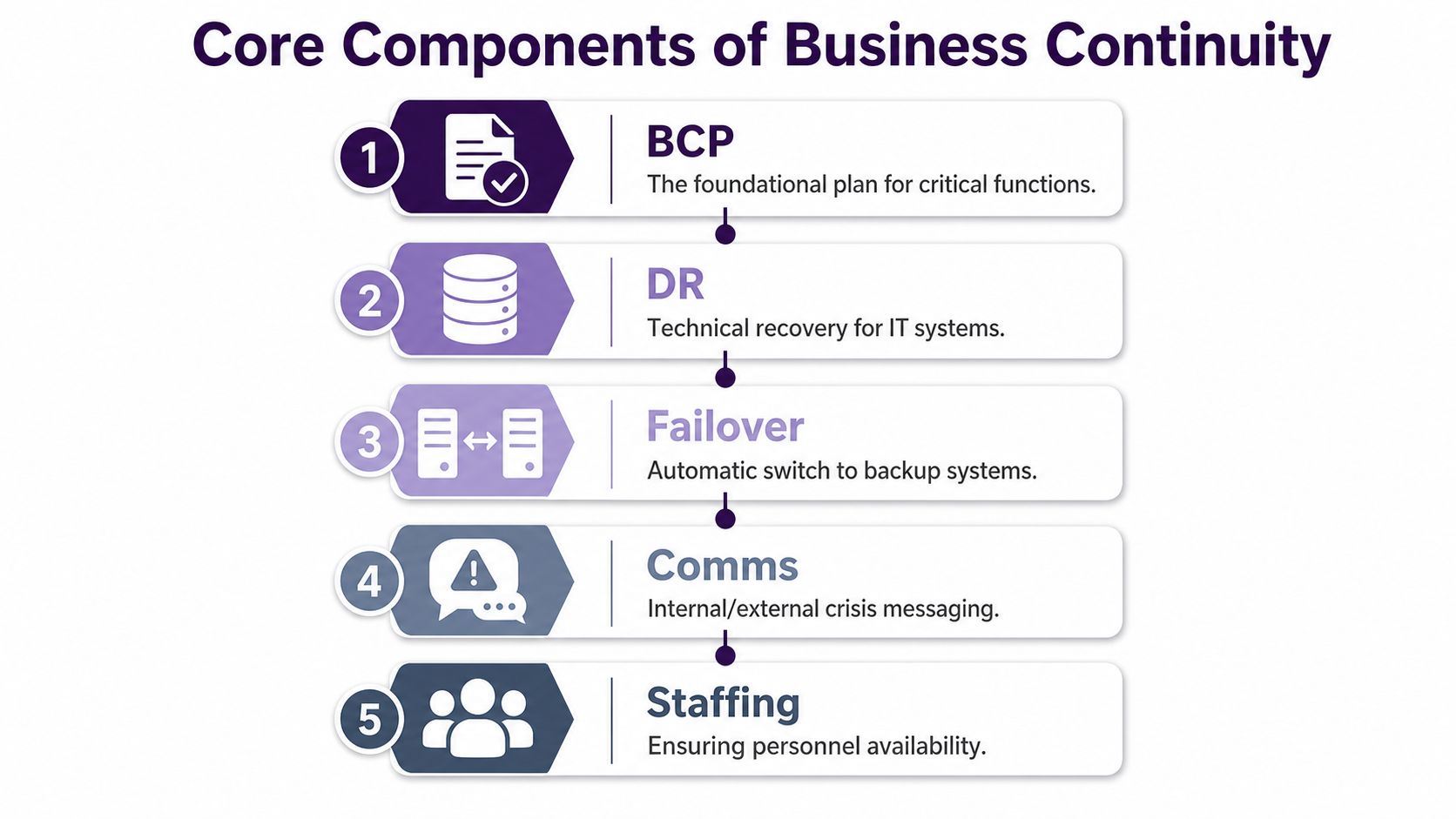
A serious business continuity solution has five parts, and they’re not interchangeable. The first is business continuity planning, which defines what matters, who owns it, and how the business keeps moving. The second is disaster recovery, which restores systems and data. The third is failover architecture, which keeps services available when a primary environment breaks. The fourth is crisis communications, which keeps employees, customers, and vendors informed. The fifth is staffing redundancy, which keeps work moving when the problem is people, not hardware.
Build the plan before you buy the tool
The planning layer comes first because it tells you what you’re protecting. Industry guidance says a technically rigorous approach starts with a Business Impact Analysis and risk assessment, then turns those findings into explicit RTO and RPO targets for each critical system, because RTO defines the maximum tolerable outage and RPO defines the maximum acceptable data loss (business continuity plan terms and recovery targets). That’s the part many teams skip, then they wonder why they bought the wrong recovery stack.
A continuity plan should also be organizational, not just technical. ISO/TS 22332 treats continuity as a structured process that requires stakeholder needs, defined roles and responsibilities, and adequate resources, which is another way of saying someone has to own execution when the pressure hits (ISO/TS 22332 guidance).
If the plan doesn’t say who acts first, who approves changes, and who speaks to customers, it won’t survive the first hour of a real incident.
For a practical benchmark, the BCP should also name critical functions, list backup communication methods, and include the resources needed to prepare, respond, and recover, which IBM calls out directly (IBM on business continuity planning). If your current plan can’t survive a manager being unavailable, it needs work.
Treat staffing redundancy as a peer to DR
Most guides go soft. They obsess over failover and backups, but real incidents often fail on staffing, not software. If a primary site is down and the customer care team is sick, delayed, or locked out, no amount of mirrored infrastructure solves the queue. The staffing redundancy layer is what lets you keep service levels stable when absenteeism, travel disruption, or vendor failure reduces available labor.
That’s why a continuity scorecard should ask five blunt questions.
- BCP Coverage: Do we know which business functions must keep running?
- DR Coverage: Can we restore systems and data within acceptable recovery targets?
- Failover Coverage: Can traffic move without waiting for a human to improvise?
- Comms Coverage: Do employees, customers, and vendors get clear updates fast?
- Staffing Coverage: Do we have trained people who can absorb the workload?
If you use software to support the operation, compare options against a real operational need, not a feature checklist. For example, the call center software capabilities listed on CallZent’s software features page are only useful if they support the continuity workflow you need during disruption.
Why Business Continuity Is Now a Board-Level Investment
The market data is the bluntest evidence that continuity is no longer a niche concern. One forecast puts the business continuity solutions market at USD 880.3 million in 2024 and projects it at USD 3,530.5 million by 2034, a 14.9% CAGR over 2025 to 2034, with North America holding more than 38% of the market in 2024, or about USD 334 million (market forecast). That’s not a side category anymore. It’s a mainstream operational spend driven by downtime risk, compliance pressure, and cyber disruption.
The older adoption numbers explain why the market is still expanding. One global survey cited in industry reporting found that only 61% of businesses worldwide had a continuity plan, while another reported 49% had one and roughly 171 million companies did not (business continuity statistics). In other words, a lot of companies still know continuity matters but haven’t built it properly.
Downtime is expensive enough to change behavior
The same reporting puts the cost in plain terms. Smaller businesses were estimated to lose about USD 427 per minute, large companies up to USD 15,000 per minute, and high-risk sectors such as finance and healthcare could face losses above USD 5 million per hour (business continuity statistics). Those numbers are why continuity decisions now reach the boardroom. Nobody wants to approve a reactive spend after the outage has already chewed through margin, trust, and staff time.
If you need a budget argument, use this logic: the cost of planning is controlled, the cost of disruption is not. That’s especially true in North America, where the market share figure shows how heavily major companies already treat resilience as a business function rather than a technical luxury.
The strongest continuity programs are also easier to justify because they align with revenue protection. When systems stay up, customers stay in the queue, orders keep moving, and managers don’t burn hours on emergency triage. That makes continuity a finance conversation, an operations conversation, and a customer experience conversation at the same time.
For a useful lens on investment framing, see the ROI discussion in CallZent’s guide to call center outsourcing ROI. The broader principle is the same, if the operating model keeps service live during stress, it pays back in stability, not just in lower direct cost.
Board-level takeaway: If your continuity plan can’t be tied to downtime cost, customer retention, and operational control, it won’t get funded properly.
Industry-Specific Continuity Requirements
A continuity plan that works in one industry can fail in another. Healthcare, finance, and e-commerce all depend on uptime, but each one stresses a different part of the continuity stack. The mistake is trying to buy one generic solution and assuming it covers every risk. It doesn’t.
Healthcare needs clinical workflow continuity
Healthcare continuity has to protect patient communication, departmental dependencies, supplier obligations, and the ability to keep treatment-related workflows moving. The FDIC and FFIEC model, which emphasizes BIA, risk assessment, risk management, and risk monitoring, reflects that process-driven mindset for regulated environments (ISO/TS 22332 and financial-sector continuity model). In practice, healthcare teams need to know who contacts patients, how referrals are handled, and what gets prioritized when systems are partially available.
A provider that only plans for IT restoration is underprepared. If the front desk, scheduling, and claims workflow can’t function, the technical fix doesn’t matter yet. That’s why staffing, communication, and dependency mapping matter as much as the electronic health record itself.
Finance needs transaction integrity and traceable recovery
Finance is less forgiving. Transaction integrity, regulatory reporting, and risk monitoring must stay aligned even when systems are degraded. The continuity program has to preserve evidence of what happened, who approved it, and when the recovery path changed. That’s consistent with the process-oriented model in the FDIC and FFIEC guidance cited above.
A bank or lender also needs a clean vendor map. If one payment partner, one authentication layer, or one data feed fails, the operational effect can cascade fast. The continuity partner has to understand those dependencies before the incident, not during it.
E-commerce needs surge handling and order orchestration
E-commerce continuity presents unique challenges. Peak events, promotions, and shipping dependencies can overwhelm a team even when the core platform is healthy. The primary risk is often not total outage, it’s partial degradation that slows order orchestration and damages customer trust.
If you’re evaluating providers in these sectors, use SwiftNet Wifi’s internet provider research as a reminder that continuity starts with basic connectivity choices as much as with software. The broader point is simple, if the underlying access layer is weak, everything built on top of it gets fragile.
For all three industries, the question is the same. Can the partner preserve service quality while the primary operation is disrupted? If the answer is vague, keep looking.
A Practical Implementation Roadmap
A continuity program should produce artifacts, not just meetings. If your team can’t point to a current BIA, a recovery matrix, and a tested communication tree, then you don’t have a program yet. You have a set of intentions.
Start with scope, then prove the assumptions
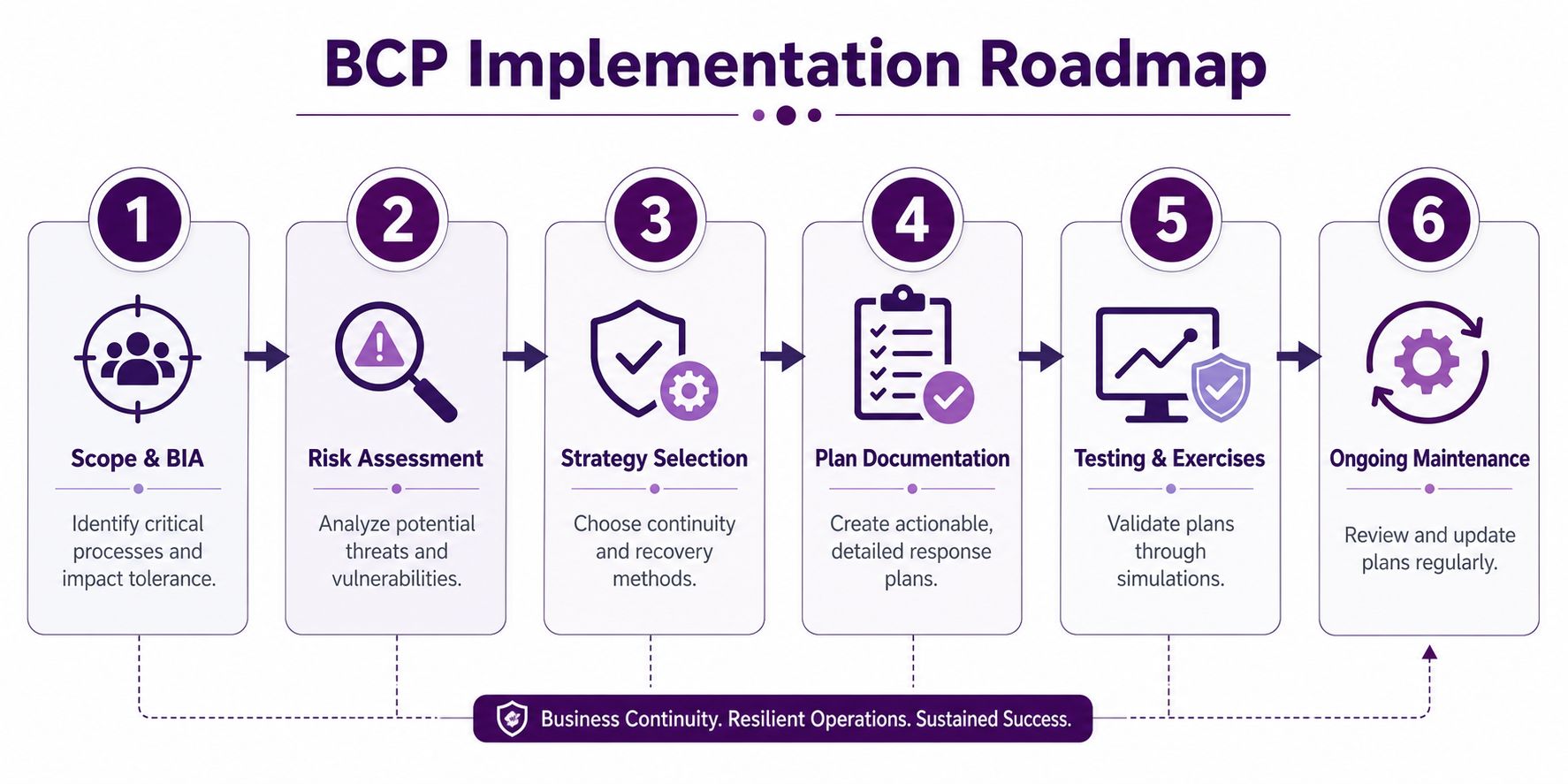
The first stage is scope and BIA, and it should produce a ranked list of critical functions, dependencies, and impact tolerance. If the team can’t agree on what matters most, the rest of the plan will drift. The second stage is risk assessment, which should identify likely threats and single points of failure, then connect them to the business functions they threaten.
Stage three is strategy selection. That means deciding whether a function needs hot failover, warm standby, alternate staffing, or a simpler restoration path. Stage four is plan documentation, and the output should be operational, not decorative. People need runbooks, contacts, approval paths, and communication templates that work under stress.
Many firms go wrong. They write polished binders and call it resilience. Real resilience lives in the documents people use during an incident.
Test the whole chain, not isolated pieces
Stage five is testing and exercises, and integrated testing matters because separate components can fail together in ways the team never rehearsed. The question isn’t whether the backup exists. It’s whether the backup, the communications path, the staffing handoff, and the vendor response work together in the same incident. IBM is clear that periodic testing, training, and realistic trial runs are necessary to expose gaps and improve the plan over time (IBM on business continuity planning).
A first tabletop exercise should be blunt. Pick one realistic outage, such as a payment platform failure or a site-level disruption, then force the team to decide who leads, how customers are told, where calls go, and what gets deferred. If that scenario falls apart in a conference room, it will collapse harder in production.
Stage six is ongoing maintenance, and that means the plan gets reviewed whenever staffing, vendors, systems, or workflows change. If your continuity documents are older than the operating model, they’re not safety net material.
For a practical outsourcing lens, CallZent’s nearshore call center page is a good example of how a service partner can fit into an actual operating plan rather than a theoretical one. Use the roadmap to identify the next action within 30 days, then stop calling it a future project.
How a Nearshore Call Center Closes the Continuity Gap
The continuity gap usually isn’t the backup system. It’s the trained human capacity to absorb customer-facing work when the primary team is buried. That’s why a nearshore call center can be a continuity asset, not just a cost line. A bilingual team in Tijuana, for example, can take overflow from a U.S. operation when storms, outages, or absenteeism cut internal coverage, especially if the runbooks, scripts, and handoff rules were already built before the incident.
People and process fail before infrastructure does
Most continuity planning talks about servers, storage, and alternate sites. That matters, but the first thing customers experience is usually slower answers, confused agents, or missed follow-up. If the in-house team is overwhelmed, the business needs trained people who can step in without rewriting the workflow on the fly.
That’s why staffing redundancy deserves the same seriousness as recovery tooling. A nearshore partner helps when you need language coverage, time zone overlap, or fast handoffs across shifts. It also reduces the chance that a single site issue turns into a total service failure.
Evaluate the partner on continuity criteria
Don’t shop a BPO on price first. Shop it on continuity fit. Ask whether the partner has surge capacity, bilingual coverage, documented escalation rules, and integration with your own incident runbooks. If those pieces aren’t in place, the partner is a vendor, not a resilience layer.
A representative example is simple. A U.S. contact center loses part of its inbound team during a regional incident. The nearshore team takes the overflow, follows the pre-approved response tree, and keeps customer updates consistent while internal leadership handles the primary disruption. That’s not glamorous, but it’s what continuity looks like when it works.
For organizations comparing operational support options, CallZent’s bilingual nearshore model is one example of a partner that can shift customer service and back-office work during disruption. The real test is whether the partner can fit into your recovery time objective without creating a second layer of chaos.
Hard truth: If your continuity plan depends on finding qualified people during the incident, you don’t have a continuity plan.
KPIs, Monitoring, and What to Review Next
A continuity program is only real if you can measure it. The dashboard doesn’t need to be complicated, but it does need to show whether the business recovered the way it promised. That means comparing actual performance against your RTO, RPO, and service expectations, then fixing the gaps instead of blaming the event.
Continuity KPI Dashboard
| KPI | Target | Review Cadence |
|---|---|---|
| Recovery time achieved vs. RTO | At or below the approved RTO for each critical function | After every major incident and at quarterly review |
| Recovery point achieved vs. RPO | At or below the approved RPO for each critical system | After every restore test and after incidents involving data loss risk |
| First-contact resolution during incidents | Stable or improving during disruption | Monthly operational review |
| Communication latency | Updates sent within the approved incident window | After every tabletop and live event |
| Staffing redundancy coverage | Enough trained backups to sustain critical queues | Monthly staffing review |
Use CallZent’s call center KPI guide to shape the customer-service side of that dashboard, then add continuity metrics on top of it. The point isn’t to create a prettier report. The point is to see whether the plan holds under pressure.
Use a 30, 60, 90 review rhythm
In the first 30 days, confirm the BIA, owner list, and communication tree. In 60 days, run a tabletop exercise and record what broke, what was unclear, and who couldn’t act fast enough. By 90 days, revise the runbooks and retrain the people who will execute them.
After that, review the plan quarterly and revalidate it whenever the business changes in a meaningful way. New systems, new vendors, new shifts, or a new service line can break assumptions faster than leadership expects. That’s why continuity maintenance matters more than continuity intent.
If your current setup doesn’t show who can recover work, who can talk to customers, and who can absorb overflow, fix that first. Then test it again. A continuity plan that hasn’t been exercised is just a document with good intentions.
🚀 Build Continuity Before the Next Outage
If you want a continuity setup that works in live operations, CallZent can help you build the staffing, communication, overflow, and bilingual customer support layer before the next outage forces your team to improvise under pressure.
Talk to an ExpertIf you want a continuity setup that works in live operations, talk to CallZent. Build the staffing, communication, and overflow layer now, before the next outage forces you to improvise it under pressure.