
OPERATIONS & PROCESS OPTIMIZATION
Business Process Improvement: A Practical Roadmap for Support Operations
Business process improvement helps support teams reduce waste, improve customer outcomes, and scale through process mapping, pilots, metrics, and change management.
TL;DR — Quick Takeaways
- When queues grow and employees feel overloaded, inspect the workflow before assuming the operation needs more people.
- Map the process as it actually works, including delays, exceptions, manual workarounds, approvals, and rework loops.
- Prioritize improvements according to strategic impact, current pain, customer visibility, and expected business value.
- Sustainable business process improvement requires baseline metrics, root-cause analysis, controlled pilots, change management, and recurring reviews.
You’ve got the extra headcount request on your desk again, and the queue is still backing up by noon. The team is tired, supervisors are chasing exceptions, and customers are hearing the same context repeated on every call. In that moment, business process improvement is usually the first lever that should get pulled, because the problem is often the workflow, not the people inside it.
Why Business Process Improvement Is the First Lever to Pull
A support operation usually doesn’t fail all at once. It frays in small, familiar ways, duplicate data entry, escalations that bounce between billing and shipping, agents re-typing the same customer context because the systems don’t carry it forward. By Friday afternoon, the queue looks like a staffing problem, but the true drag is usually a process that forces people to waste motion.
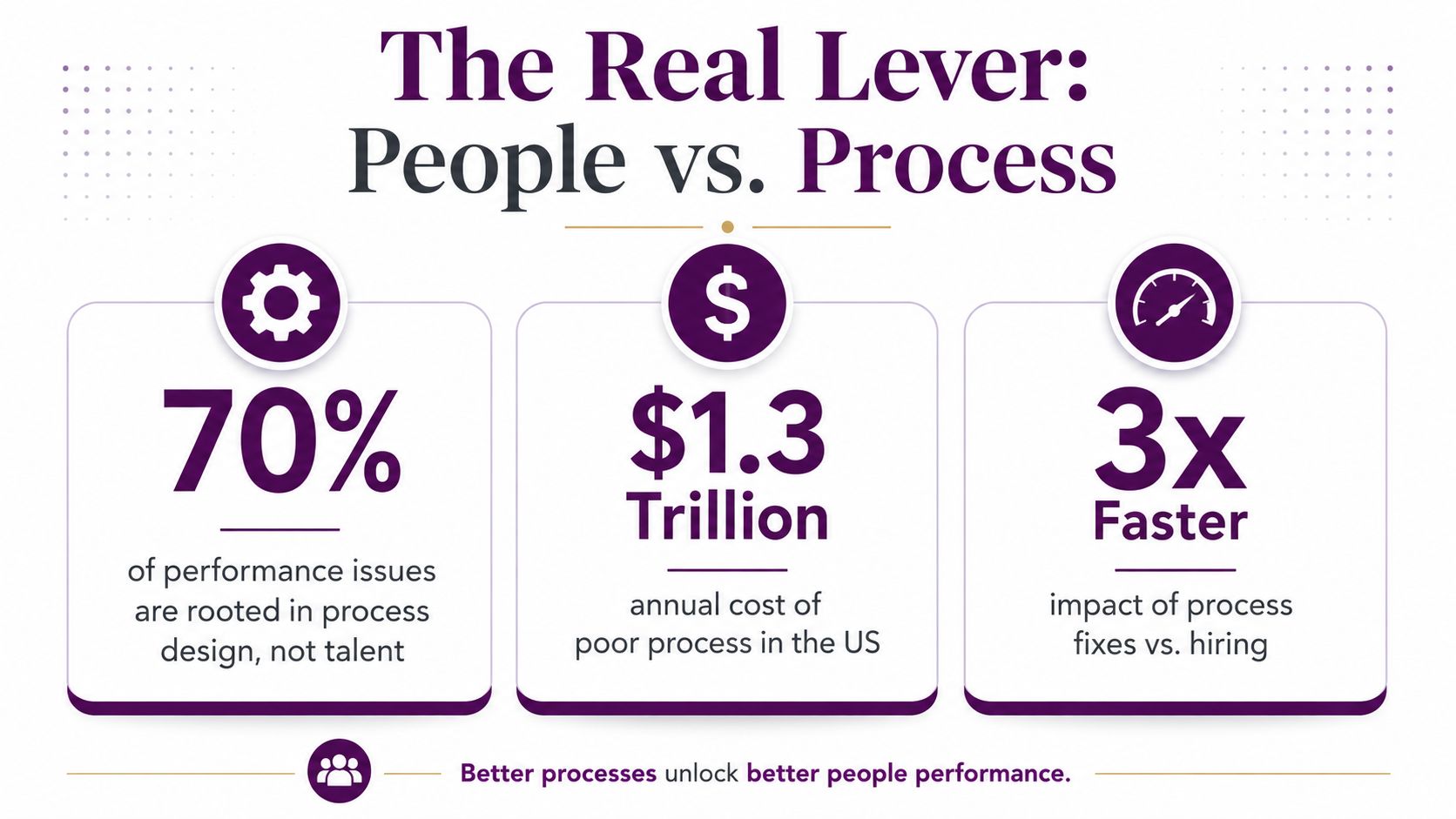
That is why process redesign usually beats reflexive hiring. Business process improvement became a formal discipline when Lean and Six Sigma moved organizations away from ad hoc fixes and toward repeatable change, and modern research still shows how few companies actively manage their processes, about 4% according to process improvement statistics. The same source links disciplined improvement programs with a 25% average reduction in operational costs, a 35% increase in employee productivity, and a 70% rate of improved customer satisfaction in surveyed organizations, which is a strong reminder that process work is part of the operating model, not a side project.
A good way to prioritize is simpler than many groups make it. Build a one-page process inventory, then score each workflow by strategic impact, current pain, and expected benefit. That turns the debate from “everyone is broken” into “which process is hurting the business most right now.”
Practical rule: fix the process that is high-volume, high-friction, and visible to customers first.
A mid-sized e-commerce company might have three loud problems on the board, returns processing, live-chat triage, and order-status lookups. Returns feel messy, but if the biggest complaint volume and margin leakage sit in live-chat triage, that is the first workflow to redesign. If order-status calls are frequent but cheap and easy to answer, they may be annoying, but they are not the best first investment.
For operations leaders in North America, the logic is similar to what is laid out in the guide from Paradigm on HR outsourcing, where the point is not to outsource for its own sake, it is to remove low-value work from the internal team so managers can focus on higher-impact fixes. The same thinking applies in a call center or BPO. Move the routine work out of the critical path, then redesign the workflow that keeps creating the same exceptions.
How CallZent approaches operational cost reduction fits that same mindset, because cost control only sticks when the underlying process stops producing waste in the first place.
Mapping the Current State Without Sanitizing It
A process map is only useful if it shows the ugly parts. If the diagram leaves out exception handling, rework loops, or the supervisor’s side-door approval, it’s not a map of reality, it’s a polished fiction. Teams that don’t track their processes end up guessing at waste instead of seeing it clearly, which is part of why disciplined management matters so much more than casual fixes.

What belongs on the map
A useful current-state map shows who touches the work, where it waits, and where it loops back. In a contact center, that means not just the agent flow, but the supervisor review, billing lookup, shipping confirmation, and any CRM workaround the team uses to keep calls moving.
The symbols that matter are the simple ones. Decision diamonds, queue points, handoffs, and rework loops tell you where the friction lives. Fancy notation doesn’t help if it hides the one thing every operator cares about, where the work stalls.
A first call resolution example from the floor
Take first call resolution in a support center. Tier 1 starts the ticket, billing checks a charge, shipping checks delivery status, and the supervisor gets pulled in when the customer is already annoyed. If the map doesn’t show the exact points where the agent waits for another team, the map is missing the business problem.
Customer feedback for continuous improvement at CallZent is a useful reminder that the map shouldn’t come only from management’s view of the work. Frontline feedback exposes the workarounds that never show up in a policy deck. That’s the artifact you want, a single diagram the team can argue over because it reflects how calls really move.
Finding Root Causes Instead of Blaming People
Most improvement programs stall right here, because the first explanation sounds plausible and everyone moves on. A training gap, a careless agent, a new hire who isn’t up to speed, those are easy stories, but they rarely survive root-cause analysis. In back-office work, the issue is often a mismatch between the systems and the process, not the person handling the file.
Use 5 Whys and a fishbone together
Start with the symptom, then ask why it happened, and keep going until you reach the system behind the symptom. The 5 Whys works best when the team doesn’t stop at the first human answer. A fishbone diagram helps separate categories like process, systems, data, training, and ownership so the room doesn’t anchor on one convenient explanation.
A loan-processing team can make this mistake fast. Rework starts climbing, and managers assume the intake agents need more training. When the team maps the workflow and fills out a fishbone, the core issue appears: a required field in the intake form doesn’t match what the CRM can supply, so agents are forced to type it manually on every file.
The real root cause is usually in the handoff or the system rule, not in the person taking the call.
Score the process before you chase fixes
When every workflow looks broken, scoring keeps the team honest. Use the same three criteria again, strategic impact, current pain, and expected benefit, then rank the candidates against one another. The loudest problem isn’t always the most expensive one.
That’s where problem-solving training at CallZent matters in practical terms, because frontline staff need a common method for isolating symptoms from causes. Once the team learns to separate people issues from process issues, the backlog gets clearer, and the fixes get more durable.
Designing and Piloting the Improved Process
Redesign fails when teams try to fix everything at once. The smarter move is to draw the future-state map, narrow the change to one painful segment, and test it before it touches the whole operation. In service work, that’s especially important because the wrong change can create a new queue while solving the old one.
Make the future state smaller than the current state
A refund flow is a good example. One support team I worked with had a four-step approval chain that slowed everything down and created repeated handoffs. The redesign collapsed that chain into a single decision supported by clear rules, which made the process easier to follow and easier to audit.
The pilot ran with a nearshore team that could absorb parallel volume without disrupting production. That matters because a pilot should be contained enough to learn from, but real enough to expose the ugly edge cases that scripted testing misses. The team tracked cycle time, escalation rate, CSAT, and rework rate so it could tell improvement from a temporary throughput spike.
Pilot the exception, not just the happy path
A pilot needs to survive at least one exception scenario. If it only works when every case is clean, it isn’t ready for production. The whole point is to see whether the new rules hold when the customer is upset, the order is incomplete, or the billing note is missing.
That’s where what is knowledge management at CallZent becomes relevant. A stable process needs the right knowledge at the point of work, otherwise the team recreates the same answer five different ways and the pilot becomes a prettier version of the old mess.
Rolling Out Changes Without Burning Out the Team
Even a good redesign dies if people don’t adopt it. That’s why change management belongs inside business process improvement, not off to the side as a soft skill. People resist what feels arbitrary, and they ignore workflows that were explained once in a meeting and never reinforced again.
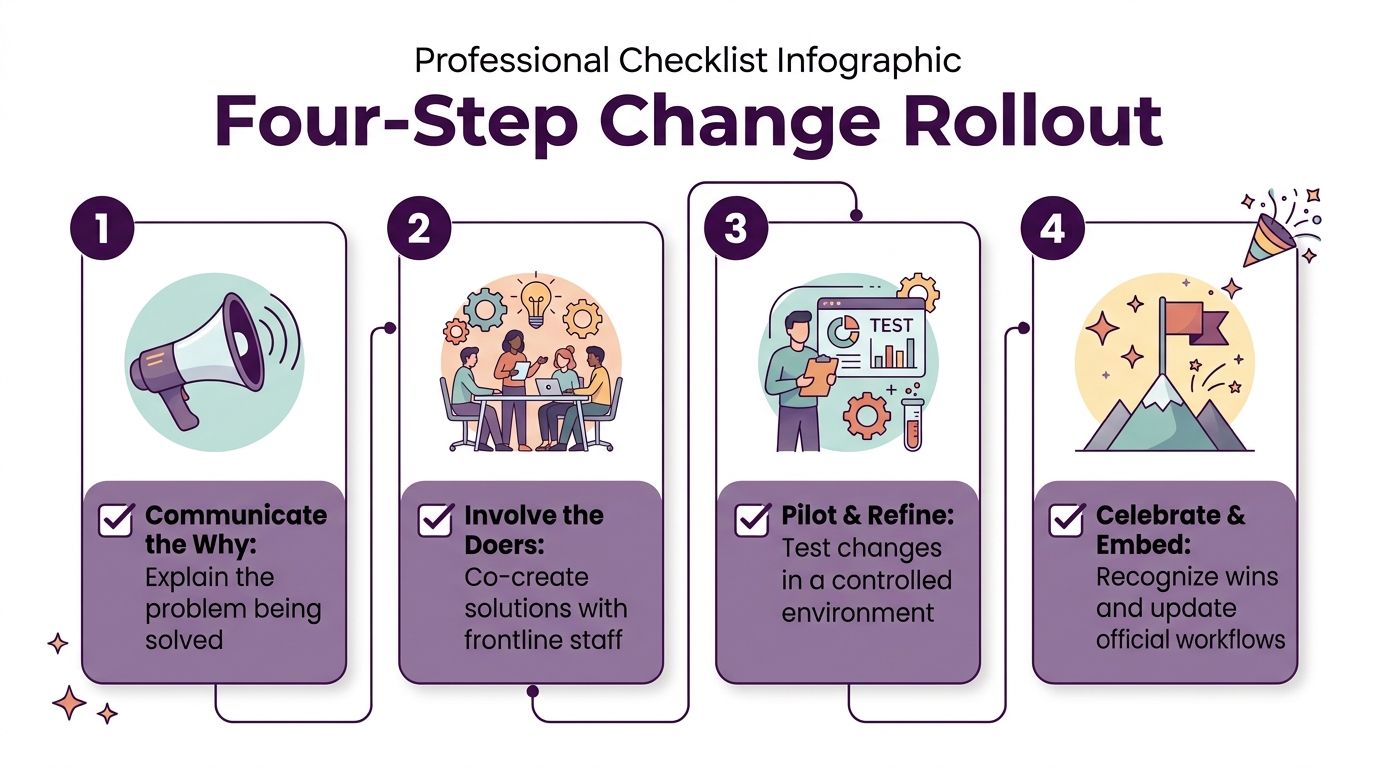
Four moves that actually move adoption
The first move is to communicate the why before the what. If people understand what problem the redesign solves, they’re less likely to treat it like a temporary management fad.
The second move is to train the workflow, not just the policy. Agents need to practice the actual handoffs, notes, exceptions, and approvals they’ll use at the desk.
The third move is to name frontline champions who can answer questions in real time. They don’t have to be loud, they just need to be trusted.
The fourth move is to track adoption metrics alongside output metrics. If the new flow looks efficient on paper but the team keeps working around it, the process isn’t embedded yet.
A readiness check from MyCulture.ai can help leadership see where a rollout is likely to stall before the work starts. That kind of check is useful because many failures aren’t technical, they’re coordination problems that show up as confusion, silence, or passive resistance.
A bilingual nearshore team can make the rollout easier in a practical way. It gives leadership coverage across U.S. business hours and after-hours support while the in-house team gets protected training time. That doesn’t remove the need for management discipline, but it does reduce the risk of launching a new workflow without enough live support.
Measuring Impact and Iterating Every 90 Days
Improvement isn’t real until the numbers say it is. The right scorecard keeps the team from over-optimizing one metric and breaking the rest of the operation. A process can look faster and still create more rework, more escalations, or more agent frustration.
The scorecard that keeps the work honest
Use four metric families together. Efficiency covers cycle time and cost per contact. Quality covers first contact resolution and defect rate. Customer impact covers CSAT and NPS. Adoption covers training completion and workflow compliance.
That balanced view matters because improvement programs often look strong on one measure while leaking value somewhere else. Call-center KPI tracking is most useful when the metrics are reviewed as a set, not in isolation, because operations problems usually show up as trade-offs before they show up as failures.
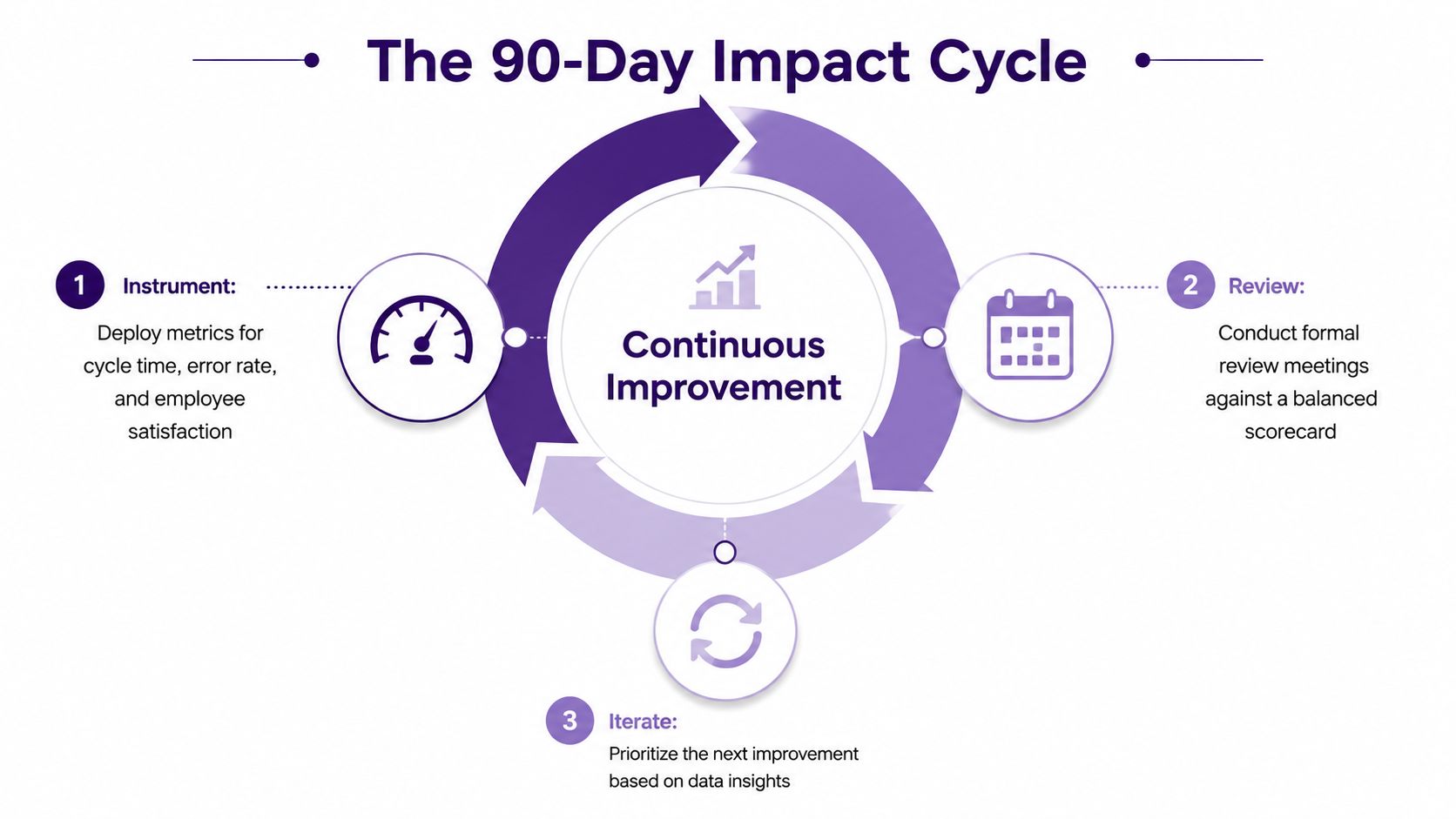
A practical cadence is a 90-day review cycle. The team instruments the process, reviews the scorecard, then decides what to iterate next. That rhythm keeps the program from turning into a one-time project with no owner after launch.
Keep the review meeting focused on decisions, not status updates. If the meeting doesn’t change the next set of actions, it’s not a review, it’s a report-out.
As one workflow stabilizes, the next item from the prioritization list moves up. That’s how the work compounds, not by chasing every problem at once, but by finishing one process cleanly and then moving to the next.
Your Business Process Improvement Roadmap
A practical roadmap starts small and stays disciplined. Pick one process, score it, map the current state, find the root cause, pilot the fix, roll it out, then measure it on a 90-day cycle. That sequence sounds simple because it is simple, but it only works when leaders treat change management as part of the process, not a message sent at the end.
The biggest failure mode is still trying to optimize a single KPI while the rest of the workflow degrades. Another common mistake is spreading the team across too many processes at once, which guarantees shallow fixes and weak adoption. The failure rates around transformation are a reminder to keep the effort focused and controlled, because broad ambition without a rollout plan becomes noise fast.
A nearshore partner can fit into each phase without taking ownership away from the business. During mapping, the team can help capture baseline data and surface exceptions. During the pilot, it can absorb parallel volume. During rollout, it can provide coverage and bilingual support while the in-house team trains and stabilizes the new flow.
For a broader operating lens, the operational efficiency playbook from Sift AI is a useful complement because it reinforces the same principle, efficiency comes from better system design, not just harder work. That lines up with what works in contact centers and BPO work every day, clear ownership, visible metrics, and a process that people can follow.
If you’re ready to tighten a support workflow, reduce rework, and build a process your team can sustain, talk to CallZent about a nearshore operating model built for customer support and back-office work. Visit CallZent to see how bilingual coverage, process discipline, and practical rollout support can help your team improve the work without burning out the people doing it.
🚀 Improve the Process Before Adding More Pressure
CallZent helps businesses build scalable customer support and back-office operations through bilingual nearshore teams, measurable workflows, and practical implementation support.