

CALL CENTER OUTSOURCING & CONTRACTS
Call Center Contracts: How to Structure SLAs, Pricing, Risk, and Nearshore BPO Agreements
Call center contracts should define scope, SLAs, pricing, bilingual staffing, compliance, AI use, onboarding, and exit planning before outsourcing begins.
TL;DR — Quick Takeaways
- Call center contracts should balance cost, service quality, compliance, operational control, and transition risk rather than focusing only on the hourly rate.
- The Master Service Agreement should handle the core legal framework, while the Statement of Work should define staffing, channels, hours, bilingual requirements, KPIs, reporting, and operating responsibilities.
- SLAs must specify the metric, calculation method, measurement period, exclusions, remediation process, and any service credits.
- Pricing should match how the work is actually delivered, whether through dedicated seats, usage, hybrid pricing, or carefully designed outcome-based compensation.
- Nearshore bilingual contracts should explicitly address English-Spanish staffing, agent location, technology ownership, scope changes, escalation paths, AI use, onboarding, and exit support.
What if the biggest mistake in a call center deal isn’t the hourly rate, but the contract language that decides who absorbs the risk when service slips, staffing changes, or AI enters the workflow? In nearshore bilingual BPO work, that gap shows up fast. A contract that looks fine at signing can become expensive once answer times tighten, escalation paths break down, or a client realizes the vendor never agreed to the disclosure language now moving into U.S.-facing service.
Key takeaway: A good contract protects both sides, but a great one makes performance easier to manage.
For readers comparing delivery models, this also means looking at the full operating picture, not just seat cost. If you’re mapping a Mexico-based partnership, start with the context in what nearshore outsourcing to Mexico means, then connect that model to pricing, service levels, and the transition plan you need. If you already have an outsourcing draft in hand, the most useful pages are the ones that explain how service levels and commercial terms fit together, like CallZent’s own service-level guidance on call center service level agreements.
Introduction to Call Center Contracts
A bad call center contract usually doesn’t fail on day one. It fails when the first real issue lands, maybe a holiday volume spike, a CRM integration delay, or a client asking where the agent is physically located. That’s why the contract matters as much as the staffing plan, especially in nearshore bilingual engagements where service quality, cost control, and compliance all sit in the same document.
In practice, the contract is the operating manual for the relationship. It should say who provides the technology, who owns the workflow, how reporting works, how much the service costs, and how either side exits cleanly if the partnership stops working. For a Tijuana-based bilingual program, that means the contract should reflect proximity to the U.S. market, English and Spanish capability, and that some programs need faster coordination than a far-off offshore model can support.
A lot of buyers still treat the contract as a legal formality. That’s a mistake. Once the seats go live, the contract determines whether a missed SLA earns a credit, whether the provider can charge extra for a new channel, and whether the handoff at termination is orderly or chaotic.
One useful way to think about it is simple. The contract sets the rules before the work gets messy.
If you want a good external benchmark for how detailed vendor agreements can be, a practical IT-support comparison is this UK IT support contract guide. The structure is different, but the discipline is the same, define the scope, define accountability, and remove the vague parts before the first invoice goes out.
Understanding Contract Types and Definitions
A call center contract is the legal and commercial framework that tells a client and a provider how customer interactions will be handled. In nearshore bilingual BPO work, that framework usually includes a master agreement, a statement of work, and one or more operating schedules. The document matters because it turns a service promise into something measurable, paid, and enforceable.
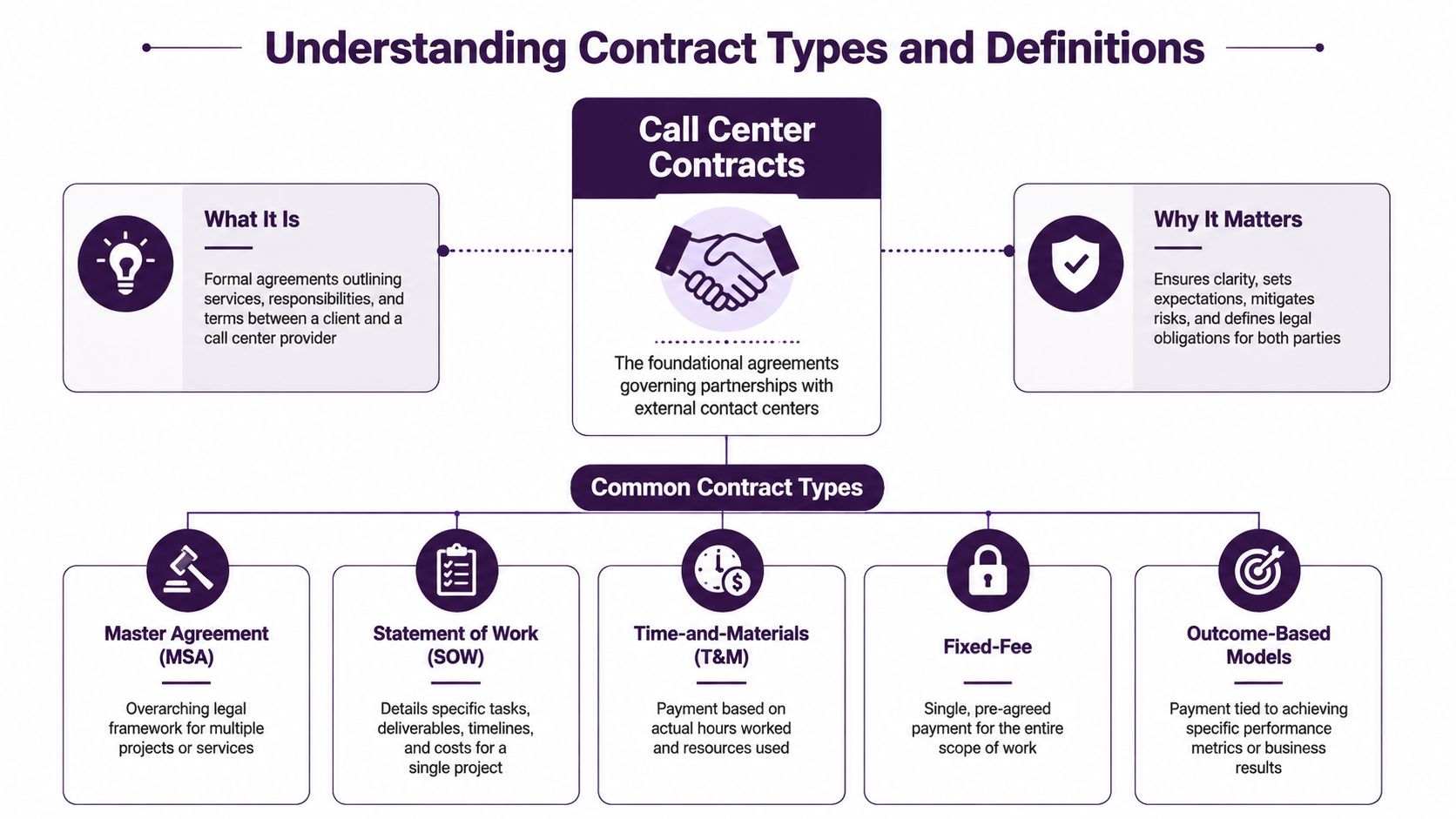
The main contract structures
A Master Service Agreement is the legal umbrella. It covers the core legal terms, liability, confidentiality, dispute handling, termination, and general governance. A Statement of Work sits under that umbrella and defines the actual campaign, the hours, the channels, the reporting schedule, and any special language needs, which matters a lot in bilingual customer care.
Practical rule: put the legal rules in the MSA and the operating details in the SOW. Mixing both in one place usually makes amendments harder later.
A time-and-materials model works when the volume is unstable or the scope is still changing. It suits pilot programs, overflow support, and short launches where the client needs flexibility more than price certainty. A fixed-fee model makes sense when scope is stable and the buyer wants budget predictability, such as a defined reservation desk or a repeatable help-desk queue.
An outcome-based model ties payment to results, not just presence. That can work when the provider can influence the metric and the effort is measurable. For customers who care about bilingual coverage and fast issue resolution, that model is attractive only if the underlying data is clean and both sides agree on how results are measured.
For a broader operational lens, CallZent’s page on vendor evaluation criteria is a helpful companion when you’re deciding whether the contract type matches the service risk you’re taking on.
How to choose the right type
A nearshore bilingual BPO campaign with a launch date, a defined script, and clear staffing needs often fits a fixed-fee SOW under a master agreement. A multilingual technical-support pilot usually fits time-and-materials because the workflow will change as you learn. A mature inbound program with stable volume may justify a more performance-linked arrangement, but only if the KPI definitions are tight and the reporting is trusted.
The wrong choice creates friction. A fixed-fee deal can become rigid if the client keeps adding channels. A time-based deal can become expensive if the vendor is forced to absorb hidden complexity. That’s why the best contracts don’t just name a pricing model, they explain why that model matches the service design.
Essential Contract Clauses You Cannot Skip
The strongest contracts don’t rely on goodwill. They rely on clauses that make performance, payment, and exit terms hard to misunderstand. In call center deals, especially bilingual nearshore ones, the practical risk sits in the details, what counts as service, what counts as a breach, and what happens when the client changes scope midstream.
SLAs and KPIs need to be measurable
A 2026 outsourcing KPI guide says the five metrics most likely to become contractual SLAs are First Call Resolution at 70%–75%, Customer Satisfaction at 85% or higher, Average Handle Time at 4–6 minutes, Service Level at 80/20, and Agent Attrition below 35% annually (call center outsourcing KPIs). Those benchmarks are useful because they turn a vague service promise into something the vendor can operate against.
In real nearshore contracts, I’ve seen trouble when the SLA says “high quality service” but never defines the measurement window, the sample size, or the reporting cadence. That language sounds flexible, but it makes disputes harder to resolve. A better draft defines the metric, the measurement period, the remediation step, and the credit if the target is missed.
Commercial terms must match how the work moves
Pricing and payment terms should say when invoices go out, what triggers extra charges, and who pays for change requests. If bilingual coverage or weekend support is part of the promise, the contract should say so in the rate structure rather than burying it in email threads. The same logic applies to ramp-up and ramp-down schedules, because staffing commitments need lead time and clean offboarding.
Here’s the practical problem. A client asks for extra Spanish-language coverage after launch, but the contract never defined the added labor or the approval path. The vendor then treats it as a change order. That’s not a surprise, it’s a drafting failure.
If a clause affects staffing, security, or billing, it belongs in the contract, not in a side conversation.
Risk, confidentiality, and exit language matter just as much
A proper contract also needs indemnification, confidentiality, liability caps, termination rights, and dispute resolution. A general legal overview from Global Response makes the same point clearly, the contract should spell out what performance is expected, who pays if things go wrong, how the relationship ends, and how conflicts are handled. For sensitive customer programs, that language should connect to the confidentiality schedule, which is why a dedicated confidentiality agreement page is worth reviewing alongside the main draft.
In a nearshore bilingual environment, security and compliance clauses should also say who owns device control, recording retention, access permissions, and data transfer rules. When those items are left vague, both sides assume the other party is handling them. That’s when the cleanest campaign becomes the hardest one to defend in a dispute.
Pricing Models Explained with Examples
Pricing looks simple until a campaign changes shape. The model that sounds cheapest at signing often becomes the most expensive once volume, staffing, language coverage, or channel mix shifts. That’s why the structure matters as much as the rate.
Compare the common pricing approaches
A seat-based model charges for assigned agents. It works when staffing is stable and you want predictable coverage, but it can feel expensive if the program is seasonal or part-time. A per-minute or per-call model tracks usage more closely, which can fit variable demand, though it can punish long interactions or complex issues.
A hybrid model combines a base staffing charge with usage or performance components. That’s often the most practical middle ground for bilingual nearshore programs that handle voice plus chat. An outcome-based model ties a portion of payment to the result, but it only works when the target is cleanly measurable and both sides trust the reporting.
Cost comparison by region
| Region | Hourly Rate | Average Savings |
|---|---|---|
| Offshore | $6–$14 | 15%–30% |
| Nearshore Latin America and the Caribbean | $8–$18 | 15%–30% |
| Onshore U.S. | $25–$42 | 15%–30% |
Independent reporting for 2026 places offshore voice agents at $6–$14 per hour, nearshore agents in Latin America and the Caribbean at $8–$18 per hour, and onshore U.S. agents at $25–$42 per hour. The same reporting says companies typically realize 15%–30% average cost savings through outsourcing (customer service outsourcing statistics 2026).
For buyers who want a pricing structure reference from another services category, Nutmeg Technologies’ pricing guide is a useful comparison point because it shows how service packaging can change the total cost conversation.
Two practical examples
A 10-seat support campaign with steady inbound volume usually fits a seat-based or hybrid model. If the program needs bilingual coverage and predictable hours, a seat model is easier to budget and easier to staff. If the call load swings with promotions, a hybrid model gives the client room to absorb demand changes without renegotiating the whole deal.
A blended voice-and-chat program often works better with separate rate logic for each channel. Voice requires live handling time, while chat can be managed differently depending on concurrency and script complexity. In that setup, a single flat rate can hide the actual cost drivers, so buyers should ask how the contract treats after-hours coverage, language mix, and queue-specific escalation.
For a deeper pricing breakdown, CallZent’s master call center pricing page is the place to start if you want to compare structure before you compare headcount.
Negotiation Tactics and Red Flag Checklist
Good negotiation starts with benchmarks, but it ends with enforceable language. Too many buyers focus on the hourly rate and forget to push for the clauses that make the rate matter in practice. The result is a contract that looks competitive and behaves poorly.
Use leverage where the contract is weakest
Anchor the discussion on region-specific labor economics, service levels, and transition risk. If the provider wants flexibility on staffing, ask for cleaner notice periods, clearer ramp rules, and defined credits when service falls below the agreed mark. If the provider offers AI-assisted routing or reporting, ask what’s included in the base fee and what shows up later as an add-on.
Negotiation rule: don’t trade away clarity just to shave a small amount off the rate. A lower rate with vague SLA language can cost more later.
A call center outsourcing contract should explicitly cover SLAs, indemnification clauses, termination rights and obligations, and dispute resolution mechanisms so the parties know what performance is expected and how conflicts are handled (Global Response legal considerations). That’s the floor, not the ceiling. In a nearshore bilingual deal, I’d also ask for an escalation matrix, approval timelines for scope changes, and written notice before any staffing or routing change that affects service.
Five red flags to catch early
- Vague SLA language. If the draft says “best effort” or “reasonable response” but never defines the measurement, push it back.
- Open-ended liability. If the provider wants broad exclusions but no meaningful responsibility, the deal is tilted.
- Hidden escalation fees. If every issue triggers a new charge, the base rate is misleading.
- Restrictive termination terms. If exit requires an unreasonably long notice period or punishing fees, you’ve lost flexibility.
- Missing AI or agent-location disclosures. If the vendor can’t explain where work is performed or whether AI is used, the draft isn’t ready.
For a practical lens on vendor risk review, CallZent’s vendor evaluation criteria page aligns well with how experienced buyers score proposals.
A client that signed without clean exit language once discovered that a small scope change had triggered a longer lock-in than expected. Another buyer accepted a vague service description and then spent months arguing over whether the metric was measured daily or monthly. Both problems were preventable. The contract should settle those points before launch, not after the first complaint.
Managing Onboarding Performance and Disputes
Onboarding is where contract language becomes real. The buyer sees whether the vendor can train fast, integrate cleanly, and report accurately. The provider sees whether the client is ready to give access, define approvals, and support launch without moving the target every week.
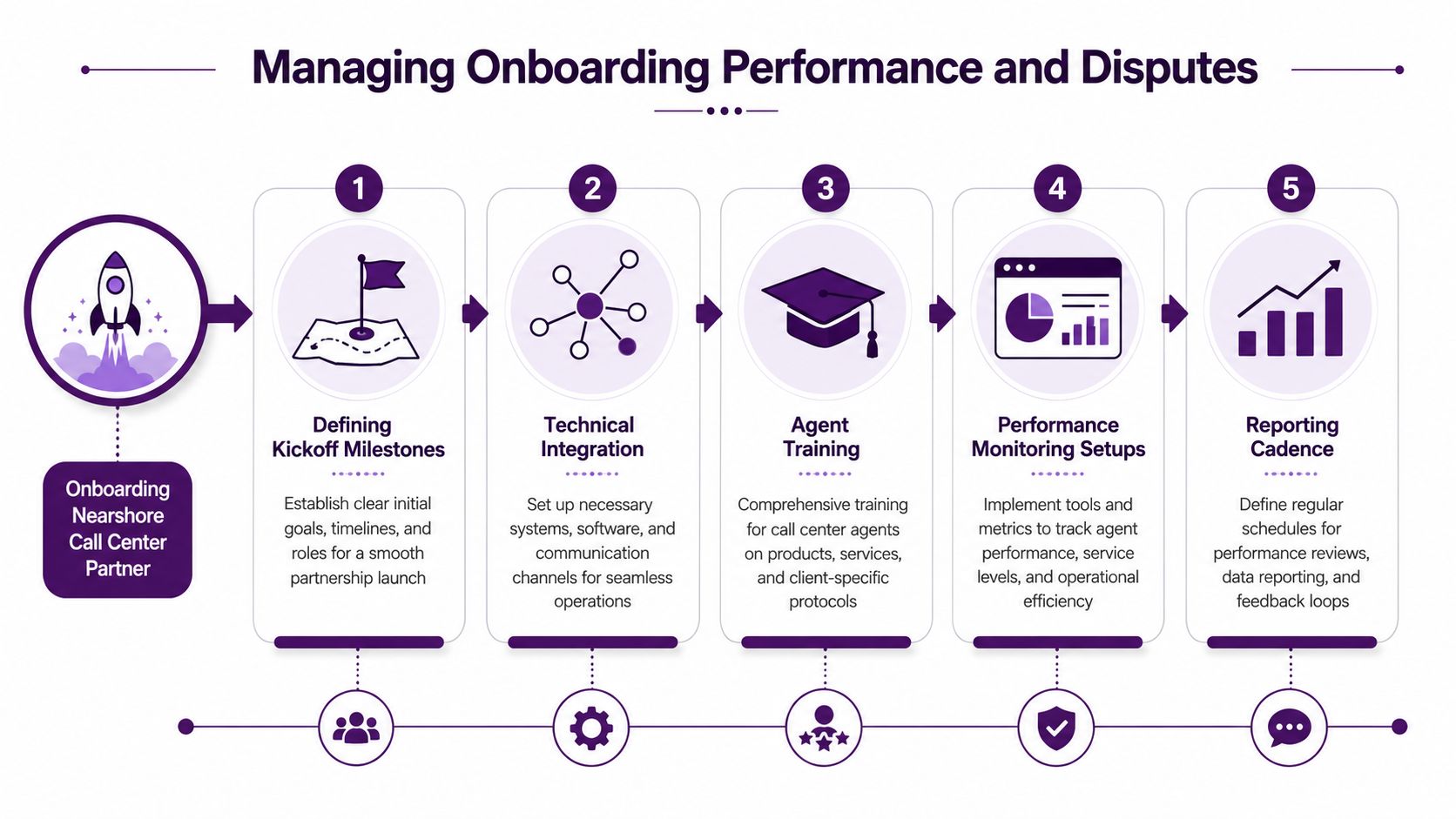
Start with the launch mechanics
Kickoff milestones should define who owns training materials, who signs off on scripts, and who approves technical access. In nearshore bilingual work, that’s especially important because language readiness and brand tone usually need early calibration. If the client waits until go-live week to approve scripts, the launch starts behind schedule.
Technical integration deserves its own checklist. A public RFP for call center services required the vendor to provide a turn-key stack with CTI/ACD, queuing, call recording, monitoring, reporting, IVR, toll-free service, anti-virus protection, PCs, headsets, PRI lines, and CRM integration through a standard CTI solution (RFP call center document). That level of detail matters because integration failures are not just IT issues, they become contract-performance issues.
Monitor with evidence, not instinct
Reporting cadence should be written into the contract and followed in operations. Daily operational snapshots, weekly quality reviews, and monthly business reviews are common structures, but the real issue is whether the same definitions are used across all reports. If the dashboard says service is healthy but the queue keeps missing callbacks, the definitions are probably too loose.
Practical rule: if the client and the vendor can’t read the same report and describe the same problem, the contract is too vague.
Disputes should move from informal escalation to documented review, then to formal resolution only if the earlier steps fail. Keep notes on call samples, staffing changes, incident dates, and approval emails. That file becomes the difference between a short disagreement and a long argument.
Use transition planning before things go wrong
Termination isn’t just a legal clause, it’s an operational plan. The contract should say how data, recordings, scripts, and queue ownership move at exit, and who is responsible for the handoff. That matters in bilingual programs where historical context and language nuance can’t be recovered from a generic export.
For implementation support and launch planning, CallZent’s implementation services are a relevant reference point for teams comparing how onboarding responsibility can be structured in a nearshore model.
Ready to Use Clause Templates and Evaluation Checklist
A contract draft gets much easier to review when the core clauses are written in plain language first. You don’t need ornate legal prose to make the deal work, you need clear obligations that match how the operation will run.
Simple clause templates you can adapt
- SLA clause: “Provider will maintain the agreed service levels for answer time, resolution, and quality reporting according to the measurement schedule in the SOW.”
- Pricing clause: “Fees include only the services listed in the rate schedule. Any added channels, staffing changes, or integration work require written approval before billing.”
- Termination clause: “Either party may terminate under the notice and cure rules in the MSA, and the provider will support transition of data, scripts, and access credentials.”
- AI disclosure clause: “Provider will disclose any AI-assisted customer interaction tools used in the program and confirm where those tools affect disclosures, routing, or reporting.”
- Confidentiality clause: “Each party will protect customer data, scripts, recordings, and operational documents and limit access to personnel with a business need to know.”
One-page review checklist
Before you sign, check these items against the draft:
- SLA metrics: Are answer time, resolution, and quality targets measurable?
- Pricing schedule: Does the rate card cover all channels, languages, and support hours?
- Staffing guarantees: Are bilingual coverage and ramp requirements written down?
- Compliance proof points: Has the provider shown how it handles recordings, data access, and disclosures?
- Escalation path: Is there a clear internal route for missed service or billing disputes?
- AI and location disclosure: Does the contract reflect the need for customer disclosure of AI use and agent location?
A 2025 legal update on the Keep Call Centers in America Act says covered businesses would need to disclose agent location and AI use in customer interactions, and revise vendor contracts to include offshore-relocation notice and compliance provisions (legal update on the Keep Call Centers in America Act). That makes disclosure language a contract issue now, not a future legal curiosity.
For teams evaluating bilingual nearshore delivery, these clauses should also reflect Spanish-language talent, proximity benefits, and the ability to coordinate quickly across borders. If you’re working through a draft now, the most useful next step is to request a contract review and compare the legal text against the service design before the launch date gets too close.
Conclusion and Key Takeaways
Call center contracts work best when they do more than set a price. They should define service, protect both sides, and make it easy to run the operation without constant interpretation fights. That’s especially true in nearshore bilingual BPO deals, where staffing, disclosures, and transition planning can’t be treated as afterthoughts.
The smartest buyers focus on five things. They choose the right contract type, they write measurable clauses, they pick a pricing model that matches the work, they negotiate for clarity instead of noise, and they prepare a clean launch and exit path. If AI, agent-location transparency, or relocation notice could affect your program, the contract should address those issues directly.
Strong contracts don’t just reduce risk, they make performance easier to manage.
If you’re reviewing a draft now, compare it against the checklist above and align it with your actual operating model before you sign.
CallZent helps businesses structure nearshore bilingual support with clear scope, service expectations, and contract-ready operating plans. If you want a practical review of your call center agreement or a fresh starting point for a Mexico-based support program, visit CallZent and ask for a conversation about your contract, your staffing needs, and your transition timeline.
🚀 Build a Call Center Agreement Around the Operation You Actually Need
CallZent helps North American businesses design bilingual nearshore support programs with clear staffing, SLAs, reporting, quality expectations, and transition plans.
Talk to an Expert