Skip to content

GLOBAL CUSTOMER SUPPORT / BPO STRATEGY
Global Call Center Solutions for 2026: A Practical Guide to Scale and ROI
Learn how to evaluate global call center solutions using total cost of ownership, compliance, scalability, technology, and bilingual support strategies.
TL;DR — Quick Takeaways
- Global call center solutions now combine cloud technology, distributed teams, AI, and omnichannel support.
- The best outsourcing decision is based on total cost of ownership—not hourly labor rates alone.
- Nearshore models often provide the strongest balance of cost, quality, and collaboration.
- CallZent helps businesses scale global support operations with bilingual nearshore call center solutions.
Most companies don’t choose the wrong support model because they misunderstand customer service. They choose it because they compare vendors on price per hour and stop there.
That shortcut gets expensive fast. A lower hourly rate can still produce a higher total cost when teams struggle with compliance, agent churn, poor handoffs, overnight lag, or weak coordination between operations and leadership.
Growing Pains or Global Gains? Your Next Move in Customer Support
If your sales are growing, your support operation is already under pressure. More tickets, more channels, more language needs, more schedule complexity, and more customer expectations all land at once. The old question used to be, “How many agents do we need?” The better question now is, “What support model can scale without creating hidden costs?”
Your customer support model is not a staffing decision alone. It’s an operating model decision that affects retention, compliance, and margin.
A practical evaluation starts with five questions:
- Can the model scale without forcing you to overhire?
- Will your managers be able to collaborate with the team in real time?
- Does the provider handle sensitive data the way your industry requires?
- Will the agents stay long enough to learn your business well?
- Can the platform give you clear reporting across voice, chat, email, and workflows?
Leaders who answer those questions early make better outsourcing decisions. Leaders who skip them often end up rebidding the account, rebuilding training, and fixing preventable service issues later.
What Are Global Call Center Solutions Today?
Global call center solutions used to mean one thing. A large operation in one location, tied to desk phones, fixed schedules, and on-premise systems. That model still exists, but it no longer defines how smart customer support is built.
Today, the modern setup looks more like a connected operating system. Calls, email, chat, SMS, social channels, ticketing, CRM history, workforce management, and AI tools all sit in one environment. Agents may be in one site, multiple sites, remote, or hybrid. Customers never see that complexity if the system is designed well.

From hardware to cloud operations
The shift from legacy telephony to cloud delivery changed the economics of support. A useful way to think about it is this: older call centers were like owning and maintaining a private power plant. Modern platforms are closer to using a reliable utility service that expands when demand rises and contracts when it falls.
That’s why the cloud layer matters so much. The Contact Center as a Service market was valued at USD 14.5 billion in 2021 and is projected to reach USD 82.43 billion by 2030, according to Plivo’s CCaaS market overview. Businesses are moving because cloud infrastructure gives them flexibility they can’t get from rigid, location-bound systems.
For a practical look at that model, CallZent’s CCaaS overview shows how companies use cloud-based support delivery to unify channels and scale more cleanly.
What a modern stack usually includes
A working global support operation usually combines several components:
- Omnichannel routing: Phone, email, chat, and social contacts land in one queue structure.
- CRM integration: Agents see order history, account notes, and prior conversations.
- Workforce management: Supervisors forecast demand and align schedules.
- Knowledge tools: Teams use shared scripts, process guides, and searchable answers.
- AI assistance: Bots and agent-assist tools handle routine tasks, triage, and summaries.
If you’re reviewing automation options, Donely’s recommended AI agents is a useful reference point for understanding how AI tools are being applied across support workflows without replacing the need for human judgment.
A global solution works when the customer experience feels local, even if the operation behind it is distributed.
True progress is not just technology. It’s coordination. The best systems let managers see service levels in real time, change staffing decisions quickly, and keep support quality consistent across regions.
Comparing Global Service Models Which Is Right for You?
Most buyers compare service models in the wrong order. They start with cost, then ask about everything else later. In practice, the better sequence is control, risk, collaboration, and then cost. Once those are clear, the right model usually becomes obvious.
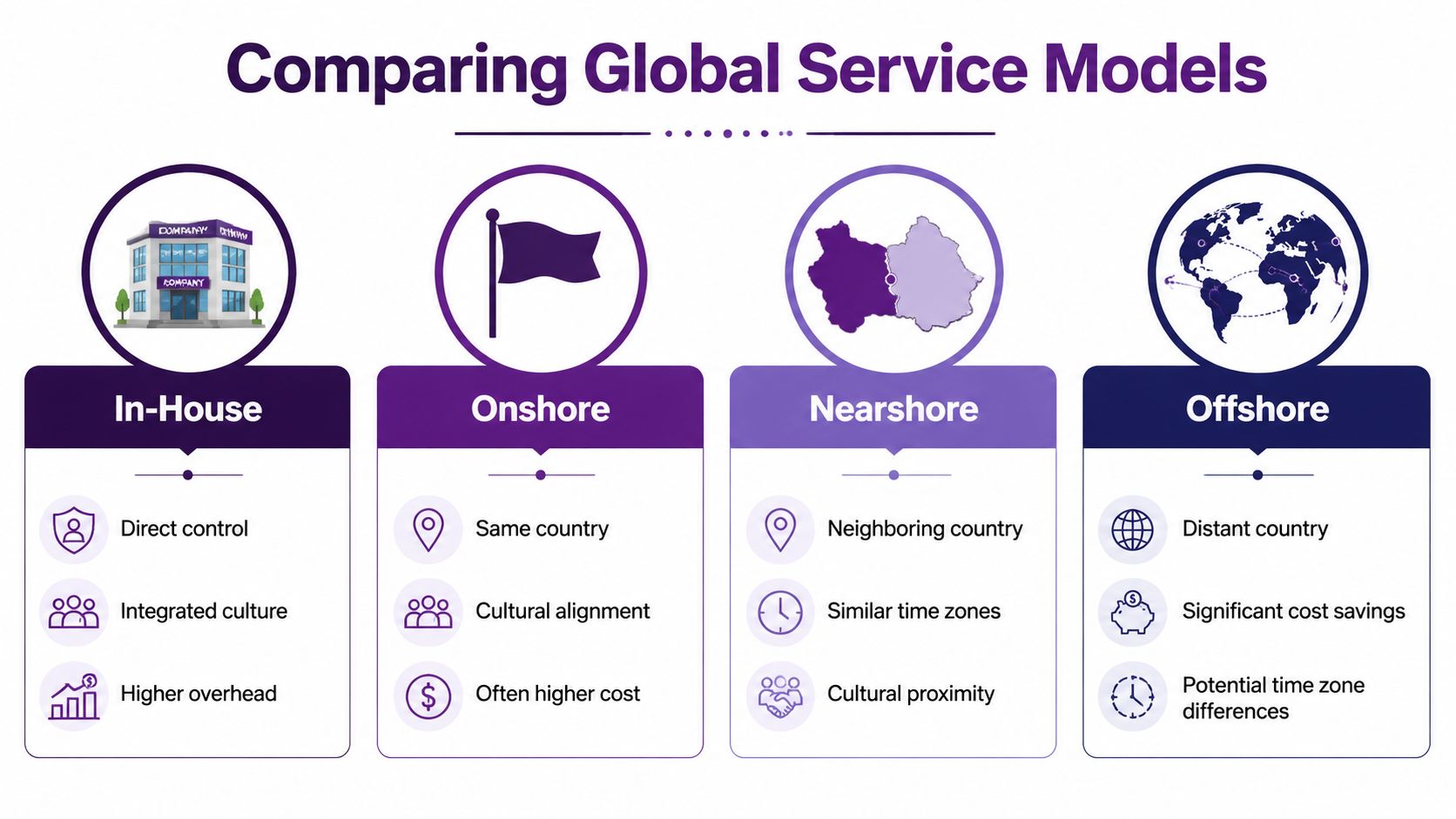
Call center model comparison
| Factor | In-House | Onshore Outsourcing | Nearshore Outsourcing | Offshore Outsourcing |
|---|---|---|---|---|
| Control | Highest direct control | Strong contract control, less day-to-day ownership | Strong visibility with easier collaboration | Varies widely by provider |
| Cost structure | Highest overhead burden | Often premium pricing | Balanced cost and access | Lowest headline labor cost |
| Time-zone alignment | Full alignment | Full alignment | Usually close alignment for North America | Often difficult |
| Culture and communication | Fully embedded | Usually strong | Often strong with bilingual depth | Can vary more |
| Compliance oversight | Internal responsibility | Easier domestic alignment | Strong option for regulated North American work | More complexity in practice |
| Scalability | Slower to build | Moderate to strong | Strong | Strong |
| Management friction | Lowest internal friction | Moderate | Typically manageable | Often highest |
In-house when support is core to the brand
In-house teams make sense when customer support is tightly tied to product complexity, brand positioning, or regulated workflows that your internal leaders want to manage directly. You own hiring, QA, training, systems, and process design.
The trade-off is overhead. Recruiting, occupancy, telecom, scheduling, supervision, attrition management, and after-hours coverage all sit on your books. If volume is unstable, in-house support can become operationally heavy very quickly.
Onshore outsourcing when proximity matters more than cost
Onshore providers appeal to companies that want external help without cross-border complexity. This model can work well for premium brands, highly sensitive accounts, or teams that want domestic alignment across language, norms, and legal frameworks.
The downside is straightforward. You usually pay for that convenience. If your business needs scale and budget discipline at the same time, onshore outsourcing can feel safe but financially tight.
Nearshore outsourcing when balance matters
Nearshore is often the most practical middle path for North American companies. You get lower operating cost than many domestic options, while preserving easier communication, overlapping workdays, and more usable management access.
That matters more than many buyers expect. For regulated industries such as healthcare and finance, nearshore providers offer advantages in data privacy, timezone alignment, and regulatory oversight compared to offshore centers, helping avoid hidden costs tied to compliance audits, data breach liability, and communication delays, as noted in NICE’s guide to global call center tools.
A more detailed model comparison is covered in this nearshore versus offshore outsourcing guide.
Offshore outsourcing when labor arbitrage drives the decision
Offshore can work well for large-volume programs with mature processes, strong documentation, and tolerance for overnight coordination. If the work is repetitive and the operating model is tightly scripted, offshore delivery can be effective.
The risk is that many companies underestimate management drag. A lower hourly rate doesn’t automatically produce lower total cost if leaders spend more time fixing misalignment, reworking QA, handling delays, or compensating for communication gaps.
Practical rule: If your operation depends on fast decisions, high-context conversations, or regulated customer interactions, evaluate total cost of ownership before you evaluate labor rate.
The 5 Core Value Drivers for Your Decision
A good outsourcing decision doesn’t come from one metric. It comes from seeing how money, people, systems, risk, and accountability interact over time. That’s where many vendor evaluations fall apart. A polished proposal can hide weak retention, thin QA, or shallow reporting.
Cost and true ROI
Hourly rate is only one line item. True ROI includes ramp speed, shrinkage management, rework, supervisor load, technology fees, quality variance, and the cost of replacing burned-out agents.
For many companies, this is the moment when nearshore becomes more attractive than it first appeared. It may not be the cheapest line item on a spreadsheet, but it often reduces the expensive problems that don’t show up in a vendor quote.
If you’re calculating those trade-offs, this article on the ROI of outsourcing call centers is a practical starting point.
People culture and performance
Support quality is not only a script issue. It’s a stability issue. Teams with poor management practices, weak coaching, or low trust rarely deliver consistent service for long.
One of the biggest underpriced variables in global call center solutions is agent culture. When agents feel supported, coached, and able to grow, they stay longer. When they stay longer, product knowledge deepens. Escalations improve. Supervisors spend less time replacing staff and more time improving quality.
Staff turnover disrupts operations in quiet but costly ways:
- Training resets: New hires need time to learn systems, policies, and customer language.
- QA instability: Calibration gets harder when the floor changes constantly.
- Customer friction: Experienced agents solve edge cases faster and with less escalation.
- Manager distraction: Leaders spend more time backfilling than optimizing.
A provider with an agent-centric culture isn’t making a soft claim. It’s showing you how it protects service consistency.
Poor culture creates hidden cost. It shows up as repeat contacts, weaker empathy, preventable escalations, and constant retraining.
The technology stack
Technology no longer sits in the background. It shapes queue efficiency, agent productivity, and customer effort. AI has moved from optional experiment to standard operating layer in many support environments.
The global call center AI market is projected to reach USD 7,084.7 million by 2030, and contact centers using AI report a 14% increase in issues resolved per hour and a 9% reduction in average handling time, according to Grand View Research’s call center AI market outlook.
What works in practice:
- Agent assist tools that surface answers during live conversations
- Speech analytics for QA review and trend detection
- Smart routing that matches interaction type to the right skill set
- Automation for simple account actions and post-call workflows
What doesn’t work is adding AI on top of broken workflows. If your knowledge base is inconsistent and your escalation logic is messy, AI will scale confusion faster.
Security and compliance
For healthcare, finance, insurance, and similar sectors, security review should happen early, not after commercials. Buyers often ask about compliance certifications late in the process, when they should be pressure-testing data handling, access controls, recording policies, and escalation governance from the start.
This is also where geography matters. Time-zone overlap helps, but governance matters more. You want a provider that can explain how it handles sensitive workflows in operational detail, not just sales language.
SLAs that actually matter
A contract full of metrics can still miss what matters. Too many service agreements focus on easy-to-report numbers while ignoring customer outcomes.
The best SLA discussion usually includes:
- Speed metrics: Response time, queue thresholds, and schedule adherence
- Quality metrics: QA scoring logic, calibration process, and coaching cadence
- Resolution metrics: First-contact resolution and repeat-contact patterns
- Business metrics: Refund avoidance, retention support, appointment conversion, or similar outcomes tied to your model
The goal isn’t a dense scorecard. It’s a scorecard that links service performance to business value.
Global Call Center Solutions in Action Industry Use Cases
The best way to judge a support model is to see how it behaves under pressure. Not in a slide deck. In a real operating situation where demand spikes, compliance rules tighten, or customer expectations shift faster than the team plan.
E-commerce during peak season
An online retailer usually faces one predictable problem. Volume isn’t stable. It surges around promotions, holidays, launches, and shipping disruptions. If the company staffs only for average demand, customers wait too long when order volume spikes. If it staffs for peak demand all year, payroll and idle time climb.
Cloud-based platforms solve part of that problem by making capacity more flexible. Modern CCaaS platforms can auto-scale resources, cutting costs by 25-40% compared to on-premise systems during peak demand while boosting first-contact resolution to over 80% through AI-driven call routing, according to Intelemark’s overview of global call center excellence.
A practical setup looks like this:
- Core team ownership: Keep a stable trained team for brand voice and high-value contacts.
- Seasonal flex capacity: Add trained overflow support for order status, returns, and delivery questions.
- Routing by intent: Send routine contacts into simpler workflows so experienced agents can handle exceptions.
For teams also reworking the technical side of remote support delivery, ARPHost, LLC managed infrastructure solutions offers useful context on the infrastructure side of virtual call center operations.
Healthcare with bilingual patient support
Healthcare organizations face a different problem. The issue isn’t only volume. It’s sensitivity. Appointment scheduling, patient questions, follow-up reminders, benefits confusion, and escalation handling all require process discipline.
A nearshore bilingual team can help when patients need support in English and Spanish and the provider needs operational coverage outside a single local office schedule. What matters here is less about flashy automation and more about controlled workflows, script discipline, and real supervisor oversight.
A practical healthcare deployment usually includes documented escalation paths, restricted data access, QA around disclosure language, and close scheduling alignment with clinics or billing offices.
Financial services and onboarding complexity
Fintech and financial services teams often underestimate how much friction appears in onboarding. Customers may need identity clarification, application support, document status updates, and reassurance when a workflow stalls.
A blended support model often performs well in these scenarios. Basic status inquiries can be standardized, but complex onboarding conversations still need trained agents who understand nuance, handoff timing, and compliance boundaries.
One nearshore option in this category is CallZent’s e-commerce and high-performance call center support model, which illustrates the broader principle that multilingual support, omnichannel access, and close collaboration matter most when customer journeys have both volume and complexity.
The strongest global call center solutions don’t force every industry into the same script. They adapt staffing, workflow, and controls to the risk profile of the business.
 Your Practical Vendor Selection Checklist
A vendor proposal can look strong on paper and still fail once live traffic starts. The safest buyers verify operating reality before they sign. That means asking better questions and insisting on specific answers.
What to verify before you shortlist anyone
Use this list during calls, site visits, or pilot reviews:
- Leadership access: Ask who will run the account day to day. Meet that person.
- Recruiting logic: Ask how the provider hires for your program type, not just general customer service.
- Training design: Review onboarding materials, nesting approach, and update cadence.
- QA process: Ask how scorecards are calibrated and how coaching is documented.
- Workforce management: Confirm how they forecast, staff, and react when volume shifts.
- Security controls: Review access handling, recording policies, and escalation governance.
- Platform integration: Check CRM, telephony, ticketing, and reporting compatibility.
- Culture signals: Ask about tenure, coaching, advancement, and supervisor-to-agent interaction.
Red flags buyers often miss
Some warning signs are obvious. Others show up in subtle language during sales conversations.
Watch for these:
- Vague reporting promises: If a vendor says reporting is “customizable” but can’t show real dashboards, push harder.
- Generic staffing claims: If every industry gets the same recruiting pitch, the model may be too shallow.
- Overfocus on cost: If price dominates the conversation, you may be looking at a low-visibility operation.
- Weak escalation answers: If they can’t explain who handles edge cases, your team will end up doing it.
- No pilot discipline: A provider that doesn’t propose a structured pilot may not manage transitions well.
For a broader due-diligence lens, CloudOrbis Inc. IT outsourcing advice is a useful companion resource because many of the same vendor evaluation principles apply across support and technology outsourcing.
Shortlist vendors that answer operational questions with process detail. Eliminate vendors that answer with adjectives.
A good final step is to test collaboration before launch. Run live planning sessions, not just sales demos. You’ll learn more from one scheduling meeting or workflow review than from a polished capabilities deck.
Your Roadmap to Successful Implementation and Measuring ROI
The contract is only the start. Most support transitions succeed or fail in implementation, where assumptions meet real traffic, real tooling, and real customer behavior.
A practical rollout usually follows a simple pattern.
Start with a controlled launch
Don’t move everything at once. Start with a defined scope, a clear contact type mix, and a manageable set of channels. Keep escalation rules tight. Review results daily at the beginning.
The strongest launches usually include:
- A documented knowledge base
- Named owners on both sides
- Clear routing logic
- A calibration plan for QA
- A schedule for performance reviews
This is also when workflow decisions matter most. If agents need five systems to complete one customer request, productivity will suffer no matter how skilled the team is.
Measure outcomes not just activity
A high-volume support operation can look busy and still underperform. Measuring ROI means connecting service data to business outcomes. That usually requires a mix of operational metrics and customer metrics.
Use a balanced scorecard that includes:
- Customer satisfaction
- First-contact resolution
- Repeat-contact trends
- Escalation rate
- Schedule adherence
- Conversion or retention impact where relevant
For a practical framework, this guide to monitoring call center performance outlines how to build a reporting rhythm that managers can use.
The long-term goal isn’t to outsource calls. It’s to build a support operation that scales with your business, protects your customer relationships, and gives leadership better visibility into service quality. The right partner helps you do that consistently, not just cheaply.
🚀 Scale Your Global Customer Support Smarter
Talk with CallZent about bilingual nearshore call center solutions designed to improve scalability, operational visibility, and customer experience.
Talk to an ExpertIf you’re evaluating global call center solutions for a North American business and want a clearer view of nearshore trade-offs, bilingual support design, or implementation planning, CallZent is one option to review as part of your vendor shortlist.