CALL CENTER OUTSOURCING
Call Center Solutions Provider Guide for 2026 and Beyond
Learn how to choose a call center solutions provider in 2026. Compare nearshore outsourcing, bilingual support, operational KPIs, technology stacks, and vendor evaluation strategies.
TL;DR — Quick Takeaways
- A call center solutions provider is more than outsourced phone support. The best providers manage customer workflows, staffing, QA, reporting, and operational scalability.
- Nearshore outsourcing in Mexico continues growing because it improves communication, bilingual support, and operational flexibility.
- Technology alone will not fix broken customer operations. Strong providers combine systems, workflows, people management, and performance oversight.
- The right outsourcing partner reduces management strain while improving customer experience and response consistency.
Growth is exciting until your team can’t keep up.
You’re closing more deals, orders are rising, and customer questions are coming in faster than your staff can handle them. Calls get missed. Emails sit too long. Good employees spend half their day reacting instead of moving the business forward. Customers notice fast.
That moment is where a lot of companies make a bad decision. They either patch the problem with rushed hiring or buy software and assume the tool will somehow fix broken workflows. It won’t.
A call center solutions provider is the smarter move when you need capacity, consistency, and control at the same time. This isn’t just about outsourcing phones. It’s about building a support operation that protects revenue, improves customer experience, and gives your internal team room to focus on growth.
The timing matters. The global contact center software market was worth over $41.7 billion in 2025 and is projected to grow at a 21.9% CAGR according to Giva’s call center statistics roundup. That level of investment tells you something important. Businesses aren’t treating support as overhead anymore. They’re treating it like infrastructure for growth.
Your customer service shouldn’t be a bottleneck; it should be your biggest competitive advantage.
Growing Pains or Growth Opportunities?
Most owners first look for a provider when something starts breaking.
A retailer gets buried during peak season. A healthcare office can’t keep up with scheduling calls. A financial services firm adds new clients faster than its front desk can support them. The pressure shows up in obvious ways. Long wait times, dropped calls, frustrated agents, and customers who next time select a competitor.
The mistake is seeing this as a staffing issue only. It isn’t. It’s an operations issue.
What changes when you treat support like a growth function
A real provider doesn’t just answer overflow calls. They help redesign how customer contact gets handled from first touch to final resolution. That includes routing logic, service levels, staffing models, escalation paths, quality assurance, reporting, and channel coverage.
A simple example: an e-commerce brand may think it needs five more in-house agents. In reality, it may need better call routing, bilingual coverage, order-status self-service, and a back-office team to handle returns and refund updates. Hiring alone won’t fix that.
Businesses usually don’t have a call problem. They have a capacity and design problem.
The strategic decision in front of you
If demand is rising, you have two choices:
- Keep patching internally: More hiring, more training, more software, more management burden.
- Partner with a provider: Add people, systems, and process discipline in one move.
The second option is usually stronger when speed matters and customer experience is already under strain.
Here’s the practical lens I recommend:
- Look at missed revenue: If customers can’t reach you, sales and renewals suffer.
- Look at management drag: If your leadership team is supervising queues instead of strategy, you’re paying for distraction.
- Look at service inconsistency: If customer experience depends on who happens to answer, your brand is exposed.
A capable provider gives you a repeatable operating model, not just extra hands. That’s what turns growth pains into growth opportunities.
What Exactly Is a Call Center Solutions Provider
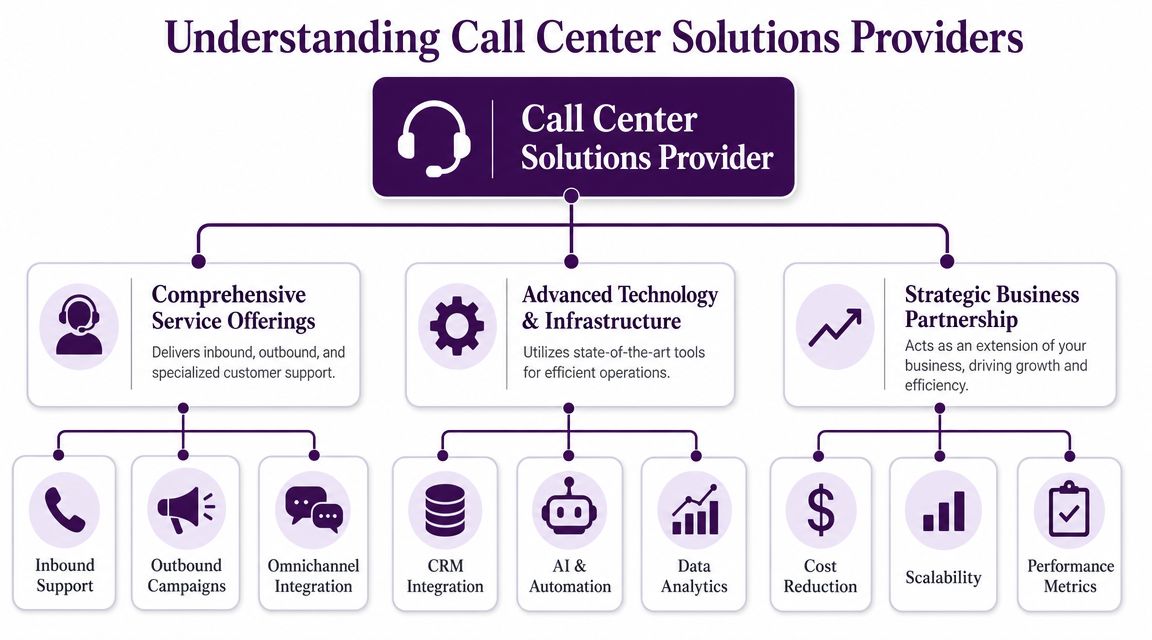
TL;DR: A call center solutions provider is a partner that combines trained agents, technology, reporting, and process management to run customer communications on your behalf. It is not just software. It is not temp staffing. It is an outsourced operating model built around business outcomes.
When owners hear the phrase, they often picture a room full of agents with headsets. That’s outdated.
A modern Call Center Solutions Provider delivers a managed service. The provider recruits and trains agents, configures the platform, builds workflows, monitors performance, and adjusts the operation as your needs change. If they’re doing the job right, customers experience them as an extension of your brand.
What it is not
Let’s clear up the confusion.
It is not the same as buying contact center software and asking your internal team to figure it out. Software gives you tools. A provider gives you execution.
It is also not the same as hiring a few remote reps through a staffing agency. Staffing fills seats. A provider owns delivery.
That distinction matters because many businesses don’t fail on intent. They fail on operating discipline.
What a true provider actually owns
A serious provider should handle things like:
- People management: Hiring, onboarding, coaching, scheduling, retention
- Operational design: Scripts, workflows, escalation paths, queue coverage
- Technology setup: Telephony, CRM connections, reporting, QA systems
- Performance management: Service levels, quality reviews, trend analysis, improvement plans
If you’re evaluating partners, ask whether they can talk in business terms. Can they discuss customer retention, lead conversion, missed-call recovery, billing support, appointment adherence, or multilingual service quality? If they only talk about seats and rates, they’re probably a vendor, not a solution partner.
For a broader view of how outsourced support fits into business operations, this CallZent guide for business leaders is a useful starting point.
The Core Services and Technologies You Should Expect
A provider should solve customer contact across the front office and the back office. If they only offer generic call answering, keep looking.
Service coverage that actually supports the business
The service mix usually falls into three buckets.
Inbound support covers the work customers initiate. That includes customer service, technical support, order status, billing questions, reservations, and appointment handling. For healthcare, that may mean intake or scheduling. For retail, it may mean returns and shipping questions.
Outbound support is where providers help drive revenue or follow-up activity. That can include lead qualification, appointment setting, surveys, collections outreach, renewals, and sales support.
Back-office support handles the work customers don’t see but absolutely feel. Think data entry, transaction processing, case updates, ticket documentation, claims support, and admin follow-through. A customer doesn’t care whether the issue was “front office” or “back office.” They care whether it got resolved.
The technology stack behind the service
The provider’s tech stack matters because bad systems create slow service.
Modern platforms rely on routing tools and customer data working together. Salesforce notes that call center software can connect customers to the right agents, escalate only calls that need a live agent, and give agents immediate access to customer information from one console through Salesforce’s overview of call center software. That’s where CTI matters. It enables screen pops, click-to-call, and integrated call handling instead of making agents jump between systems.
For buyers who want a plain-English overview of the platform side, Hosted Telecommunications’ call centre software guide offers a helpful breakdown of how these systems fit together.
A strong provider should also be able to support tools and workflows tied to call center software features like CRM integration, omnichannel visibility, and automated routing.
Practical rule: If agents have to manually search for customer history on every interaction, your operation is wasting time and frustrating customers.
A simple real-world example
Take an online store during a product launch.
A customer calls to ask where their order is. With a decent IVR, they can choose order status and get routed properly or complete a simple self-service check. If the issue is more complex, CTI pulls up their order history before the agent even says hello. The provider’s routing logic sends that call to someone who handles shipping issues and speaks the caller’s preferred language.
That setup does three things at once:
- Reduces friction: The customer doesn’t repeat basic information.
- Protects agent time: Simple requests don’t clog the queue.
- Improves resolution quality: The right person gets the call first.
That’s the difference between buying telecom and buying an operating solution.
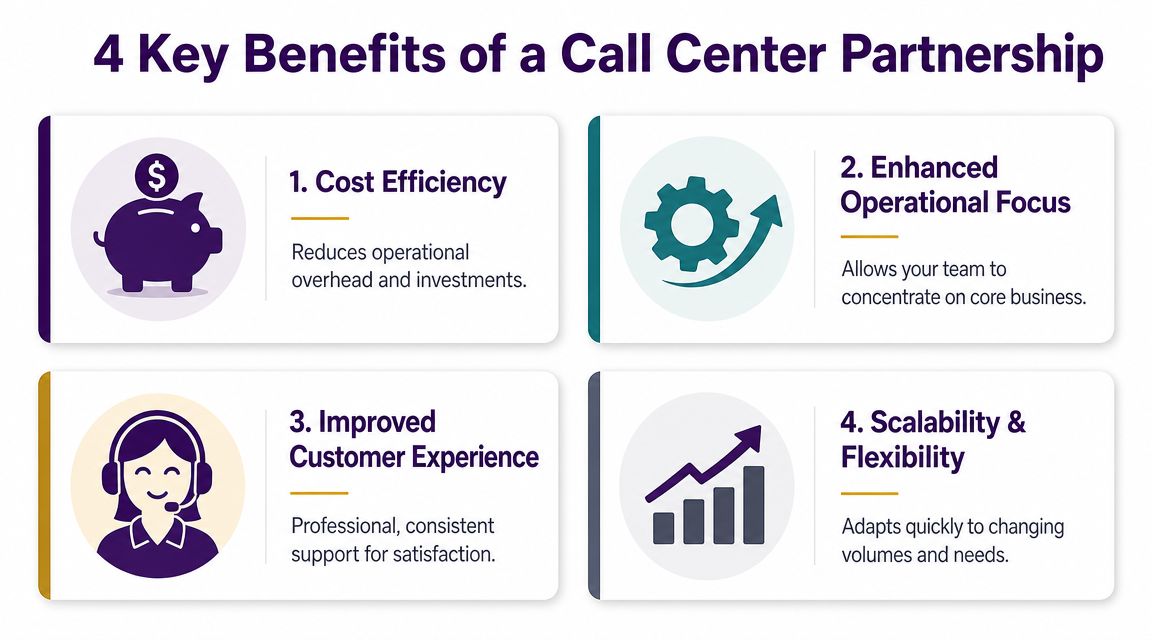
Four Key Business Benefits of a Call Center Partnership
The value of a provider isn’t abstract. It shows up in margin, management focus, customer retention, and your ability to scale without chaos.
Cost control without building everything yourself
Running support in-house means paying for recruiting, training, scheduling, supervision, QA, coverage planning, and the underlying platform. Most companies underestimate how much management attention that consumes.
A provider spreads that infrastructure across clients and gives you access to a ready-made operation. That doesn’t mean cheapest wins. It means your spending is tied to service delivery instead of fixed internal overhead.
Better execution because support is their job
If customer support sits on the edge of your business, it never gets the attention it needs.
A provider lives or dies by execution quality. That usually means more structured onboarding, tighter call monitoring, better workforce management, and clearer escalation processes than a growing company can build quickly on its own. This is especially useful when your internal leaders should be focused on product, sales, or operations.
For teams weighing support and sales expansion together, ReachInbox’s perspective on lead generation outsourcing is worth reading because it highlights how outsourced teams can support pipeline growth when internal bandwidth is tight.
Scalability when volume swings
Retail is the easiest example.
Before outsourcing, a merchant handles normal months fine but gets overwhelmed during holiday peaks. Customers wait longer, complaints rise, and managers pull people from other departments to answer phones. After moving support to a provider, the business can add trained coverage for seasonal spikes without carrying full-time overhead year-round.
That’s where the broader business process outsourcing benefits become obvious. You buy flexibility instead of building for your worst month every month.
Compliance and risk control
Some industries can’t afford sloppy support.
A healthcare practice needs disciplined patient communication. A financial firm needs secure handling of sensitive information. A reputable provider should already operate with clear controls around data access, call handling, documentation, and escalation. If they can’t explain their security approach in plain English, don’t trust them with regulated interactions.
Good outsourcing reduces complexity for the client. Bad outsourcing hides complexity until a customer or auditor finds it.
The Nearshore Advantage A Call Center Solutions Provider in Mexico
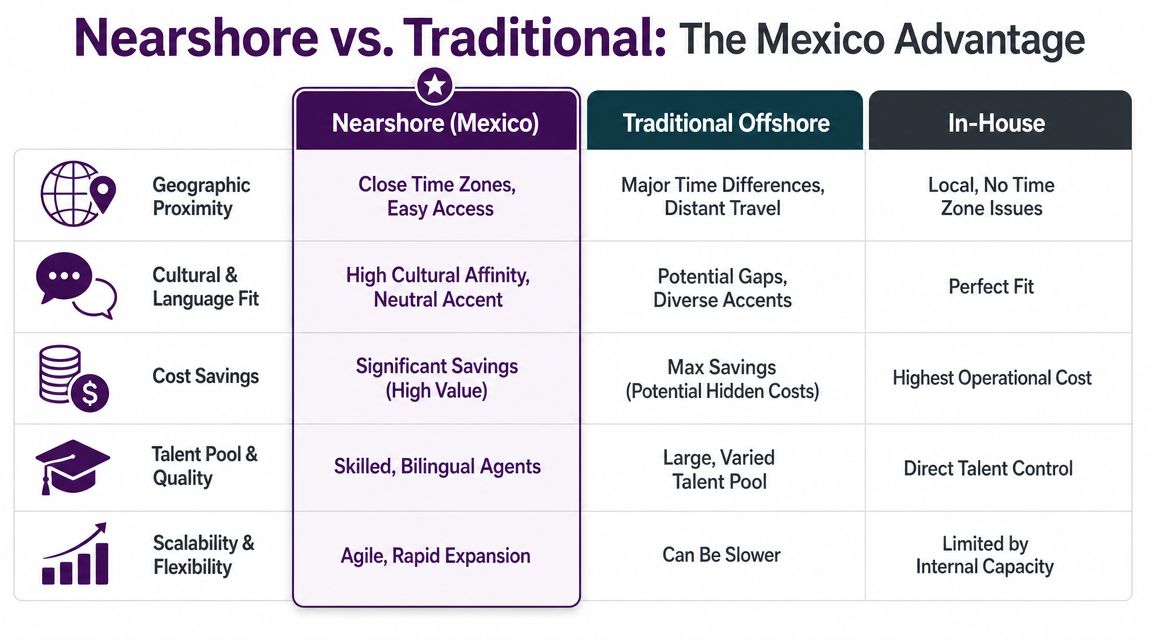
If your customers are in the U.S. or Canada, nearshore support often makes more sense than either pure offshore or fully in-house staffing.
Why nearshore works better for North American brands
Nearshore means outsourcing to a nearby country. For U.S. companies, Mexico is the obvious example.
The biggest advantage isn’t just labor cost. It’s operational fit. Shared or overlapping time zones make collaboration easier. Travel is simple. English and Spanish coverage matters more every year. Cultural familiarity improves live conversations, especially when the interaction is sensitive, urgent, or sales-driven.
That matters because multilingual support isn’t just a staffing checkbox. As noted in Liveops’ discussion of healthcare contact center operations, outsourcing can improve service through multilingual support and round-the-clock availability, but only if buyers evaluate the operational design behind it, including agent training, knowledge management, and escalation paths.
Bilingual support has to be operational, not cosmetic
Many companies say they need Spanish support when what they really need is a bilingual customer journey.
Those are not the same thing.
If a patient starts in Spanish on the phone, gets transferred to a portal in English, and then reaches an agent who doesn’t understand the full context, the experience fails. A nearshore provider should design continuity across channels, not just assign bilingual agents to a queue.
Here’s a practical example. A U.S. healthcare group has a patient who needs to reschedule an appointment, confirm coverage details, and understand pre-visit instructions. A monolingual team may complete the transaction poorly or escalate it too late. A bilingual nearshore team can handle the interaction more naturally and reduce confusion, but only if scripts, CRM notes, and escalation paths are built for both languages.
For companies comparing delivery models, this overview of nearshore call centers in Mexico gives a useful business context.
Why Tijuana is strategically appealing
For companies serving North America, a Tijuana-based model can be highly practical. Leadership can visit the operation without complicated travel. Collaboration with U.S. teams is easier because the workday overlaps. English and Spanish support can be built into the same program.
CallZent is one example of a provider operating in that nearshore model, offering bilingual inbound, outbound, and back-office support from Tijuana for North American businesses.
The right nearshore partner gives you cost efficiency without forcing you to sacrifice communication quality.
How to Evaluate and Choose the Right Provider
Most businesses ask the wrong first question. They ask, “What’s your rate?” The better question is, “How do you run the operation?”
ROI Call Center Solutions highlights scalability, security, and channel breadth as core technical differentiators, along with the need for encryption, analytics, and CRM or ERP integration in a provider’s platform, as outlined in their guidance on evaluating call center providers. That’s the baseline. You still need to test how well the provider applies those capabilities to your specific business.
Questions to ask on the first discovery call
Use direct questions. Don’t let the conversation stay high-level.
- Industry fit: Have you supported companies with my kind of customer journey?
- Ramp process: How do you train agents on product knowledge, tone, and escalation handling?
- Technology depth: What systems do you integrate with, and how do agents access customer context?
- Security posture: How do you handle encryption, access control, and regulated data?
- Performance management: How do you coach underperforming agents and report trends to clients?
- Scalability: What happens if my volume jumps suddenly or I add a second language queue?
- Pricing model: Am I paying per hour, per agent, per minute, or by some other structure?
Vendor selection checklist
| Evaluation Criteria | Question to Ask | Importance |
|---|---|---|
| Industry Specialization | Have you supported businesses with similar workflows and customer expectations? | High |
| Technology Stack | Can your platform integrate with our CRM and support omnichannel visibility? | High |
| Scalability | How quickly can you add agents, lines, or channels if demand increases? | High |
| Security and Compliance | What controls do you use to protect customer data and sensitive interactions? | High |
| Bilingual Capability | How do you maintain quality across English and Spanish interactions? | High |
| Training Process | How do you onboard agents and keep knowledge current? | Medium |
| Reporting | What performance reports do clients receive and how often? | Medium |
| Pricing Structure | What is included in the rate and what creates extra cost? | Medium |
A lot of owners also need help understanding commercial models before they compare providers. This guide on how to find and vet the best call center outsourcing companies is a useful next step if you’re building a shortlist.
What to watch for
Some warning signs show up early:
- Vague answers: If they can’t explain operations clearly, they probably don’t control them well.
- Feature dumping: If every answer is a software buzzword, you’re hearing a sales pitch, not a delivery plan.
- No ownership model: If it’s unclear who manages quality, staffing, and workflow changes, problems will land back on your desk.
Choose the provider that understands your business model, not the one with the flashiest demo.
 Measuring Success and Your Next Steps
Choosing the provider is only half the job. Managing the partnership is where results happen.
A strong operation should track a few core KPIs consistently. Industry benchmarks commonly point to a first-call resolution target of about 74% or higher, average handle time around 6 minutes, and average speed of answer of 28 seconds or less, according to Allied OneSource’s call center benchmark summary. These aren’t vanity numbers. They tell you whether customers are getting quick access and real resolution.
The KPIs that actually matter
- First-call resolution: Are issues solved without repeat contacts?
- Average handle time: Are agents efficient without rushing customers?
- Average speed of answer: Are customers waiting too long to reach someone?
- Customer satisfaction: Do customers feel helped, not just processed?
- Quality assurance trends: Are agents following the right workflow and tone?
If your provider reports activity but not outcomes, you’re managing motion instead of performance.
Your next-step checklist
Keep it simple:
- Define your needs: Volume, channels, hours, language needs, compliance needs.
- Shortlist providers: Look for operational fit, not just price.
- Ask hard questions: Training, reporting, tech integration, escalation design.
- Check cultural alignment: Especially if your customers expect bilingual or high-empathy support.
- Plan governance: Set review meetings, KPIs, ownership, and improvement cadence from day one.
A call center solutions provider should make your business easier to run and easier to buy from. If the partnership doesn’t improve customer experience and reduce management strain, it’s the wrong one.
🚀 Scale Smarter With CallZent
CallZent helps North American businesses improve customer support, technical support, lead generation, and back-office operations through bilingual nearshore call center solutions in Mexico.
Talk to an ExpertIf you’re comparing providers and want a practical conversation about bilingual nearshore support, CallZent offers no-obligation consultations to discuss your service model, coverage needs, and operational goals.