

Confidentiality Agreements
Confidentiality Agreement Guide for Nearshore BPOs
Learn what a confidentiality agreement should protect in a nearshore BPO, including customer data, vendor access, cross-border controls, bilingual wording, and operational enforcement.
TL;DR — Quick Takeaways
- A confidentiality agreement should define what information is protected, who can access it, how it can be used, and when the obligation ends.
- In a nearshore BPO, generic NDA templates often miss key risks such as cross-border data movement, bilingual enforcement, vendor chains, and industry-specific compliance.
- The strongest agreements are narrow, specific, and supported by real operational controls such as access logs, onboarding acknowledgments, vendor flow-downs, and offboarding procedures.
- BPO confidentiality agreements should cover customer data, pricing, scripts, workflows, hiring materials, call recordings, business strategy, and any derivative summaries created from client information.
- For Tijuana-based nearshore teams, the contract, Spanish-language communication, vendor access, and actual data path must line up before sensitive information is shared.
You’re about to hand customer data, pricing, scripts, or hiring materials to someone outside your building. If you don’t have a tight confidentiality agreement in place, you’re not protecting the business, you’re hoping everyone behaves. In a nearshore BPO, hope is not a control.
What a Confidentiality Agreement Really Protects
A U.S. e-commerce client sends customer records to a Tijuana support team, then pauses before the first file transfer. The deal is moving, the agents are ready, but nobody has signed the paperwork that says who can use the data, where it can go, and what happens if it leaks. That pause is exactly where a confidentiality agreement earns its keep.
In plain English, a confidentiality agreement is a contract that controls how sensitive information is shared, used, stored, and returned. In casual business speech, people often call it an NDA. That’s fine. The point is the same, protect information from misuse, not to bury the other side in legal jargon. The best versions are specific enough that both sides know what’s allowed, and narrow enough that they don’t accidentally create a fake noncompete.
Practical rule: If the paper doesn’t tell the recipient what they may do, who they may tell, and when the obligation ends, it’s too loose for a BPO relationship.
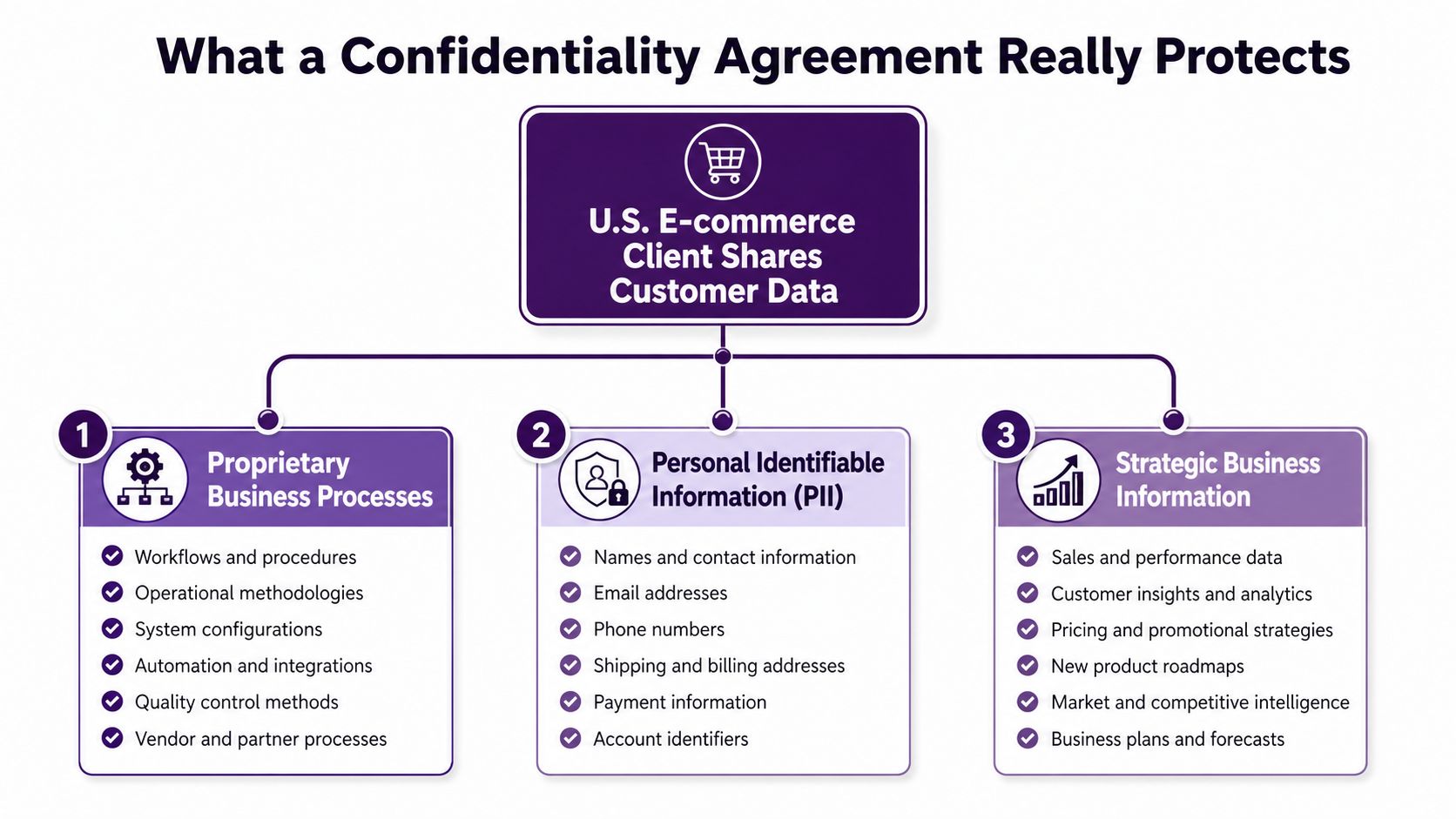
Confidentiality agreements are about control, not theater
A strong agreement protects three things at once. It covers proprietary business processes, personal data, and strategic business information. That matters in a call center because your team might handle a customer’s billing record in one queue, a product roadmap in another, and a launch script for the client’s marketing team in a third.
That’s why the contract should stay practical. If the purpose is customer support, the recipient should use the data only for customer support. If the purpose is due diligence, the recipient should use it only for that review. If the purpose is secure processing by a vendor, the contract should say so clearly and limit access to the named people who need it.
For a useful drafting starting point, the Coto & Waddington NDA template is worth reading because it shows how a basic form is supposed to look before you adapt it for real operations.
A lighter data processing addendum may be enough when the issue is only regulated handling of personal data and the parties don’t need broader secrecy obligations. But once the client is sharing scripts, pricing, workflows, forecasts, or campaign strategy, you need a real confidentiality agreement. If you’re also tightening customer privacy controls, this guide on protecting customer privacy in BPO operations fits the same problem from a different angle.
The Three Main Types and Where Each Fits
A BPO doesn’t sign one kind of NDA and call it a day. You’ll see unilateral, mutual, and multilateral agreements, and the wrong one creates friction fast. Use the right format for the business relationship in front of you, not the template that happened to be in the folder.
| Agreement Type | Best BPO Use Case | Key Clause to Adjust |
|---|---|---|
| Unilateral | Client shares data with the BPO, onboarding, outsourcing, pilot work | Definition of confidential information |
| Mutual | Joint planning, co-development, shared sales or implementation work | Permitted use and reciprocal obligations |
| Multilateral | Several parties exchange data, including subcontractors or project partners | Authorized recipients and flow-down duties |
Employees, contractors, and vendors need different paper
Employee agreements tend to be broader because the relationship is ongoing and the worker sits inside your systems every day. You want long-term confidentiality language, clear return obligations at exit, and rules that cover devices, cloud folders, and messaging apps. A contractor agreement should be tighter, tied to a project or queue, and limited to the exact work scope.
Vendor agreements are the most overlooked. If you use a QA provider, transcription service, cloud host, or training partner, the NDA has to flow confidentiality obligations down to those third parties before any data leaves your control. The internal link on financial services compliance training is useful here because financial clients usually need the tightest vendor discipline and the cleanest documentation chain.
The template you pull for a receptionist is not the template you should use for a cloud vendor handling call recordings.
In a BPO setting, I’d be blunt about the choice. Use unilateral language when the client is the only real discloser. Use mutual paper when both sides are sharing operational know-how. Use multilateral paper only when everyone in the chain needs access and you can control the flow-down. If you can’t explain the data path in one sentence, the agreement isn’t ready.
The Clauses That Decide Whether Your NDA Actually Works
A confidentiality agreement lives or dies on clause quality. I’ve seen polished forms fail because the definition was vague, the term was endless, or the recipient had no idea whether a subcontractor could touch the file. The fix is not more legal drama. It’s better drafting.
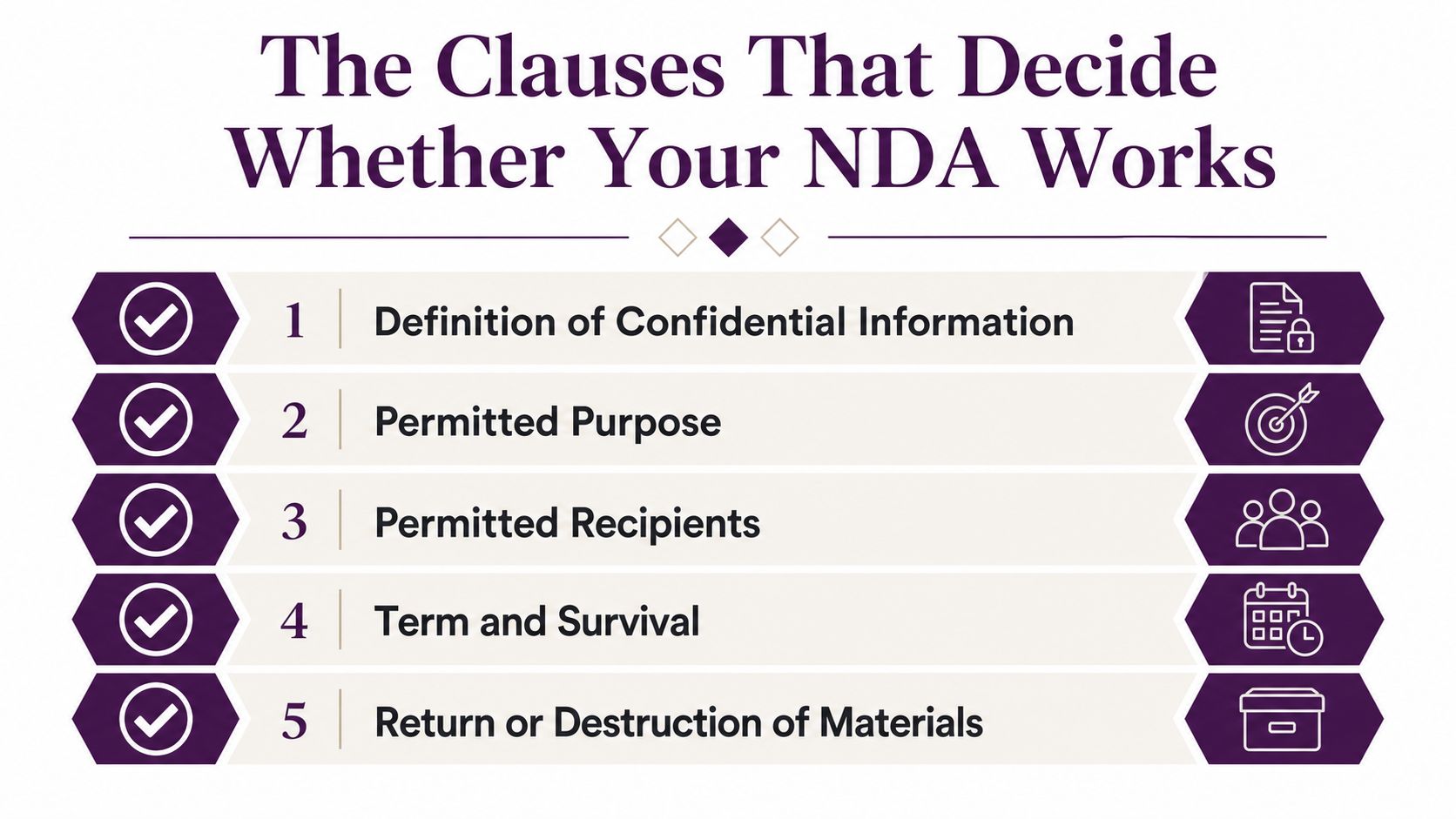
Start with the information definition
If agents handle credit card numbers, the definition should cover those records and the systems that store them. If the client shares a product roadmap, the definition should cover the roadmap, related notes, and any derivative summaries your team creates. A sloppy definition invites arguments later about whether a screenshot, export, or call summary counts.
Lock down the permitted purpose
The paper should say exactly why the information is being shared. Customer support is not product development. Debt collection is not marketing. Due diligence is not general business intelligence. When the permitted purpose is narrow, the recipient knows where the line is.
Name who can see it
The strongest agreements pair a narrow definition with explicit permitted-use limits, named authorized recipients, and a fixed survival period after termination, plus a return-or-destruction obligation at expiry, according to expert guidance in the Journal of Intellectual Property Law & Practice. That structure matters in a call center where a supervisor, QA lead, trainer, and workforce management analyst may all want a look. The agreement should say whether they’re covered, and if so, under what controls.
Set a real term and survival period
Confidentiality obligations shouldn’t drift forever unless the information justifies it. A term with a clean survival period is easier to train against and easier to enforce. If the contract says the duty ends at a specific point, your offboarding process can match the paper.
Require return or destruction
This clause matters more than people think. When the engagement ends, the client should know whether files get returned, deleted, or certified as destroyed. The Call Center Compliance page is a good companion read if you’re aligning contract language with operational retention rules.
Don’t ignore consideration
Under New York-focused guidance, enforceability also depends on consideration, which means the recipient has to receive something of value in exchange for the restriction. That’s not a technicality. It’s the difference between a clause that looks official and one that binds.
Nearshore and BPO Clauses Most Templates Forget
Generic NDA templates usually assume one office, one language, and one legal system. A Tijuana BPO doesn’t live in that world. Data moves across borders, teams work in two languages, and clients from healthcare, finance, and e-commerce all bring different compliance pressure.

Cross-border data transfer needs explicit controls
If a file moves from the U.S. to Mexico, or from either country into a third-party cloud or QA platform, the NDA should say how that transfer is controlled. That means secure sharing, access restrictions, encryption, and rules for remote work devices. In tech partnerships, confidentiality clauses need to match the actual transmission channel, because the primary failure mode is uncontrolled copying, forwarding, or storage across digital systems, as noted in practical tech-focused guidance.
A simple real-world fix is boring but effective. If the client sends data through a shared drive, lock the folder. If a team member works remotely, restrict local downloads. If a vendor touches call recordings, require the same confidentiality duty in their paper before the first file lands. The internal page on security compliance in Mexico-based BPOs is the right place to align the contract with actual site controls.
Bilingual wording can’t be sloppy
If a Spanish-speaking agent, manager, or vendor is going to be bound by the document, the English version should control, but the Spanish translation still has to be faithful. That’s not a nice-to-have. It’s how you avoid a fight over what a key definition meant in the field. Have a bilingual reviewer check the core terms, especially anything touching scope, exclusions, permitted use, and survival.
Industry overlays belong in addenda
Healthcare clients bring HIPAA-style handling expectations. Financial clients bring GLBA and PCI-DSS pressure. E-commerce clients care significantly about PCI scope and payment data handling. You don’t rewrite the whole NDA every time. You attach an industry addendum that tightens the relevant controls and keeps the base agreement stable.
A resource like hard drive shredding guidance from Reworx Recycling is useful when your offboarding process includes physical media, because the contract’s return-or-destruction language should map to actual destruction methods, not wishful thinking.
A nearshore NDA fails when it assumes English-only drafting, one-country storage, and no vendor chain. That’s not modern outsourcing, that’s a fantasy.
Two Real BPO Stories Worth Reading Carefully
A healthcare client once caught an agent forwarding a screenshot of a member record to a personal device. The agreement wasn’t fancy, but it was solid: clear permitted-use language, an audit right, and a clean remediation path. That gave the client a contractually manageable breach response instead of a debate about whether the behavior was “really” covered.
A debt collection client had the opposite experience. The BPO’s vendor agreement didn’t push confidentiality duties down to the cloud transcription provider. When something went wrong, the weaker paper couldn’t reach the third party that held the data. The campaign was lost, the relationship soured, and the client learned the hard way that a gap in the vendor chain becomes your gap.
The lesson is simple. The strength of a confidentiality agreement is judged on the worst day, not in the sales meeting. If the paper can’t handle an agent mistake or a vendor leak, it’s decorative.
Putting a Confidentiality Program Around the Paper
A signed agreement by itself doesn’t stop bad handling. The contract has to sit inside a live program that agents, supervisors, vendors, and offboarding teams follow. If the paper says one thing and the floor does another, the paper loses.
Make the policy visible and usable
Start with an internal confidentiality policy that people can read without a legal degree. It should match the agreement’s definition of protected information and explain where data can be stored, who can see it, and what devices are off limits. If agents can’t explain the policy back to you, the rollout isn’t done.
Tie onboarding to access
An onboarding acknowledgment should sit next to system access, not in a separate folder nobody opens. If the agreement requires limited use and named recipients, the access control list needs to reflect that. If the agreement requires return or destruction at exit, the offboarding checklist needs to trigger it every time.
Push the same duty to vendors
Before a sub-supplier sees a file, they need the same confidentiality obligation in their contract. That’s the flow-down. Without it, your BPO becomes the weak link, even if your own agreement looks good. The VolunteerBadge resource is a useful reminder that documentation, acknowledgment, and verification matter when people move through different roles and systems.
Monitor the behavior, not just the signature
Access logs, quarterly attestations, and exit interviews make the paper real. Logs show who touched what. Attestations force supervisors to confirm that teams still follow the rules. Exit interviews close the loop by reminding people to return or destroy materials before access ends.
This program should be reviewed at least annually, and again whenever you add a new service line, vertical, or third-party tool. If your agreement doesn’t match how the business runs, it’s already outdated.
Enforcement, Best Practices, and the Decisions You Face at Renewal
A confidentiality agreement is only useful if someone is willing to enforce it. The first move is usually a cease-and-desist letter. If that fails, the next step is injunctive relief, because once sensitive data is copied, forwarded, or shared inside a vendor chain, money damages are hard to measure and even harder to recover. Good drafting gives you leverage before a breach turns into a public problem.
The UK reforms show where major markets are heading. A 2026 fact sheet says NDAs appear in a significant majority of civil settlements, with estimates in some sectors reaching over 90%, and it notes reforms effective October 1, 2025, that void confidentiality clauses blocking victims from speaking to law enforcement, legal or regulatory advisers, therapeutic services, or family members when the conduct relates to criminal behavior, according to the UK NDA Fact Sheet. Global clients are already paying attention. Nearshore BPO contracts should leave room for the same kind of carve-outs, especially where cross-border reporting and employee support touch the same matter.
Renewal is the point where generic templates usually fail. Tie duration to the information type, with 2 to 5 years often used for fast-moving technology and longer protection reserved for true trade secrets, as noted in M&A confidentiality guidance. Require a bilingual review so the English and Spanish versions say the same thing in practice, not just on paper. Push confidentiality flow-downs to every vendor that touches client data. Run an annual attestation cycle so supervisors confirm the controls still match the work.
For nearshore teams, the standard is straightforward. Write the agreement around the actual data path, the language reality, and the vendor chain you use. That means access limits that match the floor, offboarding that returns or destroys material, and escalation paths that work across the border. For a deeper look at operationalizing these controls, see our guide on how to ensure data security and compliance. If you need a partner that treats confidentiality as an operating rule, not a template exercise, CallZent is built for bilingual nearshore support where the contract, the team, and the process have to line up.
🚀 Build Confidentiality Into Your Nearshore Operation
If you need a partner that treats confidentiality as an operating rule, not a template exercise, CallZent is built for bilingual nearshore support where the contract, the team, and the process have to line up.
Talk to an Expert