Customer Service in Spanish
Customer Service in Spanish: A Bilingual Support Guide for Growing Brands
Learn how customer service in Spanish improves retention, loyalty, regional customer experience, Spanish phone support, bilingual agent training, and nearshore support operations.
TL;DR — Quick Takeaways
- Customer service in Spanish is no longer a courtesy layer. It affects repeat purchase, loyalty, retention, and service economics.
- Spanish-language support should be treated as a primary service line, not a translated version of English support.
- The right regional Spanish matters. Spain, Mexico, and broader Latin America require different wording, tone, and formality choices.
- Strong Spanish support combines native fluency, cultural awareness, phone etiquette, routing, QA, CRM language tagging, and human escalation.
- Nearshore bilingual teams in Tijuana can help North American brands provide fast, human, and measurable English-Spanish support.
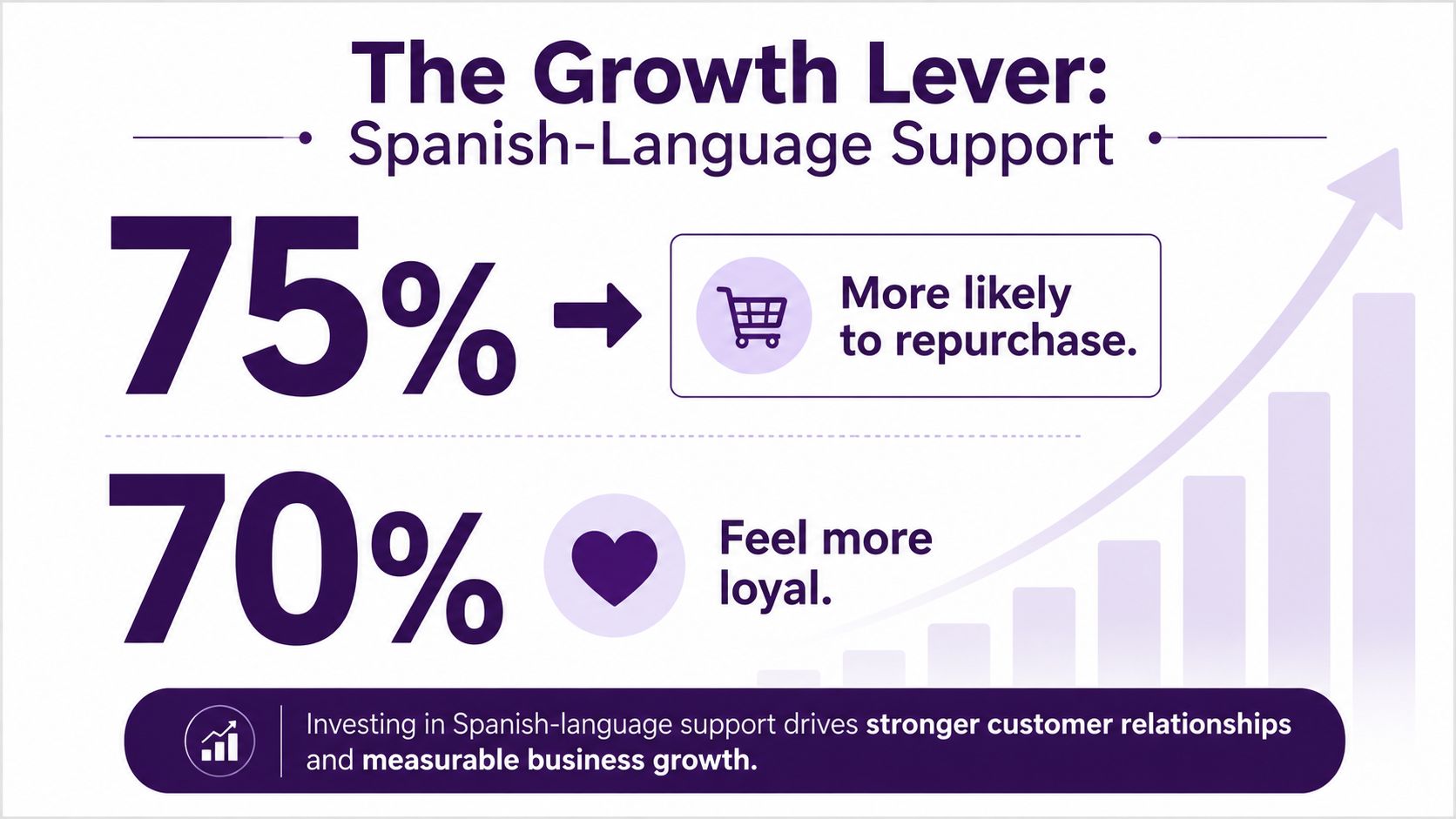
Customer service in Spanish is no longer a courtesy layer. A 2026 bilingual customer-service study found that 75% of consumers are more likely to repurchase from brands that offer native-language support, and 70% feel more loyal to those companies study. If you sell into the U.S. or Latin America, that’s a retention decision, not a translation project.
Why Spanish-Language Support Is Now a Growth Lever
The strongest reason to invest in Spanish support is simple, native-language care changes buying behavior. That 2026 study found 75% of consumers are more likely to repurchase when brands offer native-language customer care, and 70% feel more loyal to those companies study. That’s the kind of signal operators should care about, because loyalty shows up in repeat purchase, lower complaint friction, and better lifetime value.
This isn’t only about customers with weak English. The same study said the preference holds across demographics, which is why Spanish support matters in large mixed-language markets, not just in niche segments study. For brands selling across North America, the message is blunt: if Spanish-speaking customers can’t get clean, natural support, you’re creating a retention leak you’ll feel in revenue later.
The sectors that feel it first
Telecom, healthcare, finance, retail, and e-commerce feel the impact fastest because the service relationship keeps going. A small change in loyalty in those categories compounds over many contacts, renewals, and purchases. If your business has recurring interactions, Spanish coverage is part of the commercial model, not a soft brand gesture.
A useful way to think about it is this. English-only support can still function as a cost center. Spanish support is a growth lever when it keeps customers from leaving and gives them fewer reasons to shop around.
For teams mapping a more advanced operating model, multi-language support with AI is worth reviewing because it shows how language coverage and automation are increasingly designed together, not separately. That matters if you’re planning staffing, routing, and escalation around bilingual volume.
And if you need a practical starting point for Spanish coverage, CallZent’s English-Spanish support page is a direct reference point for how nearshore teams package bilingual service for North American brands.
**Takeaway: language coverage is a measurable retention lever, not a feel-good add-on.
What Customer Service in Spanish Really Means
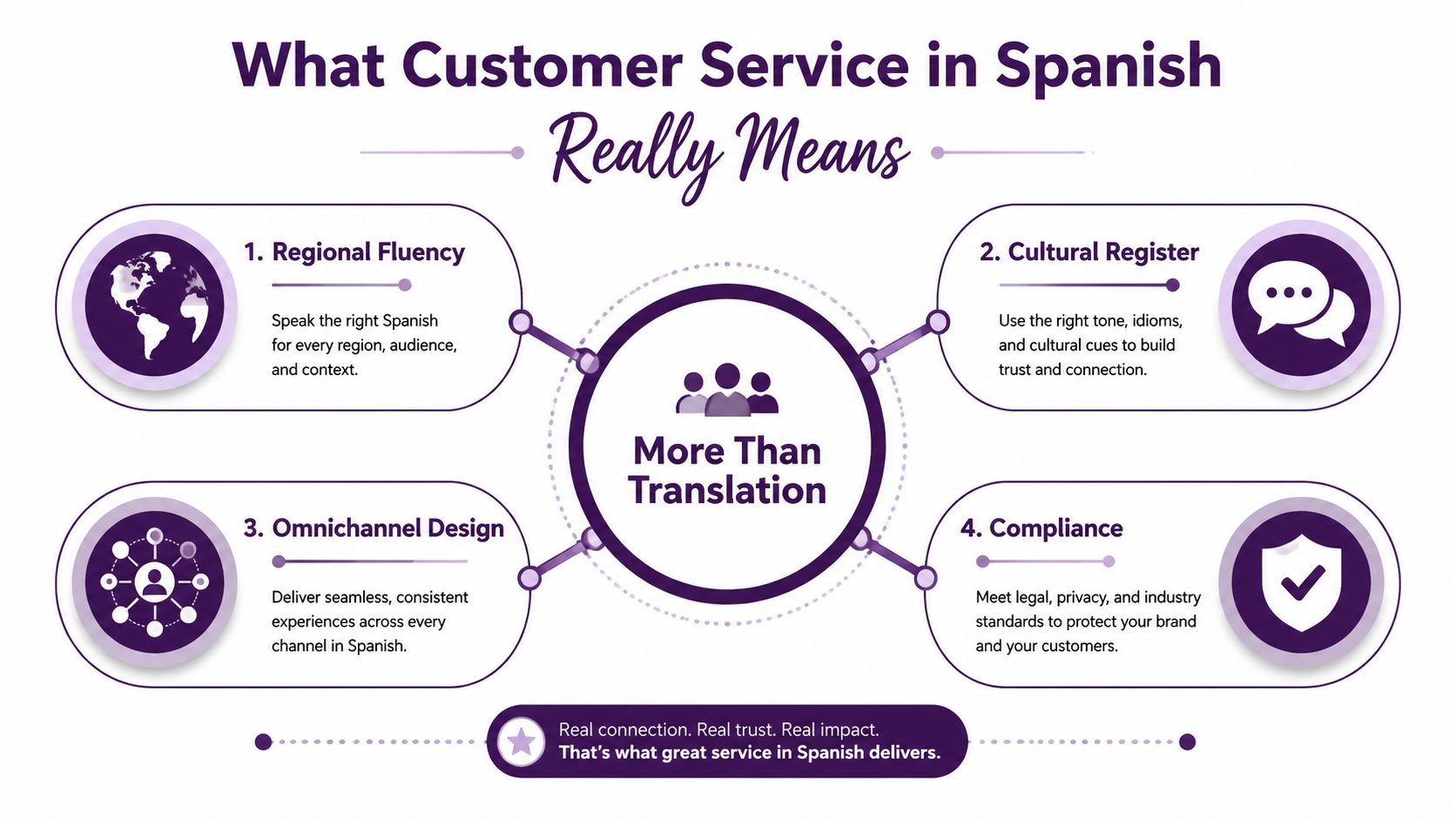
Customer service in Spanish is an operating model, not a translation job. It combines language, regional variant, service style, and channel design. If you only translate English scripts word for word, you usually get something technically correct and operationally weak. Customers hear that immediately, and your team pays for it in repeat contacts, lower first-contact resolution, and weaker satisfaction.
Language and region are not the same thing
Spain uses atención al cliente more naturally, while Latin America more often uses servicio al cliente source. Both are understood widely, but they do not land the same way. The wrong phrase can make a brand sound imported, too formal, or off-key.
Tone is a separate decision from grammar. A script can be correct and still sound stiff if the team uses the wrong register. Independent language-training guidance notes that even fluent bilingual staff can struggle with specialized customer-facing wording, which is why simple language and culturally competent communication matter more than memorized sentence fragments guidance.
A bilingual team is not enough. The team has to sound like it belongs in the market it serves.
A working definition you can use internally
Use this definition in an RFP or ops brief. Customer service in Spanish means a support model that delivers regional Spanish fluency, the right level of formality, channel-appropriate escalation, and compliant access to a human agent. It is not just “support in Spanish.” It is support that feels native to the customer’s market and still meets service standards.
That is why the difference between tú and usted matters, and why Spain vs. Mexico vs. broader Latin America should never be treated as one copy deck. The right choice depends on audience, brand voice, and the channel itself.
For a broader service benchmark, CallZent’s what defines excellent customer service resource is a useful internal anchor because it frames quality as an operating standard, not a slogan.
The Business Case Across Key Industries
Spanish coverage hits different industries in different ways, but the pattern is the same. When customers can talk to you comfortably, they stay longer, complain less, and move through the process with less friction. The 2026 bilingual study’s loyalty finding matters most where service is frequent and the relationship is long study.
Where Spanish support moves the needle
Healthcare depends on clarity. If patients can confirm appointments, ask follow-up questions, and understand next steps in Spanish, you reduce avoidable confusion across the care journey. Finance is even more sensitive, because trust, dispute resolution, and collections all break down faster when the customer doesn’t feel understood.
Retail and e-commerce are more immediate. Spanish support can protect conversion when shoppers need help before checkout, and it can support repeat purchase after the order lands. Telecom and insurance live in the churn zone, where one bad interaction can trigger cancellation, policy confusion, or a transfer to a competitor.
Operational access matters too. Examples from major providers in Spain show 24/7, low-friction phone access with multilingual coverage, which is a strong signal that Spanish queues should be staffed like a primary service line, not a fallback coverage example. That model is useful for North American brands serving mixed-language customers across time zones.
Spanish Support Priorities by Industry
| Industry | Primary Outcome | Leading Channel Mix | Spanish Coverage Priority |
|---|---|---|---|
| Healthcare | Appointment adherence and clearer patient communication | Phone, callback, secure messaging | High, with human escalation and clear follow-up |
| Financial Services | Trust, dispute handling, and payment support | Phone, email, secure digital channels | High, with fast identity and issue resolution |
| Retail | Cart conversion and repeat purchase | Phone, chat, email | Medium to high, especially during sales peaks |
| Telecom | Churn reduction and service continuity | Phone, IVR, chat | High, with strong queue management |
| E-commerce | Checkout support and post-purchase retention | Chat, phone, email | High, with fast first-response handling |
If you’re evaluating outsourcing options by category, CallZent’s top industries for nearshore outsourcing page is a practical fit because it lines up industry needs with service design, not just staffing.
Choosing the Right Regional Spanish for Your Market
Brands lose trust fast when they treat “Spanish” as one universal setting. It is not. The right choice is Spain Spanish, Mexican Spanish, or a pan-Latin American neutral style, and the decision should follow your caller base, their location, and the tone your brand already uses across the customer journey.
The three choices that actually matter
If your customers are in Spain, local wording matters. That means atención al cliente, the right level of formality, and awareness that some regions may request support in co-official languages such as Catalan, Basque, or Galician under Spain’s customer-service rules law summary. If you serve the U.S. Hispanic market or Mexico-heavy audiences, Mexican Spanish is usually the safest default because it sounds natural to a broad audience without drifting too formal or too local.
For broader Latin America, neutral Spanish can work, but only if it still sounds human. Neutral should not mean flat. It should mean vocabulary choices that avoid regional friction while keeping warmth and clarity. That is the difference between scripts that get read and scripts that lower repeat contacts.
Tú or usted
Use usted when the brand needs respect, distance, or a more formal service posture. Use tú only when your brand voice is intentionally casual and the customer base expects it. If your team cannot explain that choice in one sentence, the script is not ready.
A practical rule helps here. If the customer is in Spain and your service category is regulated or sensitive, start formal. If the customer base is younger and your brand already uses conversational tone in English, a lighter register may fit, but it still needs review by a native speaker from the target market.
Practical rule: choose the regional variant before you write the script, not after the complaints arrive.
The fastest decision tree is simple. Is the market Spain, Mexico, or mixed Latin America. Does the customer expect formality or speed. Do you need co-official language support in any region. Answer those three questions first, and your Spanish support brief becomes much easier to execute. If you want a clean market-by-market reference, Spanish customer support by region lays out the regional differences without turning them into jargon.
Phrases and Scripts That Actually Work on the Phone
Good Spanish phone support sounds calm, direct, and human. The basics matter, but only if the team uses them in the right order and with the right tone. Training starts with the standard openings, which include “Buenos días”, “Buenas tardes”, “¿En qué le puedo ayudar?”, and “¿Me permite su nombre?” training guide.
A usable call flow
Start with a greeting, move into identification, then diagnose the problem. Don’t race to the fix before the customer knows you’ve heard the issue. In Spanish, that pacing matters because rushing can sound brusque even when the words are correct.
A clean Latin American version might sound like this.
Buenos días. ¿En qué le puedo ayudar?
¿Me permite su nombre, por favor?
Entiendo su preocupación. Voy a revisar esto con usted.
Gracias por su paciencia. Si necesito escalarlo, le aviso de inmediato.
A Spain-facing version can stay slightly more formal.
Buenos días. ¿En qué le puedo ayudar?
¿Me permite su nombre, por favor?
Comprendo su incidencia. Voy a revisarlo ahora mismo.
Si hace falta, le paso con un agente humano para resolverlo cuanto antes.
Tone beats memorization
The hard part is not vocabulary. It’s de-escalation. Simple language, teach-back, and culturally competent phrasing usually outperform stiff empathy scripts, especially when the customer is upset guidance. Agents should avoid over-apologizing for everything and instead acknowledge the issue, restate the problem clearly, and give the next step.
For a working script framework, CallZent’s call center script page is useful because it reinforces sequence, not just phrases.
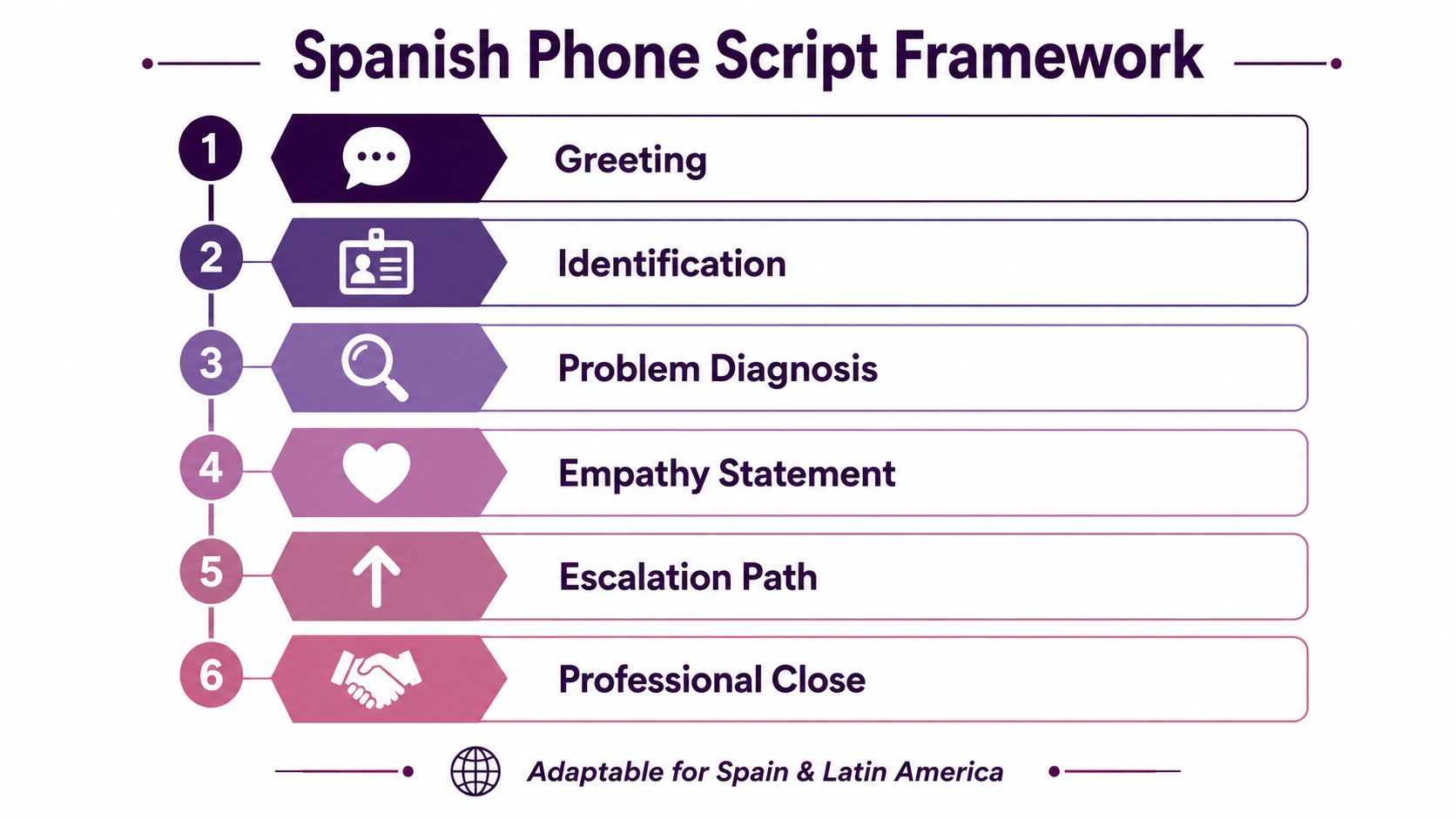
The goal is to sound human, not fluent. Fluency without warmth still feels cold on the phone.
Hiring and Training Bilingual Agents Who Sound Human
Hiring for Spanish support should start with sourcing, not just language testing. You want agents who bring native or near-native Spanish, real customer-facing experience, and enough emotional control to stay steady when the call gets messy. Language ability matters, but it’s not enough on its own.
What to screen for
Ask candidates to role-play a live service interaction in Spanish. Then check listening comprehension, not just speaking. A strong agent can hear a fast explanation, summarize it accurately, and choose the right tone without sounding scripted.
- Native or near-native Spanish: Look for natural phrasing, not just textbook correctness.
- Customer service background: Prior support experience usually shows up in pacing, patience, and problem-solving.
- Tone control under pressure: The best candidates can stay calm without sounding flat or robotic.
- Regional awareness: They should know whether they’re speaking to Spain, Mexico, or a mixed Latin American audience.
A simple 30-60-90 plan
The first 30 days should focus on region, tone, systems, and approved phrases. At 60 days, move into shadowing and guided role-play so the agent hears good calls before handling them alone. By 90 days, review quality using actual calls, not generic training quizzes.
That sequence works because it builds confidence in the right order. Product knowledge helps, but a bilingual agent who knows the product and sounds abrupt will still deliver weak CSAT. A warm, accurate agent usually outperforms a technically stronger one who freezes under pressure.
Operational rule: fluency without warmth still produces low CSAT.
For a training manager, the checklist is short. Confirm language fit, calibrate tone by market, coach call flow, review live QA, and keep correcting the same phrases until they sound natural. If the agent can’t de-escalate in Spanish, the training isn’t finished.
Tech Stack for Spanish-Ready Operations
A Spanish-ready operation doesn’t run on one tool. It runs on a connected stack where IVR, CRM, QA, and AI assistance all support the same goal, getting the customer to the right resolution path quickly. If those systems aren’t aligned, the agent has to do the work manually, which slows everything down.
Where the stack needs to connect
Spanish-language IVR menus should be simple and obvious. Language detection should route callers to the right queue without forcing them through long menu trees. CRM language tagging matters because it tells the next agent what tone, terminology, and region to expect before the call starts.
Spain’s 2026 customer-service survey found that 54% of companies already use AI tools in customer service, 73% say those tools have a positive impact, 41% are already investing in AI, and 46% plan to invest soon survey. That tells you something important. AI-assisted Spanish service is no longer an experiment. It’s becoming normal in serious operations.
There’s also a compliance line you can’t cross. Spain’s customer-service rules require a free, effective, and universally accessible channel, prohibit bots from being the only channel, and require customers to be able to request a human agent. The phone benchmark says 95% of personalized requests must be answered in under 3 minutes rules summary. That means automation has to shorten the path to a live Spanish-speaking agent, not trap the customer.
If you’re evaluating software that can assist bilingual workflows, AI-powered language translation solutions are worth comparing because the useful question isn’t “can it translate,” it’s “can it preserve speed, tone, and escalation quality.”
A practical stack checklist looks like this.
- Routing: Spanish calls go directly to trained agents.
- Language detection: The system tags the customer’s preferred language early.
- QA scorecards: Review empathy, accuracy, and resolution quality together.
- Agent assist: Give live Spanish prompts where they save time without flattening tone.
- Human escalation: Make the transfer visible, fast, and easy to request.
KPIs, Compliance, and When to Partner with a Nearshore Bilingual Center
Measure the Spanish queue on the numbers that matter, not on vanity metrics. Track CSAT in Spanish, first-contact resolution, average speed of answer against the 3-minute benchmark where it applies, escalation rate, and QA scores for empathy and accuracy. If those numbers don’t improve, the program is just costing more to sound polite.
Compliance also has to be built into the operating model. Customers need access to a human, channel design has to stay accessible, and Spain-specific language obligations can’t be handled as an afterthought.
If your internal team can’t staff Spanish 24/7 without burning out, partner before service quality drops.
That’s where nearshore makes sense. A bilingual center in Tijuana can give North American brands proximity, time-zone alignment, and English-Spanish fluency without the lag that usually shows up in offshore handoffs. CallZent is one option in that category, and its model fits brands that need Spanish support, cost control, and live-agent coverage without building everything in-house.
If you want a broader point of comparison on automation-led customer support, Andy’s transforming SMBs with conversational AI piece is useful because it helps leaders separate useful automation from noise.
The right model is the one that keeps Spanish support fast, human, and measurable.
🚀 Build Spanish Support That Feels Human
CallZent provides bilingual nearshore customer support, technical support, lead generation, and back-office services for brands that need Spanish service without losing control of quality or response time. If you’re building or fixing your Spanish queue, compare your current model against a team built for bilingual operations in North America.
Talk to an ExpertCallZent provides bilingual nearshore customer support, technical support, lead generation, and back-office services for brands that need Spanish service without losing control of quality or response time. If you’re building or fixing your Spanish queue, visit CallZent and compare your current model against a team built for bilingual operations in North America.