
Accounts Receivable and Revenue Recovery
Debt Collection Services: A Practical Guide to Recovering More Revenue
How to compare first-party, third-party, and nearshore collection models while protecting compliance, customer relationships, and net recovery.
TL;DR — Quick Takeaways
- Use first-party collection support when accounts are in early delinquency and preserving the customer relationship remains important.
- Licensed third-party collection agencies may be more appropriate for later-stage, charged-off, or difficult accounts.
- Measure recovery, right-party contact, kept promises, dispute resolution, complaints, and cost per recovered dollar—not call volume alone.
- Regulation F establishes important communication, validation, and telephone-frequency requirements for covered debt collectors.
- Digital channels and self-service payments can improve accessibility, but they require consent, suppression, privacy, and account-status controls.
- A bilingual nearshore team can support first-party reminders, payment conversations, documentation, and back-office workflows during U.S. business hours.
- Licensing and legal requirements vary by creditor, collector, debt type, communication method, and jurisdiction. Obtain qualified legal advice before launch.
A mid-market company can have healthy sales, full pipelines, and plenty of customers, yet still run short of cash because its invoices are aging faster than its accounts-receivable team can handle. The finance lead sees 60-day balances become 90-day balances, internal staff spend hours repeating unanswered reminders, and customer relationships deteriorate during increasingly awkward payment conversations.
Debt collection services should be treated as a revenue-recovery operation, not an administrative expense. The right operating model turns overdue accounts into a controlled workflow with clear contact rules, measurable recovery outcomes, and an escalation path that protects both cash flow and customer experience.
The market is already large enough to prove the point. One 2026 estimate values global debt collection services at USD 32.7 billion, with projected growth to USD 44.8 billion by 2036 at a 3.2% CAGR. The same source places U.S. industry estimates around $16.1 billion in annual revenue in 2026, while other estimates place the U.S. market near $15.2 billion in 2023. Fact.MR’s debt collection services market overview also describes a fragmented but durable sector serving healthcare, consumer credit, telecom, retail, and financial services.
When the Invoices Stop Getting Paid
A regional healthcare provider has a familiar problem. Its billing team still sends statements, answers patient questions, and handles new claims, but the overdue queue keeps growing. Accounts that once needed a courteous reminder now require research, repeated contact attempts, payment-plan discussions, and dispute resolution. The same two or three employees are expected to perform all of that work while maintaining normal operations.
That setup fails for a clear reason. Accounts receivable staff are optimized for billing continuity, not persistent recovery. They often lack dedicated skip-tracing workflows, contact-channel analytics, negotiation playbooks, and the compliance controls required for high-volume collection activity. By the time an account reaches the 90-day stage, the internal team may know the balance is real but no longer know whether the customer is reachable, disputing the charge, facing hardship, or just avoiding payment.
The economics become worse as balances age. Unpaid principal remains locked on the books, internal employees continue spending time on low-probability accounts, and management loses the cash that could fund inventory, payroll, marketing, or new equipment. A specialized operation treats each account as a sequence of decisions instead of another item on a spreadsheet.
Practical rule: If your AR team can identify overdue balances but can’t consistently verify the right party, resolve disputes, and convert contact into payment, you have a collections operating-model problem.
That doesn’t mean every account should go straight to an agency. A customer with a current commercial relationship may deserve a branded, relationship-preserving intervention first. A dormant consumer balance with failed contact attempts may need a different path. Businesses should document those distinctions in a collection policy and connect the policy to their accounts receivable management workflow.
The recovery baseline is also unforgiving. One industry summary says about 70% to 80% of delinquent debt placed with collectors is never recovered, with average recovery on placed debt often cited in the 20% to 30% range. Fact.MR’s market research links that limited recovery to the sector’s high-volume, recurring nature. The conclusion is blunt: outsourcing doesn’t make bad debt disappear, but it can prevent internal labor from becoming an additional unrecovered cost.
What Debt Collection Services Actually Include
Debt collection services cover the operational work required to move an overdue balance from identification to payment, settlement, dispute closure, or legal review. A buyer should evaluate the workflow, not just the agency’s brand or fee percentage.
First-party collections protect the relationship
First-party services operate under the creditor’s brand, usually before charge-off. The collector may use the same email domain, caller identification, payment portal, and customer-service standards as the original business. The tone is softer because the account may still be commercially valuable.
For example, an e-commerce company can send a branded payment reminder after a failed installment, offer a secure payment link, and route a customer who reports a fulfillment issue to support. The objective is to cure the balance without making the customer feel transferred to an outside agency.
Third-party collections handle harder placements
Third-party services operate under the agency’s name, commonly after internal efforts have failed or the account has been charged off. Contingency pricing is common in this model. The agency earns a percentage of recovered funds, so the buyer pays for performance rather than purchasing staff time.
A telecom provider might place aged balances with a licensed agency that verifies contact details, negotiates a settlement, records a promise to pay, and routes disputed accounts for validation review. Commercial B2B portfolios may use flat-fee or hybrid pricing when the buyer wants dedicated research, correspondence, or legal preparation.
Core deliverables vary by portfolio
A credible statement of work should specify whether the provider handles:
- Skip tracing and right-party verification: Locate updated contact information and confirm that the person reached is authorized to discuss the account.
- Omnichannel outreach: Coordinate voice, SMS, email, letters, and payment-portal prompts instead of treating calls as the only tool.
- Dispute and validation handling: Capture disputes, suppress inappropriate outreach, and route documentation requests through a controlled process.
- Promise-to-pay management: Record the commitment, schedule follow-up, and distinguish kept promises from broken promises.
- Settlement negotiation: Apply approved authority limits rather than letting every agent improvise.
- Legal escalation routing: Package qualified accounts for counsel after compliance, documentation, and economic checks.
Buyers with difficult location work should also understand the difference between skip tracing and formal tracing. A resource on UK tracing agents can help clarify how professional tracing differs from ordinary contact attempts, particularly when a debtor’s information has changed.
| Collection Service Models Compared | Brand Voice | Typical Pricing | Best Fit |
|---|---|---|---|
| First-party, pre-charge-off | Creditor’s brand | Flat fee or hybrid | Active customers, early delinquency, retention-sensitive accounts |
| Third-party, post-charge-off | Agency’s brand | Contingency | Aged consumer balances and difficult placements |
| Hybrid | Shared operating model | Mixed structure | Businesses balancing control, volume, and specialized capacity |
Before launch, make the service boundaries explicit. CallZent’s guide to handling debt collection calls is useful for aligning scripts, escalation rules, and agent behavior with the buyer’s customer-experience standards.
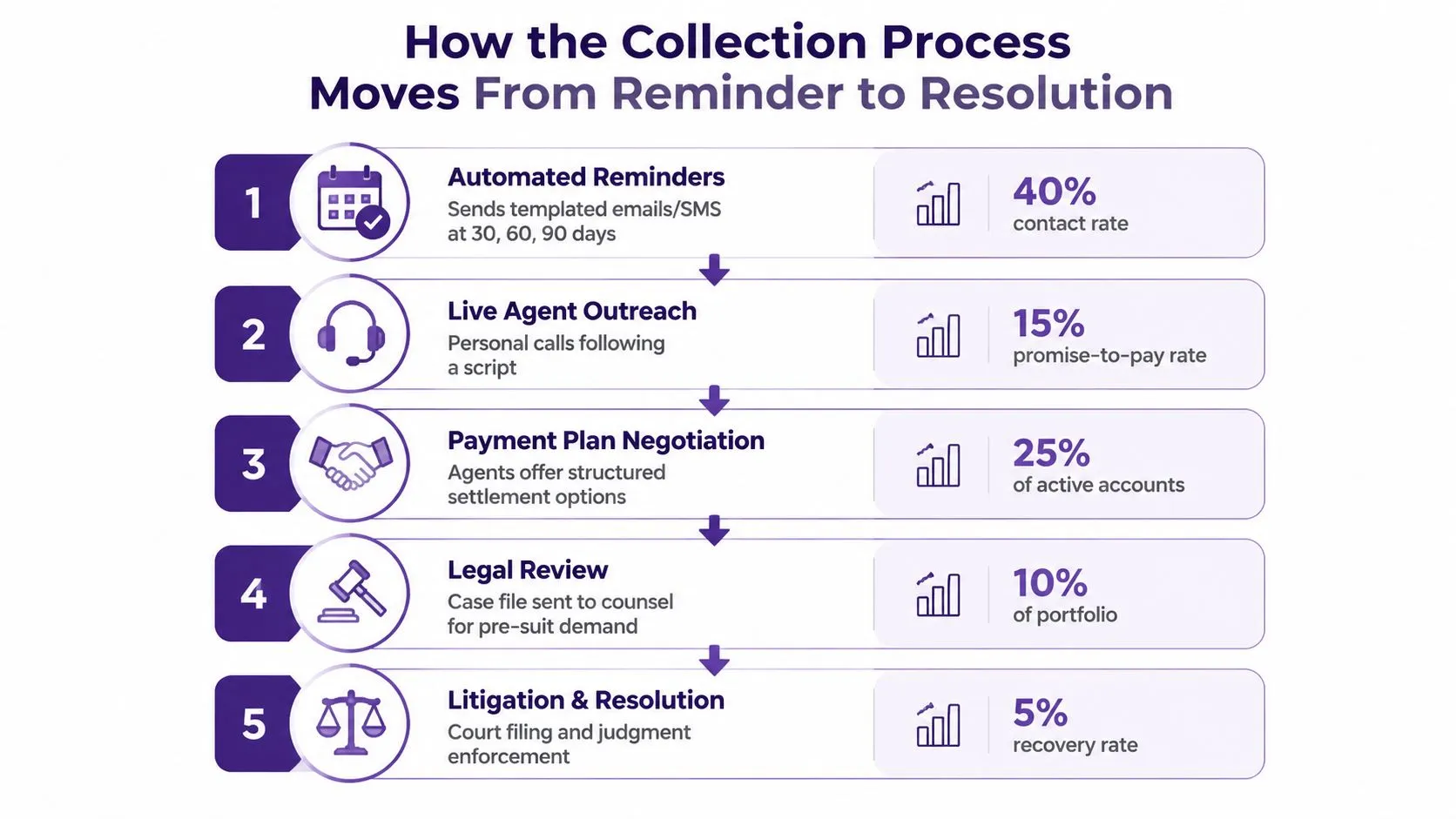
How the Collection Process Moves From Reminder to Resolution
A collection workflow should measure what changes on an account, not how busy the team appears. “Calls made” is an activity metric. A cured account, verified contact, kept promise, or recovered dollar is an operating result.
Start with low-friction payment access
The first stage uses automated reminders and self-service payment prompts. The message should state the balance clearly, provide a legitimate payment path, and make it easy for the customer to ask a question or dispute the account. The useful output is the cure rate within the early collection window, not the number of messages sent.
Digital-first outreach has a measurable advantage. Experian reports that delinquent customers who preferred digital contact were up to 30% more likely to make a payment when collectors used digital channels. It also reports that 73% of consumers contacted digitally made at least a partial payment, compared with 50% through traditional channels, and links digital-first programs to a 25% increase in resolution of accounts more than 30 days past due and a 15% reduction in collections cost. Experian’s debt collection techniques research supports using channel preference as a segmentation variable, not a cosmetic feature.
Add agents when the account needs context
Agent-led SMS and email outreach should answer questions, confirm the right party, and convert interest into a promise to pay. Track right-party-contact rate and promise-to-pay conversion, then examine whether promises are kept.
Live voice belongs later in the sequence for accounts that require negotiation, partial settlement, or a more personal explanation. Measure dollars recovered per call hour, because an agent who spends time on unreachable accounts can look productive while generating little cash.
Escalate selectively
Legal review should be a controlled exception, not the automatic final step. Counsel needs a complete file, validation history, contact record, balance support, and a clear assessment of whether expected recovery justifies legal cost. Litigation yield must be measured net of legal expense, not as a gross judgment total.
The biggest operational lever is the handoff between stages. A customer who responds to SMS shouldn’t be called repeatedly by a separate queue. A disputed account shouldn’t continue through automated reminders. CallZent’s collection call scripts guide can support script design, but the scripts only work when the CRM, dialer, payment system, and suppression logic share the same account status.
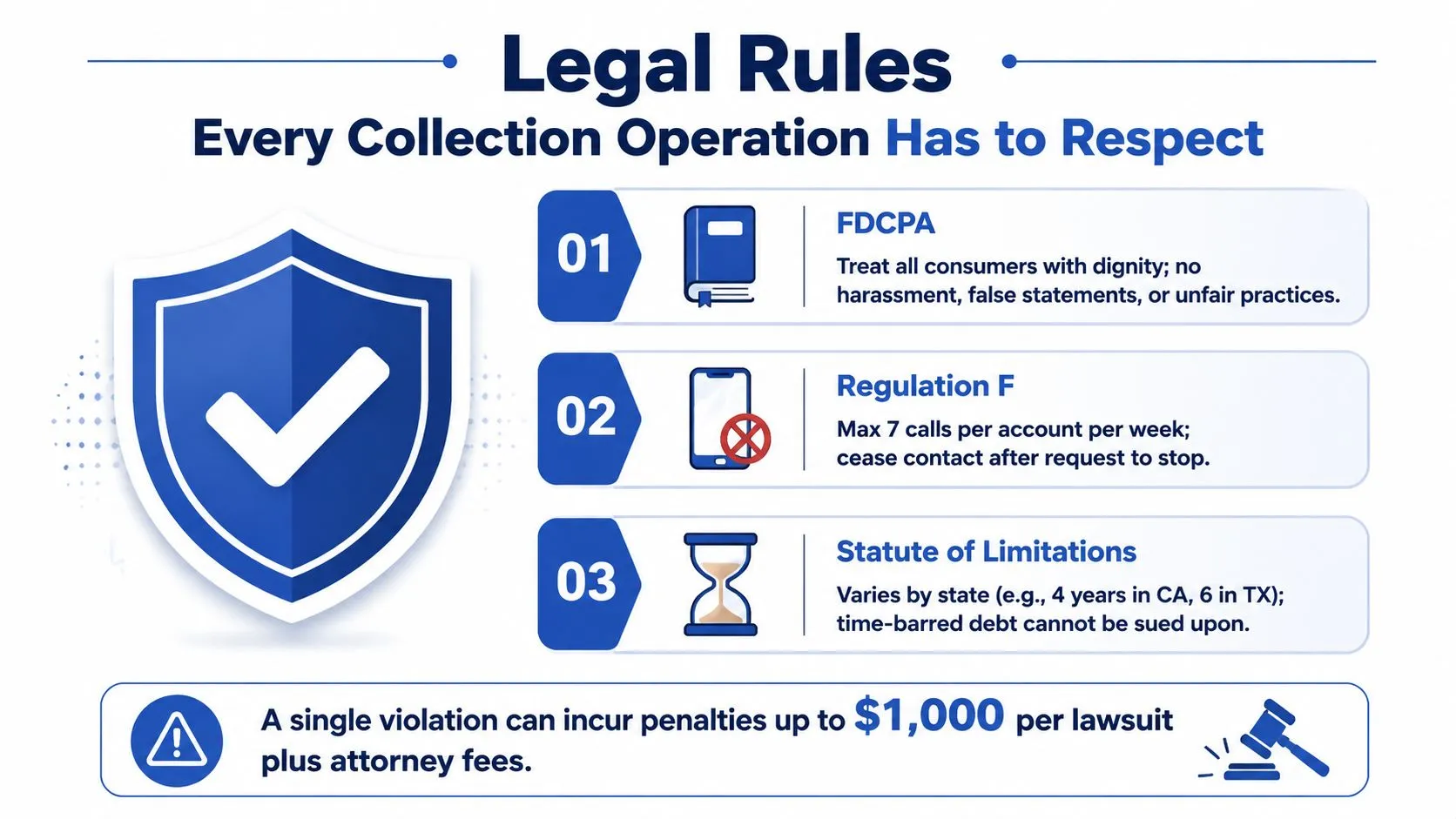
Legal Rules Every Collection Operation Has to Respect
Compliance belongs inside the workflow. The Fair Debt Collection Practices Act took effect in 1977 and remains a foundational U.S. consumer-protection law governing what collectors can say, when they can contact consumers, and how they handle disputes. The CFPB’s 2023 annual report describes a U.S. third-party debt collection market of about $17.9 billion, with roughly 133,000 employees across more than 6,300 collection agencies, so a small control failure can propagate across a large operation. The CFPB’s FDCPA annual report shows why compliance needs staffing, training, monitoring, and executive ownership.
Control contact frequency
Regulation F presumes a violation when a collector places more than seven telephone calls to a particular person about a particular debt within seven consecutive days, or calls within seven days after a telephone conversation about that debt. The system should count attempts across agents, queues, vendors, and callback activity.
Collectors also generally can’t call between 9 p.m. and 8 a.m., reveal a debt to unauthorized third parties, or use a family member or workplace contact to expose the account. The FTC’s FDCPA guidance explains these restrictions. A call-cadence engine, suppression-list scrubbing, and clear third-party verification should be mandatory controls.
Handle disputes before chasing payment
Collectors must provide validation information within five days of first contact, according to CFPB consumer guidance. Consumers can request limits on particular communication methods, and written disputes trigger operational obligations that should stop inappropriate collection activity until the account is reviewed. The FTC’s debt collection FAQ provides practical consumer-facing guidance on contact, validation, and dispute rights.
State rules complicate the picture. The CFPB source cited above notes 50 state-specific statute-of-limitations regimes, ranging from 3 to 10 years. A national operation should map the governing state before outreach, account for time-barred debt, and obtain legal review when acknowledgment or payment activity could affect the analysis. Healthcare, financial, and mobile-contact portfolios also need privacy, payment, and consent controls appropriate to the account type.
For a consumer who is navigating insolvency, collectors should keep the broader financial context in mind. A plain-language resource on bankruptcy’s impact on credit score can help explain why a collection conversation shouldn’t make unsupported promises about credit outcomes.
CallZent’s debt collection laws by state guide can serve as a starting point for state mapping, but serious buyers should still require attorney review, documented training, call-recording audits, and a process for updating rules when jurisdictions change.
The Numbers That Tell You If a Provider Is Performing
A provider can make impressive claims while recovering little net cash. Judge performance through three layers: contactability, conversion, and compliance.
The 2024 UK benchmarking survey from MaxContact reported a mean right-party-contact rate of 26%, a mean debt-collected rate of 32%, and a mean first-contact-resolution rate of 42.83% across debt collection contact centers. The 2024 UK collections benchmarking analysis is not a universal target for every U.S. portfolio, but it provides a useful warning: if the provider can’t reach the right person, downstream recovery will remain constrained regardless of outbound volume.
Measure the whole economic chain
Contactability metrics should include right-party contact, channel reach, invalid-number rate, and the percentage of accounts with a verified communication preference. Conversion metrics should show recovery as a share of placed balances, payment promises, kept promises, settlement outcomes, and dollars collected per account.
Compliance metrics need equal visibility. Track validation completion, disputes by channel, complaints per account population, call-cadence exceptions, and audit results. A provider that recovers money while generating unresolved complaints is shifting cost into legal and reputational exposure.
| Debt Collection KPI Benchmarks by Channel Mix | Voice-Only | Blended, Voice plus SMS and Email | Digital-First with Self-Service |
|---|---|---|---|
| Right-party-contact reference | Mean 26% across the cited UK benchmark | Measure separately by channel and portfolio | Track verified digital engagement and payment-session completion |
| First-contact resolution reference | Mean 42.83% across the cited UK benchmark | Compare against repeat-contact volume | Measure self-service resolution and agent exceptions |
| Debt-collected reference | Mean 32% across the cited UK benchmark | Break out by account age and channel entry | Compare partial-payment and cure outcomes |
| Cost view | Agent time and dialing expense | Cost by successful channel transition | Technology, payment, and exception-handling cost |
The most important KPI is cost per recovered dollar, calculated after commissions, technology, payment processing, internal oversight, dispute handling, and compliance work. CallZent’s performance benchmarking resource can help buyers build a reporting framework that separates leading indicators from month-end recovery totals.
In-House, Third-Party, or a Nearshore Hybrid
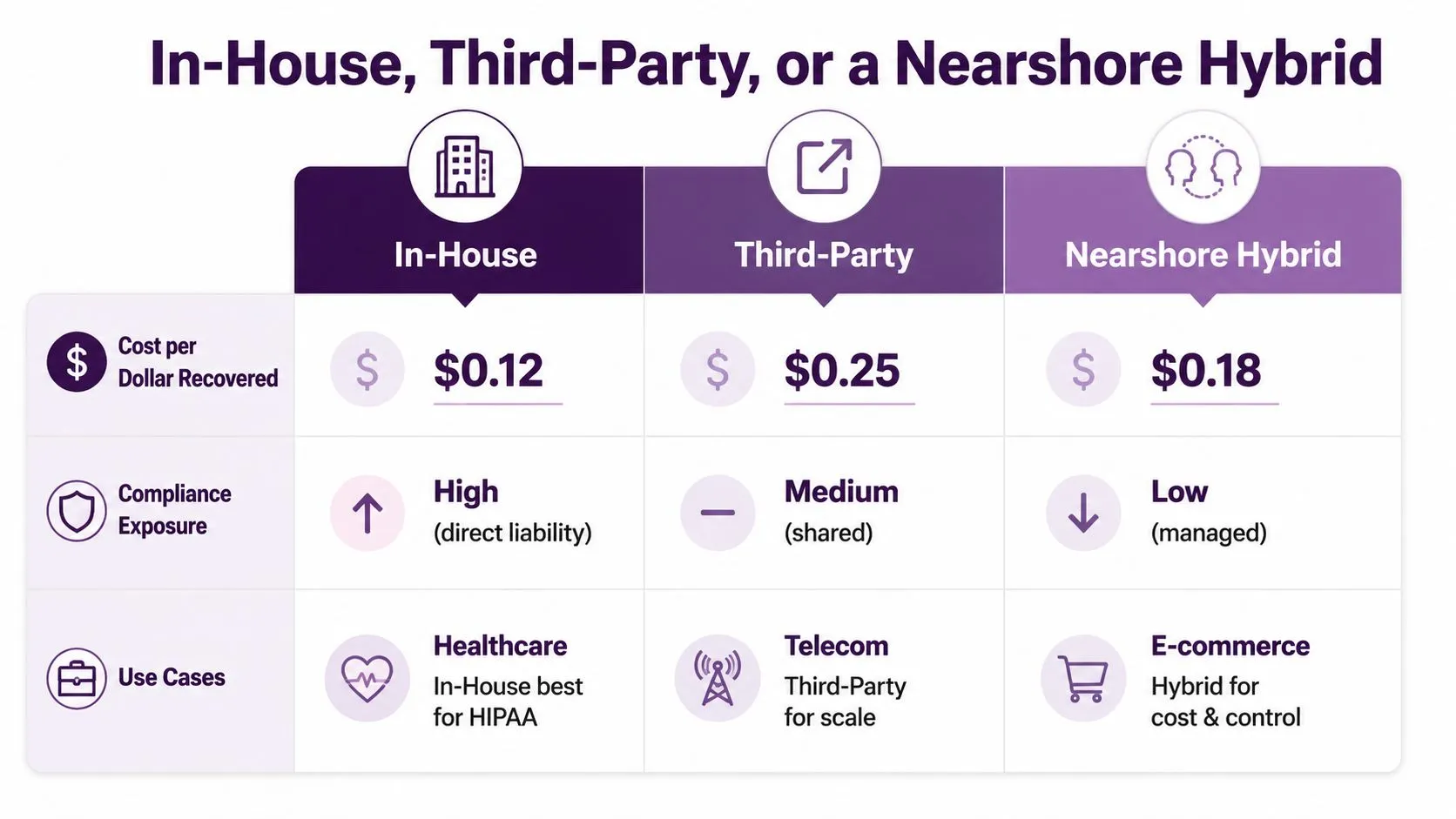
The right model depends on the portfolio, not the buyer’s preference for keeping every function internal. Healthcare, telecom, and e-commerce create different combinations of volume, sensitivity, seasonality, language needs, and compliance exposure.
In-house works when control matters most
A regional hospital system with 60,000 self-pay accounts and only two AR clerks has an in-house fatigue problem. The staff may understand the organization’s patient policies, but legacy software and competing billing work can make systematic outreach impossible. In-house collection cost is often estimated at $0.18 to $0.28 per dollar recovered, but that figure should include supervision, technology, training, absence coverage, dispute handling, and compliance administration, not just wages.
The advantage is direct brand control. The drawback is concentration risk. One absent employee, broken workflow, or poorly documented call can affect the entire queue.
Third-party contingency fits volatile volume
A mid-market telecom carrier with $40 million in aged receivables may not want permanent headcount for seasonal surges. A third-party agency can absorb placements under a contingency structure, but the buyer must account for the commission as a direct reduction of recovered cash. Domestic contingency pricing commonly falls around 25% to 35% of gross recoveries in the operating scenario described here, so the contract should show net proceeds by portfolio vintage and balance type.
This model is fast to deploy, but the carrier gives up some control over customer experience and may face weaker language coverage.
Nearshore hybrid balances control and capacity
A cross-border e-commerce brand serving Spanish-speaking customers in Texas, Florida, and California may lose recoveries when its outreach remains monolingual. A nearshore hybrid keeps strategy, data ownership, approvals, and sensitive escalations with the buyer while adding bilingual agents for live contact and digital follow-up.
The model can reduce per-collected-dollar expense relative to fully domestic third-party delivery, but only when governance is disciplined. Require access controls, documented scripts, state-by-state rules, quality monitoring, complaint escalation, and clear data-deletion procedures.
| Model | Cost per Dollar Recovered | Compliance Exposure | Strongest Use Case |
|---|---|---|---|
| In-house | $0.18 to $0.28 in the operating scenario | Direct liability | Sensitive healthcare relationships |
| Domestic third-party contingency | 25% to 35% of gross recoveries in the operating scenario | Shared operational exposure, buyer remains accountable for oversight | Telecom scale and variable placements |
| Nearshore hybrid | Evaluate against internal and domestic net cost | Managed through vendor governance | E-commerce, bilingual outreach, and flexible capacity |
That comparison should be treated as a decision framework, not a promise. The buyer’s actual result depends on account age, data quality, contactability, payment options, and the provider’s ability to follow state and federal rules.
Why a Bilingual Nearshore Partner Changes the Math
Language coverage changes more than customer comfort. It affects whether an agent reaches the right person, whether the customer understands the balance, and whether a payment arrangement is realistic. For portfolios with a substantial Spanish-speaking population, a monolingual script can turn a reachable account into an unresolved account.
Nearshore delivery adds a practical advantage because teams in Mexico, Colombia, and Central America can work within U.S. business-hour patterns while remaining closer to the buyer’s operating culture than a distant offshore queue. That proximity supports faster calibration when the buyer changes a settlement policy, payment flow, dispute rule, or escalation threshold.
Compare the full delivery model
Don’t evaluate bilingual capacity only by hourly labor cost. A lower seat rate is irrelevant if the provider creates excessive transfers, poor documentation, missed callbacks, or compliance exceptions. The buyer should compare total cost per recovered dollar, verified-contact quality, bilingual resolution, payment completion, and audit performance.
| Cost and Recovery Comparison, U.S. Bilingual vs. Nearshore Bilingual Collections | U.S. Bilingual In-House | Nearshore Bilingual, CallZent | Offshore Bilingual |
|---|---|---|---|
| Coverage model | Direct employee coverage | Nearshore BPO capacity aligned to U.S. operations | Remote delivery with greater distance from buyer |
| Language value | Strong when recruiting succeeds | English and Spanish delivery can be embedded in the workflow | Quality depends heavily on training and supervision |
| Cost lens | Salary, benefits, management, and hiring friction | Contracted capacity and governance cost | Lower labor cost may be offset by coordination and quality risk |
| Best operational fit | Stable, specialized internal portfolios | Variable volume and bilingual consumer outreach | Highly standardized work with strong oversight |
A credible partner should bring more than agents. Ask about training on FDCPA and Regulation F, access controls, payment security, recording governance, quality assurance, complaint handling, and integration with the buyer’s CRM and payment systems.
CallZent operates as a bilingual nearshore call center and BPO in Tijuana, offering inbound and outbound support that includes payment reminders and debt collection workflows. For a buyer considering this model, the relevant question isn’t whether a nearshore team sounds efficient. It’s whether the partner can prove controlled contact pacing, bilingual quality, accurate dispositioning, and transparent net-recovery reporting.
Nearshore delivery isn’t automatically right for every account. Healthcare and financial services may require careful data-governance review, while highly time-sensitive payment flows need tested integrations. The model wins when the buyer needs flexible capacity, English and Spanish coverage, and closer operational alignment without building a permanent internal team.
Evaluating Providers and Next Steps With CallZent
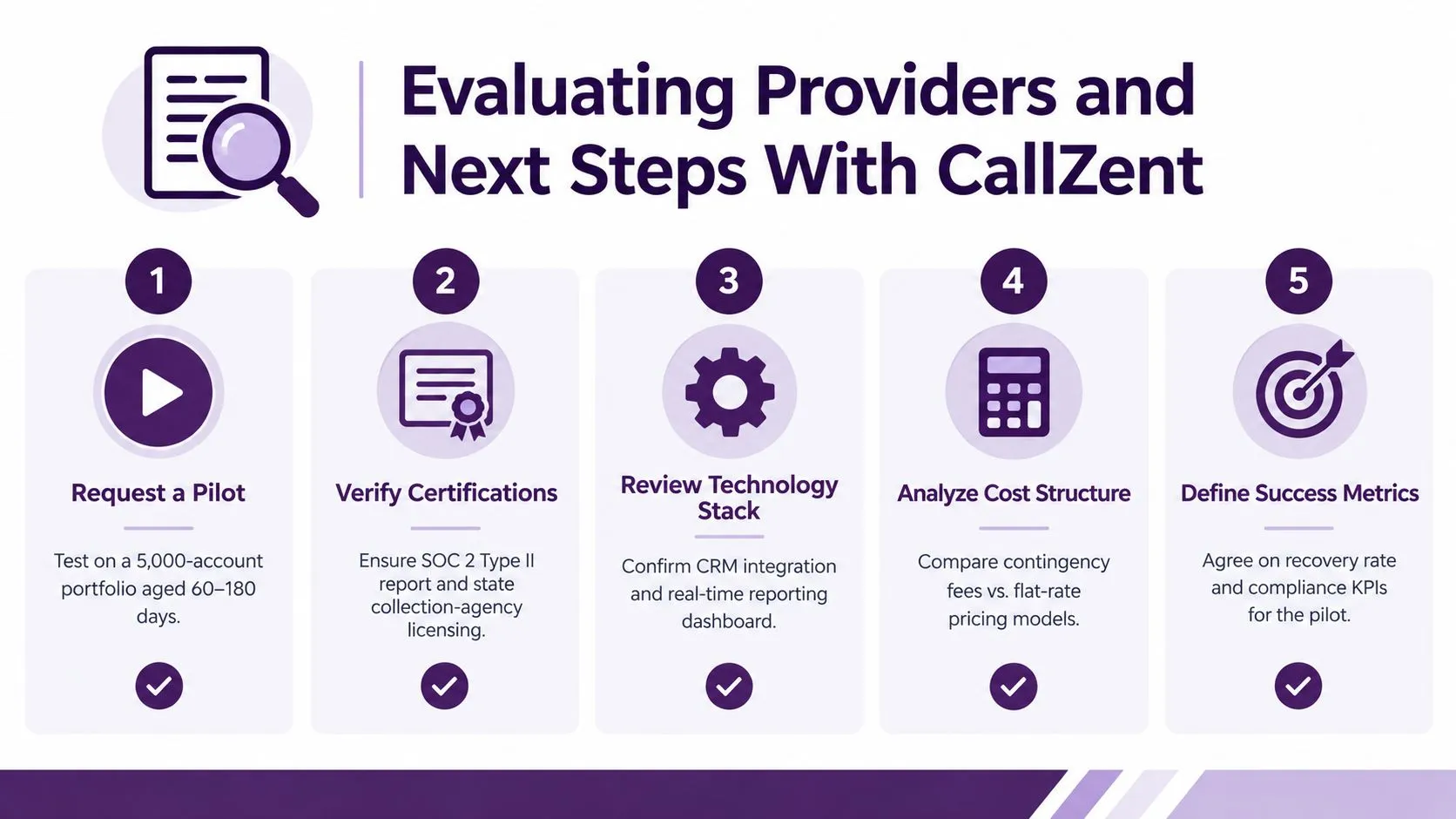
Procurement should begin with a controlled test, not a long contract. Request a pilot using a 5,000-account portfolio aged 60 to 180 days, then define the reporting, compliance, escalation, and payment rules before accounts are transferred.
Use a hard screening checklist
- Pilot design: Require account segmentation, contact-channel testing, payment handling, dispute routing, and a defined review gate.
- Licensing and assurance: Verify state collection-agency licensing in each obligor’s jurisdiction and request the provider’s SOC 2 Type II documentation when applicable.
- Call quality: Audit recordings for required disclosures, identity verification, respectful language, contact-frequency controls, and accurate dispositions.
- Reporting depth: Demand recovery and right-party-contact reporting by channel, account vintage, balance type, language, and outcome.
- Commercial alignment: Compare contingency, flat-fee, and hybrid structures using net cost per recovered dollar.
Reject providers that offer only flat-fee activity without performance accountability, can’t document consent and suppression-list controls, or operate outside the customer’s practical business hours. Also review adjacent automation costs separately. If your team is comparing the social commerce automation cost of another vendor, use the same discipline here: define the outcome, identify the recurring operating cost, and calculate the effect on net cash recovered.
CallZent can be evaluated as one nearshore option for bilingual payment reminders, outbound collection support, and back-office workflow management. A 30-minute scoping call should cover portfolio age, account volume, states involved, languages required, current contact channels, payment infrastructure, escalation rules, and the KPIs that determine whether a pilot continues.
Build a More Controlled Payment-Recovery Workflow
CallZent provides bilingual nearshore support from Mexico for approved payment reminders, inbound account assistance, customer service, documentation, and back-office workflows. Scope a program around your portfolio, systems, legal requirements, and recovery objectives.
Talk to an ExpertCallZent provides bilingual nearshore call center and BPO support for payment reminders, debt collection, customer service, and back-office operations, with English and Spanish coverage from Tijuana. Visit CallZent to scope your portfolio, compare an in-house or third-party model with a governed nearshore hybrid, and plan a pilot around measurable recovery and compliance outcomes.