
Ecommerce Operations
Boost Growth with Ecommerce Virtual Assistants for Scalable Support
Running an ecommerce business shouldn’t feel like constant firefighting. Here’s how virtual assistants create structure, reduce operational pressure, and unlock growth.
Running an online store can feel less like building a business and more like clearing a queue that refills every hour. Orders need updates. Customers want answers now. Returns pile up. Product pages need fixes. Marketing tasks sit half-finished because support work keeps pulling attention back to the inbox.
That’s usually the point where founders start asking the wrong question. They ask, “Do I need help?” The key question is, “What kind of help removes operational pressure without creating more management work?”
Are You Running Your Ecommerce Store or Is It Running You
A familiar pattern shows up in growing ecommerce brands. Sales increase, but the founder’s day gets worse. More orders create more tracking requests. More customers create more tickets. More products create more listing errors, return requests, and inventory headaches. Growth starts to feel messy instead of exciting.
A lot of owners try to solve this by hiring ad hoc support for isolated tasks. One person answers emails. Another helps with listings. Someone else schedules posts. That can work for a while, but it often turns into fragmented operations with no clear accountability.
The reason ecommerce virtual assistants have moved into the mainstream is simple. They sit right where the pressure builds. According to VA market statistics for 2025, the global virtual assistant market is projected to grow from $6.1 billion in 2024 to nearly $19 billion by 2029, with a CAGR of over 27%. The same source notes that 72% of ecommerce VAs handle customer service tasks and businesses report up to 78% savings in operating costs compared to full-time hires.
That shift matters because support is rarely just support in ecommerce. A delayed reply affects conversion. A slow return process affects repeat purchases. A product page update delayed by two days affects revenue.
Many founders start by looking for one person to “help out.” The better move is to build an operating layer that keeps the store moving while leadership focuses on assortment, pricing, retention, and acquisition. If you’re also reviewing broader strategies to increase ecommerce sales, a VA strategy belongs in that conversation because execution breaks down fast when customer-facing work has no owner.
Practical rule: If the founder is still handling routine order questions, refund approvals, and chat overflow, the business doesn’t have a staffing problem. It has an operating model problem.
For brands that want customer support to become more organized instead of more chaotic, it helps to start with a structured customer support approach for ecommerce rather than treating every ticket as a separate fire.
Executive Summary Your Quick Guide to Ecommerce VAs
Ecommerce virtual assistants are remote professionals who support the daily operations of an online store. They’re not limited to admin work. In a well-run setup, they handle repeatable tasks that directly affect customer experience, order flow, and team capacity.
Where ecommerce virtual assistants usually fit
- Customer support work like replying to email tickets, live chat questions, social media messages, and order status requests
- Store operations such as product updates, return processing, refund workflows, and inventory-related coordination
- Marketing support including social scheduling, inbox cleanup, list management, and campaign preparation
- Back-office tasks like reporting, spreadsheet updates, tagging conversations, and documenting recurring issues
What makes the role valuable
A strong ecommerce VA doesn’t just “do tasks.” They reduce operational drag. They keep routine work from interrupting the people responsible for growth decisions.
When the model works best
This model fits brands that are dealing with rising ticket volume, inconsistent response coverage, or founders spending too much time inside Shopify, Gorgias, Klaviyo, or spreadsheets instead of running the business.
For smaller teams that need support without committing to in-house staffing, a virtual assistant for small business operations can create structure quickly if the role is defined well from the start.
What an Ecommerce Virtual Assistant Actually Does
The fastest way to misunderstand ecommerce virtual assistants is to think of them as generic helpers. In practice, the role is operational. The best VAs sit inside the store’s daily rhythm and own a specific slice of the workload.
This is what that usually looks like.
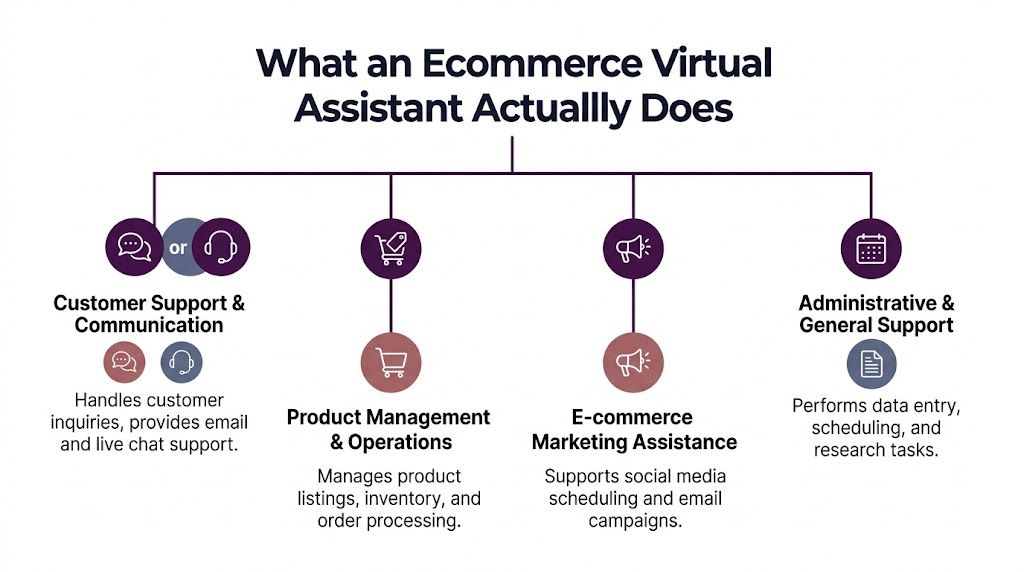
Customer support and communication
Given the obvious need, many brands start. The inbox is full, chat is inconsistent, and customers don’t care that the team is small.
Typical responsibilities include:
- Order status replies using Shopify, ShipStation, or the carrier portal to answer “Where is my order?”
- Return and exchange handling by checking policy eligibility, confirming product condition requirements, and issuing the next step
- Live chat coverage for product questions, shipping concerns, sizing guidance, or discount code confusion
- Social DM support for Instagram, Facebook, and TikTok messages that often sit between marketing and service
- Phone support for brands that still need voice coverage for urgent order issues or high-consideration products
A practical example: a VA can pull tracking details, confirm carrier movement, explain the delay in plain language, and tag the ticket correctly so the issue is visible in weekly review. That’s much more useful than copying a tracking link into an email.
Product management and store operations
A lot of ecommerce friction happens behind the scenes. Product pages need edits. New SKUs need setup. Inventory messages must stay accurate. Orders need review when something doesn’t sync correctly.
Common tasks include:
- Product listing updates for new variants, image swaps, title changes, or size chart edits
- Inventory checks when stock counts look off between Shopify and another system
- Order review for flagged transactions, duplicate orders, or address corrections
- Catalog cleanup when discontinued products still appear in collections or search
- Returns workflow support including status logging and internal notes
One of the easiest wins is assigning a VA to audit product pages before a launch. They can catch missing images, wrong variant names, outdated descriptions, or policy mismatches that would otherwise create support volume after launch.
Ecommerce marketing assistance
Not every brand needs a VA doing deep channel strategy. Many do need someone keeping the machine moving between campaign decisions.
That work can include:
- Social scheduling based on approved content calendars
- Basic email setup support such as segment prep, QA checks, and link validation in Klaviyo
- Promo coordination by updating banners, discount messaging, and homepage text
- Review monitoring so recurring complaints get routed to the right team
- Light content research for FAQs, competitor positioning, or product detail gaps
Operations and marketing often overlap. A VA might notice that customers keep asking the same question a campaign forgot to answer. That feedback loop is valuable.
Key takeaway: A good VA handles the tasks you can do, so you can focus on the tasks only you can do.
Administrative and back-office support
This category sounds less exciting, but it often creates the biggest time recovery for leadership.
Examples include:
- Ticket tagging and categorization so support trends are visible
- Spreadsheet maintenance for refunds, return reasons, vendor updates, or SKU tracking
- Calendar and meeting coordination across internal teams or suppliers
- Report prep for support reviews, product issues, or daily operational summaries
- Process documentation so repeat tasks stop living in one person’s head
One warning here: broad job descriptions create weak results. “Help with admin and ecommerce tasks” usually leads to confusion. Clear ownership works better. Assign channels, workflows, or outcomes.
If live chat is one of your biggest pressure points, it helps to match the VA role with the systems and workflows behind your live chat software for ecommerce so replies stay consistent instead of depending on whoever is online.
Hiring Your Ecommerce VA Comparing Your Options
There isn’t one hiring model for ecommerce virtual assistants. There are three common ones, and each solves a different problem. The mistake is choosing based only on hourly cost while ignoring management burden, time zone fit, and failure risk.
Here’s the practical comparison.
Hiring model comparison
| Criteria | Freelancer | Offshore Agency (e.g., Philippines) | Nearshore BPO (e.g., Tijuana, Mexico) |
|---|---|---|---|
| Cost position | Can be flexible, but varies widely by skill and availability | Often lower-cost than domestic hiring | Typically positioned between offshore and US-based hiring |
| Time zone overlap with North America | Depends entirely on the individual | Often limited for real-time collaboration | Strong overlap for same-day collaboration |
| Cultural alignment | Varies by person | Can require more calibration for tone and service style | Usually easier alignment with North American customer expectations |
| Management overhead | High. You manage training, QA, backups, and workflow design | Moderate. Agency may handle staffing, but quality control can still need close oversight | Lower when the BPO provides supervision, QA, and process support |
| Scalability | Limited by one person’s capacity | Better for adding seats | Better for building a structured team over time |
| Bilingual English-Spanish support | Possible, but not always easy to source consistently | Available in some cases | Strong fit for North American bilingual support needs |
| Single point of failure risk | High | Lower | Lower |
| Best use case | Narrow task ownership and founder-led management | Brands prioritizing low cost over proximity | Brands that need support, coverage, and operational coordination |
Where freelancers work well
Freelancers are a good fit when you already know the workflow, can train directly, and need one clearly defined function. For example, one person managing returns inboxes or updating product listings three times a week.
The downside is fragility. If that person gets sick, takes another client, or disappears, the process stops. The founder usually becomes the backup.
Where offshore agencies make sense
Traditional offshore agencies can help when coverage matters more than collaboration. They can be useful for high-volume repetitive workflows where scripts, shift coverage, and labor cost are the main priorities.
That said, ecommerce support often needs quick handoffs with marketing, fulfillment, and leadership. If your support team is asleep during your business day, that slows problem-solving. If you’re comparing recruiting approaches, this guide on how to hire your virtual assistant for ecom growth is a useful complement to the operating model discussion.
Why many brands move toward a BPO structure
A BPO model works better when you need more than labor. You need training consistency, supervision, and room to scale without rebuilding the team every quarter.
For brands dealing with support volume, returns, omnichannel service, and order-related complexity, ecommerce customer service outsourcing is often less about “outsourcing support” and more about installing an operating function that doesn’t depend on the founder.
The Nearshore Advantage Why Proximity and Bilingual Skills Matter
Nearshore support tends to get treated as a middle option between domestic and offshore. That misses the point. For North American ecommerce brands, nearshore is often the operating model that fits the work best.
According to research on virtual assistants for ecommerce operations, nearshore bilingual virtual assistants from locations like Tijuana offer 30 to 50% lower costs than US VAs, with superior cultural alignment and minimal time zone overlap. The same source notes they can reduce customer response times by up to 40% compared to Asian offshore options, which matters for the US-Hispanic market growing at 15% annually.
Why time zone overlap changes the day
A lot of ecommerce issues can’t wait for tomorrow. A promo launches with the wrong shipping message. A return policy update wasn’t reflected in macros. Customers start asking the same product question across chat and email at the same time.
When your support team is working during your day, those problems get fixed while they’re still small. Managers can review live conversations, approve a revised response, and push updates into the queue immediately.
That’s a practical difference, not a theoretical one.
Why bilingual coverage is more than translation
Serving English and Spanish customers well isn’t just about language matching. It’s about tone, context, and confidence. Customers can tell when a reply was translated awkwardly or written by someone who doesn’t understand how they shop, how they ask questions, or what concerns matter most.
A nearshore bilingual team is especially useful for brands in categories like fashion, beauty, home goods, supplements, and consumer services, where pre-purchase questions drive conversion. If a shopper asks about sizing, shipping, ingredients, compatibility, or return terms in Spanish, the quality of that answer affects whether the order happens at all.
Response quality improves when the agent understands the customer’s language and buying context, not just the script.
A real-world operating example
Take a fashion retailer selling across the US with a meaningful Spanish-speaking customer base. During a seasonal campaign, the chat queue spikes with sizing questions, shipping cutoffs, and return policy concerns. A freelancer may handle one channel well but miss overflow elsewhere. A traditional offshore team may cover volume but require slower same-day escalation on campaign changes.
A nearshore BPO team can split chat, email, and order support in real time, handle both English and Spanish inquiries, and escalate issue patterns during the same business day. That’s not just support coverage. It’s smoother conversion support and cleaner feedback to the brand team.
For North American businesses evaluating partner fit, why companies choose CallZent outlines one example of a nearshore bilingual model based in Tijuana with support and back-office capabilities.
Onboarding Your VA for Success A Practical Checklist
Most ecommerce VA problems start before the first shift. The role is vague, access is messy, and nobody has written down the process the assistant is supposed to follow. Then the owner concludes the hire “didn’t work.”
Good onboarding is less about motivation and more about clarity.

Start with process, not passwords
Before granting access to Shopify, Gorgias, Klaviyo, Loop, or your help desk, document the workflows the VA will own. Keep it simple. Short written SOPs beat long verbal explanations every time.
A useful starter checklist:
- List the recurring tasks the VA will handle in week one
- Record the steps in plain language with screenshots where needed
- Note decision rules such as when the VA can resolve an issue and when it must be escalated
- Add brand tone guidance so customer replies sound consistent
- Store SOPs centrally in Notion, Google Drive, or your internal wiki
Sample SOP structure for an order refund process
Use a short format like this:
-
Trigger
Customer requests a refund through email or chat -
Check first
Confirm order number, purchase date, delivery status, and refund eligibility under current policy -
If approved
Process refund in the platform, update the ticket, notify the customer, and tag the reason -
If not approved
Send the approved policy explanation and escalate if the customer disputes the outcome -
Log required
Record refund reason and any product issue that needs review
That kind of structure removes hesitation.
Set up secure access correctly
Remote support doesn’t have to mean loose security. Problems usually come from shared logins and uncontrolled permissions.
Use this standard:
- Staff accounts only for Shopify, help desk tools, and ESPs
- Role-based permissions so the VA can access what they need and nothing more
- Password managers instead of sending credentials in chat or email
- Two-factor authentication where available
- Signed NDAs and access policies before live work begins
Operations note: If a login can’t be revoked cleanly, the access setup isn’t ready.
Build a communication rhythm
A strong assistant still needs a management cadence. Not constant supervision. Clear rhythms.
A practical setup looks like this:
- Daily check-in on Slack or Teams for queue priorities, blockers, and urgent product issues
- Weekly review covering ticket quality, recurring customer questions, and process fixes
- Escalation lane for refunds, fraud concerns, policy exceptions, or inventory mismatches
- Shared dashboard or tracker for open issues that need cross-team follow-up
Define success in the first month
Don’t expect a new VA to master every workflow immediately. Start with narrow ownership and expand.
Good first-month goals are usually qualitative:
- Consistent handling of one or two support channels
- Accurate use of macros, tags, and SOPs
- Clean escalation on edge cases
- Reliable attendance and communication
- Fewer interruptions to the founder or operations manager
That’s the right early benchmark. Stability first, then speed.
Measuring Success KPIs and Cost of an Ecommerce Virtual Assistant
If you can’t measure the role, you’ll end up judging it by mood. One busy week will feel like failure even if the assistant is doing solid work. A better approach is to track a small set of operational KPIs tied to the function they own.

Customer service KPIs
For support-heavy roles, measure quality and speed together.
- First response time to see how quickly customers get an initial reply
- Resolution quality based on QA review, not just closure speed
- CSAT or post-support feedback if you already collect it
- Reopen rate to catch replies that appear finished but don’t solve the issue
- Escalation accuracy so the VA knows what they should handle and what needs review
If you need a more detailed framework for service metrics, these customer service KPIs provide a useful lens for support teams.
Operations and store management KPIs
For back-office and order-flow support, accuracy matters more than speed alone.
Track items like:
- Order processing accuracy
- Return and refund handling consistency
- Product update accuracy
- Internal documentation quality
- Follow-through on flagged issues
A VA who works fast but creates avoidable rework is expensive, even if their rate looks low.
Cost should be judged with structure, not just price
The cheapest option on paper often costs more in supervision, QA, missed coverage, and founder involvement. Many ecommerce teams get misled because of this.
Use a simple decision lens:
| What to compare | Why it matters |
|---|---|
| Direct labor cost | The visible line item, but not the full picture |
| Training time required | A role that needs constant retraining drains management capacity |
| Coverage reliability | One absent freelancer can stall a full workflow |
| Quality oversight | If you must review everything, the leverage is low |
| Scalability | Expanding from one assistant to a small team should not require a full rebuild |
Don’t ask only, “What does this VA cost?” Ask, “What does it cost to manage this model well?”
That’s the more accurate ROI question. In ecommerce, the role pays off when it protects response quality, shortens operational lag, and removes work from the people responsible for growth.
The Future is Proactive AI-Augmented Ecommerce VAs
The next phase for ecommerce virtual assistants isn’t just doing tickets faster. It’s using AI tools to spot patterns before they become bigger problems.
According to analysis of AI-augmented ecommerce VAs, the next evolution of the role is training VAs as trend scouts who use predictive tools to identify stock needs and customer query patterns. That source notes this can potentially boost revenue by 30% and help firms preempt stock-outs, an issue affecting 25% of US e-tailers in 2025-2026.
What this looks like in practice
A reactive VA answers the same product question fifty times. A proactive VA notices the pattern, categorizes it, and flags the root issue.
For example, if chat transcripts show repeated confusion around sizing for one apparel item, the VA can surface that trend to the ecommerce manager. The team can then update the size guide, adjust the product description, revise a macro, and potentially reduce future returns and pre-purchase hesitation.
That’s a better use of labor and a smarter use of data.
The role is changing from task support to signal detection
The strongest teams now train assistants to work with tools that summarize chats, tag issue clusters, and highlight operational anomalies. The VA still handles execution, but they also become an early warning layer across service, merchandising, and inventory.
That shift matters most for smaller ecommerce teams. They usually don’t have a full analyst, a CX operations lead, and a dedicated inventory planner. A well-trained VA using AI support can help close some of that gap.
The stereotype is outdated. Ecommerce VAs aren’t limited to data entry when the workflow gives them visibility and the tools give them context.
The important part is governance. AI should support judgment, not replace it. A smart assistant uses pattern detection to improve decisions, then a human owner or manager decides what changes to make.
Frequently Asked Questions About Ecommerce Virtual Assistants
What’s the difference between a general VA and an ecommerce VA
A general VA usually handles broad admin work like calendar management, inbox cleanup, research, and scheduling. An ecommerce VA works inside store-specific workflows. That includes tools like Shopify, help desks, return platforms, fulfillment coordination, product catalog updates, and customer support tied to orders and policies.
How do I keep store data secure with a remote assistant
Use staff accounts, role-based access, and a password manager. Don’t share master credentials over email or chat. Add NDAs, define access rules before onboarding, and remove permissions quickly if the role changes. Secure setup matters more than whether the assistant is remote.
Can one VA do everything in an ecommerce business
Usually not well. One person can handle a focused set of tasks, especially in a smaller store, but trying to make one assistant own support, catalog management, social media, reporting, and fulfillment coordination often creates inconsistency. Start with the highest-friction workflows, then expand responsibility or move to a team model if volume grows.
Should I hire a freelancer or work with a BPO partner
It depends on complexity. A freelancer can work well for narrow, stable tasks with direct founder oversight. A BPO partner fits better when you need coverage, QA, backup staffing, bilingual service, or the ability to scale without rebuilding the process each time.
How long does it take for an ecommerce VA to become productive
That depends on process quality. If SOPs, access, escalation rules, and communication rhythms are already in place, productivity comes much faster. If everything lives in someone’s head, the onboarding period gets longer and quality will be less consistent.
Scale Your Ecommerce Operations Without the Chaos
CallZent helps ecommerce brands build structured, bilingual support teams that reduce workload and improve customer experience.
Get Started with CallZentIf your store is growing but daily operations keep pulling you away from strategy, it may be time to rethink how support is structured. CallZent provides bilingual nearshore customer support, back-office services, and virtual assistant solutions for North American businesses that need scalable ecommerce operations without adding unnecessary management overhead.