
Inbound Customer Support
How to Handle Inbound Calls With Confidence and Speed
A practical guide to smarter routing, CRM context, bilingual escalation, call scripts, meaningful KPIs, and human-centered AI.
At 9 AM, a billing queue can move from manageable to chaotic before a supervisor sees the dashboard. Customers wait, agents search for account details, transfers multiply, and callers repeat information they already gave the IVR. By the time leadership notices the abandonment rate, customer satisfaction has already taken the hit.
The answer to how to handle inbound calls isn’t a better greeting alone. It’s a call path designed to move the right customer to the right resource with the right context, then close the loop cleanly. This matters in nearshore bilingual operations, where language, time zones, account history, and escalation rules all affect whether the first agent can finish the job.
TL;DR — Quick Takeaways
- Treat inbound support as a complete operating system, not only an agent responsibility.
- Forecast predictable peaks and route callers by intent, urgency, skill, and language.
- Pass CRM context through every handoff and use warm transfers for complex issues.
- Measure first-call resolution alongside AHT, ASA, abandonment, CSAT, and service level.
- Use AI for routing, authentication, knowledge support, summaries, and after-call work.
- Keep humans responsible for empathy, exceptions, persuasion, and high-stakes decisions.
The Real Way to Handle Inbound Calls Starts Before Anyone Picks Up
A queue may look calm at 8:58 AM. A few minutes later, a campaign, billing reminder, service outage, or local business opening can send callers into the same line. A published 2026 benchmark reports that 78% of call centers experience peak call volumes between 9 AM and 11 AM local time, with volume during that period rising about 40% versus the rest of the day. The same benchmark says small businesses with 1 to 50 employees typically handle 50 to 75 inbound calls daily, while enterprise centers may process 5,000 to 15,000. Those figures are documented in this inbound call center benchmark.
The operational lesson is simple: staff and route for concentration, not just the daily average. A nearshore team should build schedules around known demand windows, reserve bilingual capacity for likely language needs, and make callback available before the queue becomes unmanageable. IVR prompts should collect useful intent without forcing callers through a long menu.
Build the First Ring Around Context
Most avoidable failures begin before the first agent says hello:
- Missing CRM data: The agent can’t see an order, prior ticket, payment status, or earlier escalation.
- Weak authentication design: The customer repeats security questions after already completing verification.
- Poor queue separation: A simple status request waits behind complex technical or insurance cases.
- No overflow plan: Supervisors react to abandonment only after callers have already left.
- Unclear language routing: A bilingual caller reaches an agent who can’t comfortably handle the full conversation.
A shared knowledge base supports this preparation. It gives agents one controlled source for policies, troubleshooting steps, exception rules, and approved language. Teams can use CallZent’s knowledge management resource to think through how information should be organized before it reaches the queue.
Design Seven Connected Stages
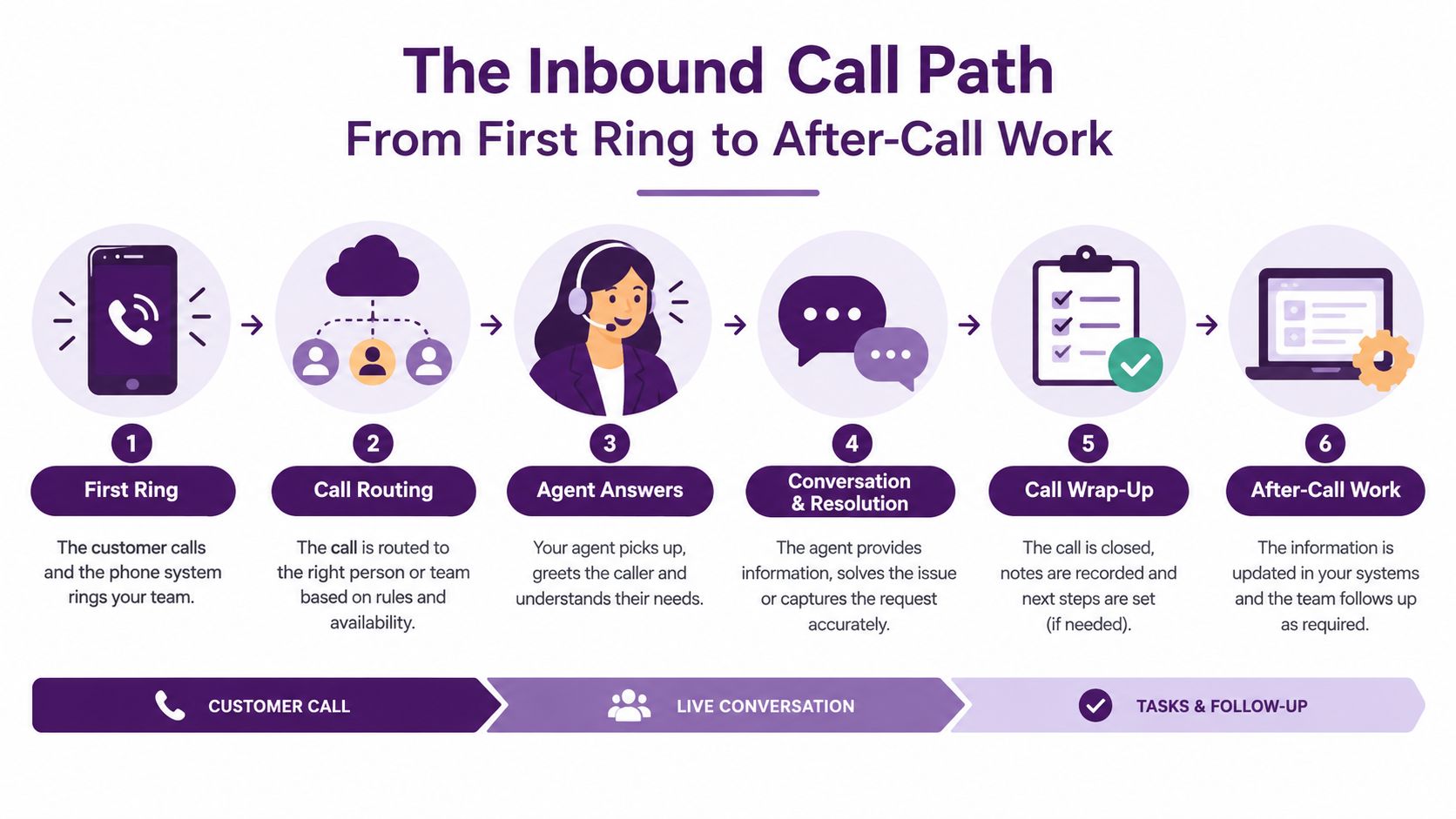
A reliable inbound operation prepares for the whole path:
- Greeting and caller orientation
- Identity verification
- Intent discovery
- Resolution or triage
- Hold or transfer
- Resolution confirmation
- After-call work
Each stage should reduce customer effort. If verification happens twice, the path is broken. If a transfer strips away the caller’s history, the path is broken. If wrap-up notes don’t tell the next person what happens next, the path is broken.
Key takeaway: The best way to handle inbound calls is to remove preventable work before it reaches the agent.
The Inbound Call Path From First Ring to After-Call Work
A call path works when every stage has a clear purpose and an owner. Agents shouldn’t improvise the basics, but they also shouldn’t sound like they’re reading a legal disclaimer.
Greeting and Verification
A practical opening can sound like this:
“Thank you for calling Northstar Support. This is Elena. May I have your name, and can we verify the account information so I can help you securely?”
The greeting identifies the business and agent, establishes a professional tone, and moves directly to the information needed to help. Once verification is complete, the CRM should show the account, recent contacts, open cases, and any relevant language preference.
Intent Discovery
The agent should identify the desired outcome, not merely record the caller’s first sentence.
Useful questions include:
- “What would you like to have resolved today?”
- “When did this issue begin?”
- “Have you already contacted us about it?”
- “Is there a deadline or service impact I should know about?”
One focused question often does more than a long checklist. The goal is to distinguish a simple request from a case requiring a specialist, supervisor, clinical reviewer, or legal team.
Resolution, Triage, and Routing
If the first agent has the authority and information to resolve the issue, they should do so. If not, the agent should explain the next step before placing the caller on hold or transferring them.
A routing platform can support this process by matching intent, skill, availability, priority, and language. CallZent’s call routing overview offers useful context for evaluating how those rules should work together.
Hold and Warm Transfer
A cold transfer sounds like, “Let me send you to another department.” It forces the caller to start over and gives the receiving agent no reason to trust the initial diagnosis.
A warm handoff is different:
“Maria, I’m connecting you with Daniel, our Spanish-speaking claims specialist. I’ve documented that the claim was denied, verified your policy, and noted that you’re calling about the treatment scheduled this week. Daniel has the case details and will continue from here.”
The receiving agent should hear the summary before the caller joins or while the caller remains connected. That single discipline prevents many callbacks and repeated explanations.
Resolution Confirmation and After-Call Work
Before closing, the agent should confirm the outcome:
“To make sure I’ve covered everything, we submitted the replacement request, your confirmation will go to the email on file, and the delivery team will contact you about the next step. Is there anything about that plan you’d like me to clarify?”
After the call, the agent records the issue, action taken, owner, promised timeline, and any escalation. Structured wrap-up codes are more useful than a long paragraph because they help supervisors identify repeat drivers and routing problems.
The Metrics That Actually Tell You How Calls Are Going
AHT is useful, but it’s a poor standalone goal. An agent can lower average handle time by rushing callers, skipping discovery, or transferring difficult cases. The queue may look efficient while repeat contacts and dissatisfaction rise.
Read the Measures as a Group
Average handle time, or AHT, includes talk time, hold time, and after-call work. Average speed of answer, or ASA, measures how long callers wait before an agent answers, excluding IVR and queue time. Abandonment rate shows how many callers leave before reaching an agent. First-call resolution, or FCR, measures whether the issue was resolved in the first interaction without a callback or transfer.
Service level connects speed and coverage. The common 80/20 benchmark means 80% of calls are answered within 20 seconds, as defined in this inbound call strategy guide. Use that benchmark as an operating reference, then adjust it to the complexity and urgency of your queue.
| Metric | Target benchmark | What movement signals |
|---|---|---|
| AHT | Set by intent and complexity | Rising AHT may indicate knowledge gaps, difficult tools, or incomplete routing. |
| ASA | Compare against your service-level commitment | A rising ASA usually points to staffing, scheduling, or queue-priority pressure. |
| Abandonment rate | Monitor alongside ASA and queue depth | Growth suggests callers are waiting too long or lack a useful callback option. |
| FCR | 70% to 79% is commonly described as good, while 80% or higher is considered world-class in FCR benchmark guidance. | Falling FCR often indicates misrouting, missing context, or weak agent authority. |
| CSAT | Compare by intent, language, and queue | A stable overall score can hide problems in one customer segment. |
| Service level | 80/20 is a common reference point | Misses during predictable peaks call for capacity or routing changes. |
A rising AHT with stable CSAT may indicate that agents are handling more complex cases correctly. A falling FCR with flat AHT points toward routing, knowledge, or transfer design rather than individual speed. Review queue-level trends weekly, not only a blended center average.
Use CallZent’s call center KPI resource to structure the dashboard around decisions, not vanity reporting. Every metric should answer a coaching or operating question.
Choosing the Right Routing Strategy for Your Call Mix
Routing is one of the strongest system-level levers because it determines who sees the caller first. The right approach depends on the balance between simple requests, complex cases, language needs, urgency, and available capacity.
| Routing style | Best call mix | Impact on FCR | Impact on abandonment | Watchouts |
|---|---|---|---|---|
| Short IVR and self-service | High volume of simple, predictable requests | Strong when the menu matches the actual intent | Can reduce queue pressure when callers complete tasks successfully | Long menus and vague options trap callers |
| Skill-based routing | Complex cases requiring product, language, or industry expertise | Strong when CRM context and authority follow the call | Can improve queue quality, but specialist queues may become constrained | Skill tags become unreliable if managers don’t maintain them |
| Callback | Queues with extended waits or concentrated demand | Depends on accurate intent capture and ownership | Gives callers an alternative to waiting live | A missed callback or vague window creates another contact |
A high-simple-call mix can support a short IVR that handles account status, appointment confirmation, or basic order information. Keep the tree shallow and offer an escape to an agent. Self-service that blocks access to a person creates frustration rather than efficiency.
A high-complexity mix needs skill-based routing connected to CRM context. Healthcare, insurance, telecom, and technical support callers often need a specialist who can make a decision, explain a policy, or access a system unavailable to generalists. Routing them by department alone isn’t enough. Include language, issue type, customer history, and urgency.
Callback becomes useful when ASA is stretched and the customer’s request can be classified accurately. Offer a predicted wait, preserve the original intent, and let the caller choose a practical contact window when the platform supports it.
The decision framework is straightforward:
- Classify the call: Identify intent, urgency, complexity, and preferred language.
- Map the queue: Check depth, service-level pressure, specialist availability, and open cases.
- Choose the least disruptive path: Use self-service for simple work, skill routing for complex work, and callback when waiting live adds no value.
Handling Tough Calls With Scripts, Empathy, and Clean Escalation
Scripts help most when they give agents a safe structure without forcing unnatural language. Tough calls require three things: name the problem, verify the facts, and make ownership visible.
An E-commerce Return Outside Policy
A customer calls after discovering that a return window has closed. The agent shouldn’t begin with a blunt policy refusal. A better opening is:
“I understand why you’re concerned. You expected to be able to return the item, and now the standard window has passed. Let me review the order and see what options are available.”
The agent verifies the order, purchase date, product condition, and reason for the return. If the policy allows no direct exception, the agent explains the rule in plain language and checks the approved exception path. Perhaps the issue involves a damaged product, a fulfillment error, or a documented delivery problem.
If a supervisor must decide, the agent should not just send the customer away. The agent summarizes the facts, transfers with context, and explains what the supervisor can review. The customer may still receive a no, but the process feels owned rather than dismissed.
This customer service empathy guidance belongs in training. Empathy doesn’t mean promising an exception. It means acknowledging the impact while staying accurate.
A Healthcare Insurance Escalation
A member calls about a denied claim and sounds frightened because treatment is scheduled soon. The first agent verifies identity, confirms the policy, checks the denial reason, and asks what decision or explanation the member needs today.
If the matter requires a Spanish-speaking specialist, the agent should explain the handoff rather than treating language support as a separate queue failure:
“I’m bringing in a Spanish-speaking claims specialist now. I’ll give them the denial details and the treatment date before they join, so you won’t need to repeat the situation.”
A suitable escalation model separates authority clearly:
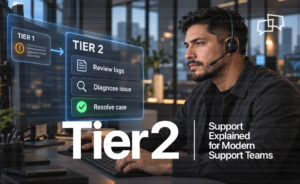
- Tier 1: General support, account access, routine status, and standard policy answers.
- Tier 2 specialist: Product, claims, technical, billing, or bilingual expertise.
- Supervisor: Exceptions, complaints, retention decisions, and unresolved service failures.
- Clinical or legal review: Matters requiring regulated expertise or formal interpretation.
The receiving person needs the customer’s identity status, intent, relevant history, action already taken, and requested outcome. That context protects the caller and shortens the path to a qualified decision.
Where AI Helps on Inbound Calls and Where It Backfires
Voice AI should reduce friction, not create a new obstacle between the caller and a capable human. Recent evidence supports a hybrid model. One 2025 study found that 60% of brands say their AI tools fall short, while only 22% have fully unified customer data. Another survey found 76% of Americans prefer businesses using branded calling, while 2026 consumer research reported that 84.9% prefer a human agent over an AI agent and 55% had escalated an AI-handled issue to a human. These findings are summarized in this inbound contact center overview.
Give AI Bounded Responsibilities
AI is well suited to repetitive, measurable work:
- Intent detection: Identify billing, technical support, scheduling, returns, or sales needs.
- Authentication support: Collect and validate routine information before connection.
- Account lookup: Surface recent orders, tickets, or appointment details.
- Knowledge suggestions: Present approved answers to agents during the conversation.
- Call summaries: Convert the conversation into structured notes and follow-up tasks.
- Language assistance: Support bilingual agents when the caller switches between English and Spanish.
For businesses exploring automated front-door coverage, intelligent call answering for businesses can help frame what an AI receptionist should and shouldn’t own.
Know the Failure Modes
AI backfires when it becomes a gatekeeper. Robotic prompts, inaccurate policy answers, dead-end self-service loops, and language detection that fails on accented English or code-switched Spanish all increase effort. A caller who says “I need help with a denied claim” shouldn’t be forced through a menu designed for payment balances.
Start with low-risk pilots:
- Automatic summaries with human review.
- Agent knowledge suggestions using approved content.
- Intent detection that recommends a queue without blocking a human.
- Authentication assistance for routine cases.
- Callback capture with clear ownership and confirmation.
Delay autonomous policy exceptions, high-stakes healthcare decisions, legal interpretation, and emotionally charged retention conversations until quality scores remain stable. The goal isn’t to remove the agent. It’s to give the agent fewer mechanical tasks and better context.
Teams evaluating this model can review CallZent’s conversational AI for customer support as part of a broader human and technology workflow.
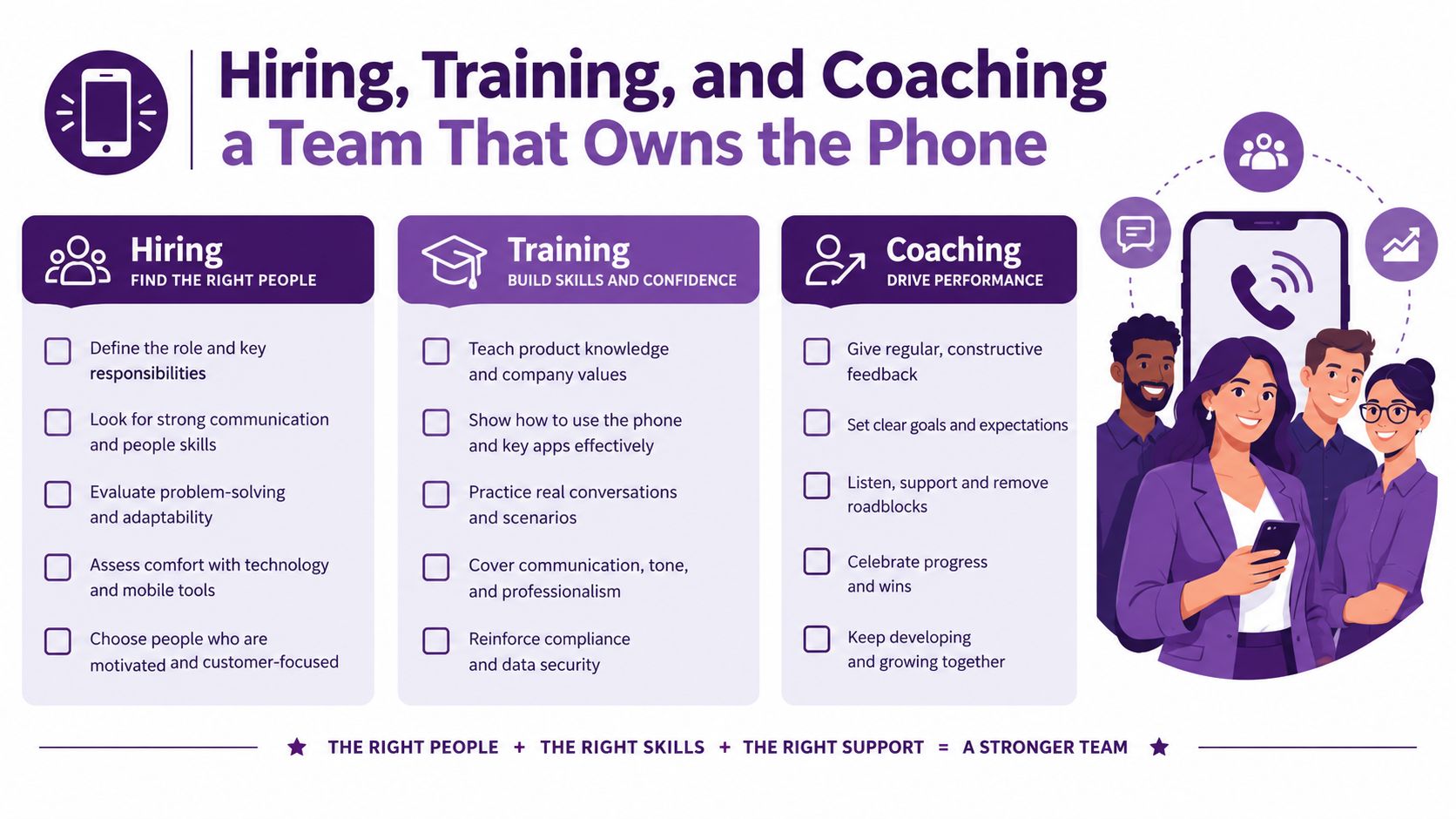
Hiring, Training, and Coaching a Team That Owns the Phone
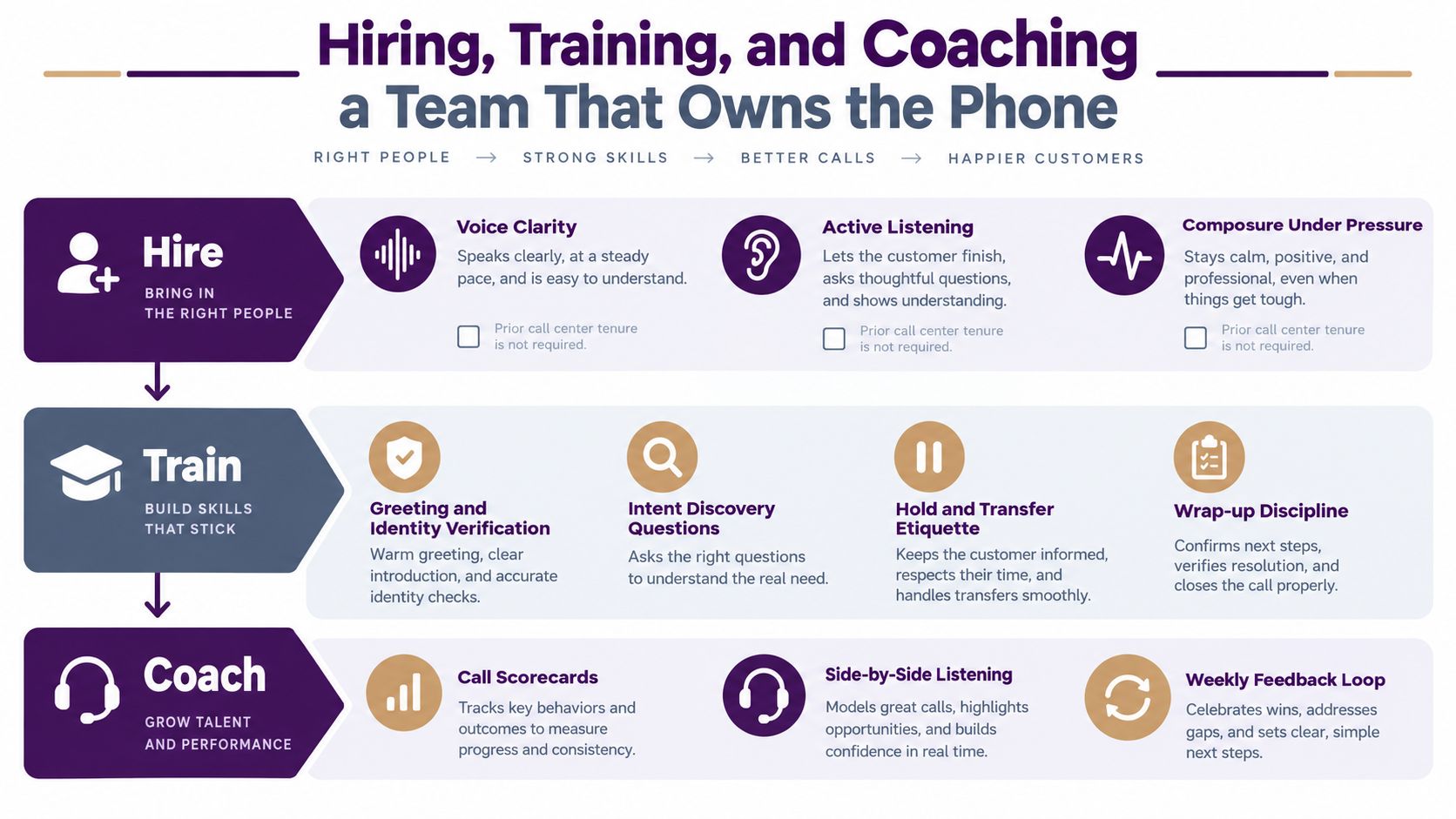
A strong call path needs people who can use judgment inside it. Hiring for prior call center tenure alone misses the qualities that customers hear immediately: clear speech, active listening, composure, curiosity, and the ability to explain a next step without overpromising.
For a bilingual queue, test real conversation in the second language. Written proficiency doesn’t prove that an agent can understand a worried caller, explain an unfamiliar policy, or switch languages without losing accuracy.
Build Training Around the Path
Use a 30-60-90 day structure:
- First 30 days: Learn systems, authentication, greeting standards, intent questions, knowledge resources, and escalation rules.
- Next 30 days: Shadow experienced agents, complete scored mock calls, practice English and Spanish handoffs, and review recorded interactions.
- Final 30 days: Move into graduated live-queue work with close QA calibration, targeted coaching, and clear authority limits.
Coach the call path, not just the agent’s tone. A friendly greeting can’t compensate for a missed verification step or an incomplete handoff.
Use a Focused Coaching Cadence
During the first coaching month, review two calls per agent per week against the seven stages:
- Did the agent establish the purpose of the call?
- Was authentication completed without unnecessary repetition?
- Did the agent identify the desired outcome?
- Was the routing decision appropriate?
- Did the transfer include CRM context?
- Did the agent confirm resolution and ownership?
- Are the wrap-up notes structured and actionable?
Pair those observations with AHT, FCR, ASA, abandonment, CSAT, and service-level movement. A low FCR pattern tied to one intent requires a process or knowledge fix. A high AHT pattern among new agents may call for practice and better tools, not pressure to rush.
A team lead can start tomorrow with this checklist:
- Define skills: List language, product, system, and escalation capabilities.
- Set the QA rubric: Score each stage of the call path consistently.
- Schedule side-by-side listening: Hear how agents discover intent and explain next steps.
- Document coaching notes: Record the behavior, impact, and agreed practice.
- Recalibrate monthly: Keep supervisors aligned on policy, scoring, and routing changes.
Operational rule: Hire for judgment, train for consistency, and coach the handoffs that customers usually experience as “starting over.”
Build a Better Inbound Call Experience
CallZent provides bilingual nearshore inbound call center and BPO support from Mexico, including live answering, customized scripts, call routing, customer service, technical support, and 24/7 phone coverage.
Talk to a CallZent Expert