

Expectation Management
How to Manage Expectations in BPO and Call Center Operations
Learn how to manage expectations in BPO and call center relationships by defining scope, confirming alignment, tracking milestones, escalating early, and protecting service quality.
TL;DR — Quick Takeaways
- Managing expectations in a BPO or call center is an operating discipline, not just a communication skill.
- Strong expectation management starts by defining the result, scope, timeline, quality level, constraints, and change path in writing.
- True alignment happens when the other party can restate the agreement in their own words.
- Teams should monitor milestones, track early warning signs, and escalate before the expectation gap becomes a service failure.
- The best BPO teams use frameworks, scripts, SLA language, and escalation paths to keep service promises realistic and measurable.
You’re on a client call, the scope sounds clear, everyone seems aligned, and then the first revision request lands with a very different interpretation of “done.” That gap is where projects slip, service teams get blamed, and good relationships turn tense fast. In a BPO or call center, how to manage expectations is not a soft skill, it’s an operating discipline that protects service quality, timelines, and trust.
TL;DR: Define the result, scope, timeline, quality level, and constraints in writing. Confirm understanding in the other party’s own words. Track milestones. Escalate early when reality changes. The businesses that do this well don’t just communicate better, they reduce avoidable friction and keep service promises realistic.
The High Cost of Unmet Expectations
A client signs off on a support launch with a clean timeline, a clear deliverable list, and a shared sense of momentum. Then the requests start drifting. One more channel. One more report. One more exception “just for this month.” By the time the team notices the pattern, the original commitment has been replaced by a moving target, and everyone is frustrated.
That’s the expectation gap, the difference between what people expect and what happens. Psychology Today frames it as a gap that’s best managed with process-oriented goals rather than outcome-only thinking, because expectations work better as adjustable forecasts than guarantees. In service delivery, that matters because the client judges the work against what was promised, not what was hoped for. Psychology Today’s explanation of the expectation gap
A churned account usually doesn’t start with one huge failure. It starts with a series of small misses, slow updates, unclear scope, or promises that were too loose to hold up under pressure. If you’re trying to build a healthier customer experience, reducing customer churn often begins with expectation control long before any support ticket is opened.
Practical rule: if the client can interpret the same promise in two different ways, the expectation is not managed yet.
The cost isn’t only financial. Unmanaged expectations create rework, damage credibility, and force your team into reactive mode. In a call center or BPO environment, that reactive mode spreads quickly, because service is judged in real time and one unclear promise can ripple across staffing, QA, and client satisfaction.
First Signs of Trouble How to Spot Expectation Gaps
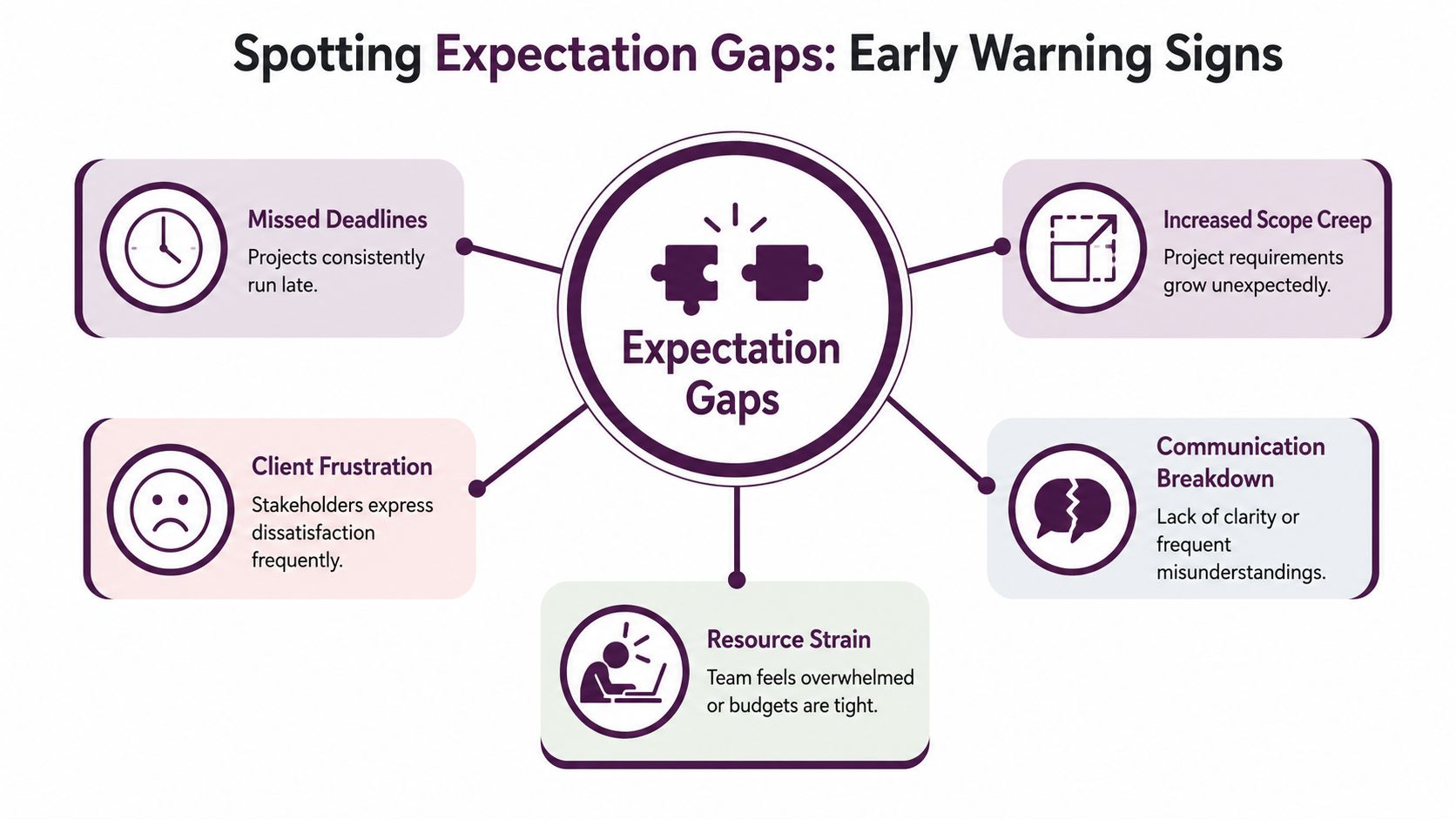
When expectations start drifting, the warning signs usually show up before the complaint does. The fastest teams catch those signals early and treat them as operational data, not personality problems.
Watch the language people use
Vague phrases like “we need it ASAP” or “make it customer-friendly” are usually not harmless shorthand. They signal that the result, quality level, or deadline hasn’t been pinned down yet. If you hear those phrases in a kickoff, a briefing, or a support handoff, there’s a good chance the team is about to discover hidden assumptions.
A disconnect between budget and goals is another early warning sign. If a client wants white-glove service, tight response windows, and heavy customization, but the operating budget doesn’t match that ambition, the expectation gap is already there. The same applies internally when leaders ask for faster service without changing staffing or process.
Notice the rhythm of change
Frequent priority shifts are rarely just “business moving fast.” They often mean the original goal was never fully shared or accepted. In call center operations, that shows up when a client keeps changing escalation rules, reporting needs, or call-handling instructions after the launch is already live.
Operational clue: when a stakeholder keeps revisiting the same decision, the expectation probably wasn’t confirmed in a way they trusted.
Track how people react
Client frustration, repeated clarification questions, and silence after updates are all useful indicators. Silence can be especially risky, because it may look like agreement while the other side is still uncertain. The CBS News guidance on managing expectations recommends asking people to restate their understanding in their own words, because true alignment shows up in how they repeat the agreement back. CBS News on restating understanding
If you’re monitoring service delivery, call center performance should be tied to whether the service still matches the expectation that was set, not just whether the team hit a task list. A project can be technically complete and still fail the expectation test if the result no longer fits what was agreed.
The CallZent Framework for Managing Expectations
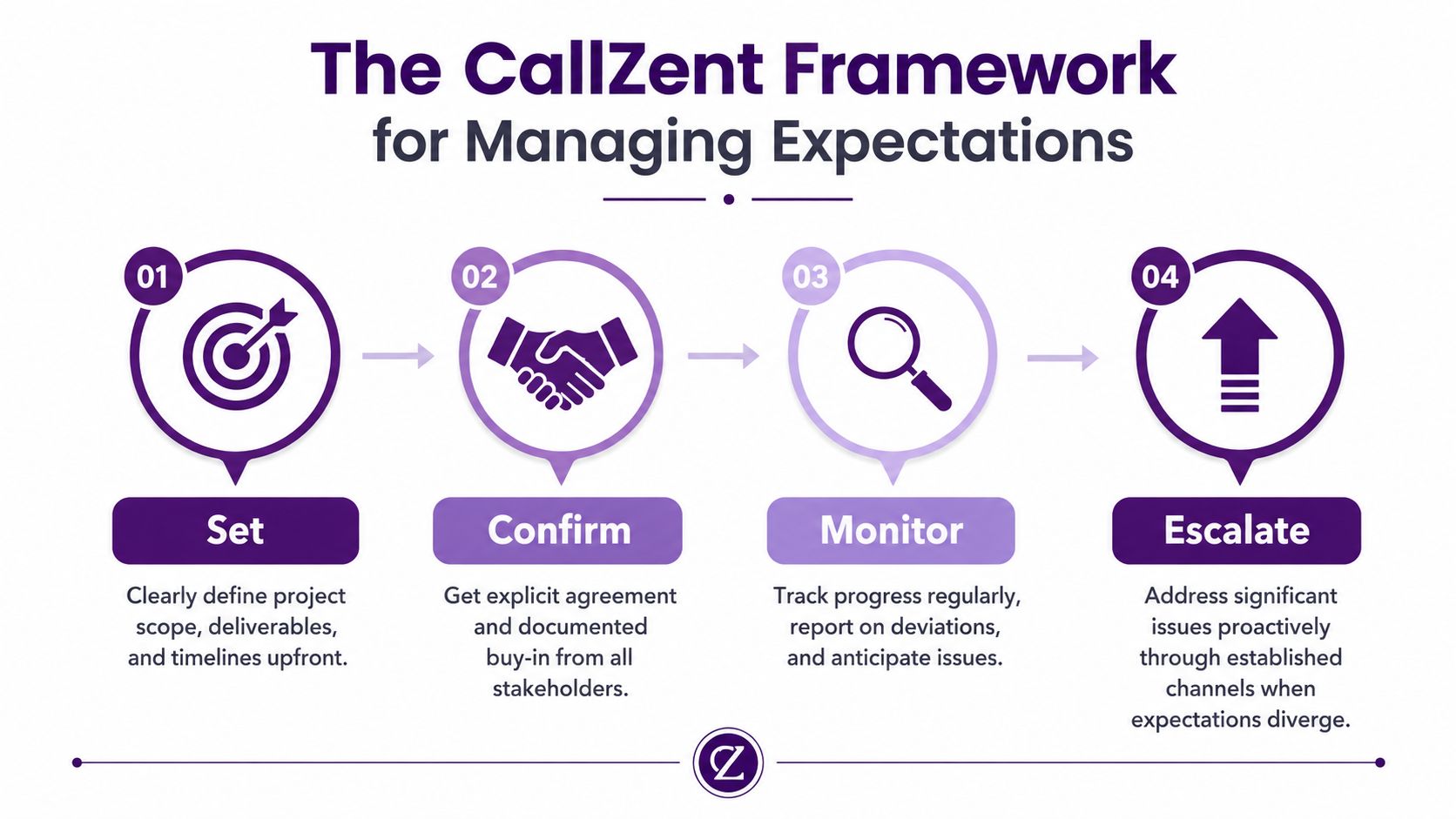
A framework only matters if it holds up under client pressure, shifting priorities, and the pace of high-volume service work. The most practical pattern I use is simple, Set, Confirm, Monitor, Escalate.
Set the terms before work starts
Set the result, scope, timeline, and boundaries before the team begins. PMI recommends using a project charter so the client and team share the same expectations, along with a formal change-management process so everyone knows what is included and what is not. PMI’s approach to managing expectations
That step turns general intent into an operating plan. If a client wants multilingual support, define exactly what language coverage means. If they want faster response times, define what “faster” means in the service model, not in casual conversation.
Confirm understanding, not just agreement
People nod in meetings for different reasons. That does not mean they accepted the same meaning. Ask them to restate the agreement in their own words, then capture it in meeting notes or email.
A simple way to do that is to ask, “Before we move on, can you repeat back what you understand the scope and success criteria to be?” It sounds basic, but it exposes gaps before they become operational problems.
Monitor against the agreement
PMI’s program-level model uses five stages: Identification of Expectations, Planning, Execution, Checking, and Tailoring, with tools such as an expectation matrix and consistent metrics collection. PMI’s five-stage expectation control model The practical lesson is clear. Expectation management is a loop, not a kickoff meeting.
In a call center, that means comparing actual service behavior with the promise that was made. If the team is meeting internal task targets but the client still feels the service is off-track, the expectation has drifted and needs to be corrected.
Escalate before the gap widens
If reality changes, raise it early and clearly. PMI also advises disclosing problems early and giving a new date whenever a project slips, which is the right move in service work too. A late surprise creates more damage than a difficult update delivered on time.
For teams that want a formal service structure, CallZent’s service level agreement guide fits this discipline by making commitments visible, measurable, and reviewable. A good guide to drafting an SLA helps teams define what gets measured, who owns each commitment, and how exceptions are handled before they turn into disputes.
From Theory to Practice Scripts and SLA Language

The fastest way to improve expectation control is to use language that forces clarity. In BPO work, vague promises create rework, extra escalations, and awkward handoffs between sales, operations, and the client. I’ve seen teams reduce that friction by replacing broad commitments with short, specific statements that are easy to repeat back.
Use a kickoff email that locks the basics
Here’s a simple version you can adapt:
Hi team,
To keep us aligned, here’s the agreed scope for this phase: [result], [deliverables], [timeline], and [key constraints].
If anything changes, we’ll document the change request before work moves forward. Please reply with any corrections or confirm that this matches your understanding.
That kind of email works because it turns the conversation into a written record. It also gives the other side a chance to confirm understanding in plain language, which is often where hidden gaps show up. CBS News on confirming understanding
Use call scripts that prevent scope drift
Try this when a client starts expanding the request mid-call:
“I want to keep the original goal clear. If we add that request, we’ll need to adjust either the timeline or the scope. Which one matters more right now?”
Or use this when a customer asks for something outside the current promise:
“I can help with that, but it isn’t covered in the current service setup. I can log it as a change request and explain what it would affect.”
That wording matters because it keeps the tone calm while setting a boundary. It also reduces the chance that your team says yes by accident, then has to explain the miss later.
Write SLAs in plain language
Good SLA language should spell out the result, scope, timeline, quality level, and constraints in writing. The clearest SLA language also defines escalation paths, exceptions, and review points so nobody has to guess what happens when service slips. If you need a reference point for structure, this guide to drafting an SLA is a useful resource for shaping the document before it reaches a client.
For teams comparing wording approaches, focus on what can be verified at checkpoints. A service clause is stronger when it names the measure, the review cadence, and the action if the measure falls short. That is how expectation management becomes part of the contract instead of a follow-up apology.
Keep the wording tight
- State the deliverable clearly: say what will be delivered, not just the general outcome.
- Define the boundary: say what is excluded as plainly as what is included.
- Name the checkpoint: say when the agreement gets reviewed again.
- Record the change path: say how new requests get approved.
CallZent’s own SLA best-practices page reflects the same practical idea, which is to make service commitments visible enough that teams can manage them day by day. In a BPO environment, that is what keeps service promises from drifting into wishful thinking.
Navigating Difficult Conversations and Common Pitfalls
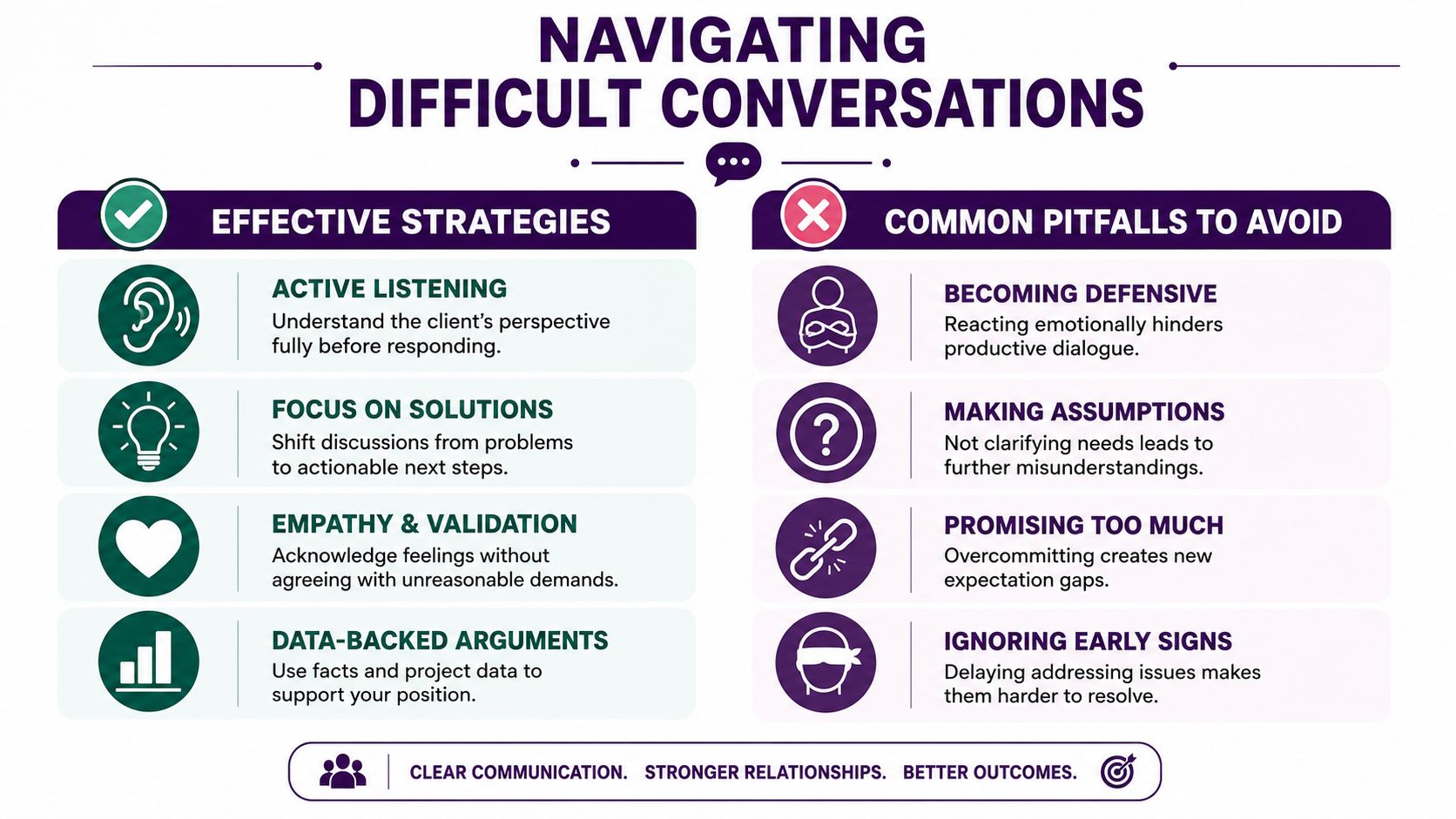
The hardest expectation conversations usually start when the other side is frustrated, pressed for time, or asking for something the service team cannot realistically deliver. Clear language helps, but it does not solve the issue by itself. You still need negotiation, scope control, and a steady way to say no without shutting the conversation down.
Lead with facts, then trade-offs
A useful response sounds like this:
“We can meet that deadline, but only if we remove feature X or accept a lower quality level on Y. Which outcome matters more?”
That phrasing works because it pushes the decision back to priorities instead of personalities. It also keeps the discussion tied to what can be delivered, which is the point when a client starts testing the boundary. Johann Wrede makes a similar point about unreasonable expectations, especially when vague wishes need to become clear commitments and trade-offs. Johann Wrede on managing unreasonable expectations
Stay steady when emotions rise
Do not argue with the emotion. Acknowledge it, then return to the facts and the options in front of you. If the other side is upset, the goal is not to win the exchange, it is to close the gap between what they want and what the service can realistically provide.
That steady tone matters even more in live support. If the conversation is getting tense, agents should use a clear de-escalation path and keep the next step simple. The de-escalation techniques for call centers agents resource is useful here because it reinforces calm language, controlled pacing, and a clean handoff when the issue needs a higher level of review.
For community-style escalation paths, this escalation guide for community managers is a good reference for matching the issue to the right response level without overreacting at the front line.
Avoid the common traps
- Promising too much: extra effort can create a new expectation gap when the client begins treating the bonus as the baseline.
- Ignoring early signs: small disagreements grow when no one addresses them early.
- Getting defensive: defensiveness shifts the focus away from the underlying issue.
- Over-explaining: long explanations can sound like excuses when a clear boundary is the necessary answer.
Early disclosure matters because delay gives the wrong expectation more time to harden into a grievance. The same principle applies in service teams, whether the issue is a missed handoff, a delayed update, or a scope request that should have been challenged sooner.
The best negotiators in service work do not sound rigid. They sound precise. That precision protects the relationship because the client knows where the line is and what it would take to move it.
Industry-Specific Scenarios and Key Takeaways
An e-commerce team that waits until peak season to set expectations is already behind. If delivery windows are tight, say so early, update customers before the gap widens, and avoid promising speed the operation cannot support. In healthcare, the pressure usually shows up in appointment wait times and follow-up steps, so the language has to stay calm, specific, and consistent. A healthcare outsourcing compliance guide matters in that setting because compliance and expectation setting often move together.
Finance teams face a different kind of pressure. Clients want certainty in an uncertain market, so the script has to separate what can be controlled from what cannot. Telecom teams, especially during service outages, need fast updates that state what is known, what is still unclear, and when the next update will arrive. That keeps silence from turning into rumor.
The pattern stays the same across industries. Set the promise, confirm the meaning, monitor the delivery, and escalate early when reality changes. That process builds trust in a service business, and it keeps BPO client relationships steady over time.
A BPO team that does this well sounds precise, not rigid. The client hears the boundary, understands the next step, and knows what would have to change before the answer changes.
🚀 Build Clearer Service Expectations From Day One
If your business wants a nearshore BPO partner that can help define scope, align service expectations, manage escalations, and protect customer trust, CallZent can help you build a support model with clear communication and accountable delivery.