
Lead Generation Outsourcing
Grow Your Business: Lead Generation Outsourcing Philippines Guide
A direct, practical guide to lead generation outsourcing in the Philippines, including service models, pricing, vendor selection, KPIs, and when nearshore may be the smarter fit.
TL;DR — Quick Takeaways
- If you’re short on pipeline capacity, outsourcing can work.
- The Philippines stands out because it offers lower operating costs, an experienced English-speaking workforce, and service models that cover prospecting, qualification, outreach, and appointment setting.
- The catch is operational friction. Offshore distance can slow feedback loops, create time zone headaches, and make day-to-day management harder than the pricing sheet suggests.
- The best outsourcing strategy starts with clarity on what you’re delegating, how success will be measured, and how tightly the external team must work with your internal sales operation.
- Nearshore may be the smarter fit when collaboration, speed, daily coaching, and sales alignment matter more than the lowest possible labor cost.
Most companies don’t have a lead problem. They have an execution problem.
The pipeline target goes up, but hiring an in-house SDR team feels expensive, slow, and risky. So the usual advice kicks in: outsource offshore, cut cost, and scale faster. That’s why lead generation outsourcing in the Philippines keeps coming up in serious conversations.
The Philippines is a real contender. It has scale, maturity, and deep BPO experience. But that doesn’t mean it’s automatically the right model for every business. If you care about speed, oversight, customer nuance, and tight collaboration with your sales team, you need to look at the tradeoffs clearly before you sign anything.
Is Your Sales Pipeline Ready for Global Scale
Are you trying to grow revenue with a sales team that’s already stretched thin?
That’s where lead generation outsourcing in the Philippines enters the picture. The country’s outsourcing sector isn’t a niche play. It’s a massive operating environment. The Philippines generates approximately $40 billion in annual export revenues from its IT-BPM industry in 2025, with lead generation outsourcing contributing to that growth, according to this Philippines outsourcing industry report.
That scale matters. It means you’re not buying an experiment. You’re buying into an established labor market, management structure, and support ecosystem built for outsourced customer-facing work.
A simple example: a SaaS company with two account executives usually shouldn’t ask an outsourced team to “generate more leads.” That instruction is too vague. It should define the ideal customer profile, target titles, outreach channels, handoff rules, and meeting standards first. If those basics aren’t documented, the vendor won’t fix the problem. They’ll just produce activity.
If you’re tightening your process before outsourcing, this guide on lead generation best practices is a useful place to start.
Practical rule: Outsource tasks, not confusion. If your ICP, message, and handoff rules are fuzzy, your vendor will mirror that fuzziness at scale.
Why Businesses Choose the Philippines for Lead Generation
The Philippines became a serious outsourcing destination for three practical reasons: cost, talent availability, and communication fit. None of those should be treated as marketing fluff. They’re the core of the business case.
The cost advantage is real
If you’re comparing offshore lead gen against a US-based in-house team, the labor gap is hard to ignore. Outsourcing lead generation to the Philippines costs 50% to 85% less than hiring equivalent in-house or US-based teams, with fully loaded agent costs ranging from $8 to $18 per hour, or $1,200 to $1,800 per month, based on this cold calling outsourcing guide.
That changes the math fast.
A startup that can’t justify a domestic SDR bench can often afford a dedicated offshore specialist. A mid-sized company can test a channel without carrying the full burden of US payroll, benefits, and recruiting delays. For e-commerce brands, healthcare groups, telecom providers, and financial services teams, that flexibility is often the difference between building a pipeline engine and talking about one.
The labor pool is built for outsourced work
This isn’t just a cheap labor story. The Philippines has been doing outsourced voice and back-office work for years. Businesses choose it because they can find people who already understand call workflows, CRM discipline, scripted outreach, and reporting expectations.
That matters practically. If you hire a lead generation partner and the team already knows how to work inside HubSpot, Salesforce, Apollo.io, and LinkedIn Sales Navigator, onboarding gets easier. The vendor still needs training on your offer and market, but they aren’t learning basic outsourced sales operations from scratch.
For companies comparing regions, this breakdown of call centers in the Philippines vs call centers in Mexico helps frame the tradeoffs more clearly.
English proficiency helps, but it doesn’t solve everything
The Philippines remains a go-to destination for English-speaking Western markets. That gives it a strong edge for phone outreach, email follow-up, and live qualification. Buyers don’t want awkward calls with agents who sound disconnected from the conversation. Philippine teams often clear that hurdle better than many lower-cost alternatives.
But don’t oversimplify it. Good English doesn’t automatically mean good selling. A rep can be fluent and still miss tone, buyer skepticism, urgency, or industry language.
Clear English gets the call started. Sales judgment gets the meeting booked.
That’s why smart buyers don’t stop at accent or fluency. They test for objection handling, listening skills, and relevance to the target market. If you sell cybersecurity to US healthcare groups, or insurance products to regional brokers, industry familiarity matters far more than generic call center polish.
Typical Lead Generation Service Models Explained
Most companies shopping for lead generation outsourcing in the Philippines ask the wrong first question. They ask, “How much does it cost?” The better question is, “Which part of my funnel am I outsourcing?”
That answer shapes everything from staffing to reporting.
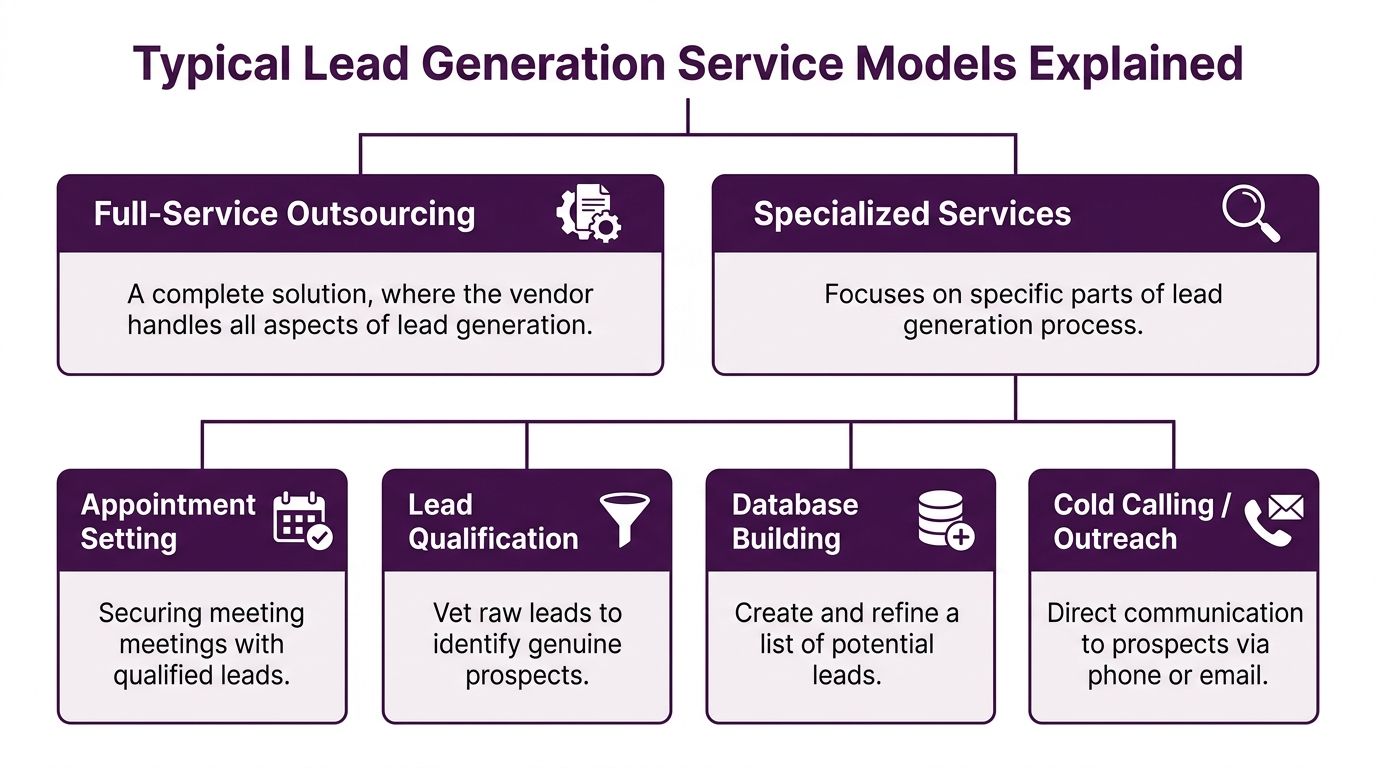
Full-service outsourcing
This model gives one vendor responsibility for the full front end of pipeline creation. That usually includes prospect research, list building, contact enrichment, outbound calling, cold email setup, follow-up, lead qualification, calendar booking, and CRM updates.
A common example is a B2B software company entering a new vertical. Instead of hiring researchers, SDRs, and an operations coordinator internally, it gives the vendor the ICP, value proposition, talk tracks, and target accounts. The provider runs the engine and hands off qualified meetings.
This setup works when you want one accountable partner and don’t want to stitch together multiple freelancers or niche agencies.
Specialized services
Some businesses don’t need the whole machine. They need one missing piece fixed.
Here are the most common specialized models:
- Appointment setting: The vendor focuses on turning qualified prospects into booked meetings. This works well when your internal marketing team already generates responses, but sales reps need help with follow-up and calendar conversion.
- Lead qualification: A team screens inbound form fills, webinar attendees, or downloaded-contact lists to separate curiosity from actual buying intent.
- Database building: Specialists use tools like Apollo.io and LinkedIn Sales Navigator to build clean target lists by industry, title, geography, and company type.
- Cold calling and outreach: The provider handles outbound calls and email sequences to start conversations with prospects who haven’t engaged yet.
If you’re in a field where outreach structure matters, this 2026 guide for contractors is a practical example of how target-specific lead generation strategy changes by industry.
Match the model to the sales motion
A B2C home services company often needs speed, volume, and quick qualification. A B2B manufacturing business usually needs tighter account targeting and longer follow-up. An e-commerce brand may want agents to qualify wholesale partnership inquiries from inbound channels. A healthcare services firm may need careful outreach and detailed data handling.
The mistake is buying a full-service package when you only need list development, or hiring a caller when your real bottleneck is bad targeting.
For businesses that need meetings, handoffs, and top-of-funnel support rather than generic call volume, appointment setting services are often the most direct fit.
Outsourcing works best when the vendor owns a specific operational outcome, not a vague promise of “more leads.”
The Pros and Cons of Philippines Lead Generation Outsourcing
A lot of content about offshore outsourcing sounds like a brochure. That’s useless if you’re the one responsible for revenue.
The Philippines offers clear advantages. It also creates real operating challenges that buyers often underestimate until the campaign is live.
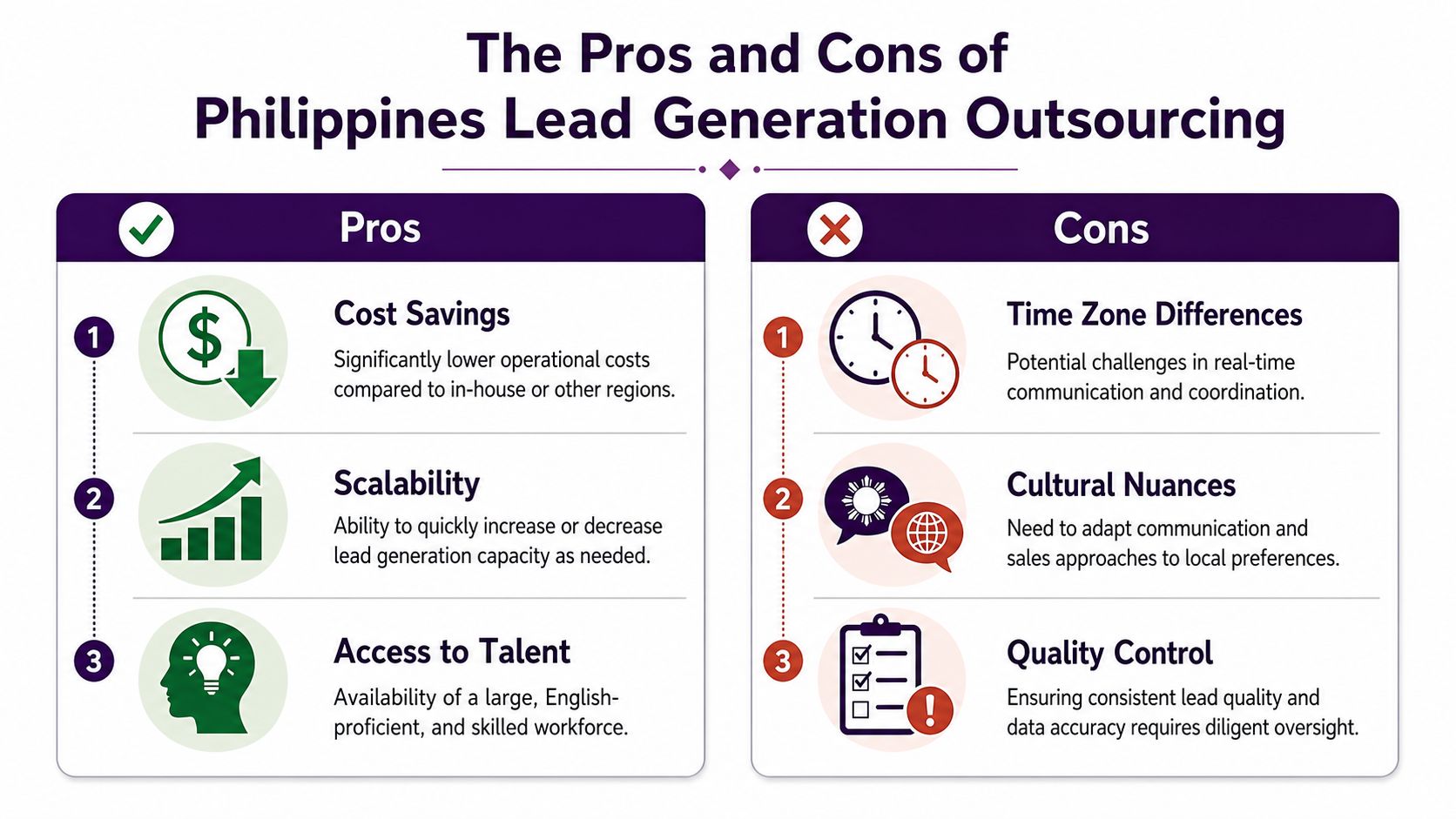
Where the Philippines makes sense
The biggest advantage is cost efficiency. That’s already covered above, and it’s the reason many companies start here. Lower labor costs let you fund more outreach activity without building an expensive domestic SDR layer.
Scalability is the next win. If your outbound motion works, an outsourced model can help you add capacity faster than a typical internal hiring process. That matters for companies launching into new regions, replacing underperforming in-house prospecting, or testing a new offer.
The third advantage is workforce depth. You can find vendors that support cold calling, email outreach, list research, CRM entry, and appointment setting under one roof. That’s useful when your internal team wants a single operating partner instead of managing separate providers.
Where things get harder
Time zone friction is the first issue. Yes, an offshore team can work while your US team sleeps. That can be useful for around-the-clock activity. It can also create a painful lag when sales leadership wants same-day script changes, quick coaching, or live campaign adjustments.
A real example: your sales manager hears three objection patterns during morning demos and wants the outbound team to update the pitch immediately. With a nearshore team, that can happen in real time. With a far-offshore team, you may wait a full cycle for the fix to show up consistently.
The hidden cost is management distance
Long-distance outsourcing puts pressure on process quality. If QA is weak, reports are vague, and call reviews happen infrequently, poor habits stick. Bad lists stay in rotation. Weak scripts keep running. Calendar quality drops before leadership notices.
Common friction points include:
- Delayed feedback loops: Coaching often moves slower when teams don’t share working hours.
- Cultural nuance: Reps may speak strong English but still miss subtle buying signals, humor, or local context.
- Quality control risk: Without tight oversight, prospect qualification standards drift.
- Security concerns: Any outsourced program handling contact data needs serious compliance discipline.
This is why companies comparing models should look beyond headline savings and study the operational side of nearshore vs offshore outsourcing costs risks and ROI.
A cheap lead that never shows up to the meeting isn’t a cheap lead. It’s wasted sales time.
The Philippines can absolutely work. But it works best for companies with strong process ownership, clear messaging, and enough management discipline to run an offshore team properly. If you want high collaboration and tight daily alignment, the distance becomes a bigger factor than many buyers expect.
A Practical Vendor Selection and Pricing Guide
Choosing the wrong vendor is expensive even when the monthly fee looks reasonable.
Most buyers get distracted by pricing models first. That’s backwards. You should start with fit, operating discipline, and evidence that the team can produce in your market. Price comes after that.
Know how vendors charge
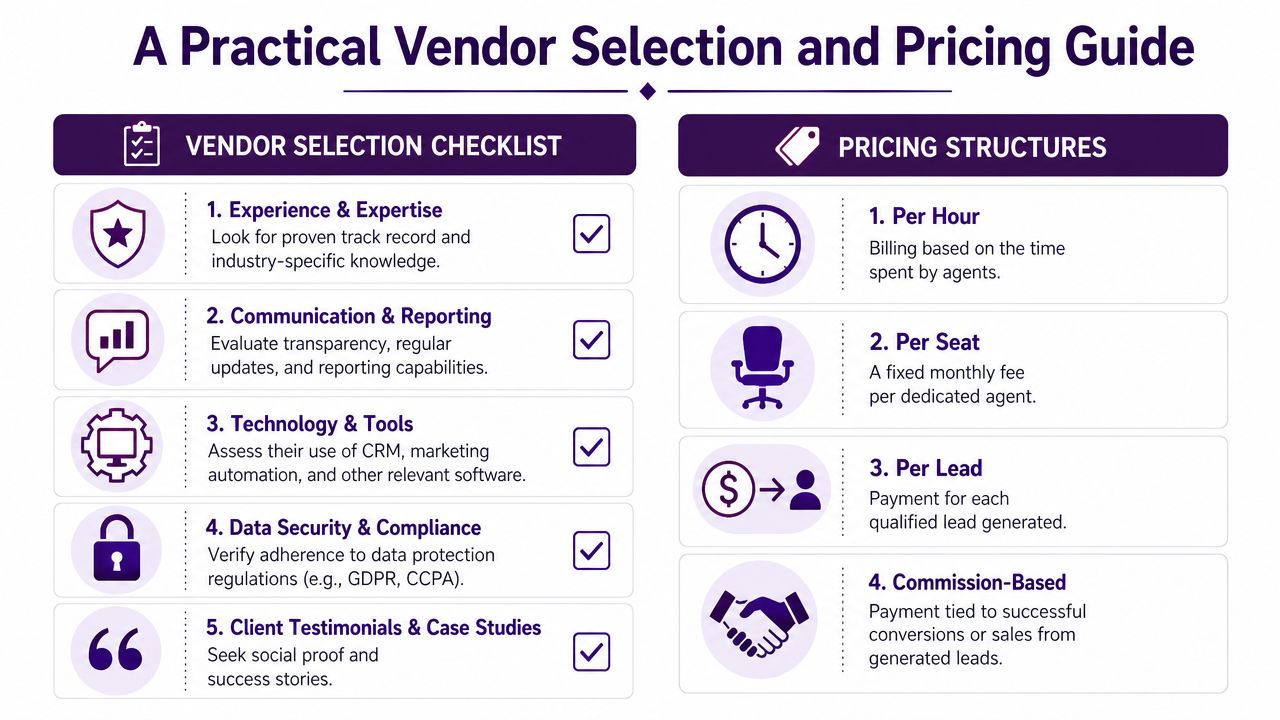
Lead generation providers usually price in a few common ways:
| Pricing model | How it works | When it fits |
|---|---|---|
| Per hour | You pay for staffed time | Useful for flexible workloads or research-heavy campaigns |
| Per seat | You pay a fixed monthly amount for a dedicated agent | Best when you want consistency and accountability |
| Per lead | You pay when a lead meets agreed criteria | Works only if the lead definition is very tight |
| Commission-based | Compensation ties to conversion or revenue outcomes | Better for mature offers with clean attribution |
None of these models is automatically better. A per-lead deal can look attractive and still produce junk if “qualified lead” isn’t defined well. A dedicated-seat model can outperform it if the agent is trained properly and managed tightly.
If you’re still weighing internal hiring against outsourced support, Netco Design’s in-house vs agency analysis is a helpful comparison for thinking through control, speed, and resource allocation.
What to demand before you shortlist anyone
One requirement is imperative: ask for case studies in your specific industry and similar target markets. That isn’t a nice extra. It’s a practical filter. The technical guidance is clear in this vendor success factors resource, which notes that vendor selection should include case studies in the client’s industry and target market because agent communication skills and sales tactics directly affect conversion.
Here’s the checklist I’d use in a real buying process:
- Industry proof: Ask for examples involving your buyer type, deal size, and sales motion.
- Tool compatibility: Confirm they work inside your CRM and prospecting stack. That usually means Salesforce, HubSpot, Apollo.io, LinkedIn Sales Navigator, and standard reporting tools.
- QA process: Ask who reviews calls, how often scripts are adjusted, and how failed handoffs get corrected.
- Reporting format: Require sample dashboards before the contract starts.
- Hiring model: Clarify whether agents are dedicated or shared across clients.
- Training plan: Ask how product knowledge, objection handling, and account targeting are taught.
- Data handling: Review security, permissions, and compliance procedures.
- Reference checks: Don’t rely on polished website testimonials alone.
For companies building a formal scorecard, vendor evaluation criteria should be documented before demos start. That keeps the selection process from turning into a beauty contest.
A grounded buying example
Say you’re a regional insurance brokerage. One vendor shows low rates but mostly has generic outbound call center history. Another charges more and shows actual experience booking meetings with brokers and policy decision-makers.
Take the second meeting. Generic BPO experience is not the same as sales development skill.
If you want a nearshore option in the mix, CallZent offers lead generation support that includes prospect list building, lead qualification, appointment setting, and nurturing. That makes it one option for buyers who want outsourced support without defaulting to a far-offshore model.
Ensuring Success With KPIs Onboarding and Compliance
A signed contract doesn’t create pipeline. Execution does.
The fastest way to waste an outsourcing budget is to launch without hard metrics, weak onboarding, and vague ownership between your team and the vendor team.
Start with a pilot and hard KPIs
The benchmark I recommend is a 90-day pilot with hard KPIs. That standard aligns with this 90-day pilot guidance, which says scalable pipeline growth requires tracking connect rate, live conversations per dial, meeting rate, show rate, and opportunity rate.
Those metrics matter because they isolate where the campaign is breaking.
If connect rate is poor, your data is probably weak. If live conversations are happening but meeting rate is low, the pitch or targeting may be off. If meetings are booked but show rate collapses, your qualification standard is too loose or the calendar handoff is sloppy.
Build onboarding like a sales enablement project
Most vendors get basic onboarding. Very few get the materials they actually need.
Give them:
- A usable ICP: Not “mid-market companies.” Be specific about industry, company profile, titles, disqualifiers, and buying triggers.
- A messaging pack: Core offer, common objections, approved claims, forbidden claims, and email tone examples.
- Call and email examples: Show what good sounds like in your business.
- CRM rules: Define required fields, disposition tags, meeting outcomes, and handoff ownership.
- Escalation paths: Make it clear who handles issues with bad data, no-shows, legal questions, or prospect complaints.
A healthcare provider, for example, shouldn’t assume an outsourced team understands how carefully outreach language needs to be handled. A telecom sales team shouldn’t assume the vendor knows the difference between a useful conversation and a curious but unqualified contact. Those details have to be taught.
Train the outsourced team the same way you’d train a new internal SDR. If you skip that step, you don’t have a vendor problem. You have a management problem.
Compliance and QA aren’t back-office details
If the provider handles prospect records, call recordings, or regulated customer information, data discipline matters. So does independent review of lead quality.
Weekly or biweekly reviews are usually the right cadence. Listen to call samples. Check meeting notes against actual conversations. Audit CRM entries. Ask sales reps whether booked meetings match the stated qualification criteria.
The strongest programs treat QA as ongoing calibration, not punishment. Scripts improve. targeting improves. handoffs improve. Without that loop, activity rises while pipeline quality drifts.
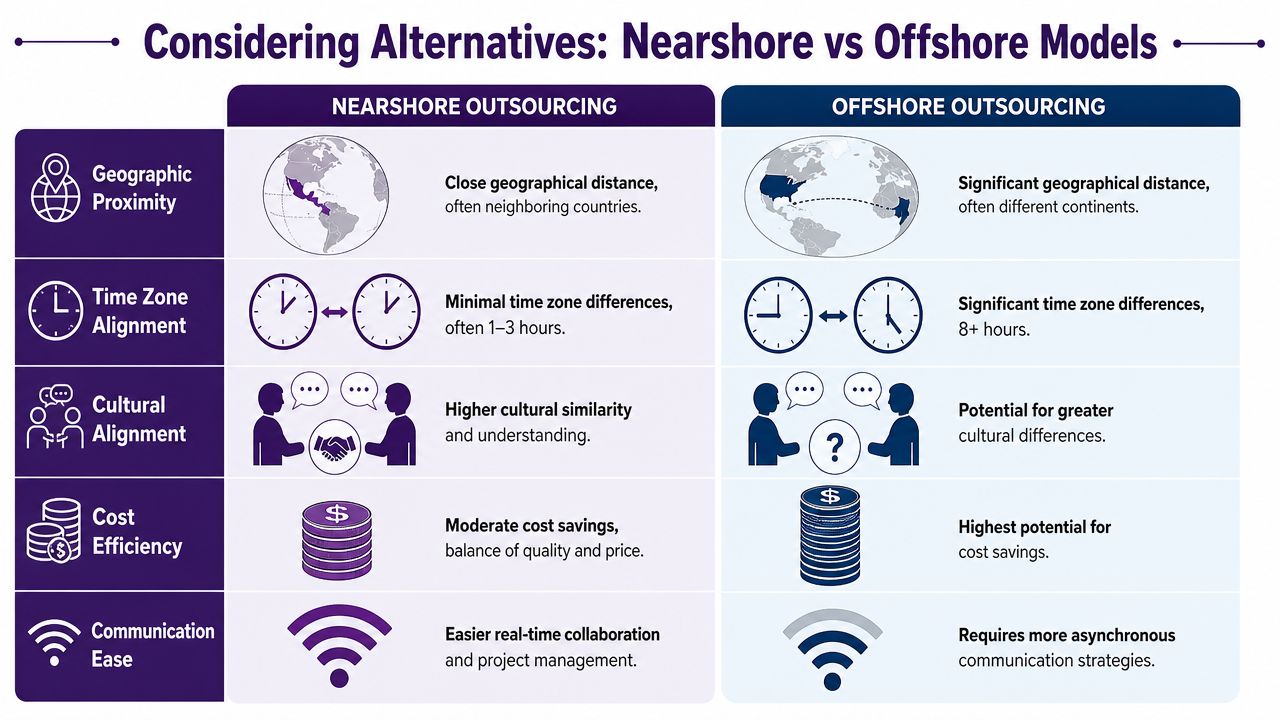
Considering Alternatives Nearshore vs Offshore Models
The Philippines is a legitimate offshore option. But if your sales process depends on speed, collaboration, and day-to-day coaching, offshore isn’t always the smartest operating model.
That’s where nearshore deserves a serious look.
Where offshore wins
Offshore usually wins on pure labor arbitrage. If your priority is minimizing top-of-funnel cost and your process is already highly systemized, offshore can be efficient. It’s often a strong fit for companies that are comfortable managing asynchronously and don’t need constant real-time interaction.
This model can work well when:
- Your scripts are mature
- Your sales handoff rules are already stable
- Your leadership team is used to remote QA and delayed feedback
- Your market doesn’t demand heavy nuance in every conversation
Where nearshore is often better
Nearshore tends to win on operating ease. Teams work closer to your hours. Collaboration is faster. Coaching is easier. Travel is simpler. Cultural references and customer expectations often align more naturally.
That matters more than buyers think.
A US sales leader can jump into a live working session, revise messaging, review call recordings, and tighten qualification criteria without waiting for an opposite-side-of-the-world handoff. If your campaign needs iteration, that speed becomes an advantage.
The vendor screening standard also shouldn’t relax just because a provider is closer. Vendor evaluation should include independent verification of client feedback and testimonials, plus strong onboarding and QA controls, as noted in this lead generation outsourcing evaluation guide.
The honest recommendation
If your operation is mature and heavily process-driven, the Philippines can be a solid fit.
If your operation still needs close collaboration, tighter sales alignment, faster issue resolution, and easier team integration, nearshore is often the smarter choice. You may give up some of the deepest labor savings, but you usually gain speed, clarity, and control.
For a lot of North American companies, that trade is worth it.
🚀 Compare Offshore and Nearshore Lead Generation Options
If you’re comparing offshore and nearshore options and want a team that works closer to your market and business hours, CallZent is worth a look. The company operates from Tijuana and provides bilingual call center and BPO support for North American businesses that need lead generation, customer support, and back-office help with tighter collaboration than a far-offshore model usually allows.
Talk to an ExpertIf you’re comparing offshore and nearshore options and want a team that works closer to your market and business hours, CallZent is worth a look. The company operates from Tijuana and provides bilingual call center and BPO support for North American businesses that need lead generation, customer support, and back-office help with tighter collaboration than a far-offshore model usually allows.