Nearshore vs Offshore BPO
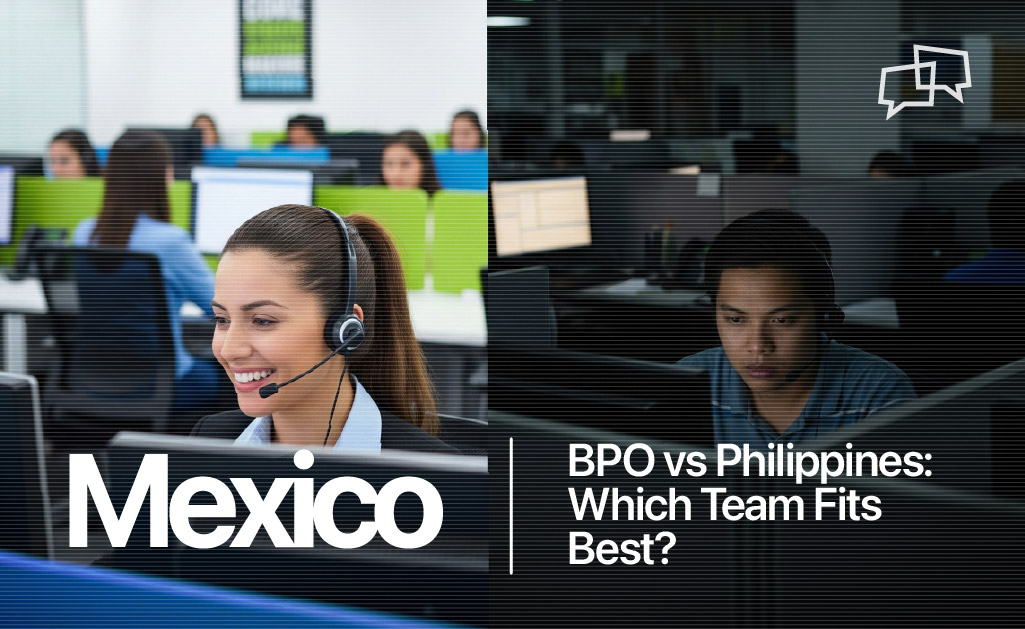
Mexico BPO vs Philippines: Which Outsourcing Location Fits U.S. Businesses Best?
Compare Mexico BPO vs Philippines outsourcing on time zones, bilingual support, cultural alignment, cost, scale, collaboration, and customer experience fit.
TL;DR — Quick Takeaways
- The Mexico BPO vs Philippines decision should start with customer experience, not only hourly rates.
- Mexico is often a stronger fit for U.S. companies that need real-time collaboration, bilingual English-Spanish support, cultural alignment, and same-day management visibility.
- The Philippines can be a strong option for 24/7 English-language coverage, highly standardized workflows, and large-scale staffing programs.
- Total operating value matters more than base labor cost. Management time, training speed, rework, customer retention, and quality consistency all affect ROI.
- The right BPO partner should feel like an extension of your internal team, not a distant vendor that makes growth harder to manage.
A support queue can look healthy on a dashboard while customers wait hours for answers, agents struggle with brand nuance, and your internal team spends every morning catching up on yesterday’s issues. That is why the Mexico BPO vs Philippines decision should not begin and end with hourly rates. It should start with the customer experience your business needs to deliver.
Both countries are established outsourcing destinations with deep talent pools and meaningful cost advantages over building a comparable U.S.-based team. The right choice depends on your customers, operating hours, service complexity, management style, and growth plans. For U.S. businesses, Mexico often creates a stronger fit when real-time collaboration, bilingual support, and cultural alignment are central to the program. The Philippines can be an excellent option when around-the-clock English-language coverage and large-scale staffing are the priority.
The real question behind Mexico BPO vs Philippines
Outsourcing is a business decision, not just a labor decision. A lower rate does not create value if communication delays lead to abandoned customers, rushed quality reviews, or a support team that feels disconnected from your company.
Before comparing providers or locations, define what success looks like. A growing eCommerce brand may need English and Spanish support during North American business hours. A healthcare organization may need dependable escalation paths, careful process adherence, and close coordination with U.S. staff. A SaaS company may need technical support agents who can join a same-day training session as product updates roll out.
Location matters because it shapes how easily your outsourced team can become a true extension of your internal operation.
Mexico BPO vs Philippines: the factors that matter
Time zones and day-to-day collaboration
Mexico’s proximity to the United States is one of its most practical advantages. Teams in Tijuana and Hermosillo operate within North American time zones, making it easier to hold live meetings, coach agents, review performance, and resolve service issues during the same business day.
That overlap can make a major difference for fast-moving businesses. If a promotion causes a spike in order questions at 10 a.m. Pacific Time, a nearshore partner can adjust staffing and communicate with your team in real time. Leaders do not have to wait overnight to address an operational concern or provide clarification on a new policy.
The Philippines is typically 12 to 16 hours ahead of the continental United States, depending on the season and location. This arrangement works well for businesses that need overnight coverage or 24/7 service. It does require more deliberate handoffs, documentation, and meeting schedules. Companies with highly structured processes may handle that model well. Companies that rely on frequent, spontaneous collaboration may find the distance more challenging. A simple U.S.-to-Manila time zone comparison can help leaders visualize the handoff reality before choosing a delivery model.
Language, culture, and customer connection
The Philippines has a long-standing reputation for strong English proficiency and a workforce experienced in voice-based customer service. For programs serving English-speaking customers, Philippine BPO teams can provide capable, professional support across many industries. The Philippine government’s industry profile describes the country’s IT-BPM sector as a major global voice-services provider, supported by English communication skills and customer service experience.
Mexico offers a distinct advantage for companies that need bilingual English and Spanish service. As the U.S. customer base becomes more diverse, bilingual support is no longer a niche requirement for many businesses. U.S. Census Bureau language data shows why language access matters for planning services and communication. It can be a direct driver of trust, conversion, retention, and customer satisfaction.
Cultural proximity also affects the small details that shape a conversation: familiarity with U.S. holidays, retail expectations, communication patterns, product references, and customer preferences. No location automatically guarantees brand alignment. Training and quality management still matter. But nearshore teams often have a shorter path to understanding the context behind a customer interaction.
For customer-facing work involving empathy, sales conversations, appointment setting, legal intake, or complex issue resolution, that shared context can help agents create more natural human connections.
Cost and total operating value
The Philippines is often associated with lower base labor costs, especially for large, standardized programs. For organizations focused on high-volume, repeatable work, this can be a compelling advantage.
Mexico may carry a higher hourly cost in some comparisons, but the total cost of ownership can tell a different story. Consider the management time required to run the program, the cost of rework, the speed of training, the impact of turnover, and the revenue at risk when customers receive poor support. A team that collaborates easily with your leaders, understands your customers, and resolves issues quickly can produce stronger business results even when its base rate is not the lowest available.
The goal is not to choose the cheapest labor market. It is to build a support operation that protects your brand while giving you room to grow. A practical call center outsourcing cost review should compare service quality, management time, customer retention, staffing flexibility, and hidden operational costs — not just hourly rates.
Scale, staffing, and flexibility
The Philippines has a significant advantage in sheer BPO scale. Large enterprises that need hundreds or thousands of agents across multiple functions can find an extensive ecosystem of providers, specialized talent, and mature delivery infrastructure. The IT and Business Process Association of the Philippines represents a broad IT-BPM sector with hundreds of member companies and partner associations across several outsourcing-related fields.
Mexico has a strong and growing nearshore BPO market, particularly for U.S. companies that need flexible teams without enterprise-level complexity. For small and midsize businesses, the ability to start with a right-sized program, refine it quickly, and scale as demand grows may be more valuable than access to the largest possible labor pool.
Ask prospective partners how they handle seasonal spikes, new service launches, schedule changes, and program expansion. Flexibility should be visible in the operating model, not just a promise made during a sales conversation. A structured vendor evaluation criteria process can help you compare providers consistently.
Travel, oversight, and relationship building
A site visit to Mexico is often simpler and faster for U.S. leaders than international travel to the Philippines. That is not a requirement for successful outsourcing, but it can be valuable during onboarding, leadership planning, quality calibration, or major program changes.
More importantly, geographic proximity reinforces a partnership mindset. When your outsourced team can work alongside your internal leaders in overlapping hours, it becomes easier to share feedback, recognize strong performance, and keep everyone connected to the same customer experience goals.
When the Philippines may be the better choice
The Philippines may be a strong fit when your primary need is 24/7 English-language coverage, your processes are well documented, and your program requires high-volume staffing. It can also work well for back-office tasks that follow clear workflows and do not require frequent live coordination with U.S. stakeholders.
Success in this model depends on disciplined operations. You need clear knowledge bases, reliable reporting, defined escalation rules, and leaders who are prepared to manage asynchronous communication. A strong partner can make these systems effective, but they should be designed intentionally.
When Mexico may be the better choice
Mexico is often the stronger option for U.S. companies that value real-time teamwork and a customer experience that feels close to home. It is particularly well suited to bilingual customer service, technical support, lead generation, appointment setting, order processing, healthcare support, legal intake, and other functions where fast feedback and careful brand alignment matter.
Nearshore outsourcing to Mexico also fits businesses that want to retain an active role in their support operation without adding the fixed cost of hiring, training, and managing a large in-house team. Same-day access to your BPO leaders makes it easier to adjust scripts, solve emerging issues, and improve performance continuously.
For companies serving both English- and Spanish-speaking customers, a Mexico-based team can turn language access into a better customer relationship rather than a separate operational burden. This is especially important for companies that want to improve customer retention through bilingual support.
How to make the decision with confidence
Do not evaluate a country in isolation. Evaluate the provider’s ability to build the specific program your business needs. Request a clear view of recruiting standards, agent training, quality assurance, reporting cadence, security practices, escalation procedures, and pricing structure.
Pay close attention to how a prospective partner talks about its agents. Customer experience improves when agents are well trained, respected, and empowered to solve problems. A provider that treats people as interchangeable seats may produce short-term coverage, but it is less likely to create the consistency and ownership your customers notice. For a deeper operational lens, review why agent empowerment in call centers works.
A practical evaluation should also include a pilot or a flexible start whenever possible. Begin with a defined scope, agree on service levels and quality measures, then expand based on results. This approach reduces risk while giving both teams time to build the working relationship that makes outsourcing successful. Strong call center reporting and KPI dashboards can help keep that pilot tied to real business outcomes.
At CallZent, that relationship is the point. The best outsourced team does more than answer calls or complete tasks. It brings capable people, clear communication, and accountable execution to the moments when your customers need you most.
Choose the location that lets your team move faster, serve customers more naturally, and stay closely connected as your business changes. The right BPO partner should make growth feel more manageable, not more distant.
🚀 Compare Mexico BPO Options With Confidence
If your business needs bilingual support, closer collaboration, and a nearshore team that understands North American customers, CallZent can help you design a Mexico-based BPO program built around quality, flexibility, and real-time execution.