SUPPLY CHAIN / OUTSOURCING STRATEGY
Outsourcing and Supply Chain Management Strategies for 2026
Learn how outsourcing and supply chain management now combine logistics, customer support, back-office operations, and nearshore strategies for resilience and growth.
TL;DR — Quick Takeaways
- Modern supply chain management now includes customer service, back-office workflows, and technical support.
- 3PL, 4PL, and BPO models solve different operational challenges.
- Nearshore outsourcing improves visibility, collaboration, and operational resilience.
- CallZent helps businesses strengthen customer-facing supply chain operations through scalable nearshore support.
How to Build a Supply Chain Outsourcing Strategy
A successful supply chain outsourcing strategy starts by identifying which processes can be handled more efficiently by a specialized partner. Businesses should focus on activities that improve scalability, reduce operating costs, and enhance the customer experience without losing visibility or control.
- Identify processes to outsource – Review repetitive or labor-intensive activities such as customer service, order processing, returns, billing, and back-office support.
- Define service levels and KPIs – Establish clear expectations for response times, accuracy, customer satisfaction, and productivity.
- Choose the right outsourcing partner – Look for industry experience, scalability, bilingual capabilities, technology compatibility, and transparent reporting.
- Integrate systems and workflows – Connect your outsourcing team with the CRM, order management, communication, and reporting tools they need.
- Monitor and optimize performance – Review KPIs regularly and work with your outsourcing partner to continuously improve processes.
What Supply Chain Processes Can You Outsource?
- Customer Service: Handle order questions, delivery updates, product inquiries, and customer issues.
- Order Processing: Manage order entry, confirmations, updates, tracking, and exceptions.
- Returns and Refunds: Support return requests, exchanges, refund processing, and customer communication.
- Billing Support: Assist with invoices, payment questions, account updates, and billing inquiries.
- Technical Support: Provide customers and partners with product, platform, or order-related assistance.
- Back-Office Operations: Outsource data entry, documentation, CRM updates, reporting, and other repetitive administrative processes.
Ready to Outsource Your Supply Chain Support?
Build a scalable nearshore team for customer service, order processing, returns, billing, technical support, and back-office operations. CallZent helps U.S. companies extend their operations with bilingual teams in Mexico.
Most companies still treat the supply chain as a logistics problem. That’s the gap.
If a customer can’t get a billing answer, can’t confirm an order change, or waits too long for support after a delivery issue, the business has a supply chain problem even if the warehouse did its job. In customer-centric industries, outsourcing and supply chain management now overlap in ways many leaders still underestimate.
This matters more going into 2026 because resilience is no longer just about freight routes, inventory buffers, or supplier diversification. It’s also about how quickly your business can communicate, recover, and keep customers informed when something changes.
Is Your Supply Chain a Competitive Advantage or a Hidden Risk
A supply chain can look efficient on paper and still fail the customer every day.
I see this when companies measure warehouse output, freight performance, and procurement savings, but ignore what happens after the order is placed. A delayed refund, a missed callback, or a poorly handled reschedule creates friction that customers remember far longer than an on-time shipment. That’s why outsourcing and supply chain management need to be viewed together, not as separate operating decisions.
The market is pushing businesses in that direction. A 2023 BCG trend summary cited by Tecsys notes that over 90% of North American manufacturing companies have relocated at least part of their production or supply chain in the past five years, and more than 90% plan similar moves in the next five years. The same summary also notes that U.S. imports from China dropped nearly 17% in the first half of 2025 compared with the same period in 2024, reflecting how quickly companies are rethinking resilience and control.
That same logic applies to service operations. If your customer-facing processes sit too far from your market, too far from your systems, or too far from your management team, they become another source of operational risk.
Key takeaways for operators
- Resilience now includes service layers: The supply chain doesn’t end at delivery. It includes order questions, returns, billing support, and issue resolution.
- Outsourcing works best when it supports control: Good partners improve visibility and speed. Weak partners create blind spots.
- Nearshore matters for regulated and customer-sensitive work: Compliance, communication, and fast escalation become easier when teams operate closer to your business context.
- Security has to be part of the model: If you’re outsourcing support or back-office functions, review how providers handle data protection and process controls, especially in regulated environments. A useful reference is this guide to security and compliance in Mexico BPOs.
Practical rule: If a customer issue can stop revenue, delay cash flow, or trigger churn, it belongs inside your supply chain strategy.
Redefining the Supply Chain Beyond Logistics
Most executives learned supply chain management as the movement of goods from supplier to customer. That definition is now too narrow.
For an e-commerce brand, the supply chain often starts when a customer asks, “Can I change my shipping address?” It continues through order confirmation, payment verification, warehouse release, last-mile delivery, return handling, refund processing, and post-purchase support. If any of those steps break, the customer experiences one failed chain.
That’s why customer service, technical support, and order administration sit much closer to supply chain performance than many companies admit. A support agent who can’t see order status in Shopify, NetSuite, or Salesforce doesn’t just create a service problem. That agent slows resolution, increases repeat contacts, and forces warehouse or finance teams into cleanup work.
Where the old model breaks
A traditional view says logistics handles movement and customer service handles communication. In practice, those functions constantly affect each other.
Consider a simple example:
- A package is delayed.
- The customer contacts support.
- Support can’t reach the warehouse team quickly.
- The customer opens a chargeback.
- Finance spends time resolving it.
- Operations now has margin loss and a customer trust problem.
That’s a single chain of events. Splitting it into separate departments doesn’t change the business impact.
The modern definition of outsourcing and supply chain management
A more useful definition includes both physical flow and information flow.
Physical flow covers inventory, warehousing, transportation, and fulfillment. Information flow covers status updates, exception handling, account verification, claims, returns, and customer communication. Once you see both together, BPO stops looking like a side service and starts looking like operating infrastructure.
In 2026, your customer service team is a critical link in your supply chain.
A strong outsourcing strategy supports that reality. It gives your business trained people, documented processes, shared systems, and escalation paths that keep customer-facing work moving even when volume spikes or disruptions hit.
If you want a broader framework for evaluating what should stay in-house versus what should move to a partner, this guide to smart sourcing and strategic outsourcing is a helpful starting point.
A late shipment can frustrate a customer. Silence after the late shipment usually loses them.
Key Outsourcing Models Explained 3PL 4PL and BPO
Companies often say they want to outsource, but they’re usually talking about very different operating models. That confusion leads to poor partner selection.
The simplest way to think about it is construction. A 3PL is a specialist contractor doing a defined part of the job. A 4PL acts more like the general contractor managing the broader operation. A BPO handles process work that may sit outside transportation, but still shapes customer experience, internal efficiency, and service continuity.
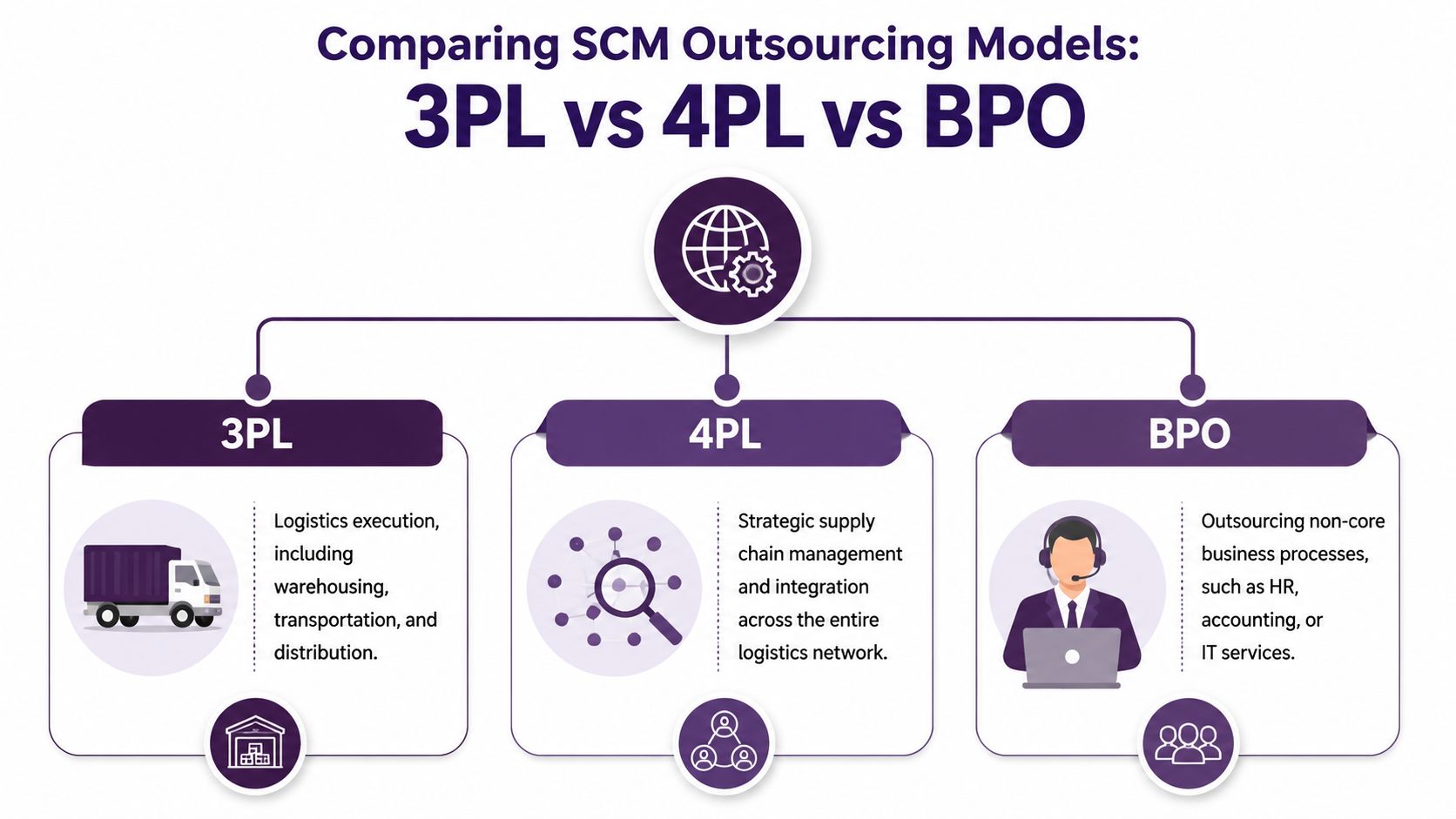
Comparison of supply chain outsourcing models
| Model | Primary Function | Scope | Best For |
|---|---|---|---|
| 3PL | Logistics execution | Warehousing, transportation, distribution | Businesses needing operational delivery support |
| 4PL | Supply chain coordination | Multi-provider management, integration, planning oversight | Businesses with more complex logistics networks |
| BPO | Business process support | Customer service, order management, technical support, back-office tasks | Businesses needing scalable process capacity and customer-facing support |
What 3PL and 4PL do well
A 3PL is usually the right fit when you need execution. You want inventory stored, orders packed, freight booked, and deliveries managed by a provider with existing infrastructure.
A 4PL fits when the network itself has become the problem. Multiple carriers, warehouse partners, customs issues, and fragmented reporting can overwhelm internal teams. In that case, one orchestrating partner can simplify control.
There’s a real operating payoff here. According to Netsuite’s summary of 2025 CSCMP data, firms that strategically outsource functions like warehousing and procurement to 3PL or 4PL providers report 20% faster speed-to-market and see a 15% to 25% reduction in fulfillment costs per order.
Why BPO belongs in the same conversation
BPO is where many supply chain discussions still fall short.
If your support team handles order updates, payment questions, account verification, delivery exceptions, returns, claims, or technical troubleshooting, that team is protecting throughput. It prevents failed handoffs between customer, warehouse, finance, and carrier.
That makes BPO especially valuable for:
- E-commerce brands with high ticket volume and returns
- Healthcare and finance firms that need documented, compliant workflows
- Telecom and subscription businesses where service continuity matters as much as shipment accuracy
- Retailers that need seasonal scale without rebuilding internal headcount
If you’re weighing where outsourcing ends and team extension begins, Nerdify’s staff augmentation guide is useful because it clarifies when you need extra hands versus full process ownership.
A good selection question
Don’t ask, “Which model is best?”
Ask, “Where is the failure point in our operation?”
- If the issue is movement, start with 3PL.
- If the issue is coordination, consider 4PL.
- If the issue is customer-facing workflow, back-office friction, or service coverage, BPO is often the missing piece.
For a plain-language breakdown of how process outsourcing works, this overview of business process outsourcing gives a solid baseline.
The Strategic Gains and Hidden Risks of Outsourcing
Outsourcing can improve margin, but the stronger reason to do it is control through specialization.
A capable partner gives you mature processes, trained labor, management coverage, and tools that would take time and money to build internally. That matters when your internal team is already stretched across sales, operations, compliance, and customer issues. It also matters when demand moves faster than your hiring cycle.

The gains that matter most
Some benefits show up immediately. Others appear in how the business handles pressure.
- Focus: Internal teams spend more time on product, sales, vendor management, and strategic planning.
- Agility: Partners can often absorb seasonal spikes or service surges faster than an in-house team.
- Market coverage: Bilingual support, extended hours, and structured back-office operations make it easier to serve more customers consistently.
- Operational continuity: When issues hit, a specialized provider usually has clearer escalation paths and dedicated management oversight.
The risks companies underestimate
The problems are familiar. Quality drifts. Reporting gets thin. Response times slip. Internal teams lose visibility. Leaders discover too late that the provider is following a generic script instead of the company’s actual process.
These failures usually come from one of three issues:
- The company outsourced a process it hadn’t documented.
- The partner couldn’t integrate with the existing system stack.
- The operating model created too much distance between the business and the work.
That third issue is where geography matters.
According to Deskera’s summary of outsourcing vulnerability research, geographic dispersion of outsourced activities significantly increases supply chain vulnerability, while nearshore models can reduce disruption risks by 20% to 30% through enhanced visibility and faster response capabilities.
Field observation: Distance doesn’t only slow shipments. It slows decisions.
Why nearshore reduces avoidable friction
An offshore setup may look efficient until something breaks at noon your time and the partner’s management team is offline. Then a simple issue waits overnight. The customer waits too.
A nearshore model reduces that delay. The team works closer to your business hours, escalation happens in real time, and supervisors can resolve exceptions while the rest of your operation is still online. That improves coordination between support, logistics, finance, and leadership.
This matters even more in customer-facing work, where speed and tone affect brand trust. In those environments, nearshore often provides a better balance of cost, visibility, and control than either onshore staffing or distant offshore delivery.
If you’re evaluating those trade-offs directly, this comparison of nearshore vs offshore outsourcing costs risks and ROI is worth reviewing.
A Practical Roadmap for Outsourcing Implementation
Most outsourcing problems begin before the contract is signed.
Companies rush into provider selection because they need relief. They choose the lowest-cost option, skip process mapping, and assume onboarding will solve the rest. It won’t. A good outsourcing and supply chain management program starts with clarity.
Step 1 Define the business problem first
Start with the workflow, not the vendor.
Are you trying to reduce missed calls, improve order-status handling, stabilize after-hours coverage, shorten return processing, or remove repetitive back-office work from internal staff? Each objective points to a different operating model and a different partner profile.
Write down:
- What process is failing: Be specific. “Customer service is overloaded” is too broad. “Order change requests are sitting too long and causing fulfillment errors” is better.
- What success looks like: Faster response, fewer handoff errors, better visibility, cleaner documentation, or more consistent coverage.
- What must remain in-house: Brand voice, exception approvals, compliance review, or senior escalation ownership.
Step 2 Build an RFP around operating fit
Price matters. It shouldn’t lead the process.
Your request for proposal should test whether the provider can work inside your environment. Ask how they handle CRM integration, QA reviews, escalation protocols, bilingual coverage, documentation standards, and management reporting. If you use tools like Salesforce, HubSpot, NetSuite, Zendesk, or Shopify, ask for a concrete explanation of how the partner will work inside them.
For physical operations, adjacent infrastructure matters too. If your process connects to loading, receiving, or warehouse handoff, practical details around dock flow and equipment reliability can affect service performance. Resources like Wilcox Door Service Inc. loading dock equipment are useful when you need to understand how facility-side bottlenecks can influence broader supply chain execution.
Step 3 Set SLAs that match the customer experience
A weak SLA measures activity. A strong SLA measures outcomes.
For BPO and back-office support, useful service levels often include:
- Response speed: How fast calls, chats, emails, or tickets are answered
- Resolution quality: Whether issues are solved without repeat handling
- Escalation discipline: How quickly complex issues move to the right owner
- Documentation accuracy: Whether notes, tags, and dispositions are complete and usable
- Schedule adherence: Whether the team is available when promised
“If the SLA doesn’t protect the customer experience, it’s probably measuring the wrong thing.”
Use a scorecard your managers will review every week. A complicated dashboard that no one uses has zero value.
Step 4 Use KPIs to manage the relationship
SLAs define promises. KPIs show whether the system is improving.
For customer-facing outsourcing, strong KPIs usually include first-contact resolution, average speed of answer, quality assurance scores, backlog age, reopen rate, and customer satisfaction trends. For back-office work, you may track processing accuracy, turnaround time, exception volume, and queue health.
If analytics are part of the engagement, specialized providers can add real value. According to Armstrong & Associates’ outsourcing analytics overview, outsourcing supply chain analytics can reduce stockouts by up to 30% and cut lead times by 10% to 15%, often delivering positive ROI within 3 to 6 months.
Step 5 Govern the partnership like an operating function
The provider shouldn’t sit outside the business. They should sit inside your operating rhythm.
That means regular reviews, shared dashboards, weekly issue logs, monthly performance discussions, and named owners on both sides. It also means documenting nonstandard workflows early. Many service failures happen because the internal team forgot to explain the exception path, not because the partner ignored it.
If you’re exploring process support beyond front-line service, this guide on outsourced back-office services is a practical next read.
The Future of SCM Technology Data and Nearshoring
Technology and geography are now tied together. That’s one of the biggest shifts shaping outsourcing and supply chain management.
AI forecasting, BI dashboards, telephony integration, CRM syncing, order management visibility, and workflow automation all sound great in a slide deck. They create value only when teams can implement and use them together. That’s where proximity starts to matter more than many companies expected.

Digital progress is real, but uneven
The push toward digital supply chains hasn’t disappeared. It has become more selective.
According to McKinsey’s 2025 supply chain risk survey, the share of companies planning major investments in digital supply chain systems dropped from 47% to 25% year over year. At the same time, 86% of executives recognize the need to invest in digital technology for supplier risk tracking. The same survey summary also notes that, in RSM US data from March 2025, 47% of middle-market companies had reached digital maturity Level 4, where data is automatically analyzed via BI tools.
That tells you something important. Companies still want visibility and resilience, but they’re more careful about where they spend and how quickly systems can produce usable results.
Why nearshore supports better tech adoption
When support, back-office, and operations teams work in a nearshore model, integration tends to be more practical.
The reasons are straightforward:
- Faster troubleshooting: Teams can resolve CRM, telephony, or workflow issues during shared business hours.
- Better process alignment: Supervisors and client teams can review live cases, not yesterday’s summaries.
- Cleaner rollout: Training, QA calibration, and escalation changes happen with less lag.
- Stronger visibility: Customer-facing teams can surface exceptions quickly before they become inventory, finance, or retention issues.
Nearshoring also fits the broader strategic direction of North American operations. As noted earlier in the Tecsys summary, over 90% of North American manufacturing companies have already relocated part of their supply chain in the past five years, reflecting a wider shift toward resilience and control rather than pure labor arbitrage.
What the next phase looks like
The future isn’t “outsource everything.” It’s outsource deliberately.
The best models will combine:
- specialized logistics partners for execution
- process partners for customer and back-office continuity
- shared data environments for visibility
- nearshore operating structures that reduce communication friction
If your current model depends on distance, fragmented systems, and after-the-fact reporting, it will keep producing the same blind spots. Businesses that win in 2026 will be the ones that connect systems, teams, and geography into one operating model.
FAQs About Outsourcing and Supply Chain Management
How does outsourcing work in regulated industries like healthcare or finance
It works when compliance is part of the design, not an afterthought.
That means documented workflows, role-based access, audit-ready records, secure handling of customer data, and provider training that matches your operating requirements. In healthcare or financial services, you also want clear escalation paths for exceptions and strict review of who can access what information. The provider should be able to explain process controls in plain English, not just say they take security seriously.
What is the typical timeline for transitioning to a BPO partner
There isn’t one universal timeline because complexity drives the schedule.
A simple overflow support program can move much faster than a fully integrated customer service and back-office transition involving CRM access, QA design, scripting, knowledge base cleanup, and escalation mapping. The biggest mistake is trying to launch before your workflows are documented. A phased rollout usually works better than a full switch all at once.
Can small businesses benefit from outsourcing and supply chain management support
Yes, especially when internal teams are overloaded by repeatable work.
Small businesses usually don’t need a massive outsourcing program. They need coverage in the places where delays hurt cash flow or customer retention. That might mean after-hours support, order-status handling, appointment coordination, lead qualification, collections follow-up, or back-office processing. The right partner gives them capacity without forcing them to build a full internal department.
What should a business look for in a modern outsourcing partner
Look for operational fit.
A good partner should align with your systems, your escalation style, your reporting needs, and your customer expectations. Digital maturity matters here. As noted in the McKinsey survey cited earlier, 47% of middle-market companies have reached a stage where data is automatically analyzed via BI tools, which means your partner should be comfortable operating in a data-driven environment rather than relying on manual status updates alone.
Is customer support really part of supply chain management
For many businesses, yes.
If support teams manage order changes, returns, shipment exceptions, billing questions, claims, or account verification, they directly affect order flow, revenue protection, and customer retention. In practical terms, they’re part of the chain that moves value to the customer and protects it when something goes wrong.
Outsourcing Supply Chain Planning
Outsourcing supply chain planning can help businesses improve forecasting, coordination, and operational efficiency by extending internal teams with specialized support. While strategic decisions should remain under company leadership, external teams can assist with data management, order coordination, customer communication, reporting, and other administrative processes that support supply chain planning.
For companies managing growing order volumes or complex customer requirements, outsourcing supporting functions can also free internal teams to focus on inventory strategy, supplier relationships, forecasting, and long-term planning.
Frequently Asked Questions About Supply Chain Outsourcing
1. What Is a Supply Chain Outsourcing Strategy?
A supply chain outsourcing strategy is a plan for determining which supply chain activities can be handled by an external partner to improve efficiency, reduce costs, increase scalability, and maintain service quality. Companies may outsource functions such as customer service, order processing, returns, billing support, technical support, and back-office operations while keeping strategic control in-house.
2. Which Supply Chain Processes Should Be Outsourced?
The best supply chain processes to outsource are typically repetitive, labor-intensive, or customer-facing activities that can be standardized and measured. These may include customer service, order processing, shipment tracking, returns and refunds, billing support, technical support, data entry, and other back-office tasks. Companies should retain strategic oversight while outsourcing processes where specialized teams can improve efficiency, scalability, and service quality.
🚀 Build a Smarter Supply Chain Strategy
Talk with CallZent about nearshore customer support and back-office outsourcing solutions designed for scalable North American operations.
Schedule a ConsultationIf your business needs a nearshore partner that can support customer service, back-office operations, and bilingual workflows with North American alignment, CallZent is a strong place to start. The team helps companies build practical outsourcing models that improve responsiveness, reduce operational friction, and support scalable growth without sacrificing visibility or control.