SaaS Customer Experience
SaaS Customer Support: Balancing AI, Humans, and Nearshore Teams
Build SaaS customer support that combines AI, self-service, human escalation, bilingual nearshore teams, practical SLAs, and retention-focused metrics.
TL;DR — Quick Takeaways
- Use self-service and AI for predictable questions, classification, summaries, and controlled workflows.
- Route billing disputes, account recovery, technical edge cases, regulated work, and churn-risk conversations to trained people.
- Measure first response, resolution, repeat contacts, transfers, reopen rates, and SLA compliance by channel and account.
- Connect support signals with customer success, product, engineering, and commercial teams before renewal risk grows.
- Build escalation rules around severity, customer impact, ownership, deadlines, and backup routes.
- Bilingual nearshore teams can provide English-Spanish coverage during North American business hours.
- The goal is not maximum automation. It is assigning the right level of judgment to every customer interaction.
SaaS customer support can cost far less than assisted service, yet the wrong automation strategy can still put renewals at risk. One industry roundup estimates that self-service contacts cost about $1.84, compared with $13.50 for assisted contacts, while B2B SaaS companies still face average monthly churn of 3.5%. Those benchmarks point to the operational challenge: reduce avoidable contact volume without making customers fight a bot when the account, revenue, or product issue is complex.
This guide focuses on the part many SaaS playbooks skip, the handoff between automation and human bilingual support. It covers support models, response metrics, escalation design, AI limitations, and how nearshore teams in Tijuana can give North American SaaS companies capacity without giving up language coverage or time-zone alignment.
Why SaaS Customer Support Drives Revenue and Retention
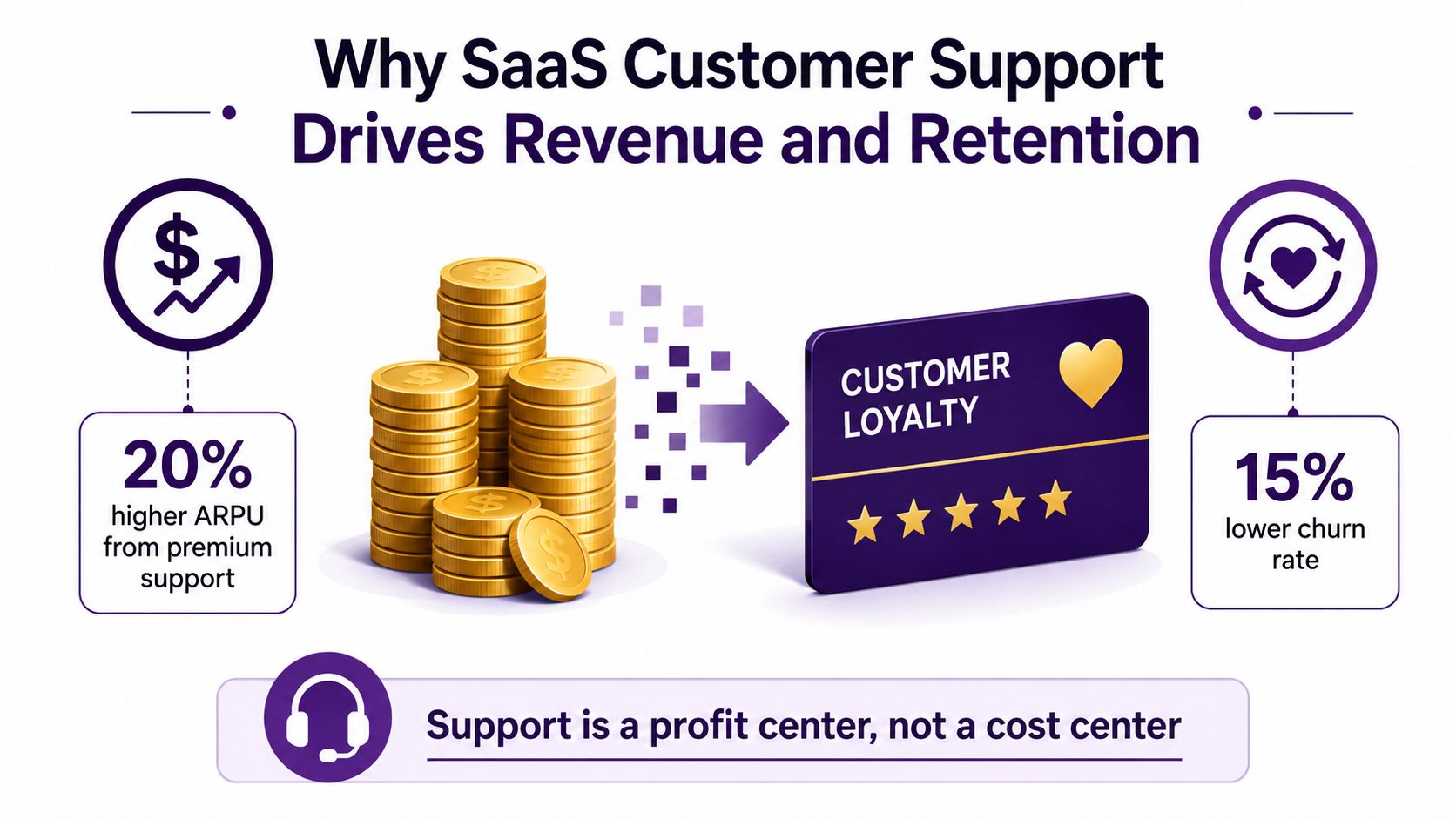
SaaS support affects recurring revenue directly. Treating it only as overhead hides the cost of preventable contacts, failed adoption, and avoidable churn. Support conversations often reveal whether customers can use the product confidently, whether implementation is stalling, and whether an account needs attention before renewal discussions begin.
The operating model determines where that capacity goes. A reliable knowledge base and automation can handle routine password questions, configuration guidance, and basic feature explanations. Human agents should take over when the issue involves billing disputes, implementation friction, technical failures, account history, or retention risk. The goal is not maximum deflection. It is to reserve judgment and language coverage for cases where a poor interaction can damage trust.
Support interactions reveal commercial risk
Support teams often see adoption problems before customer success does. Repeated questions about one workflow may expose confusing product design. A sudden increase in contacts from one account can point to an integration failure, an unresolved bug, or a customer whose internal champion is losing confidence.
Churn rarely appears as one clean event. Customers can remain polite in surveys while contacting support more frequently, reopening cases, or requesting workarounds. Route those signals to customer success and product teams, then assign an owner and a follow-up date. Without that workflow, support data becomes a report instead of an early intervention system.
Operational takeaway: A closed ticket is an output. A customer who can use, trust, and renew the product is the business outcome.
Support can also identify expansion opportunities. An agent who understands account context may notice a need for a feature, higher service tier, additional seats, or implementation guidance. Agents should document the signal and route it to the commercial owner rather than push a sale during a support interaction. Teams reviewing service infrastructure can also examine why sales teams choose integrated sales and customer service operations, especially when conversation context must move between departments.
Retention depends on follow-through, not a faster average response alone. Customer retention services can support proactive follow-up and structured customer-care workflows. For North American SaaS companies, bilingual nearshore teams in Tijuana can handle the human handoff when automation reaches its limits, preserving context across languages and giving retention-sensitive accounts a clear path to resolution.
Choosing the Right SaaS Support Model for Your Stage
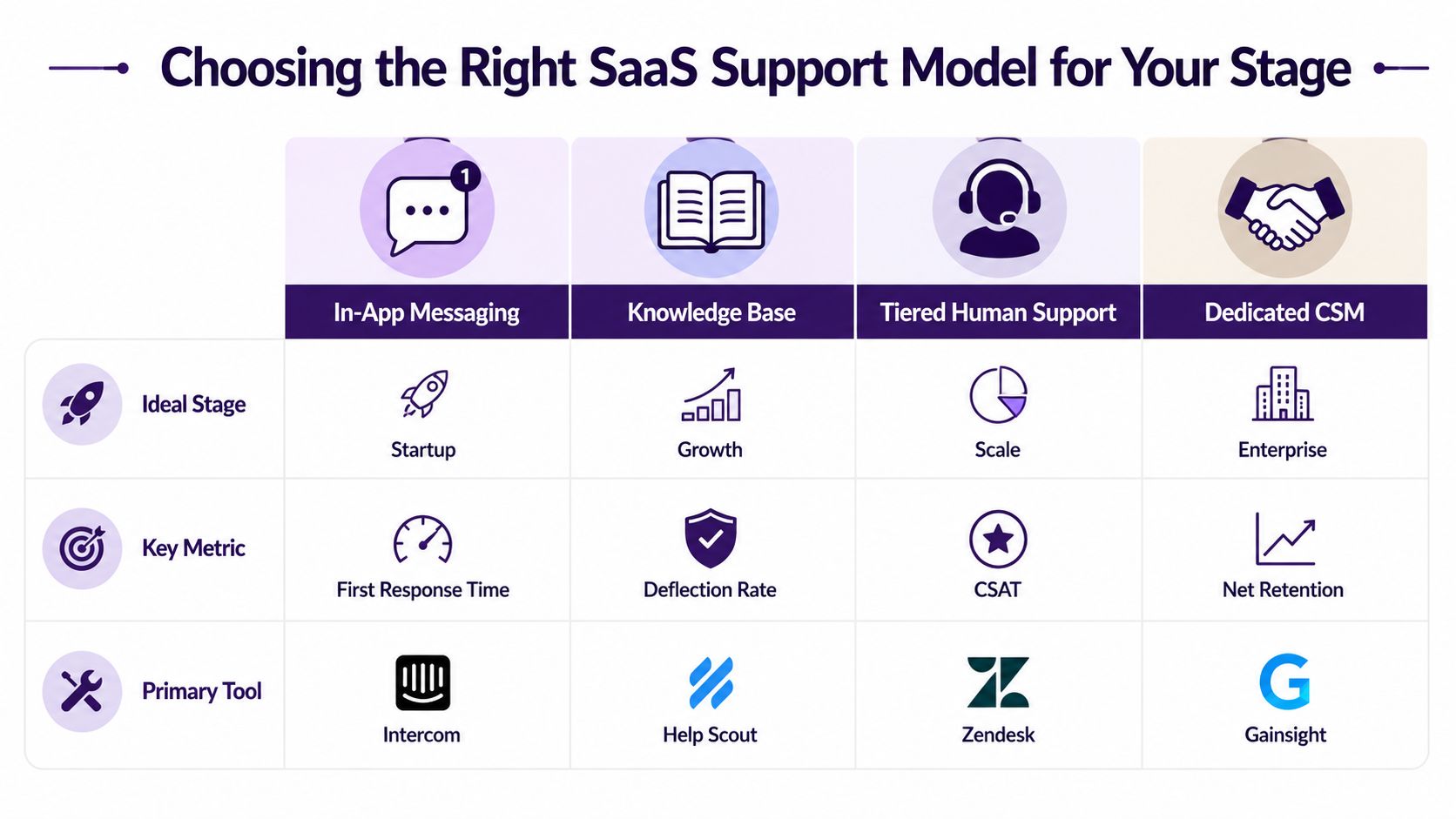
The right model depends on product complexity, customer value, and the type of help users need. A simple collaboration tool serving many smaller accounts may succeed with in-app messaging and a strong knowledge base. A security, finance, or healthcare platform serving enterprise customers needs specialist queues, documented escalation, and relationship ownership.
Four models with different jobs
In-app messaging works well when users need help while completing a workflow. Contextual prompts, guided steps, and embedded chat can prevent a customer from leaving the product to search for an answer. Its weakness is depth. It won’t replace a specialist who must investigate account history or coordinate with engineering.
A knowledge base gives customers control over routine questions and creates a foundation for AI responses. It works only when articles reflect the current product, use the customer’s language, and include clear next steps. A large library with outdated instructions creates deflection theater, not resolution.
Tiered human support fits growing products with different levels of complexity. Tier 1 can handle known questions and basic troubleshooting. Tier 2 can investigate integrations, reproduce technical problems, and coordinate with product or engineering. The handoff must include context, not a request for the customer to repeat the entire story.
Dedicated customer success management belongs with strategic or high-value accounts where adoption, renewal, and expansion require planned engagement. A CSM shouldn’t become a substitute for an overloaded support queue. The two functions need shared signals and separate responsibilities.
Match the model to the customer
| Business situation | Practical starting model | What to protect |
|---|---|---|
| Early-stage product with limited support volume | In-app guidance plus a maintained knowledge base | Fast learning from recurring questions |
| Growing SaaS product with mixed issue complexity | Tiered human support with AI-assisted routing | Clean ownership between tiers |
| Enterprise platform with strategic accounts | Specialist support plus dedicated CSM coverage | Context, accountability, and renewal visibility |
| Bilingual North American customer base | English and Spanish queues with consistent escalation rules | Language continuity across channels |
Founders often overbuild tools before they understand demand patterns. Start with a small set of categories, document the most common resolutions, and add tiers when agents repeatedly need different skills. For early teams, CallZent’s support for startups is one outsourcing option to evaluate when internal staff need additional coverage for onboarding, troubleshooting, or Tier 1 and Tier 2 work.
The Metrics That Actually Predict Churn and Expansion
CSAT and NPS have value, but they usually describe how a customer felt after an interaction. Operational metrics show what happened before that survey arrived. A useful SaaS dashboard combines response speed, resolution quality, repeat contact, and escalation behavior.
Start with response and resolution
For email, average first response time is about 12 hours, while best-in-class teams stay under 1 hour, according to benchmark data from Jitbit’s support metrics analysis. Live chat has a tighter expectation, customers typically expect a reply within 30 seconds to 2 minutes. Channel-specific targets matter because one blended average can make email look healthy while live chat is failing.
| Metric | SMB target | Enterprise target | Churn signal |
|---|---|---|---|
| Email first response time | Under 4 hours | Under 1 hour | Repeated waiting on urgent or high-value issues |
| Live chat first response time | Under 2 minutes | Under 1 minute | Abandoned conversations and repeated attempts |
| Resolution time | Based on severity and issue complexity | Tighter for critical accounts | Reopened cases or unresolved workarounds |
| Contact frequency | Monitor account baseline | Review at account level | A 50% or greater spike can predict churn within 90 days, even when CSAT remains positive, according to this SaaS support benchmark |
Use first-contact resolution carefully. A fast closure that sends the customer to another channel isn’t a success. Pair it with reopen rate, transfer rate, and customer comments so agents aren’t rewarded for closing cases prematurely.
Build an account-level view
A dashboard should let a manager filter by plan, language, channel, severity, product area, and account. Review the customer-level pattern, not only the team average. A small account with one slow reply may be less urgent than a strategic customer whose contacts have risen sharply across several days.
Teams using predictive customer analytics can combine support events with usage, renewal timing, and account history. The practical workflow is simple: flag the pattern, verify the context, assign an owner, and record the intervention. Metrics create value only when someone acts on them.
Where AI Automation Ends and Human Support Takes Over
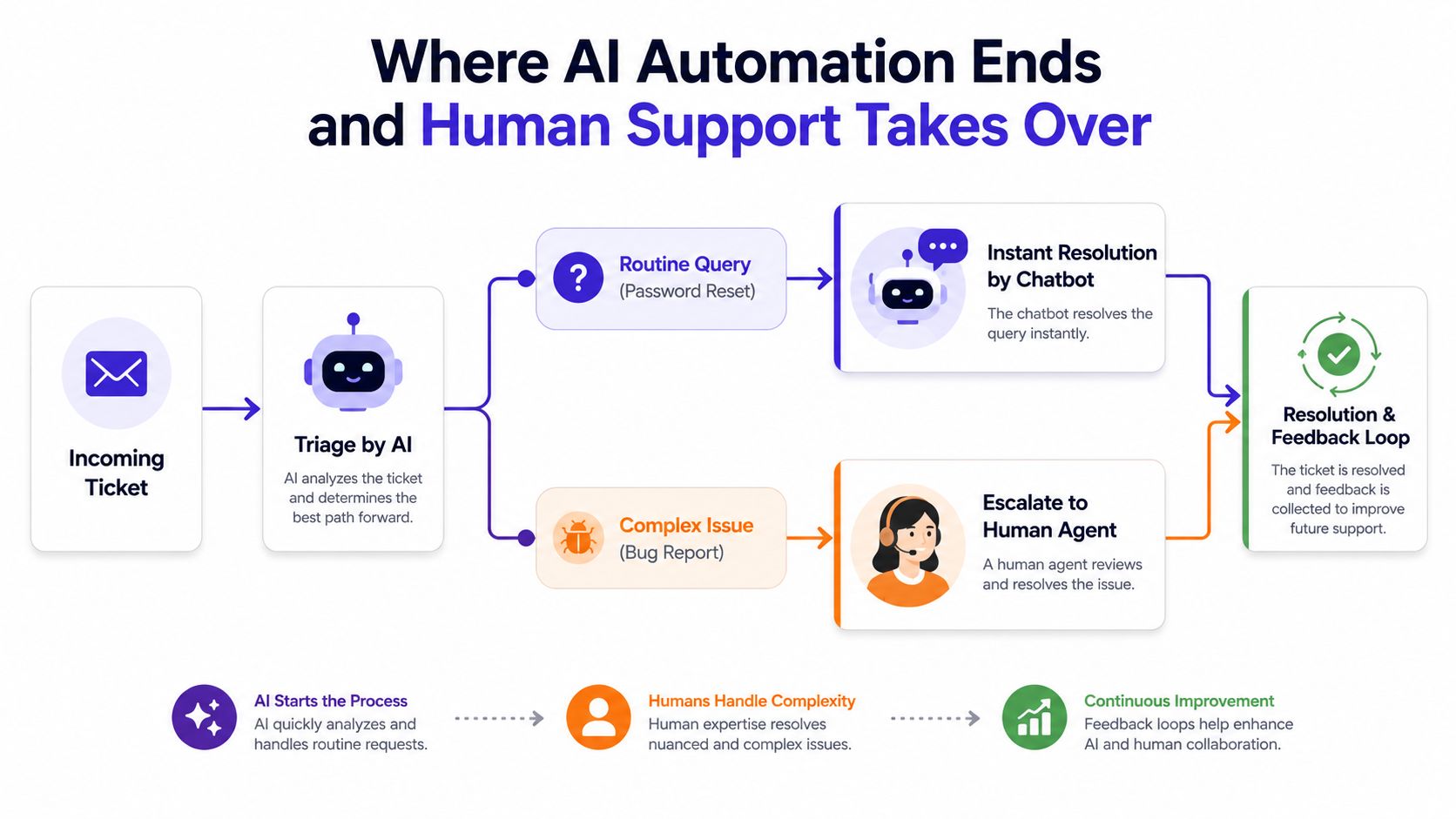
AI is excellent at reducing latency for predictable work. Benchmark data reports that AI can reduce average first response time from roughly 4 hours to under 30 seconds for automated queries, while mature deployments can autonomously resolve 50% to 70% of tickets and improve first-contact resolution by about 23%. Those findings make a strong case for automation, but they don’t justify removing human judgment from the support model.
The practical boundary is risk and ambiguity. AI can classify intent, retrieve approved content, summarize a conversation, ask for missing information, and complete tightly controlled workflows. It becomes less reliable when the customer needs an exception, the facts conflict, or the cost of a wrong answer is high.
Keep these issues human-led
- Billing disputes: A payment complaint may involve credits, contract terms, tax treatment, or a frustrated decision-maker. Route it to an agent who can verify the account and explain the outcome clearly.
- Account recovery: Identity and access issues require careful verification and an escalation path that protects the customer and the company.
- Technical edge cases: A failed integration, inconsistent data, or unusual environment may not match the knowledge base. An agent needs to collect evidence and coordinate with technical teams.
- Regulated workflows: Healthcare and financial services customers may need controlled handling, documentation, and approved language.
- Churn-risk contacts: If a customer signals cancellation, loss of trust, or repeated operational disruption, a bot should not become the final owner.
Self-service deflection remains uneven. Mature programs typically deflect only 25% to 40% of inbound volume, and deflection benchmark coverage shows why teams shouldn’t treat containment as a universal target. Another benchmark-style source reports median deflection around 22% for AI self-service, 18% for traditional knowledge bases, and 11% for pre-LLM chatbots, as discussed in SaaS customer service trends.
Human handoff rule: Escalate when the customer’s risk is higher than the cost of involving an agent.
Design the AI layer to transfer context automatically. The receiving agent should see intent, conversation history, account tier, authentication status, and the reason for escalation. Conversational AI for customer support can be evaluated as part of that hybrid architecture, provided the workflow preserves a clear route to a human.
Building SLAs and Escalation Workflows That Hold Up
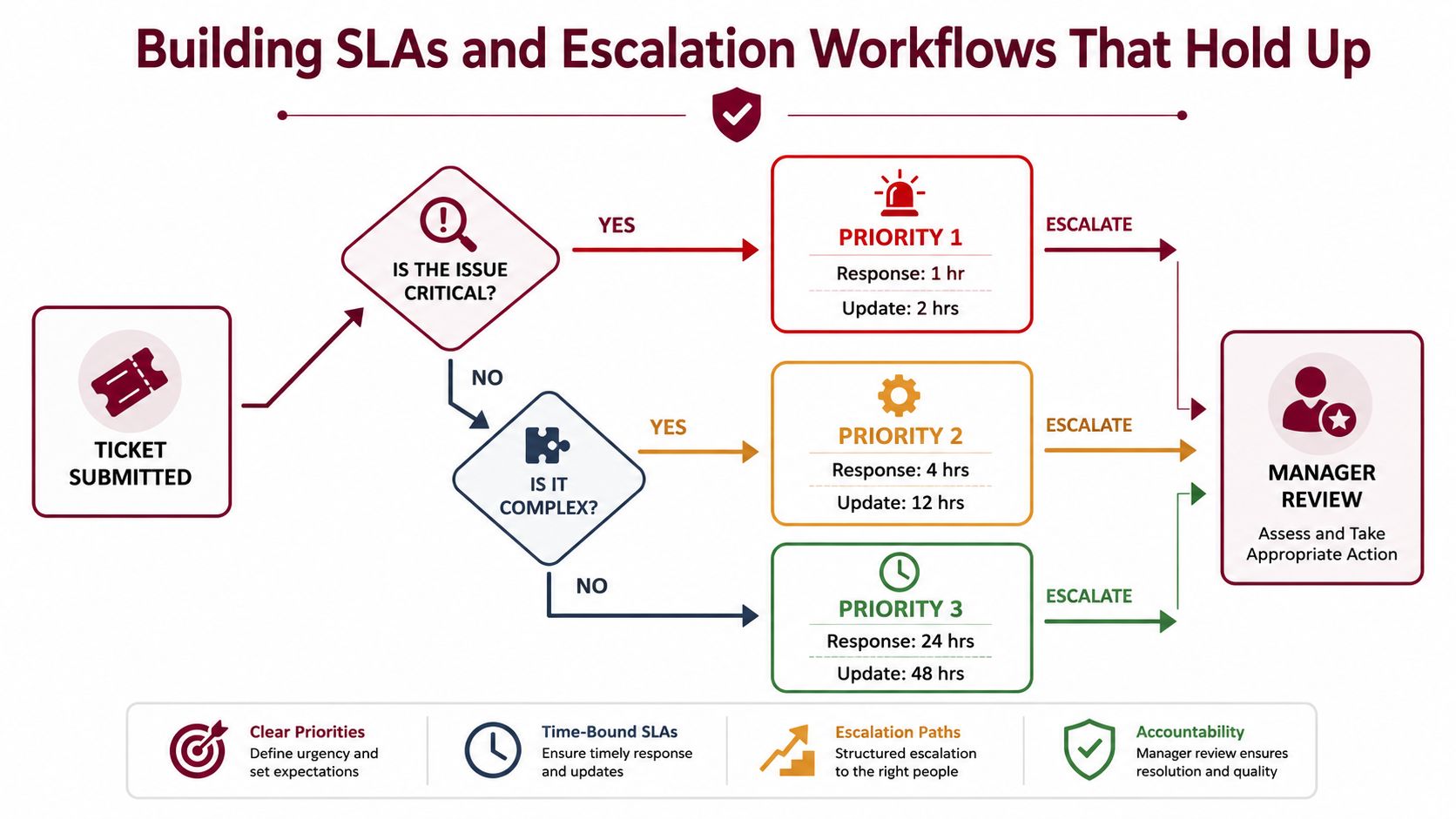
An SLA isn’t a promise to respond quickly in the abstract. It’s a set of measurable commitments tied to severity, channel, customer tier, business hours, and escalation ownership. The two essential mechanics are first response time and resolution time, with escalation triggered before the target is missed. Jitbit’s SLA guidance describes routes that move from assigned technician to team lead to administrator, a practical pattern for hybrid teams.
Use severity to control urgency
A SaaS team may set first-response targets of under 15 minutes for Severity 1, under 30 minutes for Severity 2, and an SLA compliance goal of 95% or higher, with 70% of tickets resolved at L1 without escalation, based on this SaaS escalation SOP. These figures should be adapted to product risk and staffing capacity, not copied blindly.
| Severity | Example | Response action | Escalation action |
|---|---|---|---|
| Severity 1 | Broad outage or blocked critical operation | Page the on-call owner immediately | Move to team lead and administrator if ownership isn’t accepted |
| Severity 2 | Major account function impaired | Assign a specialist and provide a clear update path | Escalate before the response or update target is at risk |
| Severity 3 | Standard question or limited-impact defect | Resolve through knowledge, AI, or L1 support | Escalate when troubleshooting fails or the customer reopens the case |
Channel and tier expectations can differ sharply. Industry guidance commonly places B2B SaaS email first response under 4 hours, high-touch enterprise email under 1 hour, and live chat under 1 minute, as outlined by SaaS reply-time benchmarks. Track business-hours rules separately from 24/7 coverage so customers aren’t given a promise the queue can’t fulfill.
Before publishing an SLA, test it with real scenarios. A ticket should have a severity, owner, next action, deadline, and backup route. Managers should review aging queues at defined intervals, while agents should know exactly when to escalate rather than waiting for a customer to complain. Teams also comparing service commitments can use this context to find the right uptime guarantee for their customer-facing promises.
Scaling with Bilingual Nearshore Teams
Domestic hiring gives a SaaS company close cultural alignment, but it can become expensive and slow to expand. Offshore staffing may offer capacity, yet distance can complicate real-time collaboration, training, and language continuity. A bilingual nearshore team in Tijuana offers a practical middle layer for companies serving North American customers in English and Spanish.
The value isn’t just access to another language. Bilingual agents can keep a conversation in the customer’s preferred language, understand regional expectations, and escalate internally without forcing the customer through disconnected queues. That matters in SaaS because a technical problem often includes onboarding, billing, and business-impact questions in the same interaction.
Design the partnership around operations
A nearshore program works when the client owns the service definition and the provider executes against shared controls. Start with:
- Queue design: Separate routine questions, technical troubleshooting, account issues, and retention-sensitive cases.
- Language routing: Capture language preference at intake and preserve it through escalation.
- Training access: Give agents product environments, approved knowledge, test accounts, and regular release briefings.
- Performance reporting: Review first response, resolution time, transfer rate, reopen rate, SLA compliance, and customer feedback by language and queue.
- Security controls: Document access permissions, authentication steps, data handling, audit requirements, and incident escalation before launch.
Accent neutrality is only one part of quality. Clear writing, accurate technical vocabulary, empathy, and consistent documentation matter more than forcing every conversation into a single scripted style. Compliance also requires process discipline, especially for healthcare, finance, and insurance workflows. A vendor should be able to explain who can access customer data, how agents authenticate users, and how sensitive cases move to authorized teams.
Geographic proximity helps managers run calibration sessions, product training, and escalation reviews with less friction than a distant operation. It also supports coverage aligned with North American working hours while giving the SaaS company a scalable staffing layer. CallZent’s bilingual call center services are one example of a Tijuana-based model built around English and Spanish customer interactions, technical support, and outsourced operational capacity.
The trade-off is governance. Nearshore outsourcing won’t fix unclear documentation, weak product ownership, or unrealistic SLAs. It amplifies the operating model you provide, so the client and BPO must jointly maintain the knowledge base, QA rubric, escalation matrix, and feedback loop.
Applying These Principles Across Industries
A SaaS support model becomes useful when it reflects the consequences of failure in each industry. The same chatbot workflow that handles a basic e-commerce question may be inappropriate for a healthcare access issue or a financial dispute.
Healthcare SaaS
A healthcare platform should route access, records, and workflow interruptions to trained human agents when the issue involves sensitive information or patient-impacting operations. AI can help classify the request and collect non-sensitive context, but the escalation path must preserve authorization checks, approved language, and complete case documentation. Managers should monitor response and resolution performance by severity rather than rewarding fast closure alone.
Financial services and fintech
A fintech support team needs a clear distinction between general product guidance and disputes involving transactions, fees, identity, or account access. Automation can explain standard processes, while bilingual agents handle emotionally charged or ambiguous cases and route regulated decisions to authorized specialists. Contact-frequency spikes deserve account-level review because repeated attempts may signal unresolved financial risk, even when the customer remains courteous.
E-commerce and retail
E-commerce SaaS teams face predictable questions about orders, returns, shipping status, and account settings. A knowledge base and AI layer can absorb much of that demand, but human coverage becomes essential during promotions, delivery disruptions, refund exceptions, and Spanish-language escalations. Staffing plans should flex around known volume patterns without allowing first-response performance to collapse during peak periods.
Telecom
Telecom support combines technical troubleshooting with retention pressure. Automated diagnostics can collect device, service, and connectivity details, but agents need authority to investigate complex failures, explain outages, and identify customers considering cancellation. Tier 2 should receive structured evidence so customers aren’t asked to repeat troubleshooting steps across multiple contacts.
SMB SaaS platforms
Small-business customers often need practical guidance rather than a long technical explanation. A bilingual Tier 1 team can help with onboarding, feature use, and basic troubleshooting, then escalate bugs or account-risk signals with the full interaction history. The model keeps routine support efficient while giving owners and operators access to a human who understands the business impact of downtime.
Across these industries, the operating principle stays consistent: automate predictable work, measure the customer journey rather than isolated tickets, and give human agents ownership of ambiguity and risk. The strongest SaaS customer support operation isn’t the one with the fewest agents. It’s the one that assigns the right level of judgment to every interaction.
Build Your Bilingual SaaS Support Team
Create a hybrid support model with English-Spanish coverage, defined SLAs, intelligent automation, and human escalation built around your customers.
Talk to an ExpertFrequently Asked Questions
1. What is SaaS customer support?
SaaS customer support helps users resolve product, configuration, integration, billing, account, and technical issues associated with subscription software.
2. How does SaaS support affect customer retention?
Support influences whether customers can adopt, trust, and continue using the product. Repeated problems, slow resolution, and poor escalation can increase renewal risk even when satisfaction surveys remain positive.
3. Which SaaS support requests should be automated?
Predictable FAQs, classification, approved knowledge retrieval, status requests, summaries, and tightly controlled workflows are common automation candidates.
4. Which support requests should go to human agents?
Billing disputes, account recovery, technical edge cases, regulated workflows, churn-risk conversations, high-impact incidents, and policy exceptions generally benefit from trained human ownership.
5. What metrics should SaaS customer support track?
Important metrics include first-response time, resolution time, first-contact resolution, reopen rate, transfer rate, repeat contacts, escalation speed, SLA compliance, CSAT, customer effort, and account-level contact frequency.
6. What is a SaaS support SLA?
A SaaS support SLA defines measurable response, resolution, update, availability, and escalation commitments according to factors such as severity, channel, customer tier, and operating hours.
7. How should AI transfer a customer to a human agent?
The handoff should include the customer’s intent, conversation history, account tier, language, authentication status, troubleshooting activity, severity, and reason for escalation.
8. What is bilingual SaaS customer support?
Bilingual SaaS support assists customers in two languages, commonly English and Spanish, while maintaining consistent product knowledge, documentation, escalation, and quality standards.
9. Why use a nearshore SaaS support team?
A nearshore team can provide compatible business hours, bilingual talent, geographic proximity, closer collaboration, and potentially lower operating costs than equivalent domestic staffing.
10. Can an outsourced SaaS support team provide Tier 1 and Tier 2 service?
Yes. A qualified provider can manage Tier 1 questions and Tier 2 troubleshooting when agents receive the appropriate product environments, training, knowledge, system access, quality controls, and escalation procedures.
CallZent provides bilingual nearshore customer support and BPO services from Tijuana, including SaaS troubleshooting, onboarding, Tier 1 and Tier 2 support, and back-office workflows for North American businesses. Visit CallZent to discuss a hybrid support model with English and Spanish coverage, defined SLAs, and escalation processes built around your customers.