

Telemarketing Services
Telemarketing Services Guide for 2026: In-House vs. Outsourced vs. Nearshore
Learn how telemarketing services work in 2026, how compliance shapes operations, and why nearshore outsourcing can improve quality, control, and ROI.
TL;DR — Quick Takeaways
- Telemarketing services are still relevant when they are treated as a structured business function, not a volume game.
- Modern telemarketing supports lead qualification, appointment setting, renewals, retention, service recovery, market feedback, and inbound conversion support.
- The smartest model depends on your campaign type, industry, compliance requirements, customer expectations, and internal capacity.
- Nearshore telemarketing services can help U.S. companies improve time-zone alignment, bilingual coverage, management access, and campaign control.
- Strong providers build compliance, QA, list hygiene, script discipline, and reporting into the campaign from day one.
Most companies ask the wrong question about telemarketing. They ask whether it still works, when the better question is whether their team is using the right operating model, list strategy, script discipline, and compliance process.
That distinction matters. Poor telemarketing feels intrusive, expensive, and hard to scale. Well-run telemarketing services feel like a controlled revenue and service channel with clear use cases: lead qualification, appointment setting, renewals, retention, market feedback, and inbound conversion support.
Key takeaway: Telemarketing still works, but only when operations, compliance, and targeting are built into the campaign from day one.
Is Telemarketing Still Relevant in 2026
Telemarketing still matters in 2026 because voice remains one of the fastest ways to qualify intent, resolve objections, and move a buyer to the next step. Digital channels create awareness. A live conversation often creates commitment.
The reason many companies dismiss telemarketing is simple. They remember bad calling, not good systems. They picture generic cold calls, weak scripts, random lead lists, and agents measured only on dial volume. That model burns money and brand trust.
Why the channel still holds its place
Modern telemarketing services work best when a business needs one or more of these outcomes:
- Faster lead qualification: Sales teams don’t waste time on unfit prospects.
- Appointment setting: Reps speak with decision-makers instead of chasing no-response emails.
- Retention outreach: Existing customers get a human touch before they churn or lapse.
- Service recovery: A live call can calm a frustrated customer faster than a long email chain.
- Market feedback: Teams hear objections, competitor mentions, and buying signals directly from the market.
For a software firm, that might mean calling inbound demo requests that stalled after form submission. For an insurance agency, it could mean annual policy review outreach. For an e-commerce brand, it may mean follow-up on high-value orders, subscription renewals, or failed checkouts.
What separates useful telemarketing from wasted spend
The strongest programs are selective. They don’t call everyone. They define who should be called, why now, what the desired outcome is, and which objections matter most. They also connect telemarketing to a business process, not just a sales target.
That usually means tighter coordination between marketing, sales, compliance, and operations. If those teams aren’t aligned, telemarketing becomes noise. If they are aligned, it becomes a practical conversion layer that other channels can’t fully replace.
What Modern Telemarketing Services Actually Are
Modern telemarketing services aren’t just sales calls. They’re structured voice-based interactions designed to move a business objective forward.
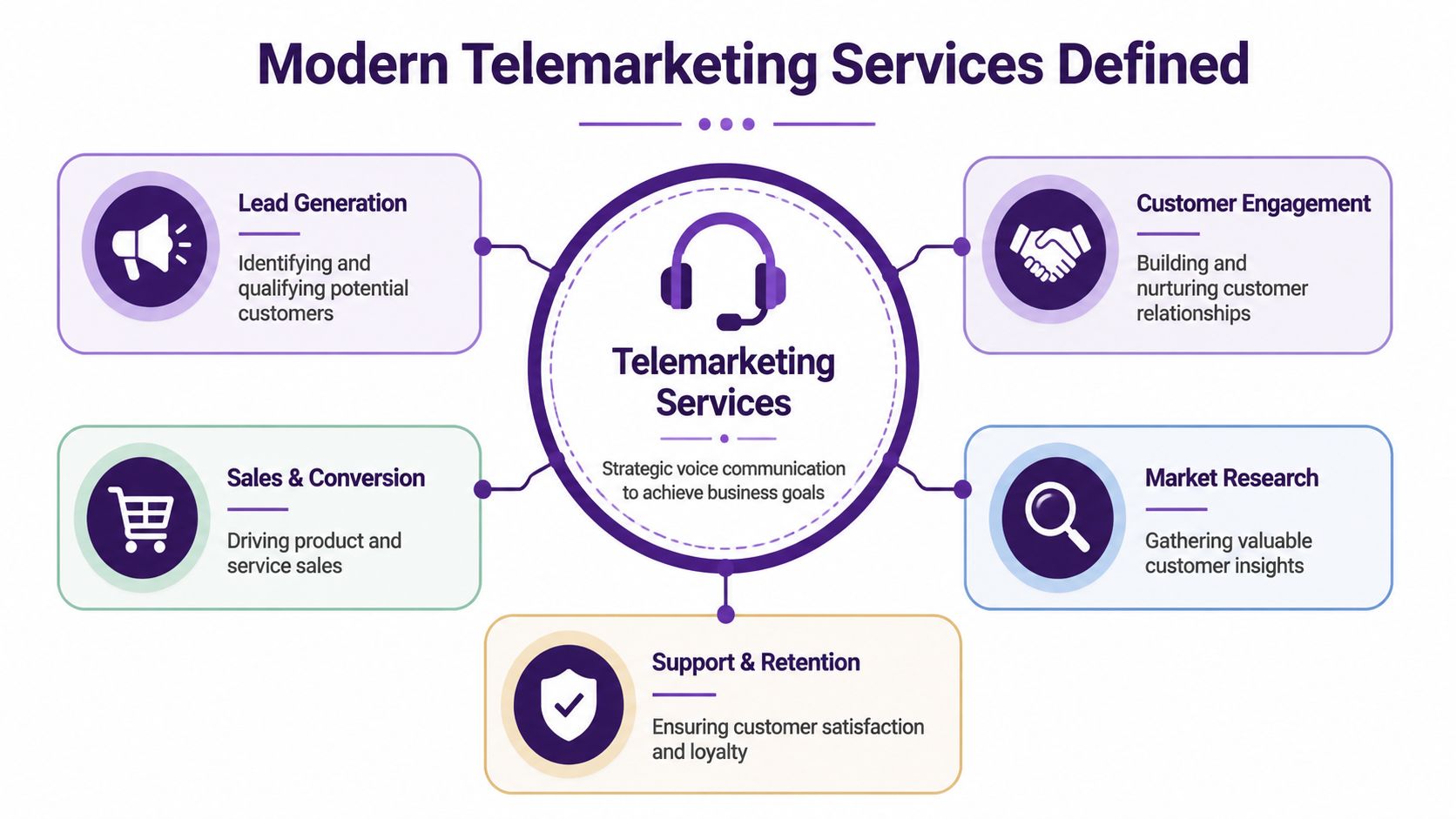
In practice, that can include outbound prospecting, inbound response handling, lead nurturing, customer reactivation, post-sale follow-up, survey calls, and account support. The common thread is that a company is using live voice conversations to create a business result that email, chat, or self-service can’t reliably produce on its own.
Telemarketing is broader than telesales
A lot of buyers use telemarketing and telesales as if they mean the same thing. They don’t.
Telesales is narrower. Its goal is to close a sale. Telemarketing services are broader and can support the sale before, during, or after the transaction. A campaign may qualify prospects, verify interest, collect missing information, confirm attendance for a demo, or recover at-risk accounts without asking for payment on the same call.
That broader view matters because many of the best telemarketing programs don’t force a sale. They remove friction so the next step happens faster.
Why this remains an established business function
The U.S. telemarketing and call center sector is still large and mature. IBISWorld projects 46,650 businesses in the industry and $30.9 billion in revenue for 2026, with the number of businesses growing at a 3.5% CAGR from 2021 to 2026 even as revenue declined at a 0.5% CAGR over the same period, according to IBISWorld’s telemarketing and call center industry data. That tells me two things. The channel hasn’t disappeared, and buyers need to be more selective because the market is crowded.
A mature market rewards operators who control quality, list hygiene, scripting, and agent productivity. It doesn’t reward spray-and-pray dialing.
What modern execution looks like
A capable operation usually combines people, process, and tooling:
- Defined call objectives: Each campaign has one job, not five.
- List segmentation: Different audiences get different scripts and cadences.
- Dialing workflow: Teams use process discipline and tools such as predictive dialing for outbound productivity to reduce idle time and improve agent focus.
- Script flexibility: Agents follow structure without sounding robotic.
- Feedback loops: Sales, CX, and operations use call outcomes to improve targeting.
If you’re evaluating workflow design, a practical buyer guide for outbound sales tools can help frame what belongs in the stack and what should stay simple.
A modern telemarketing program sounds less like a script and more like a guided business conversation.
The Main Types of Telemarketing Campaigns
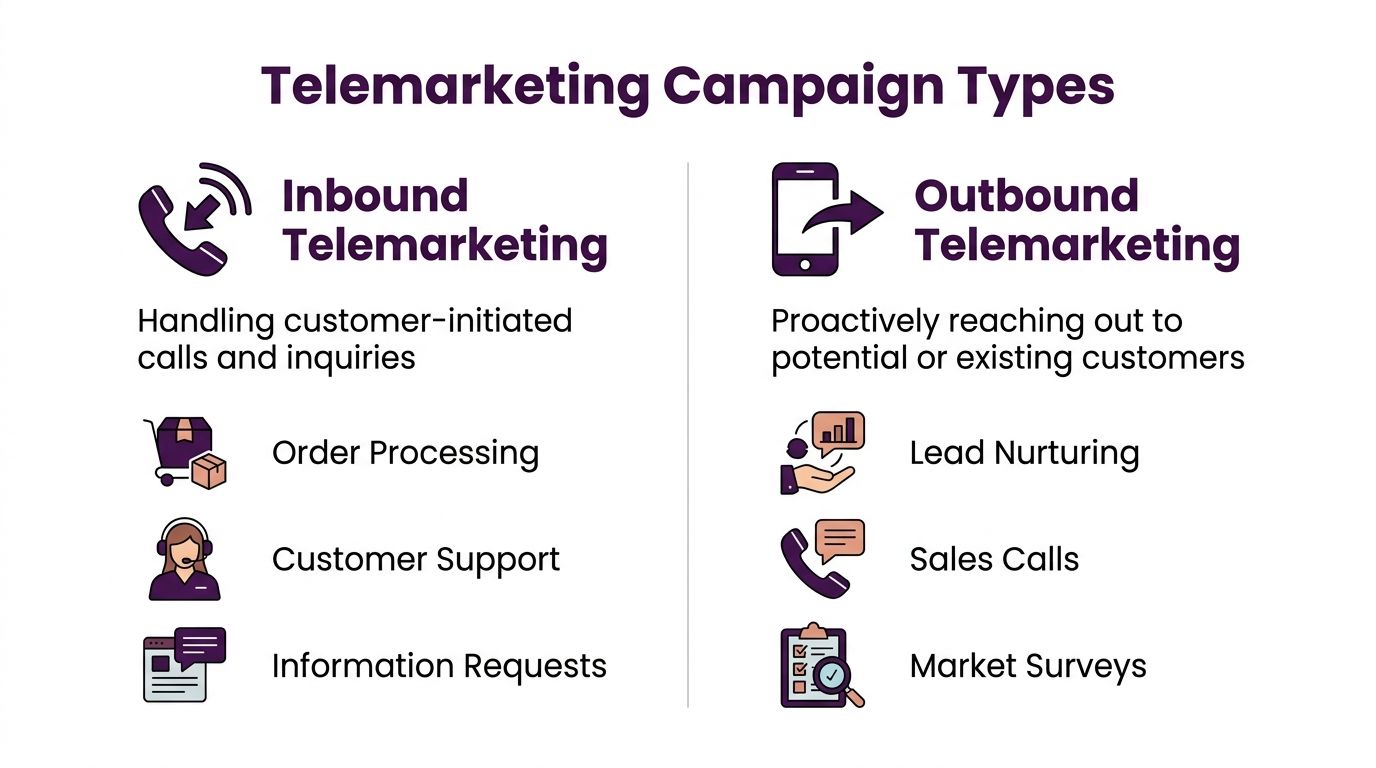
The easiest way to understand telemarketing services is to look at campaign type. Most programs fall into two operating buckets: inbound and outbound. Then each bucket splits again by audience, usually B2B or B2C.
Inbound telemarketing campaigns
Inbound telemarketing starts when the customer calls you. The intent is already present, which changes the job of the agent. Instead of creating interest from scratch, the agent needs to handle the inquiry correctly and move the caller toward a clear next step.
Common inbound examples include:
- Order support: A retail or DTC brand helps a caller complete a purchase, update an order, or clarify product options.
- Service inquiries: A healthcare office answers benefit or scheduling questions before a patient drops off.
- Response handling: A financial firm fields calls generated by direct mail, digital ads, or website forms.
Inbound programs fail when businesses assume every caller is ready to buy. Many aren’t. They need clarity, reassurance, or qualification first.
Outbound telemarketing campaigns
Outbound telemarketing begins with proactive outreach. The telemarketing label is commonly applied to this activity, and process quality is paramount here.
The global outbound telemarketing market is projected at USD 10.85 billion in 2026 and expected to reach USD 14.16 billion by 2035 at a 3% CAGR, according to Business Research Insights on the outbound telemarketing market. The same benchmark notes that cold-calling success rates often average 2% to 3%, while top teams can reach 5% to 8% meeting rates and may need 6 to 10 attempts to reach a prospect. This reflects the nature of outbound. It is rarely efficient per call, but it can still be effective at scale.
This is why good outbound teams focus on sequence design, list quality, and reachable segments. If your team is building a prospecting engine, outbound lead generation services are often a better fit than a pure telesales model.
B2B and B2C don’t run the same way
A B2B campaign usually aims for a next meeting, not an instant close. A software company might call operations leaders to qualify fit for a product demo. A logistics provider might follow up with inbound leads from a trade show and sort them by urgency, fleet size, and buying timeline.
B2C is usually faster and more transaction-oriented. An insurance broker may call consumers who requested a quote but didn’t complete the application. A subscription brand may contact customers near renewal with a service reminder and retention offer.
Here’s the practical difference:
| Campaign model | Typical goal | What works | What fails |
|---|---|---|---|
| Inbound B2B | Qualify and route | Fast response, smart questioning | Treating every inquiry the same |
| Inbound B2C | Convert or resolve | Clear answers, empathy, guided next step | Long hold times, transfers |
| Outbound B2B | Book meetings | Research, persistence, relevance | Generic pitches to broad lists |
| Outbound B2C | Renew, reactivate, sell | Timing, simple offers, trust | Aggressive scripts |
Navigating Telemarketing Compliance and Regulations
Compliance is where many telemarketing programs break down. Not because leaders ignore it, but because they treat it as a legal footnote instead of an operating requirement.
Under the FTC’s Telemarketing Sales Rule, outbound sales calls must promptly disclose that the purpose of the call is to sell goods or services before the sales pitch begins, and telemarketers must disclose material terms such as total cost and quantity before payment, as explained in the FTC’s guidance on complying with the Telemarketing Sales Rule. The important operational lesson is that compliance isn’t only about the words on the script. It’s also about timing.
Why timing changes call design
A script can contain all the right disclosures and still be used incorrectly if agents deliver them too late. That’s why serious providers build call flow controls into the process.
A compliant setup usually includes:
- Script order controls: Agents know what must be said before moving deeper into the pitch.
- Training with live scenarios: Reps practice opening language, not just objection handling.
- QA review: Managers score timing, phrasing, and escalation behavior.
- Data handling rules: Contact preferences and suppression lists need clean operational ownership.
Compliance isn’t a barrier; it’s the framework for building trust with your audience.
Multi-channel teams need one compliance mindset
Most companies don’t rely on phones alone. They also use email, SMS, forms, and CRM workflows. That creates a coordination problem. If one team follows consent rules carefully and another team runs messy outreach, the customer only sees one brand.
For teams aligning phone outreach with digital communication, Mailneo’s resource on email regulations is useful because it highlights how channel-specific rules still require one consistent operating discipline.
If you outsource, ask how the provider handles script approval, DNC suppression, QA scoring, and recordkeeping. A provider with a mature call center compliance process should be able to explain the workflow in plain English.
What practical compliance looks like on the floor
The best operations don’t rely on agent memory alone. They build compliance into onboarding, call guides, approval workflows, and quality checks. When that discipline is missing, risk shows up in small cracks first: an improvised opener, a skipped disclosure, a vague transfer note, a stale contact list.
Those aren’t minor issues. They’re signs that the operation isn’t under control.
Nearshore vs Offshore The Best Outsourcing Location
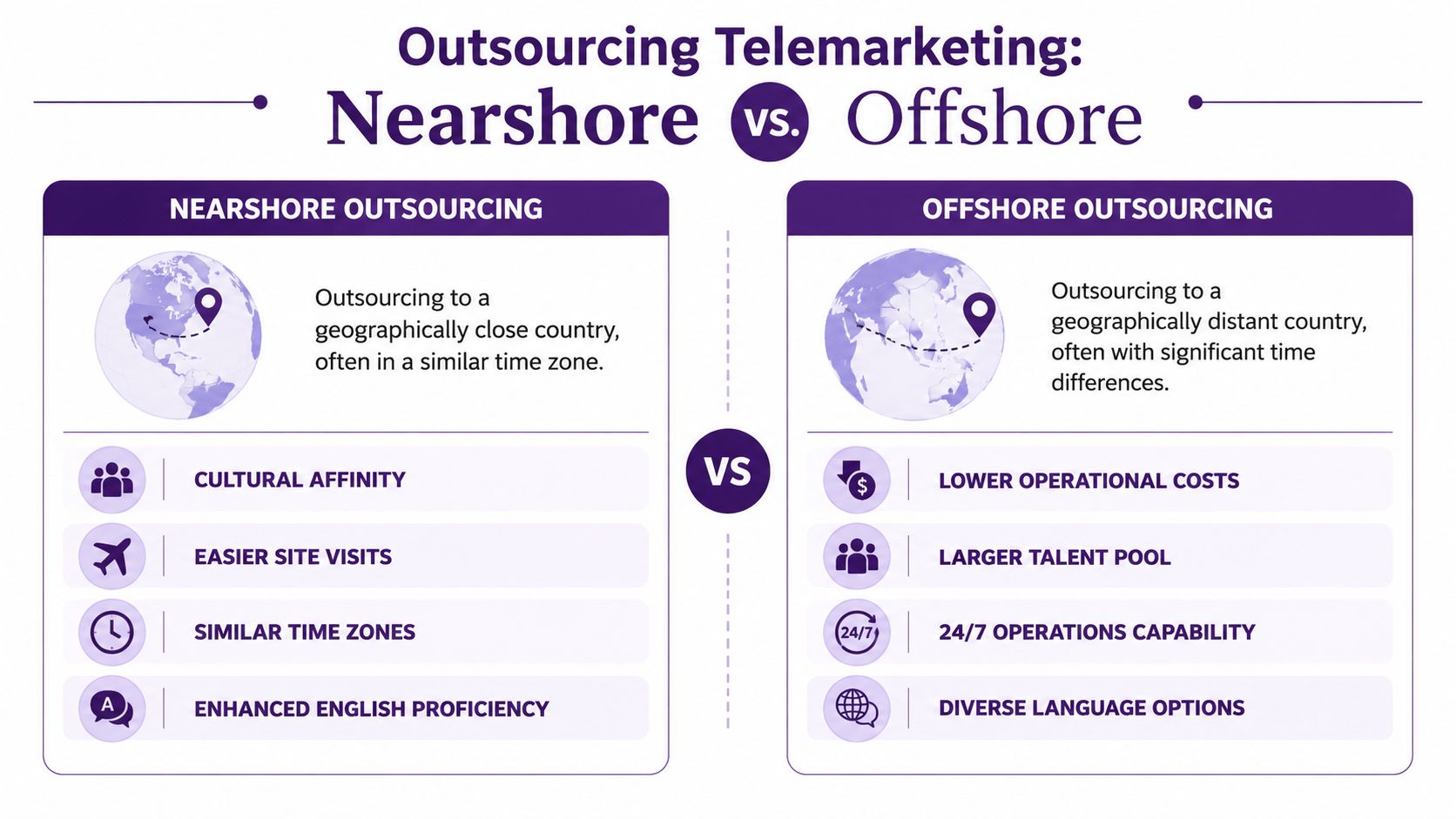
Once a company decides not to run telemarketing fully in-house, the next question is location. This choice affects more than labor cost. It shapes communication quality, oversight, reporting speed, and how easy it is to correct a campaign when performance drifts.
In-house, offshore, and nearshore each solve a different problem
In-house teams give you the most direct control. That can work well when telemarketing is closely tied to your product, your CRM logic, or regulated customer journeys. The trade-off is management burden. You own hiring, training, QA, coverage, and attrition.
Offshore outsourcing often appeals to buyers who want the lowest operating cost or round-the-clock staffing options. It can be the right fit for highly standardized workflows with clear scripts and lower collaboration needs.
Nearshore outsourcing usually sits in the middle. It gives you cost relief without stretching time zones, language expectations, and real-time coordination too far.
Why nearshore is often the stronger operating fit
For North American businesses, nearshore telemarketing services often make day-to-day management easier because teams can work in similar business hours and communicate with fewer handoff delays. That matters when campaigns need quick script changes, fresh lead batches, or same-day calibration between your sales manager and the calling team.
Cultural alignment matters too. Telemarketing isn’t only about speaking English. It’s about sounding natural in live conversation. It includes pace, phrasing, small talk, objection handling, and knowing when to be more direct or more consultative.
Here’s a practical comparison:
| Model | Main strength | Main trade-off | Best use case |
|---|---|---|---|
| In-house | Maximum control | Highest management load | Complex, tightly integrated campaigns |
| Offshore | Lower operating cost | Harder real-time coordination | High-volume, standardized workflows |
| Nearshore | Balance of quality and collaboration | Not always the absolute cheapest rate | North American brands needing flexibility |
What buyers often underestimate
Leaders sometimes compare vendors only on quoted rates. That’s too narrow. The actual cost sits in supervision time, rework, compliance exposure, ramp speed, script revisions, and sales follow-up quality.
If your account executives lose trust in outsourced leads, your telemarketing program becomes expensive even if the hourly line item looks attractive. If your team spends days waiting for basic changes because of time-zone gaps, performance stalls.
This is why many firms choose nearshore not because it’s trendy, but because it reduces operational friction. If you’re weighing trade-offs in more detail, this breakdown of nearshore vs offshore outsourcing costs, risks, and ROI is a useful reference.
The cheapest location on paper can become the most expensive model once misalignment, rework, and oversight time show up.
How to Select Your Telemarketing Services Provider
Choosing a provider is less about promises and more about operating proof. A polished pitch doesn’t tell you how the team handles stale data, weak contact rates, script drift, or agent turnover.
Start with pricing, but don’t stop there. IBISWorld’s U.S. procurement benchmark puts telemarketing services at $36.41 per representative per hour in 2026, with a 1.01% CAGR from 2023 to 2026, according to IBISWorld’s telemarketing services procurement benchmark. That benchmark is useful because it gives buyers context. It also supports a practical truth. Your unit economics usually improve more from better utilization and list quality than from squeezing the hourly rate.
Questions that separate strong providers from weak ones
Ask specific questions that reveal how the provider runs the floor:
- How do you define success for this campaign? The answer should include outcomes, not just call counts.
- What does your reporting look like? You want sample dashboards, dispositions, QA scoring logic, and escalation notes.
- How do you handle script changes? Slow change control hurts live campaigns.
- How do you train agents on our offer? Product understanding matters more than voice polish.
- How do you protect contact quality and suppression rules? This tells you how serious they are about discipline.
If a provider answers with broad assurances and no workflow detail, keep looking.
Evaluate the commercial model carefully
Not every pricing structure is wrong, but each creates different incentives.
Hourly pricing works when the campaign needs testing, training time, or consultative outreach.
Per-call pricing can fit simple programs but may encourage activity over quality.
Performance-based pricing sounds attractive, yet it only works when lead definitions and acceptance criteria are strict.
A balanced agreement usually includes clear service expectations, reporting cadence, and a shared definition of a qualified outcome.
What good oversight should include
A capable provider should offer more than agents and phone lines. It should provide:
- SLA clarity: Response time, productivity expectations, QA cadence, and escalation process.
- Operational visibility: Call outcomes by list, script version, agent, and time band.
- Coaching loop: The team should explain what they changed after reviewing results.
- Technology fit: CRM access, dialing workflow, recording, QA tools, and reporting compatibility.
If you want a pricing comparison across common delivery models, call center pricing across the U.S., Mexico, India, and the Philippines can help frame the conversation. CallZent is one example of a nearshore provider that combines bilingual agent coverage with outbound and support programs for North American businesses.
Practical rule: Buy telemarketing services the way you’d buy a revenue function. Judge the system, not the sales deck.
 Industry Specific Telemarketing Strategies
Telemarketing works best when it reflects the buying behavior and service expectations of a specific industry. Generic calling underperforms because the trigger, timing, and script logic are different in every vertical.
If you’re building internal hiring plans or comparing outsourced support with SDR-style coverage, this guide on how to hire a telemarketer is a useful companion because it helps clarify role expectations before you launch.
E-commerce
E-commerce teams usually get the most value from telemarketing when they focus on moments where a live call can recover revenue or protect customer lifetime value.
- Abandoned high-value carts: A rep can answer last-minute questions about shipping, product fit, or payment options.
- Post-purchase reassurance: A call after a complex order can reduce cancellations and support tickets.
- Subscription renewals: Voice outreach works well when a customer is about to lapse and email reminders have gone quiet.
For example, a furniture brand might call customers who stopped at checkout after adding white-glove delivery. That buyer often has practical concerns, not just price concerns.
Healthcare
Healthcare telemarketing has to be more disciplined because the call often sits close to patient trust and regulated workflows. The tone must be calm, precise, and respectful.
Common use cases include:
- Appointment reminders and confirmations
- Patient satisfaction surveys
- Referral follow-up for missed scheduling actions
The strongest healthcare scripts don’t sound sales-driven. They sound helpful, organized, and easy to act on. A clinic calling to confirm a specialist visit should reduce friction, not add pressure.
Finance
Financial services teams use telemarketing best when the call qualifies intent and reduces drop-off in a high-consideration process.
A few examples:
- Mortgage lead qualification: Reps confirm interest, timeline, and readiness before an advisor steps in.
- Application follow-up: A call helps applicants finish forms they started online but never completed.
- Cross-sell readiness checks: Existing clients may be open to another product, but only after a trust-based conversation.
In finance, the agent’s job is often to create confidence and gather accurate next-step information. Hard-selling too early usually backfires.
Insurance
Insurance is one of the clearest fits for telemarketing because timing, review cycles, and life-event triggers create natural reasons to call.
A few practical plays:
- Quote follow-up: A prospect requested pricing but didn’t bind.
- Annual policy reviews: Agents reconnect with customers before renewal windows close.
- Coverage gap conversations: Reps surface needs based on household or business changes.
Insurance buyers often need a quick human explanation more than a longer digital nurture track. The right call can move them from interest to action faster than multiple automated reminders.
The pattern across all four industries is consistent. Telemarketing services produce stronger results when the call is tied to a specific moment, a clear next step, and an audience with known intent or known friction.
🚀 Ready to Build a Smarter Telemarketing Program?
CallZent helps North American companies build bilingual nearshore teams for outbound telemarketing, lead qualification, appointment setting, retention outreach, surveys, renewals, and customer follow-up.
Talk to an ExpertIf you’re reviewing telemarketing options and want a practical conversation about campaign fit, operating model, and nearshore delivery, CallZent can help you evaluate what should stay in-house, what should be outsourced, and how to structure a voice program that supports growth without adding unnecessary risk.