

Sales Development and Lead Generation
What Is Appointment Setting? A Practical Guide to Qualified Sales Meetings
Learn how professional appointment setting turns targeted outreach into qualified, confirmed meetings that sales teams can advance into real pipeline.
TL;DR — Quick Takeaways
- Appointment setting is the process of identifying prospects, starting conversations, confirming basic fit, and scheduling qualified meetings for sales specialists.
- A calendar entry is not automatically a qualified appointment. The prospect should have a relevant need, appropriate influence, realistic timing, and a clear reason to attend.
- The process normally includes list preparation, outreach, qualification, scheduling, confirmation, CRM documentation, and a structured sales handoff.
- Measure held meetings, show rate, sales acceptance, opportunity conversion, and cost per qualified appointment—not bookings alone.
- Nearshore outsourcing can provide bilingual agents, North American time-zone alignment, quality assurance, and faster deployment.
- The client must still provide its ideal customer profile, approved messaging, CRM access, compliance requirements, and feedback from account executives.
A six-person sales team can spend the morning dialing, the afternoon chasing callbacks, and the evening staring at a calendar that still doesn’t contain enough qualified conversations. That’s the practical problem behind the question, what is appointment setting? It isn’t finding an open time slot. It’s the process of turning outreach into a scheduled sales meeting with a prospect who fits, understands the reason for the conversation, and is likely to attend.
For a nearshore call center and BPO serving North American companies, that distinction matters. A booked meeting can still be a poor sales asset if the contact lacks authority, has no active need, or expects a basic information session instead of a business conversation. This guide explains how appointment setting works, which metrics reveal meeting quality, how the process changes by industry, and when a nearshore partner makes more sense than building the function internally.
For small and mid-sized businesses, nearshore outsourcing can provide trained agents, bilingual coverage, shared time zones, quality assurance, and faster operational deployment. The partner still needs a clear ideal customer profile, approved messaging, CRM access, and feedback from the closing team.
Sales Teams Often Book Meetings Without Building Pipeline
A sales manager assigns a prospect list and activity target. Representatives make calls, send follow-up emails, and book demos. The dashboard looks active, yet account executives find junior contacts, entrenched vendors, or companies without a live project. The calendar is full, while the pipeline remains thin.
Booked meetings and pipeline-quality meetings are different outputs. A calendar slot creates preparation work, but a held meeting creates potential commercial progress only when the attendee has a relevant problem, influence in the decision, and a reason to act. Otherwise, the AE may spend the call explaining the product instead of advancing a sales conversation.
The symptoms of a busy but unproductive desk
Review these warning signs:
- High booking volume with weak opportunity creation: Setters reach their targets, but AEs rarely accept meetings as genuine sales opportunities.
- Frequent rescheduling or no-shows: The prospect agreed casually and had no clear reason to protect the time.
- Long discovery calls with no next step: The AE must establish basic fit, urgency, and authority from the beginning.
- Inconsistent notes: The invite includes a name and time, but not the business problem behind the meeting.
- Low confidence from closers: AEs prepare less carefully or begin ignoring assigned meetings after repeated disappointments.
Appointment setting became a specialized sales discipline because call volume alone does not explain revenue performance. Historical cold-calling summaries place the average near 209 cold calls per appointment and cold-call meeting rates around 1% to 3%. Other summaries describe roughly 50 to 100 calls for one appointment (cold-calling appointment-setting conversion guidance). These figures show how difficult it can be to create a meeting. They do not prove that every booked meeting has pipeline value.
Core takeaway: A calendar slot is an activity. A qualified, held meeting with a plausible buying path is a pipeline input.
The practical remedy is a tighter operating model: defined qualification rules, a structured conversation, reliable follow-up, and a documented handoff. In-house teams usually retain closer control over messaging and feedback, but they must provide recruiting, coaching, coverage, and quality management. Nearshore outsourcing can offer trained agents and shared working hours, though the partner still needs clear criteria, CRM access, and regular feedback from closers.
Teams assessing automation can also review how to build an AI sales pipeline to decide which repetitive tasks belong in software and which conversations still require a person.
What Appointment Setting Means in Practice
A calendar can fill quickly while the pipeline stays weak. Appointment setting is the work of finding potential buyers, starting relevant conversations, checking basic fit, and scheduling a meeting that a sales specialist can act on. The setter normally owns the early conversation. An account executive, consultant, clinician, or other specialist owns deeper discovery and the commercial outcome.
Three ingredients must support that work:
- A contact source: Sources can include inbound inquiries, event contacts, purchased or internally built lists, referrals, and outbound account research.
- A trained setter: The agent or SDR explains the reason for contact, handles objections, asks useful questions, and recognizes when a prospect is not ready or is not an appropriate fit.
- A qualification framework: BANT covers Budget, Authority, Need, and Timeline. A wider process may also check title match, company-size fit, active intent, budget authority, and decision-making influence, as outlined in this B2B appointment-setting checklist.
The distinction from lead generation matters. Lead generation creates awareness or identifies possible contacts. Appointment setting moves a targeted or engaged contact toward a scheduled conversation. Closing comes later, after the specialist completes discovery, presents a solution, addresses commercial objections, and secures a decision.
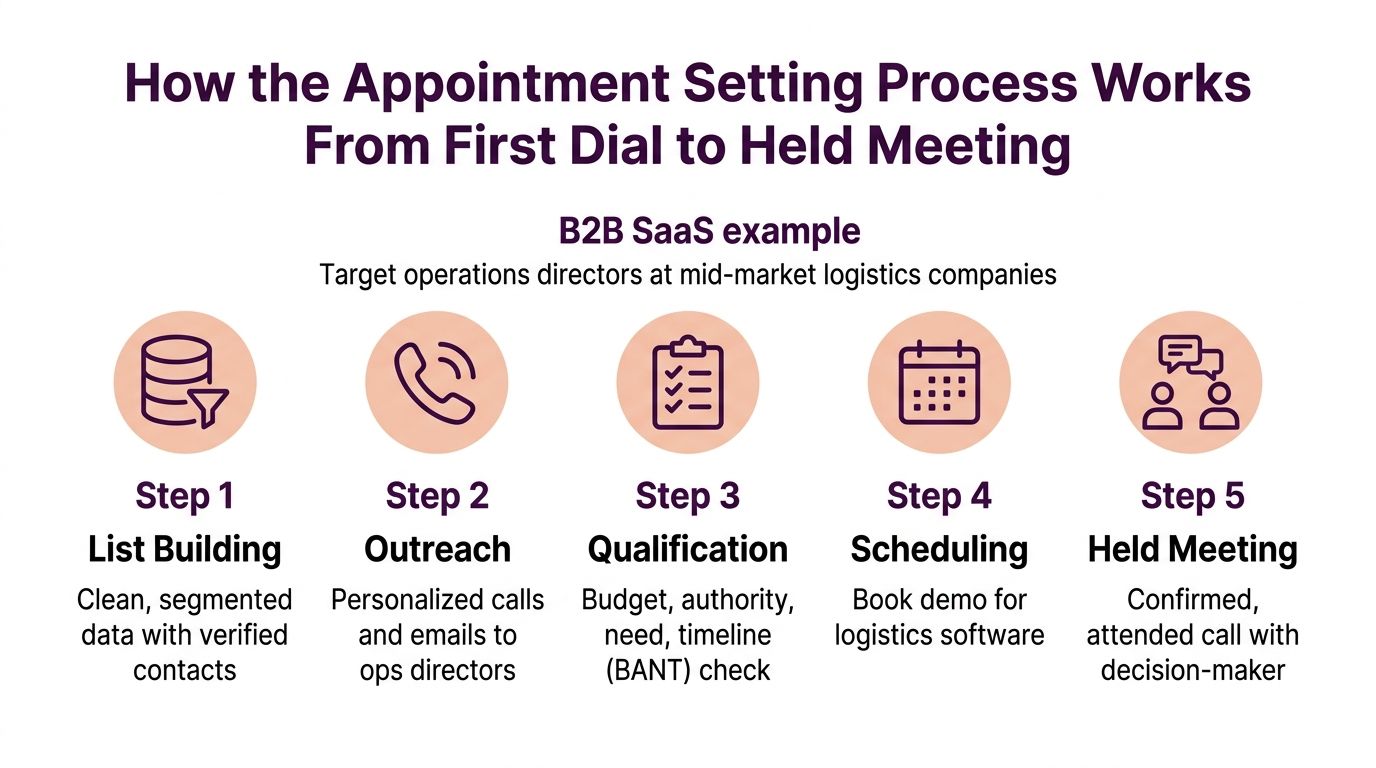
A practical example
A software company selling logistics-management tools to operations directors at mid-market logistics companies might begin with a segmented list. The setter confirms each contact’s role, then connects the call to a recognizable problem such as shipment visibility or workflow coordination.
If the operations director confirms that the problem exists, influences the project, and is reviewing solutions within a relevant timeline, the setter can suggest a meeting with the software company’s AE. The handoff should record the stated problem, the prospect’s role, the reason for interest, and known timing.
A useful working definition is simple: an appointment is qualified when the AE would be willing to prepare for it the night before. That standard is stricter than a prospect merely saying yes. It protects selling time and directs the setter toward fit rather than politeness.
Teams comparing operating models can review CallZent’s appointment setting services against their internal requirements, CRM process, and coaching capacity. For a repeatable regional outreach motion, they can also examine this proven outreach system for APAC and adapt its principles to their market, language, compliance needs, and buyer behavior.
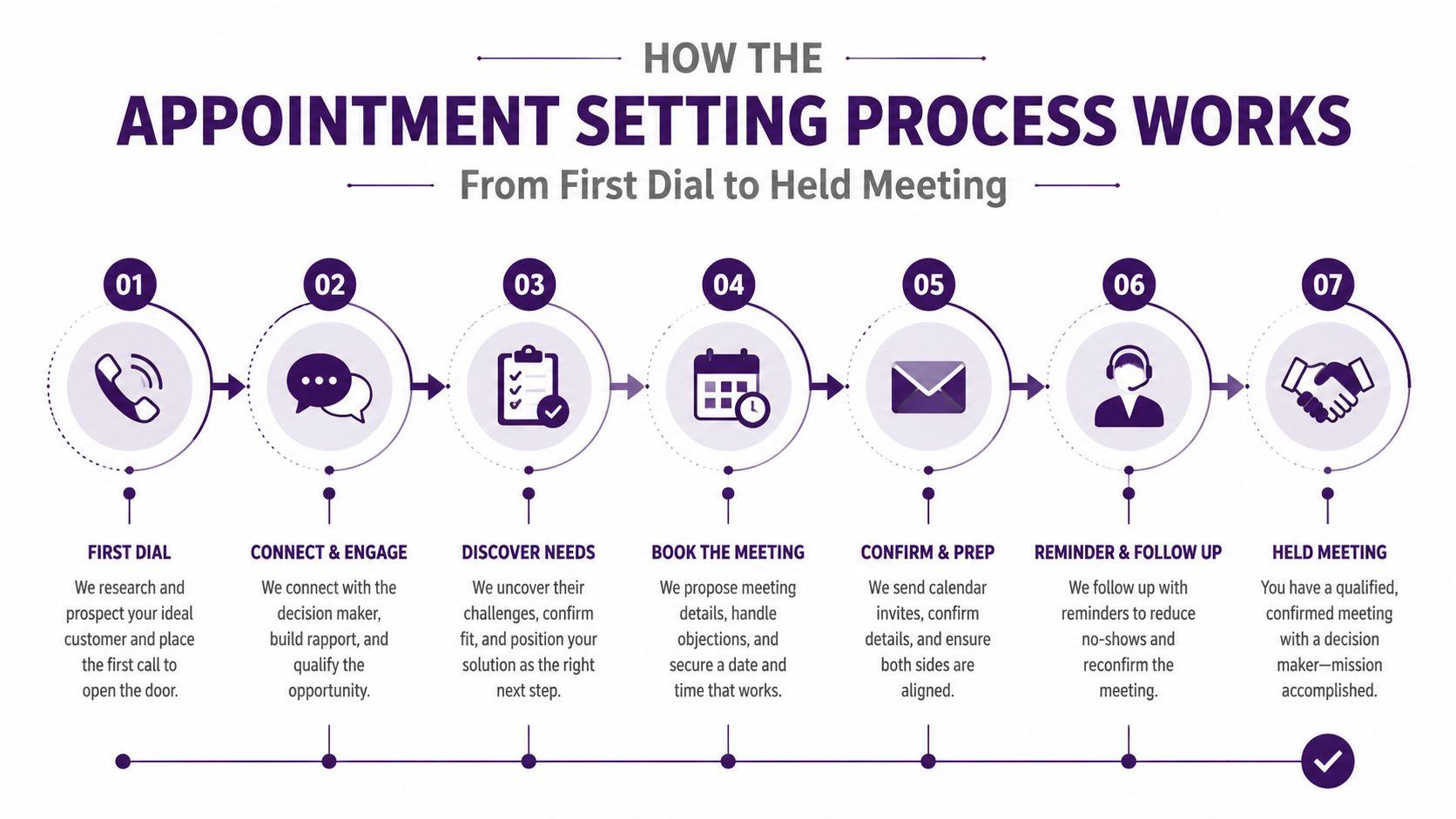
How the Appointment Setting Process Works From First Dial to Held Meeting
A calendar slot can look like progress while delivering little pipeline value. The process becomes useful when every stage has an owner, a clear output, and enough context for the next person to act. Consider a logistics software campaign aimed at operations directors.
Start with usable data
List building means defining the ideal customer profile, segmenting accounts, verifying contact details, and identifying the person who can discuss the operational problem. A shorter list of operations directors with relevant responsibilities can produce better conversations than a larger list with unclear ownership.
The first outreach has one job: earn a short conversation. The setter introduces the company, explains the reason for contacting the prospect, and connects the offer to a recognizable issue, such as shipment visibility or workflow coordination. A full product presentation belongs later.
Qualify the problem and buying context
The setter explores need, authority, timing, and fit through practical questions:
- What process is creating the most friction today?
- Who else evaluates software for that process?
- Is the company actively reviewing alternatives?
- What would need to happen before a project could move forward?
BANT can provide structure, but the exchange should feel like a business discussion rather than an interrogation. Qualification earns its place when the answers show whether an AE should invest preparation time.
Schedule a meeting with a reason
After the agreed criteria are confirmed, the setter proposes a specific time and ties the invitation to the prospect’s stated problem. The confirmation names the AE, explains the meeting’s purpose, and makes attendance easy.
Booking is only one checkpoint. A same-day recap, a reminder before the meeting, and a clear reschedule path help protect the slot. If the prospect misses the call, the setter should attempt recovery rather than close the record immediately.
The handoff should include:
- Discovery notes: The prospect’s own description of the problem.
- Qualification status: Confirmed criteria and information still unknown.
- Meeting purpose: One sentence explaining why the AE and prospect should speak.
- Next-step context: Timing, stakeholders, and preparation the AE should know.
A 2026 benchmark guide reports 70% to 85% show rates for healthy appointment-setting programs and 50% to 70% meeting-to-opportunity rates. It also identifies list quality, relevance, qualification, and ICP fit as factors affecting those stages (appointment-setting campaign metrics). These figures are reference points, not permission to count every calendar entry as pipeline.
Teams using a predictive dialing solution can increase calling efficiency, but the dialer does not verify buying context or improve a weak handoff. A meeting is pipeline-quality when the AE has a credible problem, a relevant stakeholder, and a reason to prepare.
Key KPIs That Separate a Busy Desk From a Profitable One
A desk can look busy while producing little pipeline. Dials and calendar entries show activity, but revenue teams need to follow the full path: contact to reply, reply to meeting, meeting to attendance, and attendance to opportunity.
The 2026 benchmark set from Sales Focus places a healthy B2B contact-to-meeting rate at 4% to 10%, a strong show rate at 65% to 80%, and meeting-to-qualified-opportunity conversion at 25% to 55% (B2B appointment-setting benchmarks). These ranges are starting points for diagnosis, not fixed quotas. A program may lose value through weak targeting, poor qualification, or an ineffective handoff.
Read the funnel, not one number
| KPI | What it measures | Healthy B2B benchmark |
|---|---|---|
| Contact-to-meeting rate | How effectively outreach creates scheduled meetings | 4% to 10%, according to Sales Focus |
| Show rate | How many scheduled meetings occur | 65% to 80%, according to Sales Focus |
| Meeting-to-qualified-opportunity rate | How many meetings advance into qualified pipeline | 25% to 55%, according to Sales Focus |
| Email contact-to-reply | Whether the message earns a response | 3% to 8%, according to Tomba’s campaign benchmarks |
| Phone connect rate | Whether the team reaches people by phone | 5% to 10%, according to Tomba’s campaign benchmarks |
| Positive reply-to-meeting rate | Whether interested replies become scheduled conversations | 25% to 40%, according to Tomba’s campaign benchmarks |
The table separates a calendar slot from a pipeline-quality meeting. If bookings rise while held meetings remain flat, confirmation and expectation-setting need attention. If held meetings rise but qualified opportunities do not, setters may be booking contacts outside the ICP or without a meaningful business need.
Track cost per qualified appointment, rather than cost per booked appointment alone. Outbound ROI guidance describes well-run campaigns with 85% to 95% show-up rates, 20% to 35% SQL rates from held meetings, and 15% to 30% appointment-to-close rates (appointment-setting ROI guidance). Those later-stage measures connect appointment-desk activity to commercial results and expose whether outsourcing or an in-house team is creating useful pipeline.
For consistent definitions, owners, and reporting rules, teams can use CallZent’s call center KPIs resource. A dashboard should make weak stages visible, not reward a setter for filling the calendar with meetings that sales cannot advance.
How Appointment Setting Looks Across B2B Healthcare Finance and E-commerce
A calendar slot can represent very different outcomes. A SaaS discovery call should connect a real business problem with someone who can influence a purchase. A healthcare booking must protect privacy and capture accurate scheduling details. Finance programs add consent and contact restrictions, while e-commerce appointments depend on product interest, location, and service availability.
| Vertical | Primary booking focus | Qualification and compliance focus |
|---|---|---|
| B2B SaaS and professional services | Discovery call, consultation, or product demonstration | Business pain, decision influence, ICP fit, and timing |
| B2C | Consultation, estimate, service visit, or demonstration | Fast response, accurate contact details, availability, and clear expectations |
| Healthcare | Patient or provider appointment | Consent language, privacy safeguards, identity verification, and accurate scheduling |
| Finance and insurance | Advisor consultation or application-related conversation | Approved scripts, do-not-call screening, consent capture, and careful qualification |
| E-commerce and retail | Installation, in-store consultation, or wholesale onboarding | Product or service complexity, location, availability, and fulfillment context |
Qualification depth changes by vertical
In B2B SaaS, the setter filters opportunities for the account executive. A meeting with someone who cannot influence the decision may fill the calendar without advancing the deal. The qualification conversation should establish the operational problem, the person’s role, the likely buying window, and whether the account fits the ICP.
B2C programs often accept more appointment volume because each booking may require less discovery and a quicker response. That does not make accuracy optional. Wrong contact details, unclear expectations, or unavailable time slots create avoidable cancellations and wasted service capacity.
Healthcare and finance require tighter controls. A healthcare scheduling agent may verify the provider, patient, appointment type, consent, and selected time before confirming the slot. Financial-services agents may need approved language and do-not-call screening before continuing. Quality assurance, documentation, and escalation rules therefore shape both compliance and the customer experience.
E-commerce sits between service delivery and sales. A customer arranging a home installation or store consultation may already want the product, yet the agent still needs the correct location, availability, service scope, and fulfillment expectations. Scheduling automation can support reminders and appointment changes. Teams evaluating that category can review DialNexa Labs’ scheduling automation overview.
The useful benchmark differs by vertical. A booked SaaS meeting should be judged by fit and sales progression. A healthcare slot should be judged by accuracy, consent, and attendance. An e-commerce booking should be judged by completed service or purchase progress. Comparing all three by raw booking volume hides the quality differences.
Companies assessing outsourced workflows can review CallZent’s industry-specific solutions for approaches covering sector-specific scripts, escalation, scheduling, and customer communication. Nearshore delivery may provide trained agents, bilingual coverage, quality assurance, and operating capacity without requiring the client to build every layer internally.
An in-house team keeps messaging, coaching, and sales collaboration close. An outsourced nearshore team adds operating capacity, but requires clear governance. The partner needs qualification rules, approved scripts, CRM permissions, recording standards, and regular feedback from account executives. For regulated or complex programs, process control and compliance evidence matter more than a fuller calendar.
In-house vs Outsourced Appointment Setting and Why Nearshore Wins
A sales leader may see a full calendar while account executives see meetings with no buying fit. The in-house versus outsourced decision should therefore compare more than booking volume. It should examine control, speed, management workload, coverage, and whether meetings progress the pipeline.
In-house setters work close to the brand. They can adjust messaging quickly with sales and marketing, but the company must recruit, onboard, coach, manage tools, monitor quality, and handle turnover. That model offers direct oversight, though internal leaders also carry every process responsibility.
Outsourcing transfers much of that operating work to a partner. A nearshore BPO in Latin America can align with North American business hours, support English and Spanish conversations, and provide established call-handling and quality-assurance processes. Proximity helps when prospects expect live conversations during U.S. working hours.
Compare the operating models
| Dimension | In-house team | Nearshore outsourced |
|---|---|---|
| Control | Direct daily control over messaging and coaching | Shared control through governance, reporting, and approved playbooks |
| Ramp | Requires hiring and internal training | Uses an existing recruiting, training, and QA structure |
| Cost structure | Includes salaries, tools, management, and turnover exposure | Converts much of the operating burden into a managed service |
| Coverage | Usually limited to the team’s staffing plan | Can support bilingual and extended coverage based on the program |
| Flexibility | Scaling depends on recruiting and management capacity | Capacity can be adjusted through the partner’s staffing model |
| Risk | Internal leaders own every process detail | Client depends on partner training, QA, security, and CRM discipline |
The supplied operating guidance describes nearshore programs that can ramp in 2 to 4 weeks and estimates that in-house costs may reach 1.4 to 1.8 times loaded salary after recruiting, training, management, and turnover. Treat those figures as planning guidance, not a universal cost formula. Actual economics depend on the program, region, tools, supervision, and meeting-quality requirements.
For companies booking fewer than 80 to 100 qualified meetings per month, the same guidance states that outsourcing almost always wins on cost per meeting and time to result. That threshold is a decision aid, not a guarantee. Compare the partner’s total fee with internal recruiting, management, technology, and quality costs, then test whether the meetings meet sales acceptance standards.
The practical recommendation
Keep strategy, pipeline ownership, enterprise relationships, and closing in-house. Consider a nearshore outsourcing model when internal sellers spend too much time researching, dialing, following up, and rescheduling instead of selling.
The trade-off requires due diligence. Request call recordings, inspect coaching practices, confirm CRM integration, review data handling, define escalation paths, and agree on what counts as qualified before launch. A nearshore partner adds capacity, but the client still needs governance, feedback from account executives, and a shared definition of a pipeline-quality meeting.
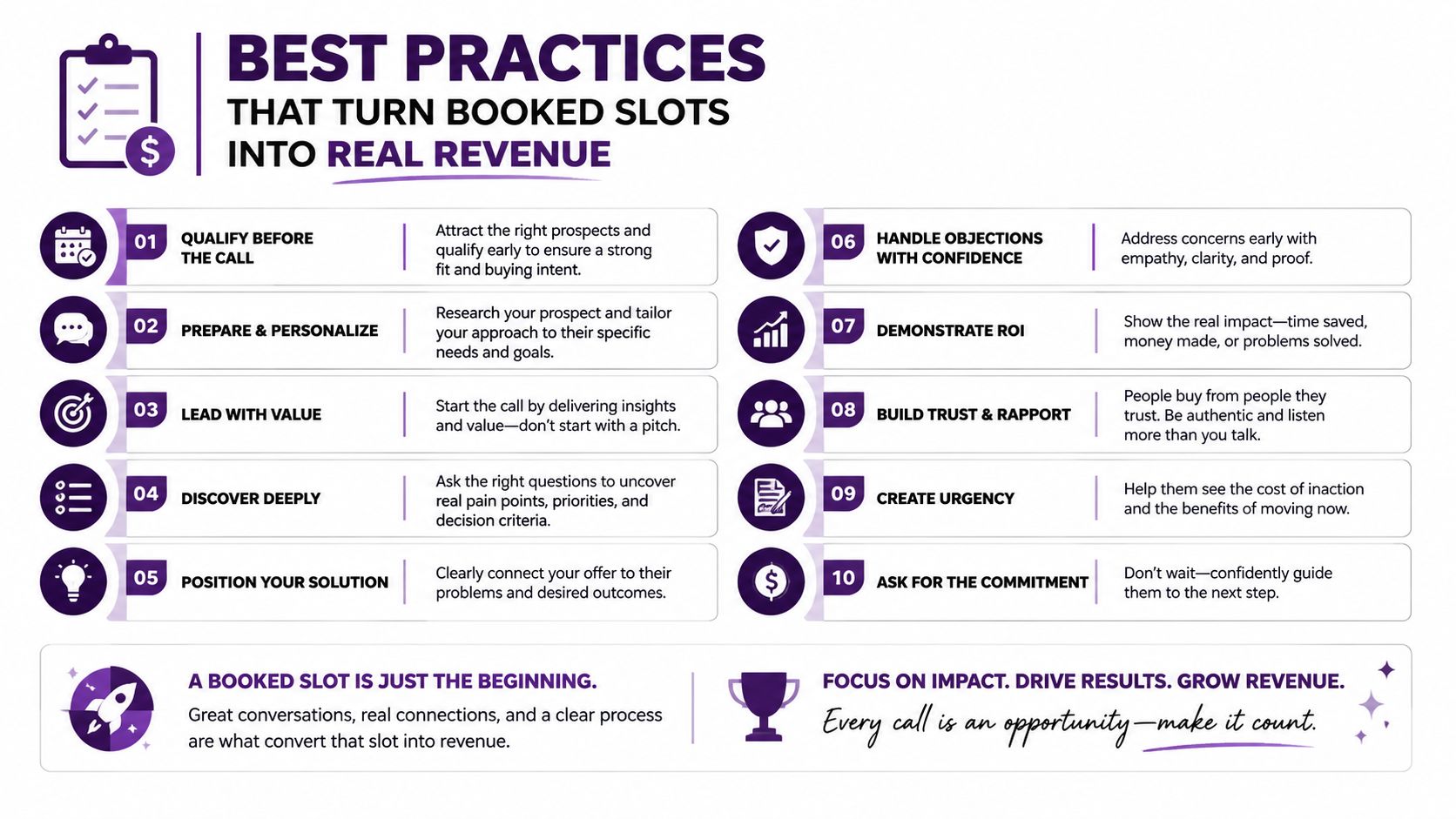
Best Practices That Turn Booked Slots Into Real Revenue
A calendar can look healthy while the pipeline remains weak. A meeting becomes commercially useful only when the prospect fits the account profile, has a relevant problem, and agrees to a next conversation with a clear purpose. Appointment-setting teams should optimize for held, accepted meetings, not booked slots alone.
Put qualification before activity
Write the qualification rules before the first call. Define the target company, relevant roles, problem signals, decision influence, and timing. Build those rules into the opener and discovery prompts, so agents can screen for fit without improvising.
BANT can give a team a shared language, but it should guide the conversation rather than turn it into a checklist. A prospect may not disclose budget during the first interaction. The setter can document authority, need, timeline, and the agreed next step without forcing an artificial answer.
Review meeting quality against sales acceptance, not agent effort. If account executives repeatedly reject meetings because the problem is unclear or the contact lacks influence, revise the qualification rules and coaching before increasing call volume.
Use several channels with one message
Phone conversations create context that email cannot always provide. Email gives the prospect a written reference point, while LinkedIn can support recognition and follow-up when that channel fits the buyer.
A coordinated cadence keeps the core message consistent while adapting its format. The caller should know which email was sent, what the prospect engaged with, and which question remains unanswered. Conflicting messages make a booked meeting feel less credible before it begins.
Protect the handoff
An AE should receive more than a calendar invite with a company name. The meeting brief should include:
- Business problem: What the prospect said is not working.
- Role and influence: Why this person matters to the buying process.
- Timing: Whether the issue is active, planned, or exploratory.
- Reason to meet: The question or outcome the AE should address.
- Risk flag: Any missing qualification detail or competing priority.
CRM logging, disposition codes, lead scoring, and reminder workflows reduce preventable errors. Weekly review of recorded calls can expose messaging drift, weak questions, and meetings scheduled without a confirmed need.
No-shows also belong to the appointment-setting process. Use a confirmation cadence, a simple reschedule path, and a recovery attempt. Those steps separate a temporary scheduling problem from a prospect who never showed meaningful intent.
The standard is not a full calendar. It’s a calendar filled with meetings that a qualified seller can advance.
CallZent provides bilingual nearshore call center and BPO support for outbound outreach, lead generation, scheduling, confirmations, rescheduling, and related customer operations. If your sales team needs more qualified conversations without shifting senior sellers into constant prospecting, visit CallZent to discuss an appointment-setting workflow built around your ICP, CRM, qualification rules, and North American calling hours.
Turn More Outreach Into Qualified Sales Conversations
CallZent provides bilingual nearshore appointment setting, lead qualification, scheduling, confirmations, and follow-up support for North American companies. Build a program around your ideal customer profile, CRM, sales process, and meeting-quality standards.
Talk to an Expert