
Healthcare Answering Services
24/7 Medical Answering Service: A Buyer’s Guide for Practices
Compare 24/7 medical answering services by patient safety, HIPAA workflows, bilingual coverage, clinical escalation, integrations, pricing, and reporting.
TL;DR — Quick Takeaways
- A 24/7 medical answering service must support patient access without allowing unlicensed agents or automation to make clinical decisions.
- Require a signed Business Associate Agreement when applicable and verify how protected health information is accessed, stored, transmitted, retained, and removed.
- Separate routine administrative requests from calls that require escalation under clinician-approved protocols.
- Test the provider with specialty-specific simulations before launch, including routine, urgent, bilingual, and failed-escalation scenarios.
- Use automation for approved scheduling and structured intake while maintaining a clear route to trained agents and licensed clinicians.
- Practices serving Spanish-speaking patients should evaluate English-Spanish coverage as an access requirement.
- Compare answer performance, documentation, escalation, audit trails, integrations, staffing continuity, and contract terms—not price alone.
Your front desk closes at 5 p.m., but your patients don’t. A parent may call at 2 a.m. about a child’s fever. A patient with chest discomfort may reach voicemail on Saturday night. By Monday morning, your team could be sorting through a backlog of messages without knowing which calls needed immediate attention.
A 24/7 medical answering service can solve that access problem, but only if it does more than pick up the phone. The right partner captures information securely, separates routine requests from urgent concerns, follows your written protocols, and reaches the appropriate clinician without creating false reassurance.
This guide is for small practices and specialty clinics comparing in-house coverage, outsourced support, domestic teams, nearshore bilingual providers, live agents, and hybrid technology. The recommendation is straightforward: evaluate patient safety and response quality before hourly or per-minute price.
Key takeaway: Coverage only creates value when it preserves clinical safety, accurate documentation, and reliable escalation, not merely call pickup
Why Your Practice Needs Coverage That Never Sleeps
A small cardiology office opens Monday to a weekend voicemail about chest discomfort. The message sits beneath refill requests and appointment changes. No one meant to ignore the patient, but the practice had no process for separating a potentially urgent concern from routine work.
After-hours demand is large enough to affect staffing, escalation, and patient safety. The patient-phone analysis cited earlier found that 16.5% of calls arrived after hours, including weekday evenings and weekends. Its review covered 29 million calls across 297 practices and 3,959 locations, so this is an operating pattern worth measuring in your own practice, not a rare exception.
| Metric | Value | What It Means |
|---|---|---|
| Calls reviewed | 29 million | The finding reflects broad operational demand, not one office’s experience |
| Practices included | 297 | Patterns extend across many medical practices |
| Office locations | 3,959 | Multi-location demand is represented |
| After-hours share | 16.5% | Daytime-only staffing can miss a meaningful portion of patient communication |
Coverage quality matters as much as coverage hours. A separate healthcare call-center report found that only 19% of healthcare call centers operate 24/7, while 53% operate close to continuous service, such as 24/5 or extended daily schedules. It also reported a 4.4-minute average hold time and 16% average abandonment rate. A phone line that technically remains open still fails patients when callers wait too long or abandon the call. Read the healthcare call-center report.
Three decisions shape the outcome
First, decide whether your team can staff overnight and weekend coverage without pulling front-desk employees away from daytime work. Then compare domestic and nearshore staffing, particularly if your practice serves Spanish-speaking patients. Nearshore coverage can improve bilingual availability, but only when the vendor can demonstrate language proficiency, privacy controls, and reliable escalation.
Finally, match the service to patient risk. Message-taking may suit routine administrative requests. A specialty clinic handling symptom calls, medication concerns, or post-procedure issues needs protocol-driven intake and a defined route to the on-call clinician.
“24/7” can describe a live agent answering every call, an automated menu collecting messages, or an overnight operator following a narrow script. Those models produce different access and escalation outcomes.
Review after-hours medical answering service options by mapping call types, likely urgency, languages, and escalation rules before comparing prices. The least expensive seat is not a bargain if it delivers vague messages or delays a clinically important response.
What a 24 7 Medical Answering Service Actually Does
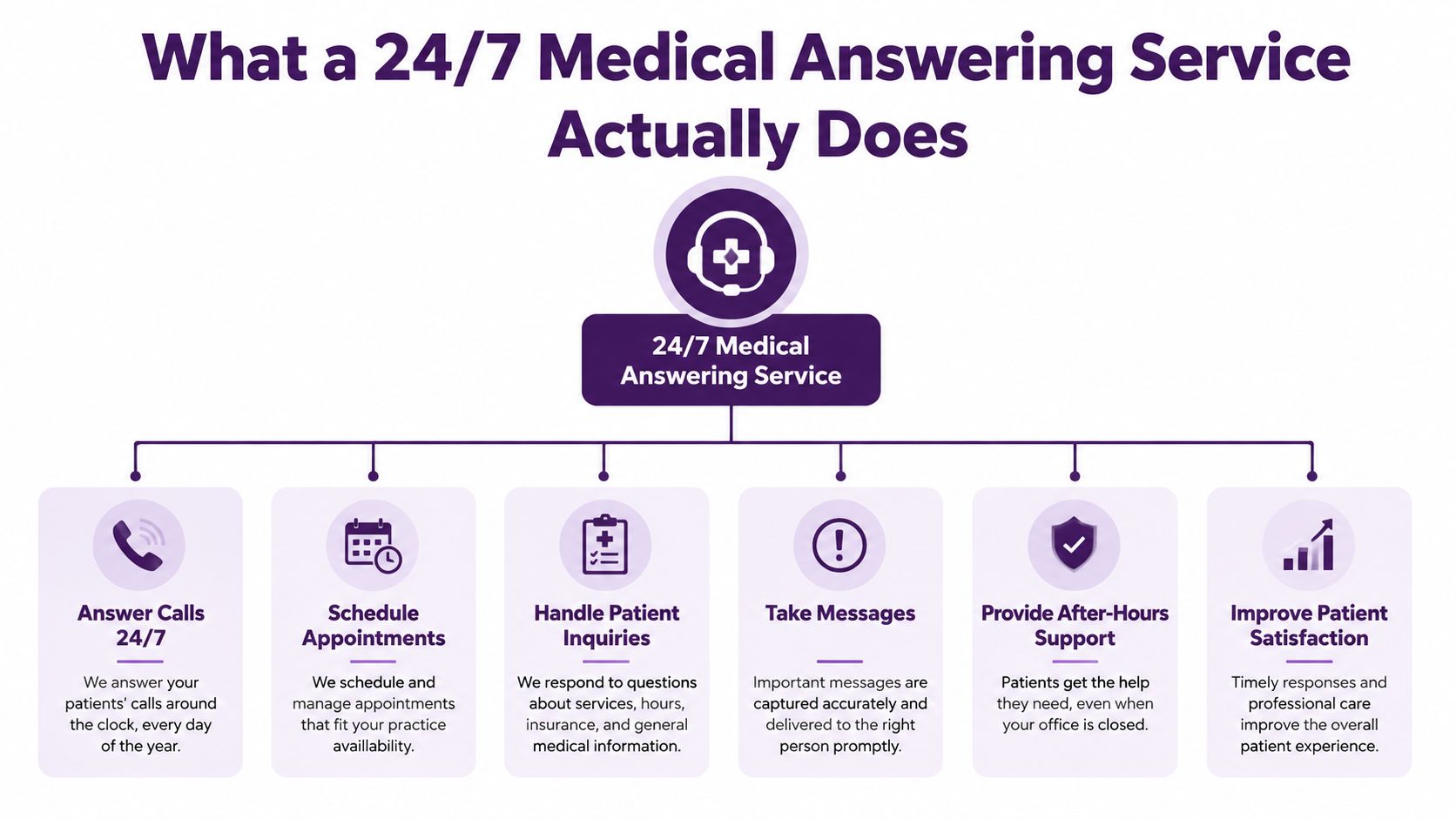
A 24/7 medical answering service is an external team, supported by telephony and workflow tools, that answers patient calls for your practice throughout the day, overnight, on weekends, and during holidays. Agents use your approved instructions to identify the caller, collect limited information, schedule or record routine requests, and route calls according to urgency.
The label matters less than the workflow behind it. A message-only service may capture a name, callback number, and reason for calling. A clinical escalation service adds structured intake, urgent-call routing, on-call schedules, and documentation. A hybrid model may use automation for routine requests while sending complex or high-risk conversations to trained human agents and licensed clinicians.
Match the coverage tier to the call
Message-taking works for low-risk administrative requests. A patient calling to confirm office hours, request a records transfer, or ask for a routine appointment callback may not need a live clinical conversation. The service records the request and delivers it through the approved channel.
Protocol-driven triage separates intake from medical judgment. Unlicensed answering staff can gather limited information, but they can’t assess or advise on a patient’s condition. Emergency, urgent, and medical-advice calls must move to appropriately licensed clinicians under the practice’s protocol. Review telephone medical-advice guidance.
Hybrid coverage handles routine volume efficiently. Automation can collect structured information or assist with scheduling, while a live agent takes over when the caller is confused, distressed, or describing symptoms that require escalation. The handoff should preserve the conversation context, not force the patient to start again.
Consider two calls from parents at night. A parent asking about a child’s fever may need intake and a clinician-directed response. A parent describing a suspected medication reaction needs immediate protocol review and escalation. In both cases, an answering agent should avoid diagnosing the child. The difference is how quickly the workflow identifies risk and connects the caller to the right professional.
Practices evaluating staffing workflows can also review Headset Army for support scheduling as a resource for understanding support scheduling operations. For broader patient-access design, see medical call center services that transform patient care.
The Non-Negotiable Features Buyers Should Demand
A vendor’s feature sheet doesn’t prove that its operation is safe. Ask to see the documents, workflows, training materials, escalation records, and integration behavior that support each promise.
Compliance must exist in the contract and workflow
A HIPAA-conscious provider should offer a signed Business Associate Agreement and explain how it protects PHI during calls, message delivery, recordings, transcripts, and system access. The service should also describe secure intake, role-based access, retention rules, and incident handling. Review HIPAA-compliant answering safeguards.
Don’t accept “HIPAA compliant” as a complete answer. Ask who can access call records, how the provider removes access when staff leave, where information is stored, and how your practice receives an audit trail.
Clinical boundaries need to be explicit
Unlicensed agents may collect information and route the call. They shouldn’t interpret symptoms or give medical advice. Your vendor must show how emergency, urgent, routine, refill, and scheduling calls are segregated, and who approves protocol changes.
If that boundary is vague, the practice carries avoidable regulatory and clinical risk. A missed escalation can become a patient-safety event, while unsafe reassurance can create a far more serious problem than a delayed callback.
Integrations should reduce duplicate work
The service should connect with your scheduling platform, telephony environment, and EMR where appropriate. At minimum, messages need consistent structured fields, timestamps, caller identity, reason for contact, disposition, and escalation status. Automatic chart delivery is useful only if staff can verify what entered the record.
Language access and response rules matter
For practices serving Spanish-speaking communities, bilingual agents should handle the conversation naturally rather than transfer the caller to an uncertain queue. A monolingual workflow can push patients toward voicemail or cause clinically important details to be lost in translation.
Set response windows by call category. Some healthcare policies require urgent after-hours calls to be returned within 30 minutes, while non-urgent but time-sensitive calls may be returned within one hour. Review an after-hours patient-communication policy example.docx).
Ask every provider: “Can you demonstrate this workflow with a simulated urgent call and show me the resulting record?” A real demonstration exposes gaps that a sales presentation hides. For broader compliance planning, use CallZent’s healthcare outsourcing compliance guide.
How an After-Hours Call Actually Flows End to End
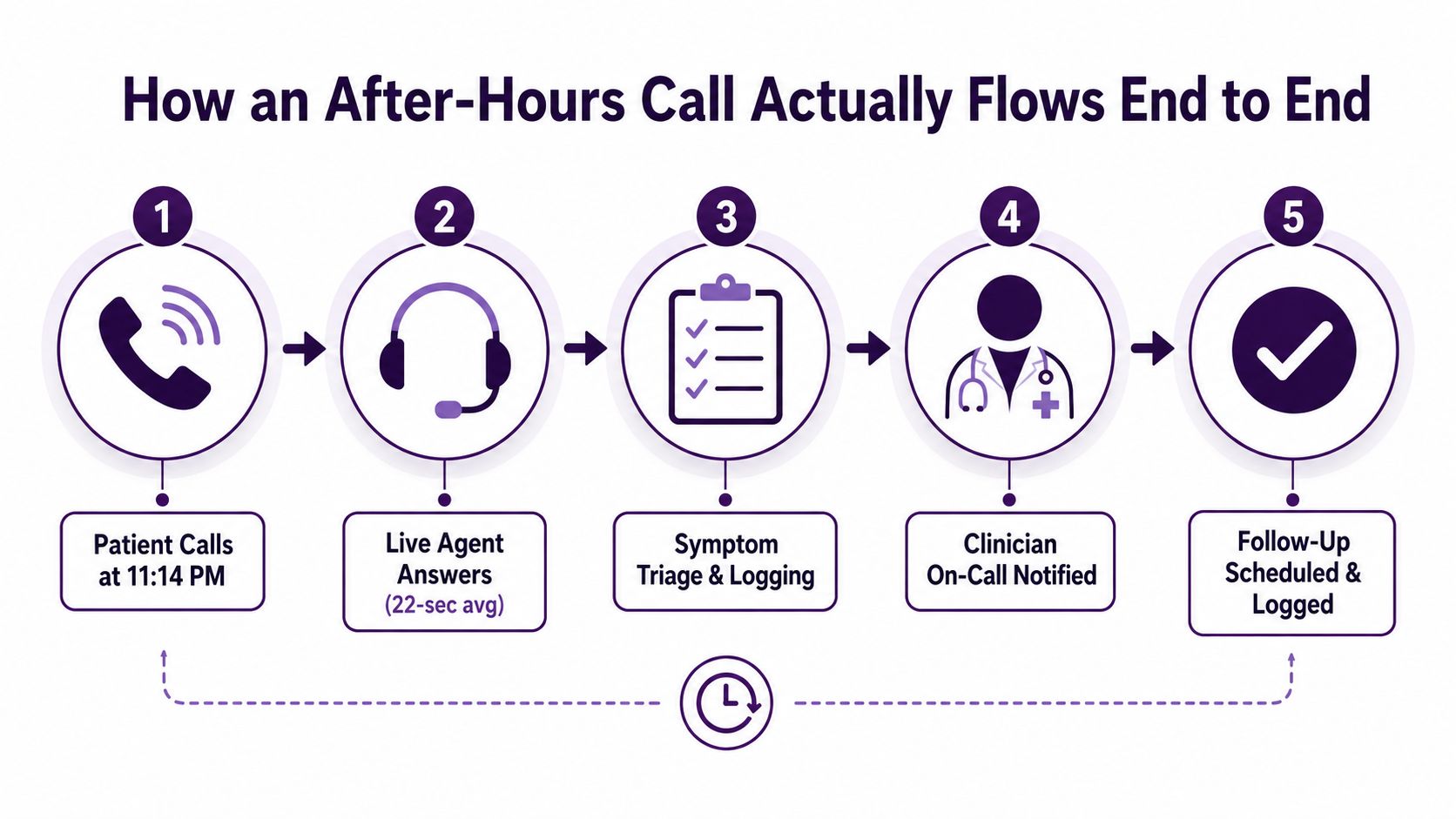
At 11:14 p.m. on a Saturday, a 63-year-old patient calls the practice line and reports chest discomfort. The agent should identify the caller, confirm the callback number, collect only the information permitted by the protocol, and recognize that the call requires immediate escalation. The agent shouldn’t diagnose the patient or decide that the symptom is harmless.
A strong workflow has distinct handoffs:
- The service answers and verifies identity. The agent confirms the patient record and a reliable callback number before discussing protected information.
- The agent follows the practice script. The script captures the approved intake details and avoids improvising medical advice.
- The system classifies the call. Chest discomfort follows the urgent pathway, while a routine administrative request follows a separate queue.
- The on-call clinician receives the escalation. The handoff includes the caller’s information, time of contact, stated concern, and relevant intake details.
- The encounter is documented. The final record shows what happened, who received the escalation, and whether follow-up remains open.
The buyer should ask a vendor to demonstrate every step using the practice’s actual specialties and on-call schedule. The service should also explain what happens if the first clinician doesn’t answer, the backup clinician is unavailable, or the patient calls back before the case closes.
Routine calls shouldn’t create clinical noise
At 9 p.m., a patient may call for a refill request. The agent can verify identity, capture the medication and pharmacy information according to the practice’s policy, and send the request to the appropriate queue. That workflow should not wake the on-call provider unless the practice’s protocol identifies a clinical concern.
Speed still matters. A VHA access study covering 285 facilities found that the best quartile answered calls in 34.7 seconds or less, while the worst quartile ranged from 107.7 to 351.3 seconds. Review healthcare call-center access benchmarks.
Operational standard: Sub-minute answering isn’t a luxury. It helps keep urgent callers out of voicemail and gives the escalation workflow a chance to work.
Use outsourced escalation workflows to formalize who receives each call, how backups activate, and how unresolved cases are reported.
Nearshore Bilingual Coverage as the U.S. Healthcare Default
For a U.S. practice with a meaningful Spanish-speaking patient population, bilingual coverage shouldn’t sit at the bottom of a vendor comparison sheet. It affects whether patients explain symptoms accurately, understand next steps, complete scheduling, and trust the practice enough to call again.
A fully in-house team offers direct control, but overnight and weekend coverage can strain small staffs. An offshore-only provider may offer lower labor costs, yet distance from U.S. workflows, unfamiliarity with local healthcare expectations, and inconsistent language quality can create friction. A nearshore bilingual team offers a practical middle path.
| Coverage model | Main advantage | Main concern |
|---|---|---|
| In-house | Direct supervision and close clinical coordination | Staffing nights, weekends, holidays, and absences can be difficult |
| Offshore-only | Broad labor availability and potential cost savings | Time-zone, communication, and healthcare-context gaps may affect handoffs |
| Nearshore bilingual | Close time-zone alignment, English and Spanish fluency, and easier collaboration | Requires careful clinical training and governance like any outsourced model |
A Tijuana-based nearshore operation can collaborate with U.S. practices during overlapping business hours, support after-hours schedules, and maintain shared escalation protocols. That proximity doesn’t automatically make a provider clinically qualified. It does make training sessions, workflow updates, quality reviews, and operational communication easier to coordinate.
What to verify before choosing nearshore
Ask whether agents are fluent in both languages, whether they understand specialty terminology, and whether quality reviewers evaluate bilingual calls. Confirm that scripts, escalation instructions, patient identifiers, and documentation fields remain consistent in English and Spanish.
Nearshore is especially sensible when your practice needs coverage that can scale without repeatedly recruiting local overnight staff. Explore nearshore outsourcing solutions as one model, then compare it against your actual call patterns, language needs, and clinical oversight requirements.
My recommendation is firm: if Spanish-speaking patients make up a meaningful part of your panel, make bilingual coverage a pass-fail requirement. Don’t purchase a cheaper monolingual queue and call it access.
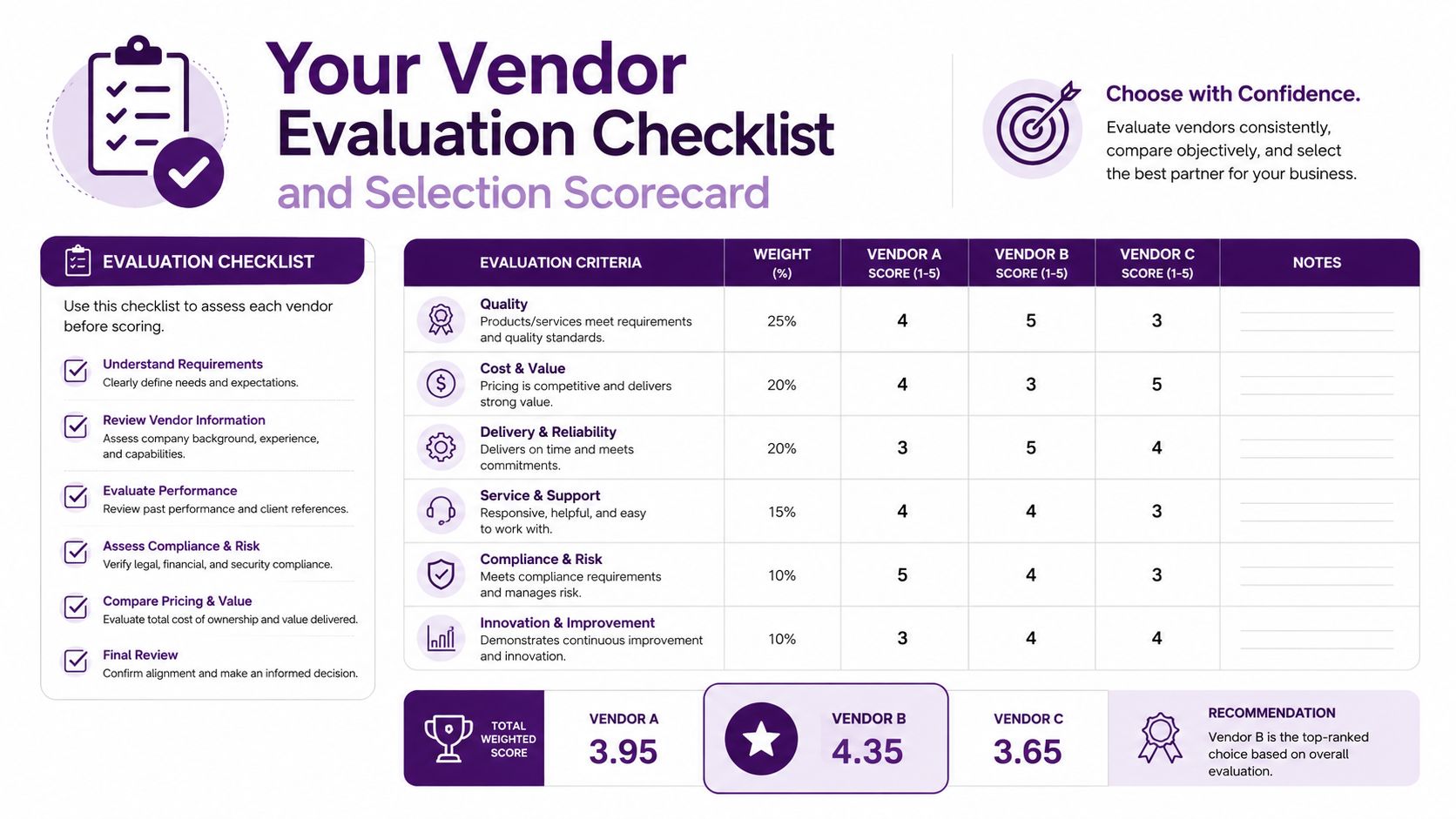
Your Vendor Evaluation Checklist and Selection Scorecard
Score vendors against evidence, not polished demos. Ask each provider to respond to the same scenario, submit the same documentation, and explain how performance is reported after launch.
Suggested evaluation categories
Use a simple internal scorecard. You can assign the highest weight to patient safety and escalation, followed by compliance and security, then workflow fit and language coverage. Pricing should matter, but it shouldn’t compensate for an unsafe triage model.
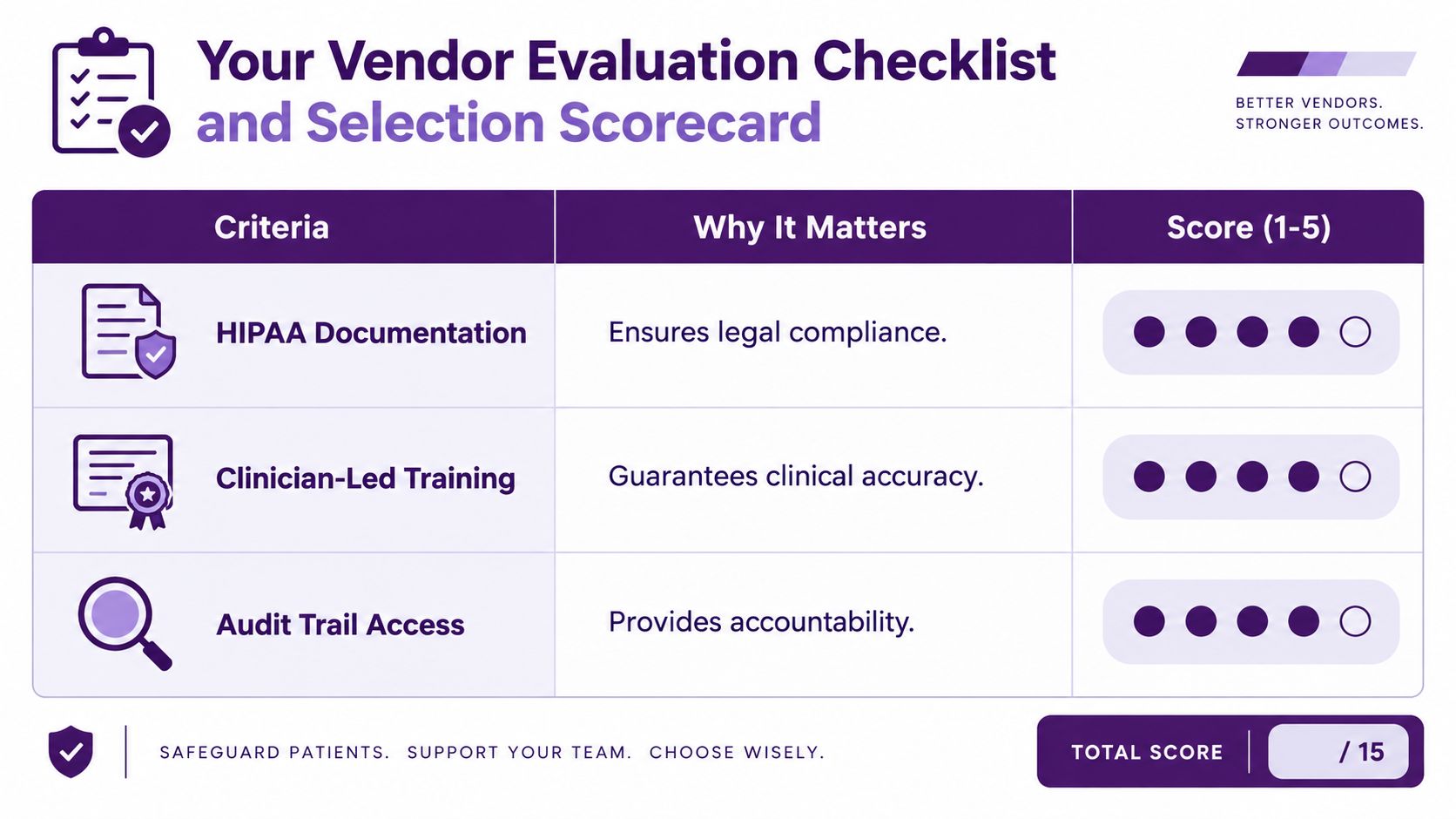
| Criterion | What to verify | Suggested priority |
|---|---|---|
| HIPAA documentation | Signed BAA, secure PHI handling, access controls, retention, incident process | Highest |
| Clinical training | Specialty scripts, clinician-reviewed protocols, testing before launch | Highest |
| Escalation performance | Response windows, backup contacts, unresolved-case reporting | Highest |
| Audit trails | Call records, timestamps, dispositions, escalation history | High |
| EMR and scheduling integration | Structured delivery, chart visibility, appointment workflow | High |
| Language coverage | Live English and Spanish support, bilingual quality review | High |
| Continuity planning | Backup staffing, phone-system contingency, disaster recovery | Medium |
| Contract flexibility | Pilot option, exit terms, volume adjustments, SLA remedies | Medium |
Red flags that should end the conversation
- No BAA: A provider that won’t sign the required agreement shouldn’t receive PHI.
- Vague escalation language: “We notify the doctor promptly” isn’t a measurable operating standard.
- No clinical owner: Ask who approves scripts and protocol changes.
- Demo avoidance: Give the vendor a chest-pain scenario, a medication-reaction scenario, and a routine refill request.
- No audit access: If you can’t review what happened, you can’t manage quality.
- Unclear bilingual capability: Ask for a Spanish-language role-play, not a checkbox on a brochure.
Your practice may also coordinate the answering partner with medical billing services by Happy Billing when administrative workflows overlap. Keep the evaluation focused on documented responsibilities, secure data movement, and clear ownership between vendors.
Pricing Models and How to Estimate Real ROI
Medical answering services generally price through per-call, per-minute, bundled, or tiered subscription structures. Each model rewards a different call pattern.
Per-call pricing can be easier to forecast when interactions vary in length. Per-minute billing may suit a practice with short, predictable calls, but long symptom-intake conversations can make the invoice less predictable. Bundles and subscriptions can simplify budgeting, although unused capacity and overage rules need close review. Hybrid plans may separate automated routine work from live-agent escalation.
Build the business case from missed access
Start with your own data, not a vendor’s generic calculator. Pull call records and estimate:
- Calls that arrived after hours.
- Calls that reached voicemail or abandoned in a queue.
- Calls that required staff callbacks.
- Calls that became appointments, refills, urgent escalations, or unresolved cases.
- The value of retaining or scheduling one patient.
- The proposed service fee, implementation cost, and internal oversight time.
A basic model is:
Recoverable value = missed-call opportunities × realistic patient value, minus service cost and management cost.
Don’t assume every missed call becomes revenue. Build conservative, expected, and upside scenarios using your own patient-retention and scheduling data. A high-volume specialty clinic may benefit from automation for routine requests and live clinicians for escalation. A smaller practice may prioritize a consistent live voice and straightforward message delivery.
The healthcare answering-services market has been projected at about $1.5 billion in 2025 and more than $3.2 billion by 2033. Those are market projections, not a guarantee that any vendor will produce a return for your practice. Review the buyer’s guide and market discussion.
Negotiate around proof
Request a pilot lasting long enough to include ordinary demand, weekends, and at least one high-pressure period. Put answer-time, escalation, documentation, bilingual quality, and reporting expectations in writing. Avoid a long minimum commitment until the vendor proves that its workflow works with your scripts, clinicians, scheduling system, and patients.
If you’re comparing outsourced coverage with software seats, review the broader cost structure of Zendesk pricing per agent, but don’t compare license price alone. Your real alternative may include recruiting, supervision, training, schedule coverage, compliance work, and the cost of unresolved patient calls.
Common Buyer Mistakes and the Questions That Prevent Them
The biggest mistake is assuming every 24/7 service offers the same access. One provider may use live agents and a clinician escalation tree. Another may route every call to voicemail after collecting a name. Both can advertise continuous availability.
Ask: “Who answers at night, what information can that person collect, and what happens when a caller reports an urgent symptom?”
The second mistake is selecting the lowest per-minute rate without testing escalation quality. A low price doesn’t help if agents miss the urgency, send incomplete messages, or fail to activate the backup provider.
Ask: “Can you show anonymized escalation logs, response timestamps, unresolved cases, and quality-review findings from a recent operating period?”
The third mistake is allowing AI-only routing to handle clinical uncertainty. Automation can support intake and routine scheduling, but it shouldn’t provide medical advice or create false reassurance. Unlicensed staff and automated systems need a clear handoff to licensed clinical personnel when the protocol requires it.
Ask: “Who clinically signs off on protocol changes, and can we disable automation for symptom categories that need human review?”
Contract questions matter as much as technology
A service-level agreement should define answer performance, escalation windows, backup procedures, documentation, reporting, incident notification, and remedies when the provider misses its obligations. If the contract only promises availability, it doesn’t protect patient access.
Ask how implementation works, who trains the agents, how updates reach the team, and how quickly your practice can change an on-call schedule. Patients shouldn’t experience confusion because a vendor transition left two competing scripts in circulation.
You should also ask whether patients can tell they’re speaking with an outside team. The answer isn’t the key issue. Consistent identity verification, accurate information, respectful communication, and reliable handoffs matter more than pretending the service is internal.
Short answers to common concerns
How long does implementation take? It depends on integrations, specialties, scripts, schedules, and testing. A responsible provider should give you a defined onboarding plan rather than rush a generic script into production.
Can outsourcing disrupt patient trust? It can if agents sound unfamiliar with the practice or transfer callers repeatedly. Use role-play, call monitoring, and patient-feedback review during the pilot.
What should happen during transition? Run the old and new workflows in a controlled period, publish one escalation path, verify every on-call contact, and monitor unresolved calls daily until the handoff is stable.
What should the buyer remember? Always-on coverage is useful only when the service knows its limits, follows your protocols, protects patient information, and gets urgent calls to licensed professionals quickly.
Build a Safer After-Hours Access Workflow
Discuss an English-Spanish healthcare support model built around your approved workflows, security requirements, scheduling needs, and escalation structure.
Talk to an ExpertFrequently Asked Questions
1. What is a 24/7 medical answering service?
It is an external service that answers patient calls throughout the day, overnight, on weekends, and during holidays using workflows approved by the healthcare organization.
2. Can answering-service agents provide medical advice?
Unlicensed answering agents should not diagnose patients or provide medical advice. Their role should be limited to approved information collection, administrative assistance, routing, and escalation to appropriately qualified personnel.
3. Does a medical answering service need a Business Associate Agreement?
When the provider is a business associate under HIPAA, the covered entity must have an appropriate contract or arrangement requiring safeguards for protected health information. Practices should confirm this with qualified counsel.
4. What should a medical answering service document?
Documentation may include permitted caller identifiers, callback information, time of contact, stated reason, routing category, disposition, escalation recipient, acknowledgment, and outstanding follow-up.
5. Can automation be used for medical answering?
Automation can support approved scheduling, office information, structured intake, and routine requests. It should maintain a clear human handoff and should not replace licensed clinical judgment.
6. What is a medical answering service escalation workflow?
It is a documented process defining which call categories require notification, who receives them, when backup contacts activate, and how acknowledgment and resolution are recorded.
7. Why is bilingual medical answering important?
English-Spanish coverage can help patients communicate in their preferred language while supporting more consistent intake, scheduling, documentation, and escalation.
8. How much does a 24/7 medical answering service cost?
Pricing depends on volume, call duration, live-agent requirements, languages, integrations, clinical escalation, reporting, technology, and contract structure. Models may be per call, per minute, bundled, subscription-based, or dedicated-team.
9. How should a practice test an answering-service provider?
Run simulations covering routine administrative calls, urgent protocol categories, failed primary escalation, Spanish-language interactions, disconnected callers, and documentation review.
10. What are warning signs when choosing a medical answering service?
Warning signs include no appropriate BAA, vague escalation promises, unsafe automation claims, no protocol owner, weak audit access, unverified bilingual capability, and unclear incident-response procedures.
CallZent provides bilingual nearshore call center and BPO support from Tijuana, including live patient call answering, appointment support, intake capture, and escalation workflows for healthcare providers. If your practice needs English and Spanish coverage with coordinated operations across North America, visit CallZent to discuss a practical coverage model and evaluate your after-hours demand.