
Financial Services Compliance Training
Financial Services Compliance Training for BPO Teams: Practical Guide for 2026
Learn how to build financial services compliance training for outsourced and nearshore teams. Cover regulatory mapping, role-based curriculum, smart delivery, ROI, and BPO oversight.
TL;DR — Quick Takeaways
- Map regulations to real job tasks. Start with the rules that apply to each workflow, not with a generic annual course.
- Build role-specific tracks. Lending, operations, customer service, collections, back-office, and QA teams need different training.
- Use delivery methods that fit live operations. Microlearning, mobile access, scenario practice, and floor reinforcement work better than long lectures for busy teams.
- Measure more than completion. Track assessments, QA findings, escalation quality, documentation accuracy, and operational errors.
- Keep outsourced teams inside the same control system. A nearshore partner should follow your standards, records, refreshers, and reporting rhythm.
Is your compliance training protecting your operation, or just creating a file that proves someone clicked “complete”?
That gap matters more than most leaders want to admit. In financial services, weak training doesn’t only create audit pain. It creates avoidable mistakes in customer conversations, inconsistent escalations, poor documentation, and damage to trust that takes much longer to repair than a training module does to assign.
For outsourced teams, the risk gets sharper. A BPO agent may handle customer onboarding, payment conversations, account servicing, collections, fraud flags, or data-sensitive workflows. If training is generic, translated poorly, or disconnected from work on the floor, people fall back on habit. In regulated work, habit is not a control.
A real concern sits underneath all of this. Approximately 20% of employees in finance lack vital information needed to meet their compliance obligations, creating clear exposure to misconduct and penalties according to Knowingo’s analysis of compliance training in the finance sector. That’s not a learning problem alone. It’s an operating model problem.
For teams that outsource regulated customer work, the answer isn’t to avoid outsourcing. The answer is to design training as part of service delivery from day one. That means building the same discipline into onboarding, nesting, QA, coaching, supervisor oversight, and documentation. Firms that do this well treat training as a control, not an HR event.
If your operation includes customer contact, back-office processing, or bilingual support in finance, your training model needs to be as deliberate as your security model. That’s especially true in nearshore environments handling sensitive workflows like those described in financial services call center operations.
Key takeaway: The most effective financial services compliance training doesn’t sit on top of operations. It’s built into how the work gets done.
Introduction Your First Line of Defense Against Risk
Most compliance failures don’t start with bad intent. They start with unclear instructions, role confusion, or a frontline employee making a judgment call without enough context.
That’s why financial services compliance training should be treated as a frontline risk control. In a BPO setting, this becomes even more practical. You’re not training people in a vacuum. You’re training them to handle real calls, real records, real authentication steps, and real escalation paths while meeting service levels.
Where training usually breaks down
A lot of programs fail for predictable reasons:
- Generic content: One annual course gets assigned to everyone, regardless of role.
- Weak examples: The material explains rules but never shows what the rule looks like in a live interaction.
- Poor retention: Agents complete the module, pass a quiz, then forget what to do under pressure.
- No operational link: QA, supervisors, and trainers don’t reinforce the same standards.
- Limited audit readiness: Records exist, but they don’t clearly prove who was trained on what and when.
In outsourced environments, another issue appears quickly. Client policy, local team habits, language nuance, and production pressure can drift apart. If nobody actively manages that drift, training becomes ceremonial.
What strong programs actually do
Strong programs look less impressive on paper and perform better in practice. They tie training to daily work.
A customer service agent handling account updates needs one set of rules and scenarios. A collections agent needs another. A back-office team reviewing documents needs another. Supervisors need a different layer focused on oversight, documentation, and escalation quality.
That operating discipline matters because the consequences aren’t only regulatory. They show up in repeat contacts, avoidable escalations, rework, poor customer confidence, and tense audit prep.
The best compliance training answers a simple question for the employee: “What do I do in this situation, and how do I prove I handled it correctly?”
For BPO leaders, this changes the conversation. Training is no longer a support function. It’s part of service design, staffing readiness, and client risk management.
Building Your Compliance Blueprint Regulatory Mapping
Before building a course, build a map. If you skip that step, you’ll end up teaching broad principles while missing the actual rules tied to the work your team performs.
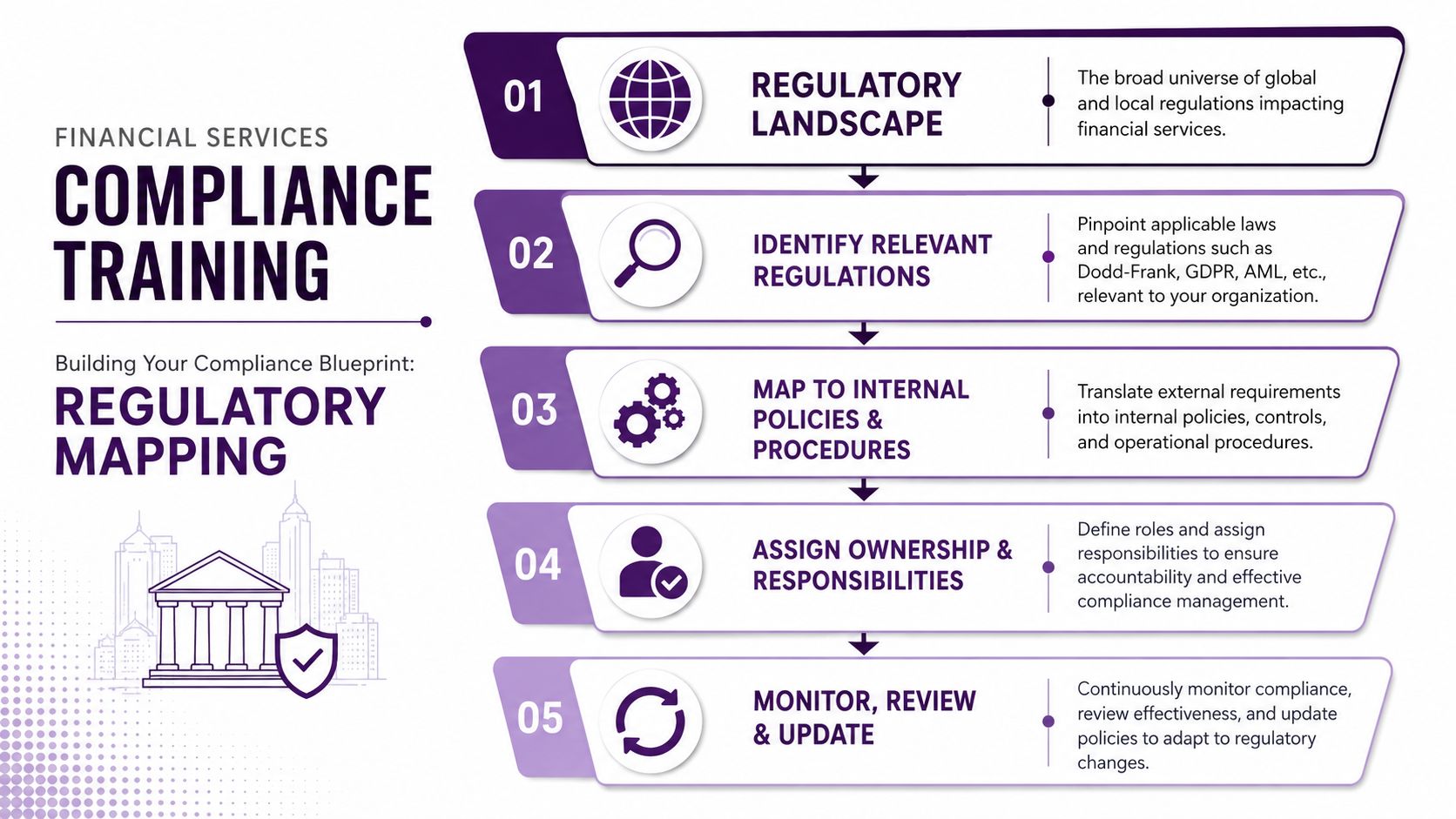
Financial services training must explicitly cover Sarbanes-Oxley (SOX), the Patriot Act, anti-money laundering (AML), and insider trading laws where relevant, as noted by eLearning Industry’s overview of compliance training in financial services. Generic overviews often miss that level of specificity, and that’s exactly where training programs become too vague to be useful.
Start with workflows, not departments
A practical compliance map starts with the work itself. In a BPO, departments can hide risk. Workflows reveal it.
Build your map this way:
-
List the workflows
Account opening, payment handling, customer verification, complaint intake, collections calls, email support, document indexing, dispute handling, fraud escalation. -
Match regulations to each workflow
A customer onboarding flow may trigger AML concerns. Recorded communications may trigger recordkeeping and communication standards. A back-office archive process may trigger data retention rules. -
Translate rules into local procedures
Legal language becomes operational language. “Retain records” becomes “save interaction notes in the approved system, use approved disposition codes, and don’t move regulated information into side channels.” -
Assign ownership
Compliance writes the standard. Operations applies it. QA tests it. Training teaches it. Supervisors reinforce it. -
Document evidence
Your map should connect each role, workflow, risk, training module, and proof requirement.
Teams that need a clearer framework for converting external obligations into internal controls can borrow structure from resources like Bridge IT Solutions’ compliance guide. It’s not finance-specific, but the discipline of mapping obligations to practical controls is useful.
A real example from a customer onboarding queue
Take a new agent supporting customer onboarding for a financial client.
Their compliance map might include:
- Identity handling: What information can be requested, how it must be stored, and what never belongs in free-text notes.
- AML awareness: How to recognize a mismatch, unusual urgency, incomplete explanations, or behavior that requires escalation.
- Communication standards: What can and cannot be promised to the customer.
- Recordkeeping: Which system of record must hold the interaction trail.
- Escalation path: Who receives a suspicious or incomplete case, and what evidence must be attached.
That map becomes the backbone of the curriculum, the QA scorecard, and the audit file. Without it, training turns into broad awareness. With it, training becomes a managed control environment.
For outsourced teams, this structure should also line up with the client’s documented standards and internal monitoring. A useful benchmark for that alignment is a clear call center compliance framework.
Designing a Curriculum That Actually Works
Once the compliance map is done, curriculum design gets easier. A common mistake is trying to create one polished course for everyone. It looks efficient. It usually fails.
Role-specific training tracks must be developed for functions such as lending, operations, and customer service, with scenarios tied to the actual work people do, as explained by OnCourse Learning’s guidance on financial services compliance training. In live operations, relevance drives retention.
What doesn’t work in a call center environment
Long lecture-style modules are hard on busy teams. They pull agents off the floor for too long, they overload memory, and they rarely mirror the pace of actual customer interactions.
A one-size-fits-all model also creates friction:
| Approach | What happens in practice |
|---|---|
| One annual course for all roles | Agents complete it, but frontline decisions don’t improve much |
| Policy-only instruction | Staff know the words but not the behavior |
| Quiz-only validation | People memorize answers without applying judgment |
| Generic examples | Employees don’t recognize risk in their own workflows |
That’s why the better approach is narrower and more operational.
What works better
Use layered curriculum design.
Core layer
Everyone needs the same foundation on conduct, data handling, escalation discipline, documentation standards, and the client’s mandatory controls.
Role layer
The training demonstrates its utility in practice. A lending support rep should practice disclosure accuracy and document handling. A customer service rep should practice authentication, note quality, and red-flag escalation. A back-office processor should practice exception handling and record retention.
Scenario layer
This is the difference-maker. Build short exercises around real situations:
- A caller pushes for account action without completing verification
- A customer story doesn’t match submitted documentation
- An agent sees potentially suspicious account behavior during a routine service interaction
- A supervisor notices repeated note-taking errors that create retention risk
Practical rule: If a training module can’t be turned into a supervisor coaching example or a QA calibration discussion, it’s probably too abstract.
For teams shaping this by role, there’s a useful parallel in broader workforce design. This guide to HR compliance training is outside financial services, but it reinforces the same operational truth. Training sticks when it matches role, risk, and consequence.
Build for reinforcement, not completion
A strong curriculum doesn’t end with the LMS module. It shows up again in nesting, floor support, QA comments, refresher huddles, and supervisor coaching.
That’s why outsourced teams need curriculum tied directly to agent development plans. If training lives in one system and coaching lives somewhere else, the message fragments. A better model connects compliance content with structured agent training programs so the same behaviors are taught, tested, and reinforced consistently.
Modernizing Delivery with Smart Technology
The delivery method matters because operations matter. In a BPO, every hour spent in training is an hour not spent handling volume. That doesn’t mean training should be shortened at any cost. It means delivery should fit the rhythm of the floor.
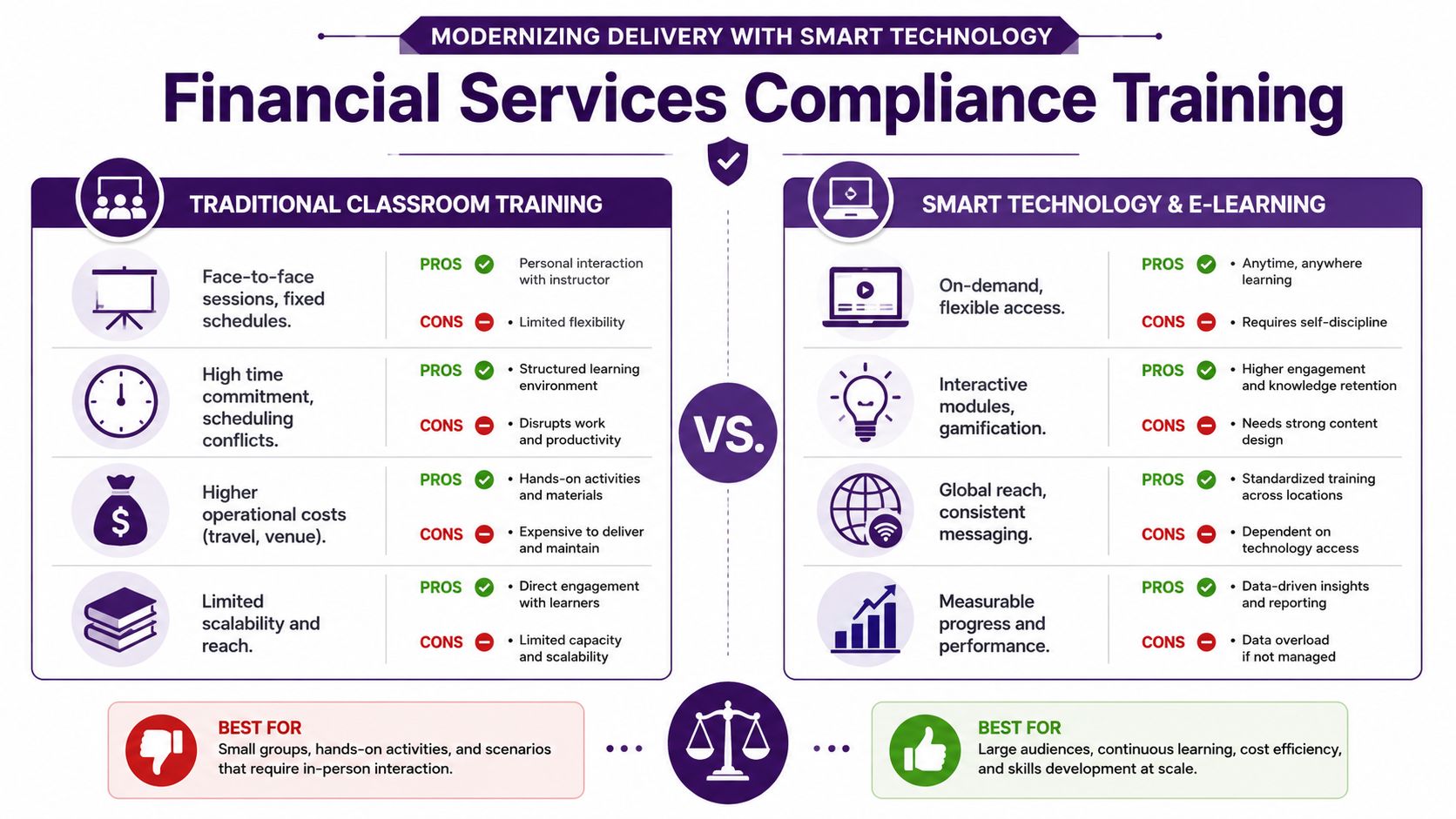
Modern platforms are proving why this shift matters. Financial compliance training platforms can achieve 95%+ completion rates through mobile-first design, AI-powered personalization, and microlearning, according to 5Mins.ai’s review of financial compliance training platforms. That matters because completion is often the first operational hurdle, especially with distributed teams and shifting schedules.
Traditional delivery versus smarter delivery
Classroom sessions still have a place. They work well for launch training, complex policy changes, and supervisor-led discussion. But they’re hard to scale and difficult to repeat without disrupting service levels.
Smart delivery methods tend to perform better in day-to-day environments:
- Microlearning modules: Good for refreshers, updates, and high-risk reminders.
- Mobile access: Useful for distributed teams, split schedules, and quick reinforcement.
- AI-personalized paths: Helpful when one role needs more support on specific topics than another.
- Scenario-based quizzes: Better than passive reading because they test decision-making.
- Embedded prompts: Useful when agents need support in the flow of work.
What to look for in the platform
A financial services training stack should do more than host videos and quizzes. It should support control evidence and operational coaching.
Look for:
- Audit-friendly records: Clear proof of assignment, completion, and version history
- Role mapping: Training tied to job function and risk exposure
- Fast update cycles: Policy changes should be publishable without rebuilding the whole course library
- Assessment depth: Scenario scoring matters more than simple recall
- Manager visibility: Supervisors need to see who is struggling before errors show up in production
If you’re evaluating LMS requirements through a compliance lens, even outside finance-specific examples, LearnStream on LMS HIPAA features is a useful reminder that regulated training platforms need strong documentation, assignment logic, and reporting discipline.
Delivery should support live decisions
One of the most practical upgrades is connecting training with floor support. If an agent is unsure how to handle a suspicious request, the best system doesn’t force them to remember a policy paragraph from last quarter. It gives them approved decision support in the moment.
That’s why many operations pair formal training with tools like guided workflows, searchable knowledge bases, and real-time agent assistance. In compliance-sensitive environments, speed matters, but guided accuracy matters more.
Measuring What Matters Proving Training ROI
If the only number you can show is completion rate, your training program is under-measured.
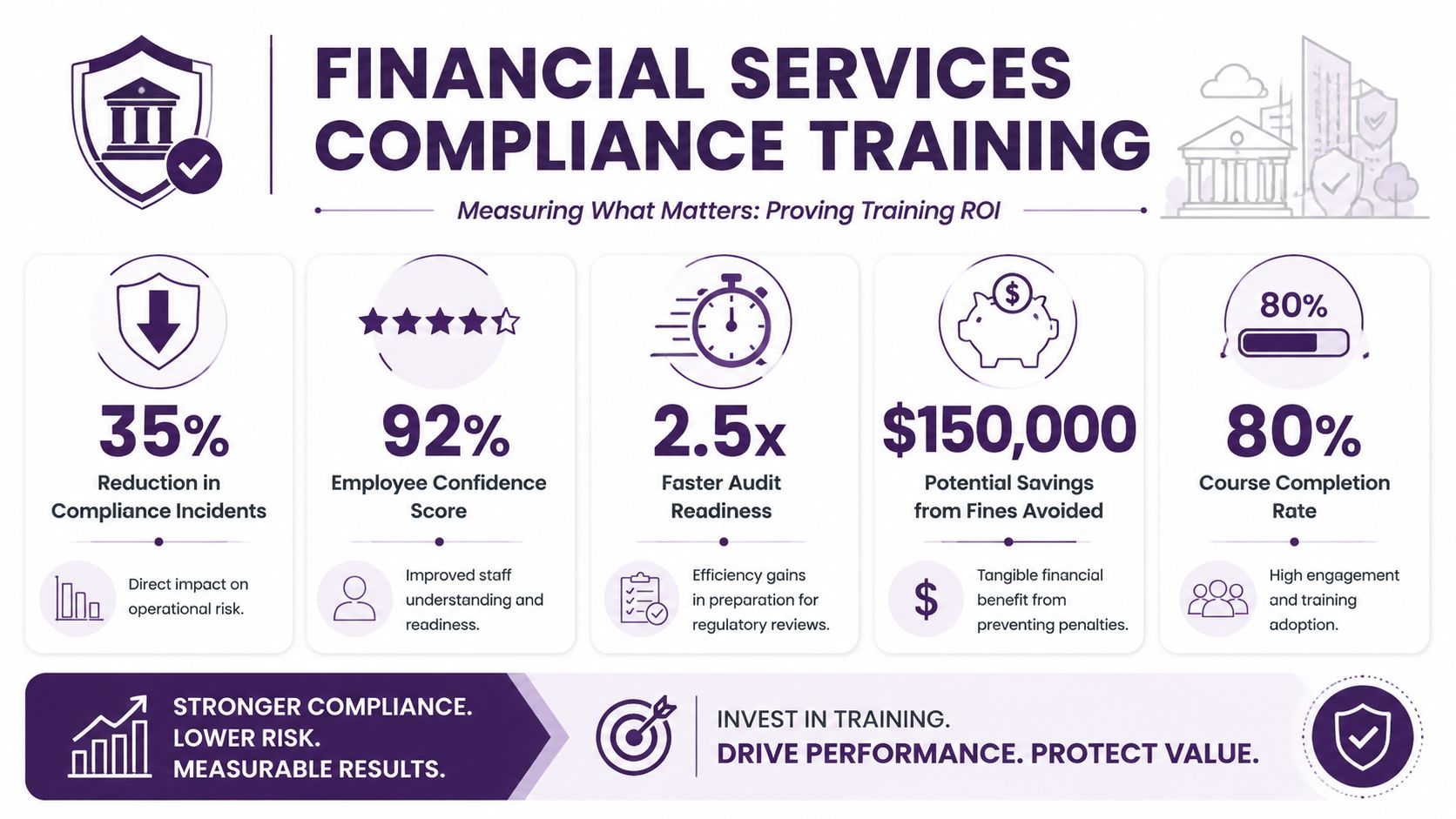
The business case is getting stronger, not weaker. The US market for compliance training for financial institutions is projected to grow by USD 1.6 billion between 2024 and 2029, at a CAGR of 14.7%, according to Technavio’s market analysis of compliance training for financial institutions in the US. Firms don’t invest at that level because training is fashionable. They invest because the cost of getting it wrong is real.
One note on the infographic above: the visual is useful as a reporting concept, but your own ROI reporting should rely on your internal data, audit results, and documented error trends.
The metrics that actually matter
A practical scorecard usually includes four layers.
Learning metrics
Did people complete the right training? Did they pass? Did their post-training performance improve compared with their baseline?
Behavior metrics
Are agents applying the training? You’ll usually see this in QA reviews, escalation quality, note quality, authentication accuracy, and adherence to approved scripts or disclosures.
Risk metrics
Are compliance-related incidents declining? Are fewer cases being reworked because documentation is incomplete? Are supervisors finding fewer repeat errors in the same categories?
Business metrics
Is the program helping the firm avoid preventable exposure? Cost avoidance is one of the clearest ways to explain ROI. If stronger training reduces the likelihood of fines, audit findings, operational mistakes, or customer trust issues, that value belongs in the business case.
Training ROI in finance is rarely about “learning culture.” It’s about reducing avoidable risk while keeping the operation usable.
Why localization matters in bilingual teams
Many firms weaken their own program by translating modules word-for-word and assuming the message survived.
It usually didn’t.
A bilingual US-Mexico operation needs localization, not direct translation. Policy language may have a literal equivalent, but customer interactions often depend on nuance. The employee has to understand what a red flag sounds like, how an escalation should be phrased, and which behaviors are prohibited even when a customer is pressuring for speed.
A direct translation can preserve terminology while losing judgment. That’s dangerous in finance.
For nearshore operations, it’s smarter to measure comprehension through scenarios in the working language of the role, then monitor application in QA and floor observations. That’s where dashboards become useful. Training leaders, compliance teams, and operations managers should review the same evidence in a shared reporting and KPI dashboard environment.
Integrating Training with Your Nearshore BPO Partner
Outsourcing customer operations doesn’t outsource regulatory accountability. The client still owns the obligation. The BPO becomes part of the control environment.
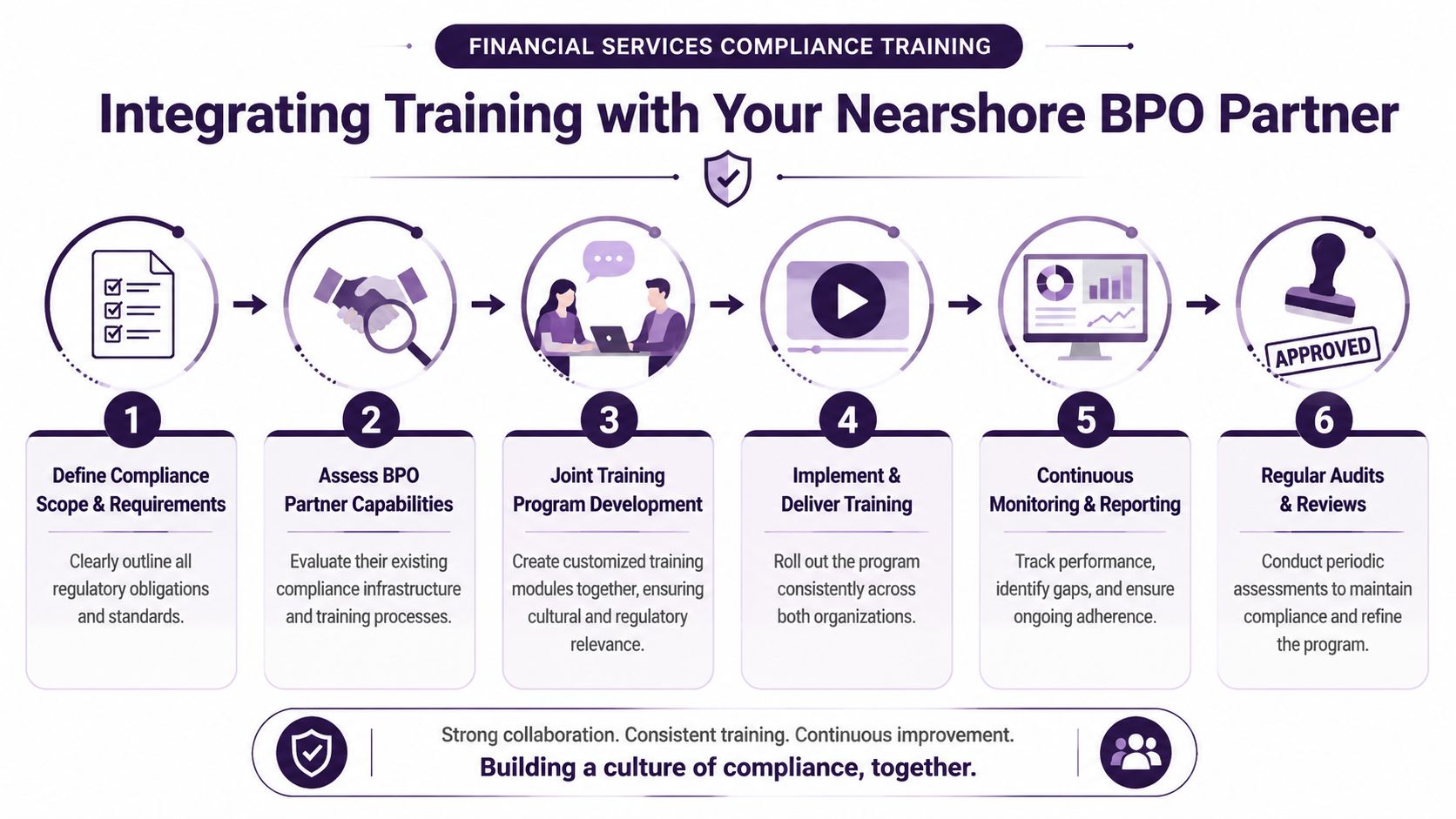
That’s why governance matters from the first conversation. Effective programs require annual training for all employees, immediate training for new hires, and specialized programs for high-risk staff, all documented in written supervisory procedures (WSPs) according to Xantrion’s guidance on financial services regulatory compliance. In a nearshore model, those expectations need to extend cleanly to the outsourced team.
What to vet before launch
Don’t start with pricing. Start with operational fit.
Review the partner’s ability to support:
- Role-based training deployment: Can they assign and track by function, not just by account?
- Document control: Can they maintain version discipline for procedures, scripts, and policy acknowledgments?
- Supervisor accountability: Do team leads coach to compliance behaviors, not just productivity?
- Training records: Can they produce clean evidence for auditors and client reviews?
- Refresh rhythm: Can they retrain quickly when policies change?
A good partner should also be able to explain how new hires are trained before taking live interactions, how tenured staff receive refreshers, and how high-risk queues get tighter oversight.
A simple partnership model that works
The cleanest model is shared ownership with distinct roles.
| Area | Client responsibility | BPO responsibility |
|---|---|---|
| Regulatory interpretation | Define required standards | Apply standards operationally |
| Training content approval | Approve policy and critical modules | Localize delivery and reinforce on floor |
| QA design | Set compliance-critical items | Score consistently and coach to findings |
| Audit evidence | Define required proof | Maintain records and produce evidence on time |
| Change management | Communicate policy updates | Retrain staff and confirm adoption |
How to keep oversight without slowing production
Many programs tend to get too heavy. They create so many approvals and meetings that training updates lag behind live operations.
A better model uses a standing governance rhythm:
- Weekly operational reviews: Training gaps, QA findings, policy questions
- Monthly compliance reviews: Trend analysis, refresher priorities, documentation checks
- Quarterly audits: Sampling of records, calibrations, escalation quality, WSP alignment
- Immediate update path: Fast retraining when the client changes a critical rule or script
A nearshore BPO works best when compliance standards are centralized, but reinforcement is local and continuous.
The strongest outsourced teams don’t treat compliance as a client requirement sitting outside daily work. They build it into onboarding, floor support, coaching, and supervisor routines. That’s what turns a vendor relationship into a controlled operating model.
Conclusion From Compliance Chore to Competitive Advantage
Financial services compliance training works when it’s built like an operating system, not a yearly event. The practical path is clear. Map the rules to the work. Build role-specific training. Deliver it in formats the floor can absorb. Measure application, not just attendance. Extend the same discipline to any nearshore or outsourced team touching regulated workflows.
That approach reduces friction for employees, gives supervisors something concrete to coach, and gives compliance leaders better evidence when auditors ask hard questions.
Handled well, training stops being a defensive chore. It becomes part of service quality, customer trust, and risk control.
🚀 Ready to Strengthen Financial Services Compliance Training?
CallZent helps North American financial services teams build bilingual nearshore BPO operations with role-based training, QA discipline, reporting visibility, escalation workflows, and compliance-aware customer support.
Talk to an ExpertFAQs About Financial Services Compliance Training
What is financial services compliance training?
Financial services compliance training teaches employees and outsourced teams how to follow the rules, procedures, documentation standards, and escalation requirements that apply to regulated financial workflows.
Why is compliance training important for BPO teams?
BPO teams may handle customer data, onboarding, payments, account servicing, collections, fraud flags, or document processing. Without role-specific training, outsourced agents can create compliance, security, documentation, and customer trust risks.
What should financial services compliance training cover?
Training should cover the regulations and procedures tied to each role, including identity handling, AML awareness, recordkeeping, approved communications, data handling, escalation paths, documentation rules, and client-specific operating standards.
Why is role-based compliance training better than generic training?
Role-based training connects rules to the actual decisions employees make on the floor. A lending support agent, collections agent, customer service agent, QA analyst, and back-office processor each face different risks and need different scenarios.
How often should compliance training be refreshed?
Compliance training should happen during onboarding, before agents handle live work, when policies change, after QA findings reveal gaps, and on a recurring schedule such as annual or quarterly refreshers depending on risk exposure.
How should companies measure compliance training effectiveness?
Companies should measure more than completion. Useful metrics include assessment scores, QA findings, escalation accuracy, documentation quality, authentication errors, incident trends, rework rates, and audit evidence quality.
What is regulatory mapping in compliance training?
Regulatory mapping connects each workflow to the applicable rules, risks, training modules, procedures, QA checks, and proof requirements. It helps turn broad legal obligations into daily operating controls.
Why does localization matter for bilingual nearshore teams?
Localization matters because direct translation can preserve words while losing judgment. Bilingual teams need scenarios, coaching, and QA examples in the working language of the role so agents understand what risk sounds like in real customer interactions.
How should a nearshore BPO partner support compliance training?
A nearshore BPO partner should support role-based training deployment, documented refreshers, version control, supervisor coaching, QA alignment, training records, audit evidence, and fast updates when client policies change.
How can CallZent help with financial services compliance training?
CallZent helps financial services teams build bilingual nearshore support operations with compliance-aware training, QA processes, reporting, escalation discipline, customer service workflows, and operational oversight from Tijuana.
If you’re building or tightening a regulated customer operation, CallZent can help you design a nearshore support model that treats compliance training, operational discipline, and bilingual service quality as one integrated system.