
HEALTHCARE BPO & PATIENT ACCESS
Healthcare Call Center Outsourcing: A Practical Guide for Patient Access and Support
Healthcare call center outsourcing expands patient access, bilingual coverage, and scheduling capacity while protecting HIPAA workflows and service quality.
TL;DR — Quick Takeaways
- Healthcare call center outsourcing works best when it solves patient-access, staffing, scheduling, and workflow problems—not when it is treated as a generic labor-cost strategy.
- A healthcare BPO should demonstrate appropriate HIPAA controls, PHI safeguards, role-based system access, documented training, escalation procedures, and Business Associate Agreement readiness when applicable.
- EHR and CRM integration should be mapped before launch because technical connectivity alone does not guarantee that scheduling, documentation, and escalation workflows will work correctly.
- Bilingual nearshore teams can help U.S. healthcare organizations provide English-Spanish patient support with overlapping business hours and easier collaboration with internal teams.
- The safest rollout is phased: discovery, integration, training, limited launch, QA calibration, and then controlled expansion based on patient-access KPIs.
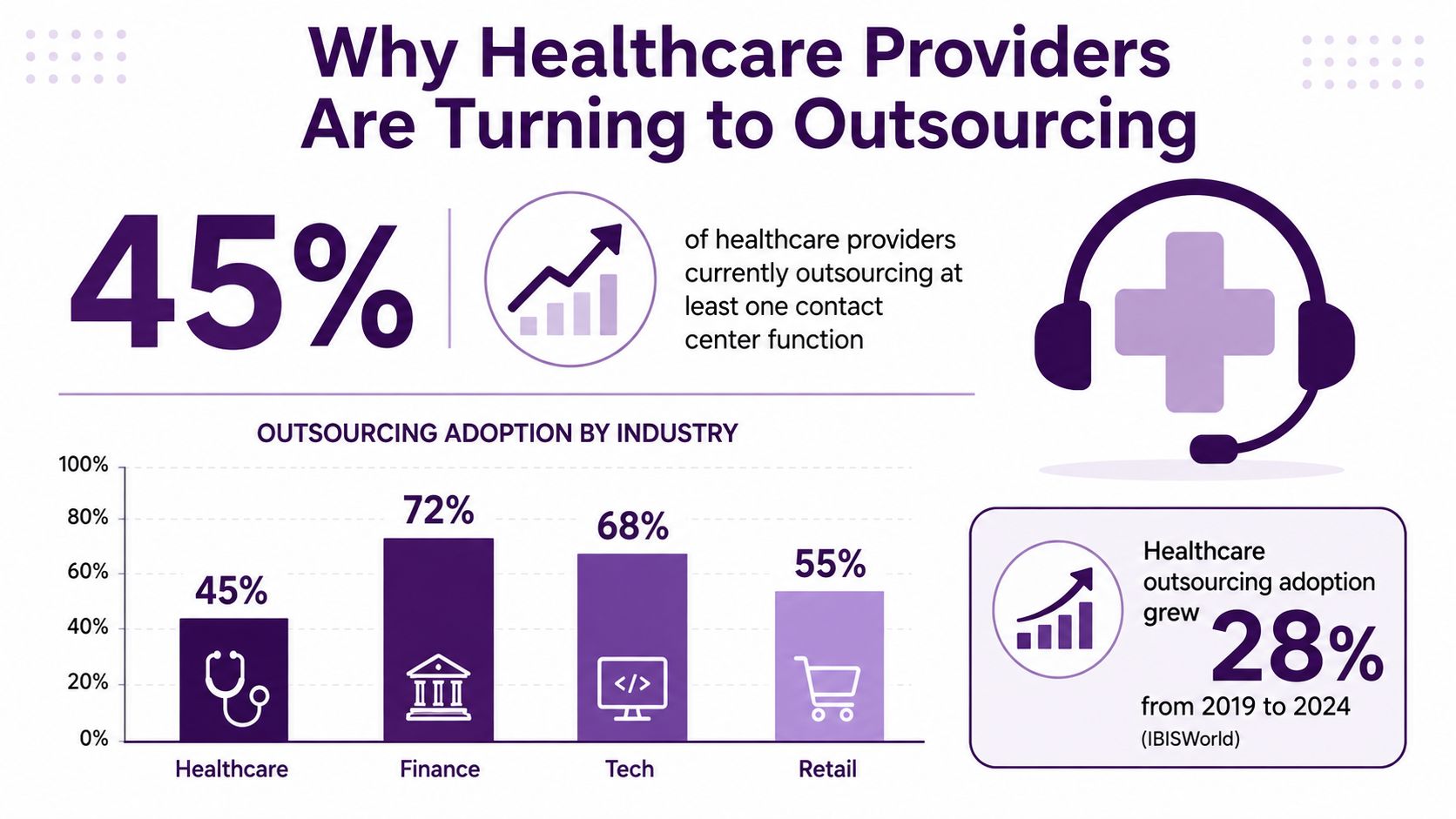
Healthcare call center outsourcing is no longer a side conversation. The global call and contact center outsourcing market is estimated at USD 97.31 billion in 2024, and it’s projected to reach USD 163.86 billion by 2030 at a 9.8% CAGR according to Grand View Research. Yet in healthcare, adoption is still selective, not universal, with only 19% of responding organizations in the HCCT survey saying they outsource call center operations, which tells you the opportunity is real and the bar for execution is high.
That gap matters because healthcare contact centers carry more than call volume. They carry access, scheduling accuracy, patient trust, and revenue capture. A provider that treats outsourcing like a generic labor swap usually ends up buying more risk than relief.
Why Healthcare Providers Are Turning to Outsourcing
The business case starts with scale. Healthcare contact center outsourcing sits inside a large and expanding market, but healthcare itself is still underpenetrated compared with other industries. That matters because providers who adopt early can shape the operating model around their workflows, instead of forcing patients and staff to absorb the friction of an underbuilt internal team.
A healthcare call center statistics report says the average healthcare call center handles about 2,000 calls per day, while staffing covers only about 60% of required demand, and average hold time is 4.4 minutes, far above the Healthcare Financial Management Association’s 50-second benchmark. The same source places average annual operating cost at USD 13.9 million, with about 43% of spending going to labor, which explains why leaders keep revisiting the outsourcing decision. You can see the operational pressure directly, the phone doesn’t stop, but the team can’t stretch indefinitely. Dialog Health’s healthcare call center statistics
What the adoption numbers really mean
Healthcare is still behind the broader outsourcing curve. The HCCT survey found that only 19% of responding organizations outsource call center operations, while another 2025 industry summary says about 36% of healthcare organizations outsource some or all call center functions, up 12 percentage points from five years earlier. That spread tells a simple story, different sample sets, same direction, more providers are testing the model, but many still keep it in-house because the consequences of a bad implementation are too costly to ignore. HCCT survey report, 2025 healthcare outsourcing summary
Practical rule: outsource when the problem is structural, not temporary. If your team can’t cover demand, can’t answer fast enough, or can’t keep up with seasonal volume, buying more phones rarely fixes the root issue.
One useful way to think about the decision is through operating leverage. If an in-house team is spending most of its time answering repetitive access calls, escalating schedule questions, and chasing down after-hours coverage, then outsourcing becomes a staffing model, not just a vendor choice. For a broader look at how switching models affects operations, PEO call center switch insights offers a helpful lens on transition planning.
If you’re comparing whether the function belongs inside your organization or with a specialist, the right starting point is often healthcare BPO services. The key question isn’t whether outsourcing is mainstream. It’s whether your patient access operation can keep absorbing demand without degrading service or adding compliance exposure.
Comparing Onshore Nearshore and Offshore Options
Geography shapes healthcare outsourcing more than most buyers expect. The cheapest model on paper isn’t always the least expensive in practice, because healthcare calls depend on training depth, schedule alignment, bilingual performance, and secure collaboration with internal teams. The right model depends on which problem you’re solving first, cost, continuity, or compliance fit.
Where each model tends to fit
Onshore teams usually work best when leaders want the tightest regulatory comfort and the least cultural translation. Nearshore teams, especially in Mexico and Latin America, often fit North American healthcare because the time zone overlap supports live collaboration, bilingual coverage, and faster issue resolution. Offshore teams can still make sense for highly scripted or volume-heavy work, but specialty scheduling and access coordination tend to be harder when the team is far from your operating hours and local workflow norms. For a side-by-side look at the structural trade-offs, see offshore vs. nearshore contact center outsourcing.
| Criteria | Onshore (US) | Nearshore (Mexico) | Offshore (India/Philippines) |
|---|---|---|---|
| Regulatory alignment | Strong internal familiarity with U.S. healthcare operations | Strong fit when governance is well defined | Can work, but requires more process discipline |
| Time-zone overlap | Best for live collaboration | Strong overlap with North American teams | Often requires more shift planning |
| Bilingual support | Available, but often expensive | Strong fit for English and Spanish support | Usually more limited for North American bilingual needs |
| Cultural alignment | High | High for many U.S. healthcare workflows | Varies by team and program |
| Specialty scheduling fit | Strong when trained internally | Strong when agents are trained on protocols | Can be harder without deep workflow immersion |
| Cost pressure | Highest | Balanced | Lowest on labor, but not always on total operating cost |
The practical trade-off buyers miss
The table hides a real point, total cost isn’t just labor. It also includes training time, escalation volume, schedule disruption, and the manager hours spent fixing avoidable mistakes. When a team is close in time zone and language, clinical, billing, and patient access leaders can calibrate more quickly, which usually shortens the feedback loop.
A healthcare operation should choose geography the way it chooses staffing, by matching the work pattern, not by chasing a headline rate.
For North American providers, nearshore often lands in the middle for a reason. It gives you enough proximity for same-day collaboration, enough bilingual depth for patient-facing work, and enough cost relief to justify outsourcing without turning the experience into a compromise. That balance is harder to get from far-off delivery centers when the calls are clinical-adjacent or workflow-heavy.
HIPAA Compliance and PHI Security Requirements
Compliance can’t be bolted on after the fact. A healthcare call center partner either knows how to handle protected health information, or it turns your vendor review into a series of uncomfortable exceptions. The basics matter, but the crucial test is whether the partner can prove that controls exist, are enforced, and are audited in the actual operating environment.
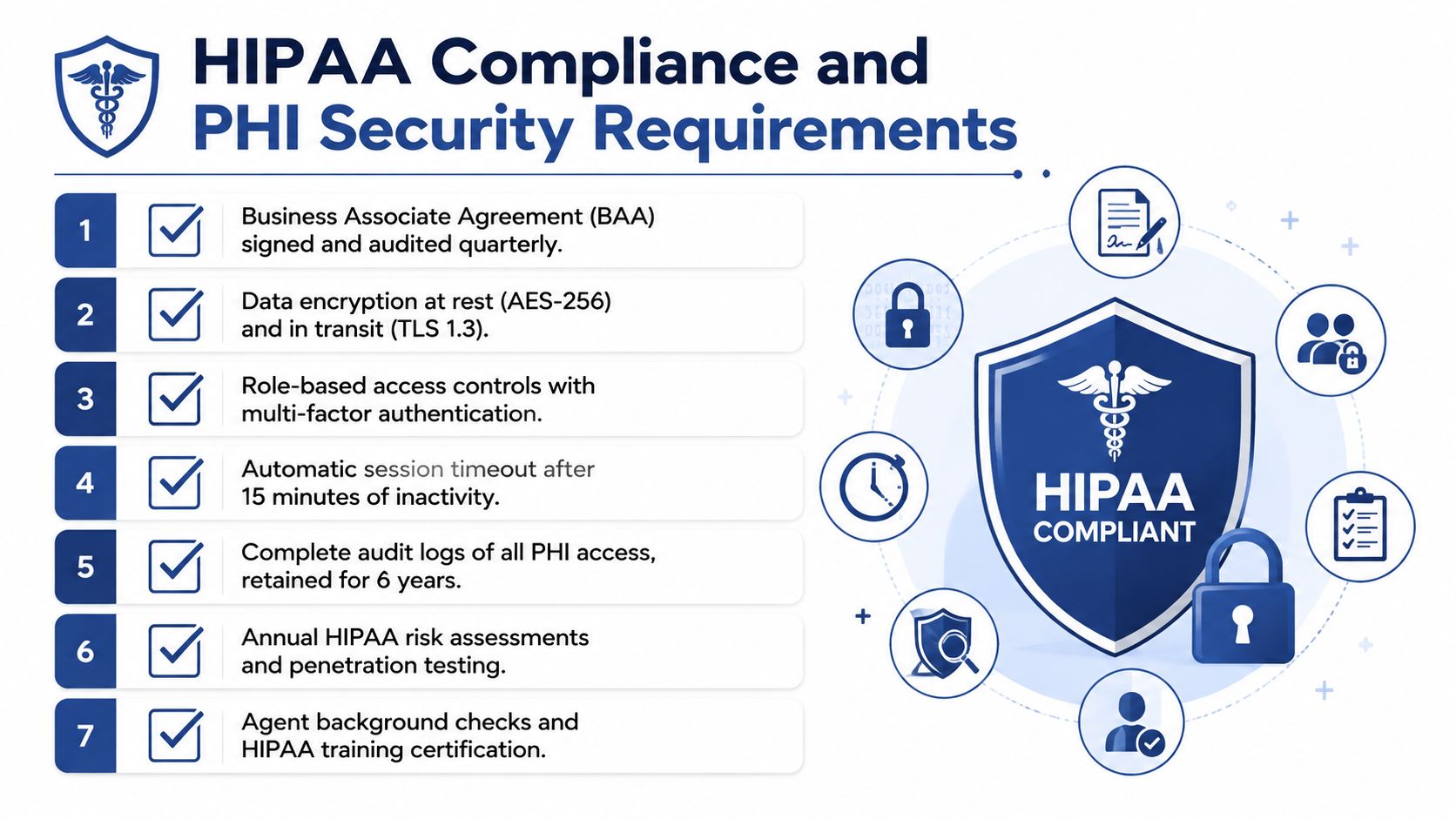
The cleanest way to review a vendor is to ask for evidence in three layers, legal, technical, and physical. A strong healthcare outsourcing compliance guide should help you frame the conversation before procurement gets too far along.
What to verify before any live patient work
- Business Associate Agreement: Make sure the BAA spells out PHI handling, breach notification duties, subcontractor obligations, and audit rights.
- Access controls: Ask who can see patient data, how role-based permissions work, and how multifactor authentication is enforced.
- Encryption and logging: Confirm that voice and data channels are protected and that access logs are retained and reviewable.
- Training evidence: Request proof that agents receive HIPAA training and ongoing refreshers, not just a one-time onboarding deck.
The physical side matters too. Nearshore facilities should have controlled access, clean desk expectations, screen privacy, and documented device handling. If a partner can’t explain what happens to retired hardware or storage media, that’s a sign the security culture is thinner than the sales deck suggests.
For guidance on the disposal side of compliance, Georgia HIPAA secure IT disposal is a useful reference point because secure disposal is part of the chain of custody, not an afterthought. Health systems need the same mindset they use for records retention, if a device touched PHI, its end-of-life process needs to be treated as a controlled process.
Bottom line: don’t ask whether a vendor says they are HIPAA-ready, ask how they prove it in audits, access control, training, and disposal practices.
Hidden Operational Challenges That Derail Outsourcing
The failures usually don’t start with the call queue. They start earlier, in the handoff between operational promises and healthcare reality. The three issues that break most programs are slower EHR integration than expected, multilingual coverage that looks broad but lacks depth, and specialty scheduling that needs more protocol knowledge than a standard contact center can supply.
A healthcare outsourcing guide notes that EHR interfaces can require 30+ additional days beyond the initial plan, and that number is worth taking seriously because integration is where many go-live schedules slip. The problem isn’t just technical connectivity. It’s the way data fields, workflows, and ownership lines have to be mapped before agents can move without creating duplicate entry or fragmented follow-up. Neowork’s healthcare outsourcing call center guide
EHR integration is a workflow problem before it’s an IT problem
One health system can have a technically sound API and still struggle if patient access teams, scheduling managers, and IT haven’t agreed on what gets written where. That’s why technical discovery has to start during vendor selection, not after the contract is signed. If the vendor’s team can’t walk through HL7 compatibility, access permissions, and escalation paths with your internal staff, you’re not looking at a launch plan, you’re looking at a guessing game.
Multilingual support creates a different kind of risk. A payer might say it offers Spanish coverage, but the real test is whether native-speaking agents are available during peak hours, whether bilingual QA is formalized, and whether surge periods have enough capacity to absorb demand. A healthcare payer outsourcing guide flags that AEP spikes can be 3–5× normal volume, which is exactly when weak language capacity becomes an access problem instead of a staffing issue. Fusion CX’s healthcare payer outsourcing guide
Specialty scheduling exposes protocol depth
Specialty scheduling is where generic call handling falls apart. Calls often require payer-specific prerequisite checks, provider routing, authorization logic, and urgency triage, so first-call resolution depends on whether the agent has the workflow knowledge to finish the task without bouncing the caller to someone else. A healthcare outsourcing comparison also notes that long hold times, dropped calls, and high abandonment usually show up when routing and staffing don’t match actual demand patterns. Assort Health’s outsourcing comparison
A good real-world example is orthopedics or cardiology scheduling. If the caller needs a provider who accepts a specific plan, the agent often has to verify prerequisites, check visit type, confirm urgency, and route correctly the first time. If that knowledge lives only in tribal memory, the outsourced team will create callbacks, and callbacks are where patient frustration starts.
If a vendor talks mostly about answer speed and almost nothing about protocols, the team may be able to take calls, but not finish healthcare work.
Your Vendor Evaluation Checklist
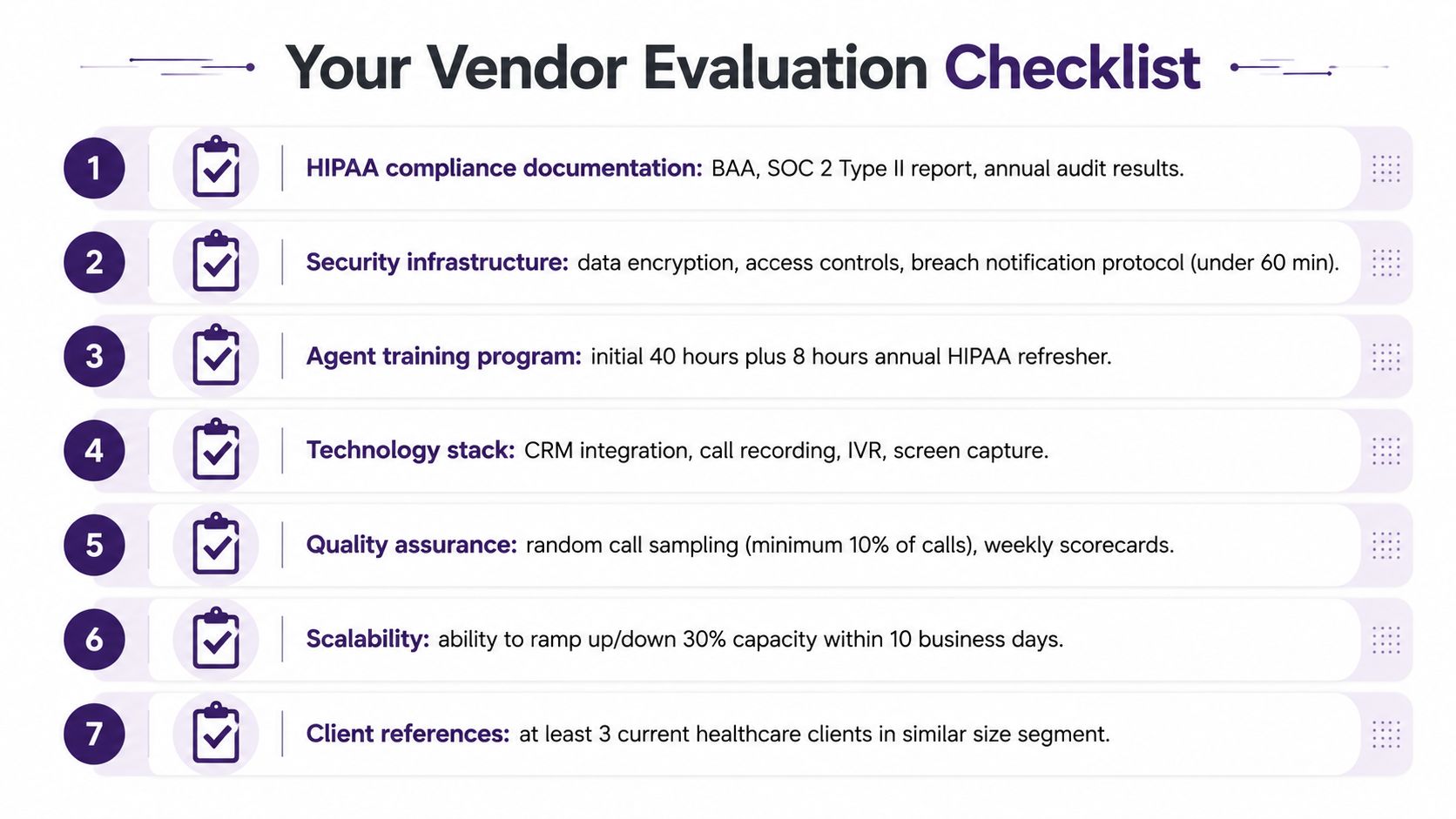
A strong healthcare vendor review should feel more like an operations audit than a sales conversation. The best partners can show how they handle compliance, integrations, training, and surge capacity without sliding into vague promises. The worst ones hide behind broad language and generic CX metrics that don’t map to patient access.
Questions that separate real healthcare operators from generalists
- Show the compliance package: Ask for the BAA, current audit evidence, and proof of agent training, then verify the dates, not just the existence of the documents.
- Walk through the tech stack: The vendor should explain CRM integration, call recording, IVR, and screen capture in a way your IT team can challenge.
- Test bilingual depth: Don’t accept a language list. Ask how many native-speaking agents are available, what hours they cover, and how QA is scored in each language.
- Check the QA rhythm: Request sample scorecards and listen to how often calls are reviewed, calibrated, and corrected.
- Ask about ramp speed: The team should be able to explain how they absorb seasonal demand without breaking service levels.
If you want a more formal framework for comparing partners, vendor evaluation criteria can help you build a consistent scorecard. I’d also take cues from top security outsourcing considerations when reviewing controls, because healthcare vendors should be able to discuss not only service quality but also access discipline and breach response.
What to ask in the demo
- Training depth: How long is onboarding, and what healthcare scenarios do agents practice before handling live calls?
- Escalation paths: What happens when a call touches clinical nuance, eligibility ambiguity, or an authentication issue?
- Reporting cadence: Can the vendor give you live visibility into queue health, abandonment, and resolution patterns?
- Reference quality: Do the references resemble your patient mix, your care setting, and your call complexity?
A good vendor answers directly and shows artifacts. A weak vendor smooths over detail and offers reassurance instead of process. That difference usually predicts how the partnership will feel after go-live.
Building Your Implementation Roadmap
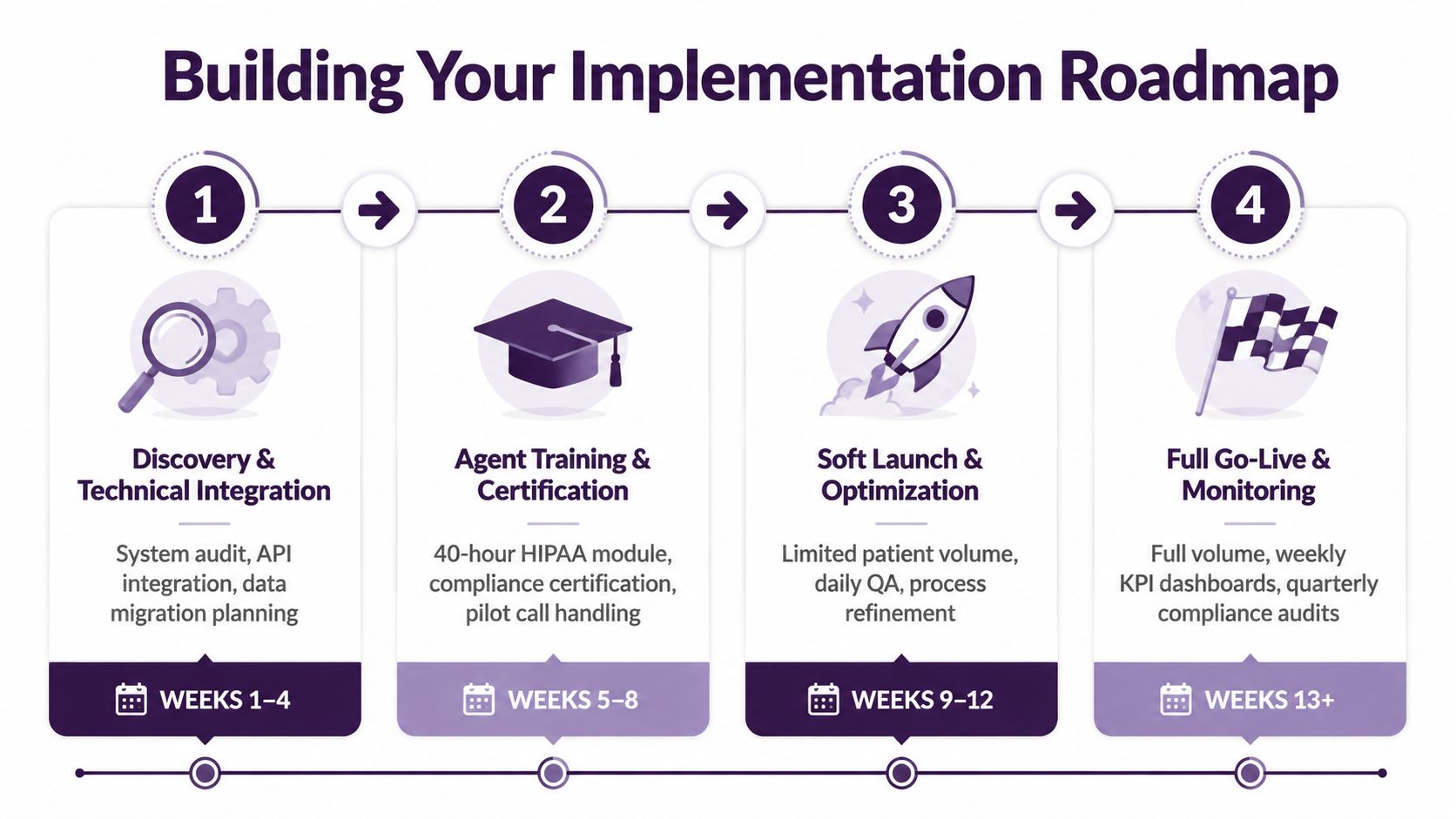
The cleanest rollout is phased, not heroic. Providers that try to flip the switch all at once usually discover too late that training, integration, and governance were not aligned. A slower start feels uncomfortable, but it gives both teams time to catch issues before patients do.
Phase one is discovery and technical integration
IT, operations, and the vendor map the workflow. The goal is simple, decide what data has to move, what tools agents will use, and where exceptions will land. If the EHR and CRM teams are not involved from the start, the project tends to drift into rework later.
Phase two is training and protocol development
Agents need more than script memorization. They need scenario practice for rescheduling, referrals, bilingual handoffs, and escalation rules, plus enough healthcare context to know when a call needs a different path. The partner should certify agents before they touch live volume, and clinical or operations leaders should sit in on calibration sessions so expectations stay aligned.
Phase three is soft launch and optimization
Start with limited patient volume and daily QA review. That makes it easier to catch issues like wrong dispositions, incomplete notes, or call transfers that are happening too often. If the partner cannot show coaching adjustments within that window, the process is too loose.
Phase four is full go-live and monitoring
Once the team is stable, shift to weekly KPI review and scheduled compliance audits. Watch for patterns in hold time, abandonment, and repeat calls, because those are usually the first signs that routing, training, or staffing needs adjustment. The transition is healthy when the internal team trusts the outsourced team enough to stop shadow-managing every step.
Key takeaway: launch success depends less on the contract and more on the quality of the first 60 to 90 days of operating discipline.
Why Bilingual Nearshore BPO Fits Healthcare Best
For North American providers, bilingual nearshore BPO is often the most practical middle path. It gives you live collaboration during shared business hours, easier escalation with internal teams, and better fit for patient-facing work that can’t be handled as a simple script. The value shows up most clearly when scheduling, access, and service recovery all need to happen quickly.
That’s where healthcare customer service outsourcing becomes a strategic choice rather than a cost-cutting move. Nearshore teams in Tijuana can support English and Spanish conversations with the kind of time-zone alignment that keeps managers, supervisors, and client teams in the same workday rhythm. That makes it easier to solve issues before they spread across the queue.
The strongest case for nearshore is not just cost, it’s operational fit. You get proximity for site visits and calibration, a stronger cultural match for U.S. patient expectations, and a service model that’s easier to govern than a far-off delivery center when calls require protocol depth. If your healthcare operation needs bilingual support, compliance discipline, and real-time collaboration, nearshore is the option that most naturally balances all three.
If you’re evaluating whether your patient access or scheduling work belongs with a specialist, CallZent can help you compare the requirements against a nearshore operating model. Visit CallZent to discuss bilingual healthcare call center outsourcing, compliance expectations, and the workflows your team needs to protect.
🚀 Expand Patient Access Without Sacrificing Control
CallZent helps North American healthcare organizations build bilingual nearshore support teams around patient access, scheduling, administrative workflows, quality assurance, and clearly defined compliance requirements.
Talk to an Expert