

Customer Experience Strategy
How to Measure Customer Lifetime Value for Growth
Learn how to measure customer lifetime value using historical and predictive models, and how contact center performance impacts retention and profitability.
TL;DR — Quick Takeaways
- Customer Lifetime Value (CLV) measures how much a customer is worth over time.
- The simplest formula is revenue per customer multiplied by lifespan.
- Historical CLV is the best starting point for most businesses.
- Contact center performance directly impacts retention, costs, and long-term profitability.
Most companies say they care about customer loyalty, but they still measure success one sale, one conversion, or one support ticket at a time.
That’s the gap.
If you want to know whether your acquisition budget makes sense, whether your support team is protecting revenue, or whether a customer segment is profitable, you need to know how to measure customer lifetime value. CLV turns customer relationships into a financial metric you can manage.
Key takeaway: CLV isn’t just a finance metric. It’s the clearest way to connect customer experience to long-term revenue.
Why Customer Lifetime Value is Your Most Important Metric
CLV matters because it forces better decisions.
A business that knows what a customer is worth over time can stop treating every lead, every sale, and every support request as isolated events. Instead, it can decide where to spend, where to improve service, and which customer segments deserve more attention.
CLV changes how you judge growth
Plenty of teams celebrate top-line growth while ignoring what happens after the first conversion. That’s how companies end up overspending on acquisition, underinvesting in retention, and missing the fact that support quality is shaping future revenue.
CLV fixes that by reframing the question. Not “Did this customer buy?” but “What is this relationship worth if we keep it healthy?”
That shift affects decisions across the business:
- Marketing spend: You can judge acquisition channels by the quality of customers they bring in, not just volume.
- Customer service investment: Faster, better support becomes easier to justify when it protects retention.
- Pricing and packaging: You can see whether customers stay long enough for your model to work.
- Sales handoff quality: A poor onboarding experience often lowers customer value long before churn shows up in reports.
It’s especially important in service-heavy businesses
In e-commerce, CLV often gets discussed as a purchase pattern problem. In BPO, telecom, healthcare, insurance, and financial services, it’s also an operations problem.
A delayed response, poor escalation process, weak resolution workflow, or language barrier can shorten the relationship. A strong support experience can extend it.
That’s why CLV works as a north-star metric. It connects revenue, retention, and customer experience in one number.
The companies that measure CLV well usually stop asking whether service is a cost center. They start asking which service improvements produce the best long-term return.
Gathering Your Data Foundation for CLV Calculation
Most CLV mistakes start before the math does.
The formula isn’t the hard part. The hard part is pulling the right numbers from the right systems and making sure they describe the same customer relationship.
The basic version is simple. CLV = Average Revenue per Customer × Customer Lifespan, and subscription businesses often refine that to monthly revenue per customer divided by monthly churn rate. One cited example calculates $80 average monthly revenue ÷ 4% churn = $2,000 CLV, while a cost-aware version expands to (Average Revenue Per Customer × Lifespan) − Total Costs according to KISSmetrics’ CLV guide.
Start with the core data points
You don’t need a perfect data warehouse to begin. You need a clean first pass.
Look for these inputs:
- Revenue by customer: Pull this from your billing platform, ecommerce system, ERP, or subscription tool.
- Customer start date: You need to know when the relationship began.
- Customer end date or churn date: If the customer has left, record when.
- Order count or invoice count: This helps when you use a historical model.
- Unique customer IDs: Without this, you’ll double count orders and distort purchase frequency.
- Service cost data: Support time, account management, refunds, and delivery costs all matter if you want net CLV instead of revenue-only CLV.
Pull support data too, not just sales data
Many teams fall short by neglecting support data.
If you only export revenue data, you’ll get a number. It just won’t tell the full story. Contact center records often explain why one customer segment lasts longer, renews more often, or costs more to serve.
Useful support-side inputs include:
- Interaction volume by customer
- Reason for contact
- Resolution status
- Escalation history
- Renewal or cancellation triggers
- Language preference
- CSAT, NPS, or QA trends if you track them
Those metrics don’t go directly into every CLV formula, but they help explain the lifespan part of CLV. They also show where retention risk is coming from.
If your team already tracks service health, this overview of KPIs in customer service helps tie operational reporting to revenue outcomes.
Keep one rule in mind
Your data has to describe the same unit of analysis.
If finance reports by account, support reports by contact, and sales reports by opportunity, you can’t combine them blindly. Decide whether you’re measuring CLV at the customer, account, household, or contract level. Then map all inputs to that level.
Here’s a practical check:
| Data input | Typical source | Why it matters |
|---|---|---|
| Revenue | Billing, ERP, ecommerce platform | Forms the value side of CLV |
| Lifespan or churn | CRM, subscription platform, contract records | Determines relationship length |
| Order or invoice count | Commerce or finance system | Needed for historical CLV |
| Service costs | Support platform, payroll, finance | Converts gross CLV into net CLV |
| Interaction history | Contact center software, CRM | Explains retention and churn drivers |
Don’t wait for perfect data
A small business can start with exports from Shopify, Stripe, QuickBooks, HubSpot, Salesforce, Zendesk, or a call center dashboard.
A larger company may pull from a CRM, a billing system, and a workforce management platform.
The point is to start with a version you trust enough to improve. Clean enough beats delayed forever.
How to Measure Customer Lifetime Value with Historical Data
Historical CLV is the best place to start because it uses behavior that already happened.
You’re not predicting anything yet. You’re calculating value from actual transactions, actual customers, and actual retention patterns. For most businesses, that’s the fastest path to a usable baseline.
The historical CLV formula
A common historical method breaks CLV into three parts:
- Average Order Value (AOV) = Total Revenue ÷ Number of Orders
- Purchase Frequency (F) = Total Orders ÷ Unique Customers
- Customer Lifespan (L) = 1 ÷ Churn Rate
- CLV = AOV × F × L
A cited example calculates AOV = $50, Purchase Frequency = 2, Lifespan = 4 years, which produces CLV = $400, based on a 25% annual churn rate. The same source notes that businesses tracking historic CLV often see a correlation with a 75% Customer Retention Rate (CRR). Those benchmarks come from Influence.io’s guide to calculating customer lifetime value.
A spreadsheet example you can copy
Let’s say you run a service business with repeat billing and enough transaction history to see customer patterns.
Your worksheet might look like this:
| Input | Value |
|---|---|
| Total revenue | $50,000 |
| Number of orders | 1,000 |
| Unique customers | 500 |
| Annual churn rate | 25% |
Now calculate each part:
- AOV = $50,000 ÷ 1,000 = $50
- Purchase Frequency = 1,000 ÷ 500 = 2
- Lifespan = 1 ÷ 25% = 4 years
- CLV = $50 × 2 × 4 = $400
That’s a revenue-based historical CLV.
It’s simple, fast, and useful. It tells you what the average customer has been worth based on past behavior.
Revenue CLV is useful, but profit CLV is better
Practitioners usually tighten the model at this stage.
Revenue-only CLV can make weak customer segments look stronger than they are. If one segment generates healthy top-line revenue but creates heavy support demands, returns, rework, or account management overhead, gross CLV overstates the value.
So after your first pass, subtract the costs to serve.
That includes items like:
- Support labor
- Refunds or credits
- Implementation or onboarding effort
- Account management time
- Special handling or compliance overhead
You don’t need perfect cost allocation on day one. Start with the major buckets. Refine later.
Practical rule: If a customer segment is expensive to support, don’t trust a revenue-only CLV number.
Historical CLV works best when behavior is stable
This method is especially useful when:
- Customers buy or renew on a repeat basis
- You have enough transaction history to estimate churn
- Your pricing model is consistent
- You need a fast baseline for retention and acquisition decisions
It’s weaker when the business is changing quickly, when contracts vary widely, or when account expansion drives a large share of value.
In those cases, use historical CLV as your floor, not your final answer.
Don’t overcomplicate your first model
The first version should answer practical questions:
- Which customer segments are worth more?
- Which channels bring customers who stay longer?
- Which accounts look profitable only because you’re ignoring service costs?
- Which customers deserve retention attention before they churn?
If you want another perspective on model selection, this breakdown of the customer lifetime value formula is helpful because it shows how different businesses adapt CLV calculations to fit their operating model.
Historical CLV isn’t glamorous. It is useful. That’s why it should be your starting point.
Forecasting Future Revenue with Predictive CLV Models
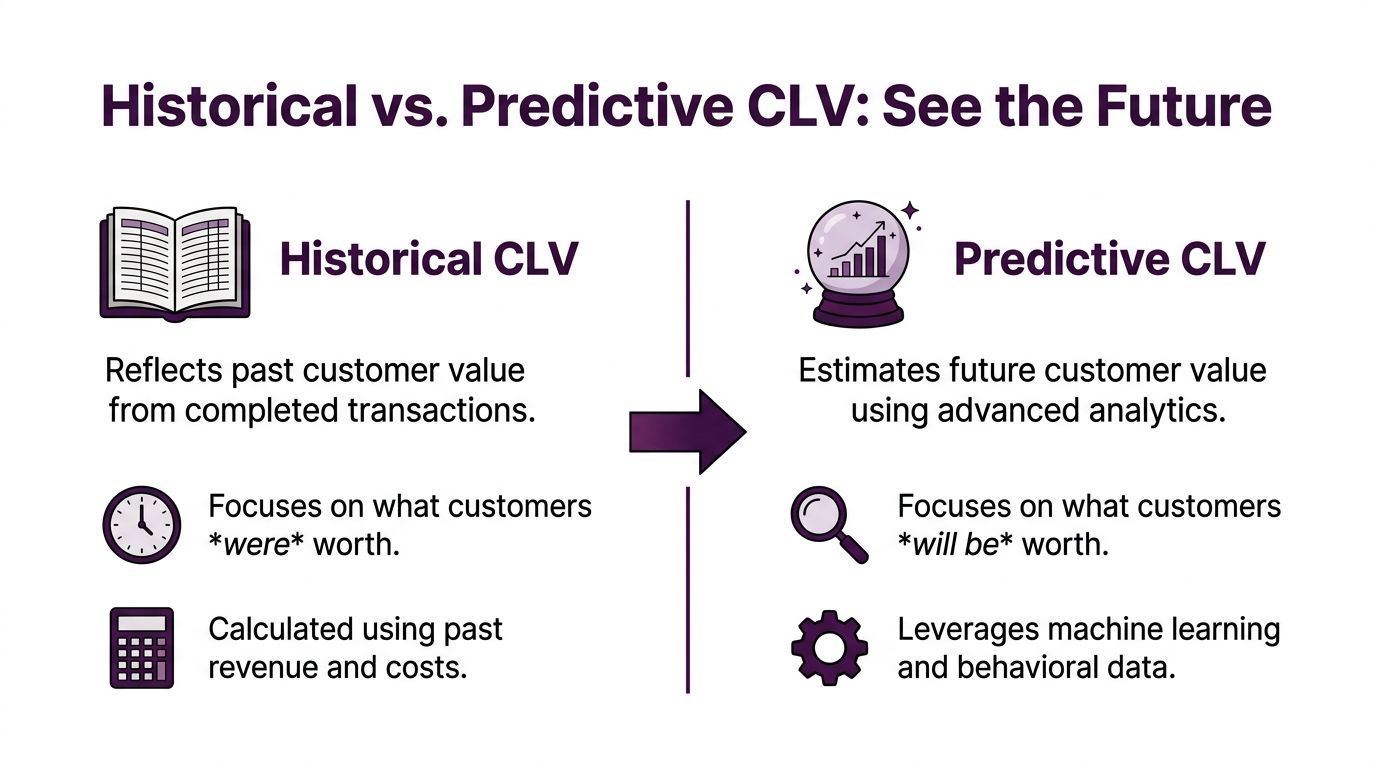
Historical CLV tells you what happened. Predictive CLV helps you decide what’s likely to happen next.
That matters when customer value depends on renewals, recurring service fees, expansion revenue, or churn risk that changes over time. Subscription businesses, BPO-supported service models, telecom providers, insurers, and financial services teams usually need this forward-looking view.
Historical and predictive CLV solve different problems
Use historical CLV when you need a grounded baseline from past transactions.
Use predictive CLV when you need to estimate future revenue and retention under current conditions.
The difference is practical:
| Model | Best for | Main input style | Main weakness |
|---|---|---|---|
| Historical CLV | Stable businesses with usable transaction history | Completed orders and known churn | Looks backward |
| Predictive CLV | Recurring-revenue and service businesses | ARPA, margin, churn, future cash flow assumptions | Depends on model quality |
A practical predictive formula
For BPO-supported businesses, one cited predictive formula is:
(ARPA × Gross Margin) ÷ Churn Rate
A published example uses $20k ARPA, 80% gross margin, and 2.5% monthly churn, producing $640k CLV. The same source says businesses tracking predictive CLV monthly achieve 30% higher retention by using AI to flag churn risks, and it identifies CLV:CAC greater than 3:1 as a key benchmark for sustainable growth in Wall Street Prep’s lifetime value overview.
That formula is useful because it forces you to look at the right drivers:
- ARPA tells you the average account value.
- Gross margin keeps profitability in view.
- Churn captures how fast value disappears.
When predictive CLV is worth the extra effort
Not every company needs an advanced forecast.
Predictive CLV becomes worth it when:
- Revenue is recurring
- Churn is measurable at regular intervals
- Accounts expand or contract over time
- The sales cycle is expensive enough that future value matters for budgeting
- Your retention team needs early-warning signals, not just historical reporting
This is also where customer success, support, and operations data become more valuable. Product usage, complaint frequency, resolution quality, and renewal behavior can help you estimate future value more accurately than transaction history alone.
Teams that want to connect those signals more directly to retention planning should also look at how predictive analytics supports customer retention.
Don’t confuse more complexity with more truth
A predictive model can be smarter than a historical one. It can also be worse if the inputs are weak.
Common failure points include:
- stale churn assumptions
- missing service cost changes
- disconnected support and billing data
- forecasting future account expansion with no real basis
- treating every customer segment as if it behaves the same way
Predictive CLV is only as good as the churn logic behind it. If your churn input is wrong, the output will look precise and still mislead you.
A sensible progression
Teams generally benefit from following this order:
- Build a clean historical CLV baseline.
- Segment customers by industry, contract type, or channel.
- Add churn and margin assumptions.
- Layer in service and retention signals.
- Review the model regularly instead of treating it like a one-time finance exercise.
That progression keeps the model tied to operations instead of turning it into a spreadsheet nobody trusts.
Connecting Contact Center Performance to Higher CLV
CLV becomes operational at this point.
If you run a support-heavy business, the contact center influences customer lifetime value every day. It affects whether customers stay, how costly they are to serve, whether they expand, and whether they leave frustrated enough to cancel at renewal.
Traditional retail formulas often miss that. In service businesses, a stronger fit is CLV = (Average Annual Contract Value × Average Retention Years) – Service Costs. Another important service-side factor is support quality. In North American markets, offering high-quality bilingual English and Spanish support can boost customer lifespan by 20-30%, according to Lexer’s discussion of measuring customer lifetime value.

The CLV formula has operational levers inside it
Every CLV model includes some version of these drivers:
- revenue per customer
- retention period or churn
- service cost
- expansion or repeat purchase behavior
Contact center performance touches all four.
A customer support team doesn’t just answer tickets. It shapes how long the relationship lasts and how expensive that relationship becomes.
Which contact center KPIs matter most
Not every call center metric affects CLV equally.
Some are useful for staffing and queue management but don’t say much about long-term value on their own. Others sit much closer to retention and profitability.
Here’s how the most important ones connect.
First Contact Resolution protects lifespan
When a customer gets a complete answer on the first interaction, the business avoids repeat contacts, frustration, and escalation.
That helps in two ways:
- It lowers service cost per issue.
- It reduces the chance that support friction pushes the customer toward cancellation or non-renewal.
High First Contact Resolution tends to support longer relationships because customers don’t have to fight the company to get basic help.
Average Handle Time only matters in context
AHT is one of the most misused contact center metrics.
Shorter calls can reduce cost. That’s real. But if agents rush customers off the line, fail to diagnose the issue, or transfer too early, low AHT can damage CLV.
The right question isn’t “How fast are we ending interactions?”
It’s “Are we resolving issues efficiently without creating future churn?”
That’s why AHT should be read alongside FCR, escalations, quality assurance scores, and repeat contact rate.
A low-handle-time support team can still destroy value if customers have to come back twice.
NPS and CSAT are not CLV, but they often point to it
NPS and CSAT don’t replace financial measurement.
They do help explain it.
If a customer segment reports stronger satisfaction and is also renewing more consistently, that’s useful evidence that the support model is contributing to value. If satisfaction drops and churn later rises, the support team probably saw the warning signs before finance did.
These indicators work best as leading signals, not final proof.
Bilingual support affects retention quality
For companies serving North American customers, bilingual support isn’t just a service preference. It can be a retention lever.
If a customer can explain a billing problem, healthcare question, telecom issue, or insurance concern in their preferred language, resolution tends to be cleaner and trust tends to be stronger. That’s especially important in high-friction service categories where misunderstanding creates repeat contacts and cancellations.
In practical terms, bilingual support can influence:
- Lifespan: Customers stay longer when service feels accessible.
- Cost to serve: Fewer misunderstandings usually mean less rework.
- Expansion potential: Customers are more open to renewals, upgrades, and added services when trust is high.
Sales-support overlap can raise account value
In many businesses, the contact center also handles light upsell, save offers, renewal outreach, collections, or lead qualification.
That means operations can influence the revenue side of CLV too.
Examples include:
- a retention specialist saving an at-risk account
- a reservation agent increasing booking value
- a support rep spotting a need for add-on services
- an outbound team recovering dormant customers
Those moments don’t look like marketing wins in the reporting stack, but they raise lifetime value when handled well.
A practical way to connect KPIs to CLV
If you want to make this measurable, don’t stop at average call center reporting.
Map contact center metrics to customer cohorts. Then compare those cohorts by retention, revenue, and service cost.
A simple view looks like this:
| Contact center signal | Likely CLV impact |
|---|---|
| Higher FCR | Longer lifespan, lower service cost |
| Lower repeat contacts | Lower support cost, better customer experience |
| Better QA consistency | More stable retention outcomes |
| Strong bilingual service | Better trust and longer customer relationships |
| Smarter save and upsell motions | Higher account value |
If your team already reviews operations at that level, this guide on how to monitor call center performance is a practical next step.
The main point is simple. Contact center KPIs are not just service metrics. In the right model, they’re CLV levers.
Common CLV Measurement Mistakes to Avoid
A bad CLV model is dangerous because it looks disciplined.
You’ve got formulas, dashboards, and averages. But if the model leaves out the wrong thing, it can push budget and service decisions in the wrong direction.
Mistake one: using one company-wide average
An average CLV number is easy to present and often hard to use.
It hides the fact that some segments renew longer, cost more to support, or buy differently. A healthcare account, a telecom subscriber, and a one-time retail buyer should not sit in the same CLV bucket.
Segment before you optimize.
Useful segmentation options include:
- Channel of acquisition
- Product or service type
- Industry
- Language preference
- Contract type
- Support intensity
Mistake two: ignoring service costs
This is one of the most common errors.
A revenue-only CLV model can make growth look healthy even while margins shrink. That problem gets worse in support-heavy businesses where service complexity rises over time.
A key projection for 2026 is that measuring CLV under tighter privacy rules will get harder for predictive models that rely on rich behavioral data. The same source warns that relying only on revenue is risky because servicing costs have risen 15% YoY with AI agent integration, which can lower net CLV even when revenue goes up, according to Swetrix’s guide to measuring customer lifetime value.
Mistake three: picking the wrong model for the business
Some teams force an e-commerce style transaction model onto a service contract business.
Others build predictive models before they can even trust churn or cost data.
Use the model that matches your business reality:
- historical CLV for a practical baseline
- contract-based CLV for service-heavy relationships
- predictive CLV when recurring revenue and churn data are strong enough to support forecasting
Mistake four: forgetting the privacy-first shift
CLV used to lean heavily on detailed tracking. That’s getting harder.
If your model depends on highly granular behavioral data across channels, be careful. Privacy constraints can reduce visibility and make certain attribution paths less reliable. That doesn’t mean CLV goes away. It means first-party data from CRM, billing, and support systems becomes more important.
Build a CLV model you can still trust if tracking gets thinner. Billing records and service logs usually outlast marketing attribution tricks.
Mistake five: treating CLV as a finance-only exercise
Finance should own the rigor. It shouldn’t own the whole conversation.
The best CLV work happens when finance, marketing, customer service, and operations use the same definitions and review the same segments. Otherwise, each team optimizes its own metric and nobody protects long-term value.
Your Action Plan to Measure and Grow CLV
Most companies don’t need a bigger CLV theory. They need a working process.
That process should be simple enough to start now and strong enough to improve over time.
Start with a baseline you can defend
Begin with historical CLV.
Pull revenue, order or billing counts, unique customer counts, and a usable churn estimate. Calculate a first version. Then pressure-test it with finance and operations.
If the number surprises people, that’s good. It means the conversation is moving from assumption to evidence.
Segment before you make decisions
Don’t optimize the average customer. That customer usually doesn’t exist.
Break the data into groups that matter to your business:
- New vs. long-tenured customers
- High-support vs. low-support accounts
- Inbound-led vs. outbound-led customers
- English-dominant vs. bilingual service segments
- Contract clients vs. transactional buyers
CLV becomes useful for action, not just reporting, at this stage.
Use service data to find what lifts value
The fastest gains often come from fixing customer friction.
Look for patterns in:
- repeat contacts
- unresolved issues
- cancellation reasons
- escalations
- renewal timing
- onboarding friction
- service cost by account type
That analysis often tells you more about future value than top-line revenue alone.
Build improvement moves around retention and expansion
Once you know which segments are valuable, protect them.
That may mean better onboarding, smarter save workflows, bilingual support coverage, more consistent QA, or stronger renewal outreach. For Shopify-focused teams, this practical guide on How to Increase Customer Lifetime Value for Your Shopify Store is a useful example of how retention and repeat purchase tactics connect back to CLV.
If customer loyalty is your main growth lever, this article on improved customer loyalty is also worth reviewing.
Keep the model alive
A CLV model should change as the business changes.
Review it on a regular cadence. Revisit churn assumptions, service costs, and segment definitions. Add predictive elements when your data is strong enough. Remove weak assumptions when they stop reflecting reality.
The teams that get the most value from CLV don’t treat it like a one-time calculation. They use it as an operating metric.
Best use of CLV: measure it, segment it, then use it to decide where service improvements will produce the strongest long-term return.
🚀 Ready to Turn Customer Experience Into Revenue?
CallZent helps businesses improve retention, reduce churn, and increase customer lifetime value through nearshore support and performance-driven operations.
Schedule a CallIf you want help turning customer service performance into measurable lifetime value, talk with a strategist at CallZent. A strong nearshore support operation can improve retention, reduce service friction, and give you cleaner data for smarter CLV decisions.