
Lead Generation & Appointment Setting
Lead Generation Appointment Setting Services: A Buyer’s Guide
Compare qualification, outreach controls, held meetings, pricing, and SLA terms before choosing a bilingual support partner.
TL;DR — Quick Takeaways
- Separate qualified leads, bookings, held meetings, and sales-accepted outcomes.
- Agree on qualification criteria, response targets, coverage, and ownership before launch.
- Verify permissions and suppression controls before contacting prospects.
- Compare matched cohorts and total cost rather than raw calendar volume.
- Use a bounded pilot with quality gates, mature attendance data, and clear exit terms.
A promising inquiry can lose momentum while it waits for someone to follow up. Effective lead generation appointment setting services connect the right prospect with the right sales representative through timely outreach, consistent qualification, and a reliable calendar handoff. A full lead list is not enough if meetings rarely happen or fail to meet your sales criteria.
Lead Generation and Appointment Setting Compared at a Glance
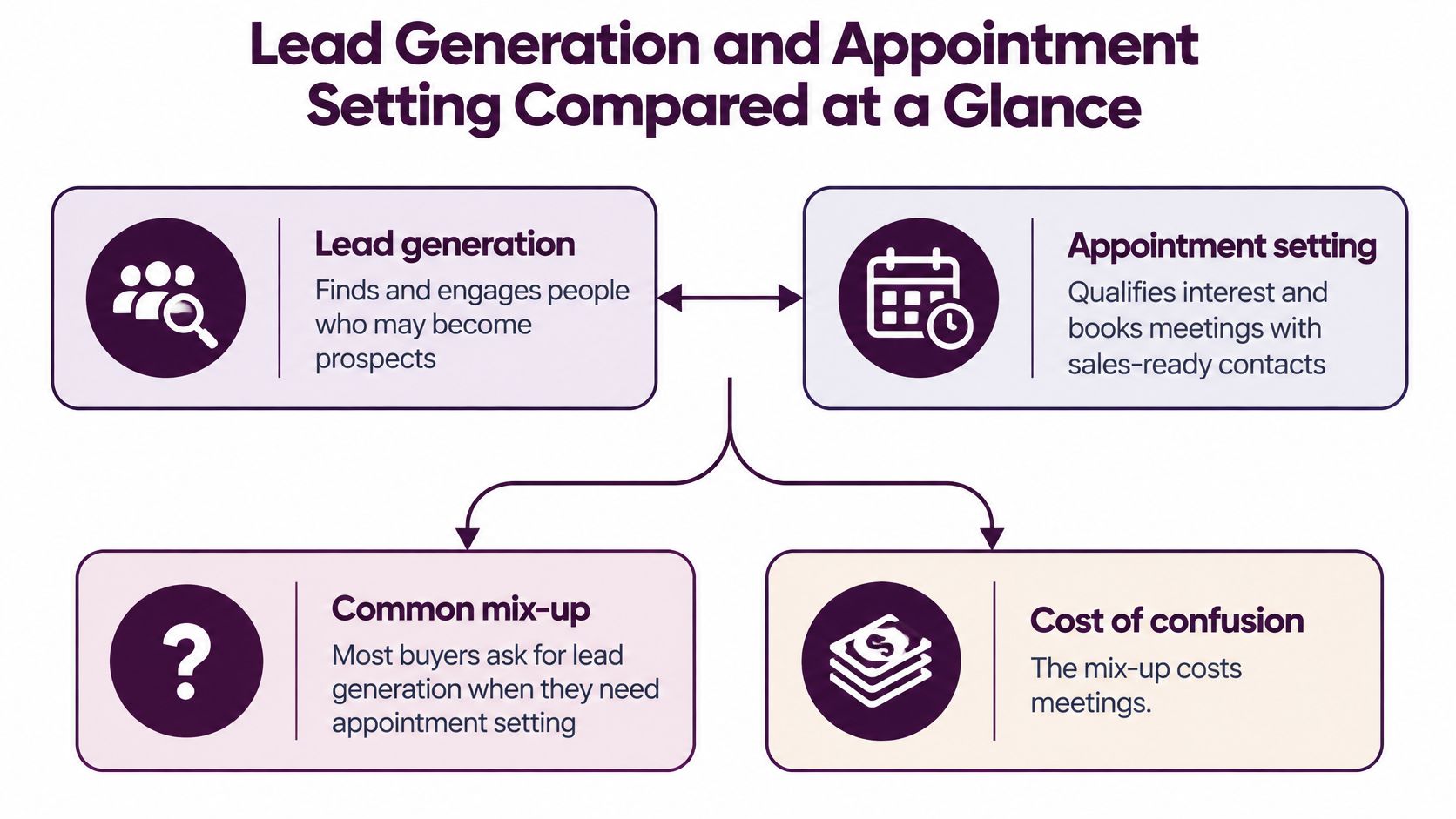
Most buyers ask for lead generation when they need appointment setting, and that mix-up costs meetings. You don’t have a list problem if your CRM already holds inquiries nobody has called. You have a follow-up and qualification problem, and buying more names won’t fix it.
CallZent’s lead generation service supports prospect engagement and qualification, while appointment setting services focus on scheduling qualified conversations. Confirm the exact scope, sources, channels, and handoff responsibilities for your program.
| Aspect | Lead generation | Appointment setting |
|---|---|---|
| Main goal | Find and engage prospects who may buy | Book a qualified meeting for the client’s sales team |
| Starting point | Target list, web form, ad response or inbound inquiry | A prospect who has shown interest or been identified as a fit |
| Typical output | Qualified leads passed to sales | Confirmed, scheduled meetings on calendars |
| Success measure | Qualified leads and pipeline created | Meetings held and accepted by sales |
| Ownership after handoff | Client sales team works the lead | Client account executive attends the meeting |
Say a software company’s operations director submits a web form at lunch. An agent calls within minutes, confirms the director owns the problem, checks the buying timeframe, and verifies the team size fits your criteria. The director leaves that call with a 30-minute discovery meeting on your account executive’s calendar. That’s appointment setting, not list building.
Many vendors bundle lead generation appointment setting services into one package. Bundling can work, but it blurs accountability when lead volume looks healthy and held meetings don’t. One provider can deliver both jobs. Your contract still needs to name which outcome you’re paying for, who owns each handoff, and what counts as qualified.
Compliance Rules and a Sample Call Script
Consent and suppression controls belong in the campaign setup, before an agent makes contact. A compliant script cannot repair a missing or unclear consent record.
Consent and Contact Controls Before Launch
For U.S. outreach, review the audience, phone-number type, dialing technology, use of prerecorded or artificial voice, message purpose, and applicable jurisdictions before launch. TCPA requirements vary with those facts. A live, manually dialed call does not automatically escape do-not-call, state-law, or other obligations.
The FTC’s Telemarketing Sales Rule guide explains relevant disclosures, restrictions, and exemptions. B2B outreach should not be treated as categorically exempt from every rule. Have qualified counsel approve the campaign’s consent, suppression, calling-time, recording, and recordkeeping requirements.
Keep the form wording, timestamp, source, named business, and scope of any permission tied to the lead. A phone number on a form is not, by itself, proof that every type of marketing contact is authorized. An agent’s opening question cannot retroactively cure permission that was required before dialing or sending a message.
Process opt-outs promptly through the approved suppression workflow and stop the affected outreach. Synchronize the relevant dialing, messaging, CRM, vendor, and duplicate records. Set the legally applicable scope and deadlines with counsel rather than assuming one rule covers every channel or campaign. The FCC’s robocall and robotext resources provide a starting point for reviewing federal requirements and changes.
Use truthful identity and offer language. Qualification and booking agents should not promise savings, eligibility, or results that the business cannot support. Review the evidence behind the call and CRM record as well as what the agent said.
A Sample Script You Can Audit
Use a written appointment setting script that reviewers can check line by line.
- Identify yourself and the company: State your name and the business you represent.
- Confirm the request and willingness to continue: Explain the reason for the permitted contact and ask whether it is a suitable time. Verify required permission before outreach; this opening does not create retroactive consent.
- Ask three qualifying questions: Follow the client’s approved questions about need, authority, and timeframe.
- Offer two times: Give options in the prospect’s time zone.
- Read back the booking: Confirm the date, time, attendee, and meeting format before ending the call.
- Honor an opt-out immediately: Record the request, suppress the record, and end the call politely.
Practical rule: Do not accept an appointment until the required permission evidence, identity disclosure, and qualification criteria can be verified in approved records. Use recordings only where authorized and lawfully obtained.
How Appointment Setting Runs From First Contact to Booked Meeting
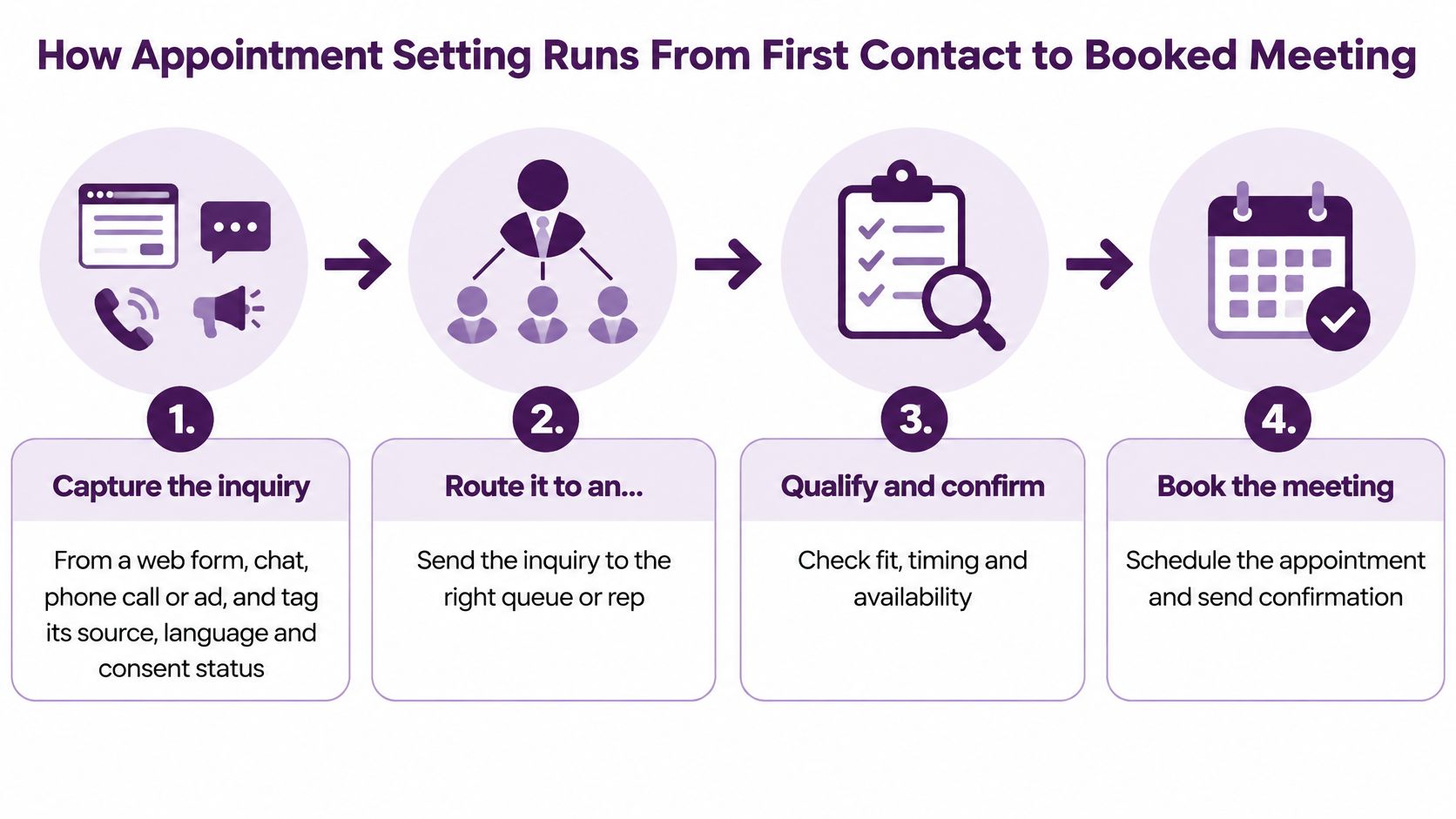
Good lead generation appointment setting services run like a relay with named owners, not a shared inbox everyone assumes someone else is watching. Each step below either protects speed and meeting quality or leaks both.
The Seven Steps in Lead Generation Appointment Setting Services
-
Capture and tag the inquiry: Pull the lead from a web form, chat, phone call, or ad, then tag source, language preference, and consent status. The common slip is accepting the lead without those fields, which makes later reporting and suppression unreliable.
-
Route it promptly: Send the inquiry to a named owner with the required language and product skills. During agreed coverage hours, measure time to first attempt and time to live contact separately. A routing alert or automated acknowledgment is not a completed conversation.
-
Use the approved first-contact channel: Call when appropriate to the prospect’s request and campaign permissions, then support the conversation with permitted email or messaging. Don’t lead with a generic automated acknowledgment and call that follow-up. The prospect needs a human conversation. Our detailed breakdown of the lead generation process in BPO shows how capture, routing, and CRM work need to stay connected.
-
Follow a documented cadence: Set attempt limits, spacing, permitted channels, local-time windows, and stop conditions. Log every attempt and stop for opt-outs, invalid details, or other disqualifying conditions. Test follow-up patterns against your own contact and complaint data rather than treating a fixed attempt count as universal.
-
Qualify against written criteria: Confirm the need, the decision-maker, the timeframe, and budget or authority before offering calendar time. If the prospect fails a criterion, record the reason code instead of dropping the lead without notice.
-
Book and confirm on the client’s calendar: When scheduling is part of intake, our agents move qualified inquiries toward a consultation according to the availability and rules you set. Confirm which reminder channels and follow-up activities the contracted program includes, and use them only where permitted. The preventable error here is sending an invite without confirming the prospect’s time zone.
-
Document and track attendance: Write call notes, disposition, consent status, appointment details, and the eventual show or no-show outcome into the CRM. Confirm the supported booking platforms, CRM access, shared calendars, communication tools, and integration responsibilities before launch. Without attendance tracking, you can’t distinguish a booking problem from a qualification problem.
Set Response Standards Around Actual Coverage
Harvard Business Review’s 2011 lead-response research links faster outreach with qualification. Historical findings should inform testing rather than serve as conversion guarantees.
Agree on a response target that matches buyer expectations, lawful contact windows, staffing, and lead urgency. A first attempt within five minutes can be an illustrative target for high-intent web inquiries during covered hours; it is not a universal benchmark or a promise of a particular conversion rate.
After-hours ownership matters. A form submitted at 8 p.m. should be handled according to the prospect’s local time, permissions, requested channel, and contracted coverage. If live outreach must wait, assign an owner and a permissible next contact window. Preserve the original inquiry timestamp so reporting does not hide the delay.
Metrics That Show Whether Appointments Are Worth Booking
Booked meetings are the easiest number to inflate in lead generation appointment setting services. Book loosely, skip hard qualification questions, and the calendar fills up. Your sales team pays for that later in no-shows and unqualified conversations.
KPI Table for Lead Generation Appointment Setting Services
| KPI | What it measures | Benchmark or target |
|---|---|---|
| Speed to lead | Time from inquiry to first contact attempt | Agreed covered-hours target; distinguish first attempt from live contact |
| First-attempt contact rate | Unique eligible leads reached on first attempt ÷ unique eligible leads receiving a first attempt | Set from your pre-pilot baseline and report by source each week |
| Attempts before disposition | Calls and touches before a lead is closed | Approved limits, spacing, permissions, and stop conditions |
| Qualified conversation rate | Qualified unique conversations ÷ eligible live conversations | Set from your pre-pilot baseline by source and language |
| Meeting booked from conversation | Booked meetings divided by qualifying conversations | Set using comparable offer, source, and qualification criteria |
| Show rate | Unique meetings held ÷ eligible bookings due in the same cohort | Must match or beat your baseline before scale-up |
| Sales-accepted meeting rate | Held meetings accepted by sales ÷ held meetings assessed; disclose pending reviews | Sales marks accept or reject with a reason on every meeting |
| Cost per held meeting | Defined total program cost ÷ held meetings in a matched cohort | Also report cost per held, sales-accepted meeting using that distinct denominator |
Use your own pre-pilot baseline and comparable campaign segments. Define duplicates, reschedules, cancellations, pending attendance, and sales-review deadlines before reporting. Show booked, held, and sales-accepted outcomes separately so one label cannot conceal another stage.
Calculate each metric from fields agents already touch. Use inquiry and attempt timestamps for speed to lead, disposition codes for contact and qualification outcomes, calendar status for bookings, attendance for show rate, and a sales accept or reject field with a reason. If those fields aren’t mandatory, your dashboard is decoration.
How to Read the Numbers Together
Don’t diagnose one metric at a time. If speed to lead is slow and contact rate is low, fix routing, staffing, or alert ownership before you rewrite the script. Agents can’t qualify people they never reach.
If contact rate is healthy but show rate or sales acceptance is weak, look at qualification and booking quality. Agents may be booking polite interest instead of verified need, decision-maker status, an agreed problem, and a real timeframe. Tighten disqualification rules and review recordings before you add more outreach volume.
Judge the program by held, sales-accepted meetings, because that’s the point where a booked appointment becomes usable sales capacity.
Report every KPI by response-time bucket, language, and lead source. A single average can hide a paid campaign that performs well in English and badly in Spanish, or web leads that collapse after hours. Our guide to an outsourced lead generation review can help you structure that review before renewal. Investigate the weakest comparable segment and verify the cause before changing staffing or qualification rules.
Engagement and Pricing Models Compared
The hourly rate is only one way to buy lead generation appointment setting services, and it’s rarely the whole invoice. Compare what each model rewards, because the billing method will shape agent behavior whether you plan for it or not.
Five Models for Lead Generation Appointment Setting Services
| Model | How you are billed | Best fit |
|---|---|---|
| Dedicated hourly team | Per agent hour for a dedicated bilingual team | Steady, ongoing campaigns |
| Per booked appointment | Fee for each meeting that meets agreed criteria | Short tests with strict meeting definitions |
| Per qualified lead | Fee for each lead that passes agreed screening | High volume with clear screening rules |
| Monthly retainer | Fixed monthly fee for agreed hours and capacity | Predictable budgets and long programs |
| Hybrid | Base hourly or retainer fee plus a bonus per held meeting | Shared risk on results |
Hourly pricing can make staffing assumptions visible, but confirm whether the billed unit is scheduled, logged-in, productive, or another defined hour. In a hypothetical example, three agents billed for 160 hours each produce 480 hours. At an illustrative $12 per billed hour, that equals $5,760 before separately scoped costs. These figures are an arithmetic example, not a CallZent quote or minimum rate.
Ask what sits outside the rate before you sign. Customer-specific CRM seats, telephony, premium platforms, or custom integrations may require separate pricing. Get those items in writing, with the vendor or platform named, so a low hourly quote doesn’t grow after launch.
Per-appointment pricing needs the tightest definitions. It can look efficient because you pay per meeting, but it rewards booking volume. Your contract must define a qualified meeting precisely, including decision-maker status, agreed problem, timeframe, attendance, and what happens when sales rejects the meeting.
Per qualified lead works when screening rules are binary and auditable in the CRM. It works badly when “qualified” depends on judgment nobody wrote down. A monthly retainer suits predictable capacity, but you should still tie reporting to response speed, attempts, show rate, and sales acceptance. Our overview of BPO pricing models explains how those structures differ in practice.
Choose the billing structure that fits your scope, predictability, and ability to verify outcomes. Hourly or retainer arrangements can support ongoing coverage; output fees require auditable acceptance and rework rules. A hybrid can combine capacity funding with incentives for held, sales-accepted meetings. No model removes the need for quality controls.
Vendor Criteria and Sample SLA Terms
Don’t choose lead generation appointment setting services from a sales deck and a reference call. Ask for operating evidence you can verify in the CRM, recordings, staffing schedule, and contract.
Vendor Checklist for Lead Generation Appointment Setting Services
- Bilingual depth: Can agents run full English and Spanish qualification conversations without handing the prospect to another queue mid-call?
- Time-zone overlap: Do staffed hours match your buyers’ working hours and your sales team’s handoff window?
- Dedicated or shared agents: Are agents assigned to your account, or does a shared pool pick up your leads between other campaigns?
- CRM and calendar integration: Can the team work inside your CRM, shared calendars, and approved communication tools from day one?
- Reporting detail: Will you see response time, contact, qualification, booking, and attendance by source and language?
- Consent handling: Can the provider show consent fields, suppression workflows, and monthly audit records?
- Qualified meeting definition: Is there a written definition covering need, decision-maker status, agreed problem, timeframe, and attendance?
Nearshore location matters for a practical reason, not as a slogan. A Tijuana team shares Pacific time with California, so a hot lead qualified at 10 a.m. can reach your account executive the same working morning. Bilingual agents can also keep an English or Spanish conversation with one owner instead of forcing a relay that slows booking. Confirm actual dedicated or shared staffing, availability, backup coverage, and escalation access in the statement of work.

Technology questions belong in the same review. If a provider proposes automation for first touch or scheduling, ask how permissions are checked, when a person takes over, how failed handoffs are detected, and what appears in the CRM. A successfully generated invitation does not prove that qualification was accurate or the prospect agreed to attend.
Sample SLA Terms to Put in Writing
Use these terms as contract clauses, not kickoff promises. Each one needs a measurable target, a verification method, and a named owner.
| SLA term | Sample language | What to verify |
|---|---|---|
| Coverage hours | Agents staffed during agreed business hours, with after-hours coverage if contracted | Staffing schedule in the statement of work |
| Hot lead escalation | Qualified leads routed to the client within an agreed number of minutes | Routing log with timestamps |
| Script changes | No script change goes live without written client approval | Version history in a shared folder |
| Consent handling | Opt-out requests recorded and suppressed across calling and text workflows | Prompt suppression tested before launch and monitored during operation; periodic audit evidence |
| Reporting | Weekly report with response time by source and language | Sample report reviewed before signing |
| Pilot exit | Written right to end the pilot with agreed notice | Exit clause in the contract |
Review sample reports and recordings before signing, not after the first invoice. Our guide to call center service level agreements is a useful reference when you turn these rows into clauses. If a provider can’t show a routing log or suppression audit, that SLA term isn’t operational yet.
Ask about agent turnover during due diligence, too. Every departure creates retraining work and a stretch when prospects speak with someone still learning your product, objections, and disqualification rules. Request retention data and ask how replacement agents are trained and certified before they take live leads.
Run a Bounded Pilot Before You Sign
Consider a bounded pilot with a defined team before committing to a longer program. A 30-day pilot is an illustrative structure, not a universal test duration for lead generation appointment setting services. Decide from recordings, CRM timestamps, and held meetings, not from a confident kickoff call.
- Pick two lead sources: Use web forms and one paid campaign so you can compare speed, contact quality, and attendance across channels.
- Record your baseline first: Capture speed to lead, attempts per lead, qualified conversation rate, and show rate before the first pilot call.
- Run the approved operation: Staff the agreed team for the approved test period, with permission evidence, scripts, and suppression controls in place before contact.
- Audit recordings weekly: Check identity disclosure, consent confirmation, qualifying questions, and accurate offer language.
- Decide on held meetings: Evaluate held, sales-accepted meetings with cost, quality, and compliance gates. Allow enough time for bookings to mature; a short pilot may not establish long-cycle revenue impact.
A go decision looks like stable first-contact speed, complete attempt records, and a show rate that matches or beats your baseline. Investigate slow first contact, weak attendance, incomplete reason codes, or rising opt-outs and complaints. Stop affected outreach immediately if required permissions or suppression controls fail; do not wait for the end-of-pilot review. Fix routing or qualification before you renegotiate price, because a cheaper broken workflow still wastes your sales team’s time.
Frequently Asked Questions
What are lead generation appointment setting services?
They combine prospect sourcing or engagement with qualification and meeting coordination. Scope varies by provider. Define whether the deliverable is a qualified lead, a booked appointment, a held meeting, or a held meeting accepted by sales, and assign ownership for every handoff.
What is the difference between lead generation and appointment setting?
Lead generation identifies and engages potential buyers and develops qualified interest. Appointment setting confirms fit and schedules a specific conversation. One provider may perform both, but the sources, qualification criteria, calendar rules, deliverables, and acceptance evidence should remain explicit.
How should a business define a qualified appointment?
Document the required customer profile, need, decision-maker or relevant stakeholder, service area, timeframe, and any appropriate commercial criteria. Confirm willingness to attend and meeting details. Define duplicates, reschedules, cancellations, rejection reasons, review deadlines, and whether attendance is required for billing.
Is contacting every lead within five minutes required?
No. A five-minute first-attempt target can suit some high-intent inquiries during agreed coverage, but it is not universal. Set targets around urgency, permitted contact times, channel preference, staffing, and campaign rules. Measure first attempt and live contact separately.
How many follow-up attempts should appointment setters make?
There is no universal count. Agree on attempt limits, spacing, permitted channels, local-time windows, and stop conditions. Use contact, opt-out, complaint, and conversion evidence to refine the cadence. Stop affected outreach when permission is withdrawn or a required control fails.
Does a phone number on a form authorize all marketing calls and texts?
No. Permission requirements depend on the campaign, technology, message purpose, number type, and applicable jurisdiction. Retain the exact form wording and supporting evidence, and approve the workflow before outreach. A verbal opening cannot retroactively supply consent required before contact.
Which appointment-setting metrics matter most?
Track first-attempt speed, live-contact rate, qualification, bookings, attendance, sales acceptance, and costs with matched cohorts and explicit denominators. Segment by source and language. Show pending outcomes, duplicates, and exclusions, and assess quality and compliance alongside meeting volume.
What is the difference between cost per held meeting and cost per accepted meeting?
Cost per held meeting divides defined program cost by meetings held. Cost per held, sales-accepted meeting uses only held meetings that pass sales acceptance. Keep cost boundaries and cohorts comparable, disclose pending reviews, and avoid using the two labels interchangeably.
How are lead generation appointment setting services priced?
Providers may charge by hours, retainer, qualified lead, booked appointment, or a hybrid structure. Confirm billed units, staffing, tools, setup, supervision, quality review, and variable charges. Output-based fees need clear acceptance, attendance, rejection, duplicate, and rework rules.
What should an appointment-setting pilot include?
Use a defined scope, approved contact controls, baseline metrics, named owners, and CRM evidence. Review scripts, routing, qualification, attendance, costs, and sales feedback. Set stop and exit criteria, and allow sufficient time for meetings to occur before deciding whether to scale.
Bilingual Nearshore Support in Mexico
Build an Appointment-Setting Program Around Qualified Meetings
Discuss your lead sources, English-Spanish coverage, qualification criteria, CRM workflow, and service goals with CallZent. Scope a pilot with clear ownership, reporting, and acceptance rules.