

Telecommunications Customer Experience
Telecommunications Customer Service: A Complete Operations Guide
How telecom operators, ISPs, MVNOs, and device companies can improve resolution, manage complex escalations, protect revenue, and scale customer support.
TL;DR — Quick Takeaways
- Telecommunications customer service must connect billing, provisioning, technical support, retention, fraud, and compliance workflows.
- First-contact resolution should be measured by contact reason instead of reported as one blended percentage.
- Agents need unified access to CRM, billing, account status, provisioning, and interaction history to resolve issues without unnecessary transfers.
- Automation works best for bounded, low-risk tasks; complicated billing disputes, cancellations, and network problems need controlled human support.
- Nearshore delivery can provide bilingual coverage, overlapping business hours, and faster collaboration with North American billing and network teams.
- A telecom outsourcing partner should be evaluated through live workflows, system controls, security practices, escalation discipline, and pilot results—not price alone.
A subscriber calls after three billing cycles of a roaming dispute. Their account has already been disconnected once, the latest invoice still includes a charge they don’t recognize, and the first agent transferred them without explaining what would happen next. That isn’t a simple call-volume problem. It’s a failure across billing, account status, technical support, retention, and escalation control.
Telecommunications customer service either resolves the customer’s full problem or creates another contact. For telecom operators, internet service providers, MVNOs, and device businesses, the difference affects churn, complaint exposure, agent workload, and revenue protection.
This guide takes an operations-first view of the function. It covers the friction that makes telecom harder than other support environments, the technology stack that scales, the KPIs that matter, the trade-offs between insourcing and outsourcing, and the due diligence required before selecting a partner. For additional context on systems used in the sector, this OnRoute telecom guide offers a useful overview of software requirements for telecommunications teams.
What Telecommunications Customer Service Really Means Today
The customer in the opening scenario doesn’t care which department owns the roaming adjustment. They want someone to explain the invoice, restore service if necessary, verify the account, and prevent the same charge from returning next month. A telecom operation that handles only the phone conversation, while leaving the underlying billing or network issue untouched, hasn’t solved the customer’s problem.
Four jobs must happen in parallel
First, the agent has to diagnose service problems. That may involve device setup, connectivity, speed, signal, provisioning, or an outage affecting multiple subscribers. The agent needs enough account and network context to distinguish a customer-specific issue from a wider incident.
Second, the team must explain itemized charges. Telecom bills combine voice, data, equipment, taxes, promotions, roaming, usage, adjustments, and plan changes. Agents who can’t see the billing history or explain proration will send customers to another queue.
Third, support must protect valuable accounts. A cancellation request often follows a failed repair, an unexplained charge, or repeated transfers. Retention works only when the representative can identify the reason for dissatisfaction and offer an authorized, accurate resolution.
Fourth, the operation must meet regulatory and carrier-specific clocks. A complaint, porting issue, service interruption, privacy concern, or emergency-services matter may require a defined process and documented follow-up. The queue can’t treat every contact as an ordinary request.
The operation behind the phone call
A well-designed telecom support function connects the front line to billing, provisioning, network operations, fraud, collections, and compliance. It also records what happened, what was promised, who owns the next action, and when the customer should receive an update.
Operational rule: If an agent can’t identify the next owner and deadline before ending the interaction, the contact isn’t controlled.
The rest of this article looks at the structural difficulty of the vertical, the technology needed to reduce avoidable effort, the metrics that expose operational weakness, and the sourcing choices that shape quality. The focus is practical, based on the decisions that determine whether customers receive a resolution or another transfer.
Why Telecom Support Is Harder Than Other Industries
A disputed roaming charge can require billing review, a network ticket, and a decision about service continuity in one interaction. Telecom support carries that operational load because it connects a recurring bill with a physical or wireless network, regulated services, financed equipment, identity-sensitive accounts, and interruptions customers experience as urgent. Retail support may resolve a return, while SaaS support may troubleshoot a feature. Telecom support often has to control several dependencies before the customer can receive a credible answer.
The satisfaction baseline reflects the pressure. A 2025 ACSI market reference summarized by the Telecommunications Consumer Forum reported that internet service provider satisfaction rose 1% to 72 out of 100, while satisfaction with cell phone manufacturers fell 4% to 78 out of 100, a decade low. The survey period covered the 12 months ending in March 2025, so these figures provide a broad market reference rather than a score for every operator.
Telecom friction creates longer, harder contacts
Subscribers cannot change a phone number, home connection, device ecosystem, or service bundle without possible consequences. Porting, equipment financing, installation, and disputed cancellation fees can keep customers with a provider while generating repeated escalations.
Billing adds handle time quickly. An agent may need to review voice, data, equipment, tax, promotion, usage, and mid-cycle adjustment lines before explaining a changed bill. A short billing question can become a detailed account investigation, especially when the customer suspects an unauthorized charge or a failed plan change.
Network ownership creates a second control problem. A front-line representative may correctly identify the need for a network ticket, while only a NOC or engineering team can close the technical issue. Without an integrated handoff, the customer experiences the case as unresolved even when the first agent completed the correct diagnostic work. The operation needs clear ownership, status visibility, and a deadline for the next update.
The benchmark gap is also visible in the 2025 Ofcom customer service report. It references global telecommunications averages of 5.7 out of 10 on a Happiness pillar, an average Net Promoter Score of 14, and a separate benchmark in which only 35% of consumers reported being satisfied or very satisfied with telecom customer service. The same Ofcom report places telecommunications first-contact resolution around 52% to 58%, below a cross-industry average of about 70%.
Telecom Support vs Other Verticals
| Pressure Point | Telecom | Retail | SaaS |
|---|---|---|---|
| Core issue | Billing, connectivity, provisioning, devices, and service continuity | Orders, returns, delivery, and product questions | Product access, configuration, and feature use |
| Resolution dependency | Often requires billing, provisioning, or NOC ownership | Usually handled within the service or fulfillment workflow | May require engineering or product support |
| Customer friction | Customers may face disruption, disputed charges, and complex plan rules | Customers can often return or replace a product | Customers may switch tools, but data and workflow migration create friction |
| Escalation risk | Complaint clocks, outage handling, porting, and account security | Refund and delivery policies | Contract, uptime, and technical severity commitments |
Telecom leaders should not copy targets from a generic retail queue. Set the operating model around bill shock, network dependency, retention risk, and regulated escalation. Use nearshore deliberately when the model provides stable coverage, language alignment, schedule overlap, and stronger coordination with internal billing or network teams. For cases requiring deeper technical ownership, a defined tier 2 network support model gives front-line teams a controlled escalation path instead of asking them to work faster without the authority to resolve the fault.
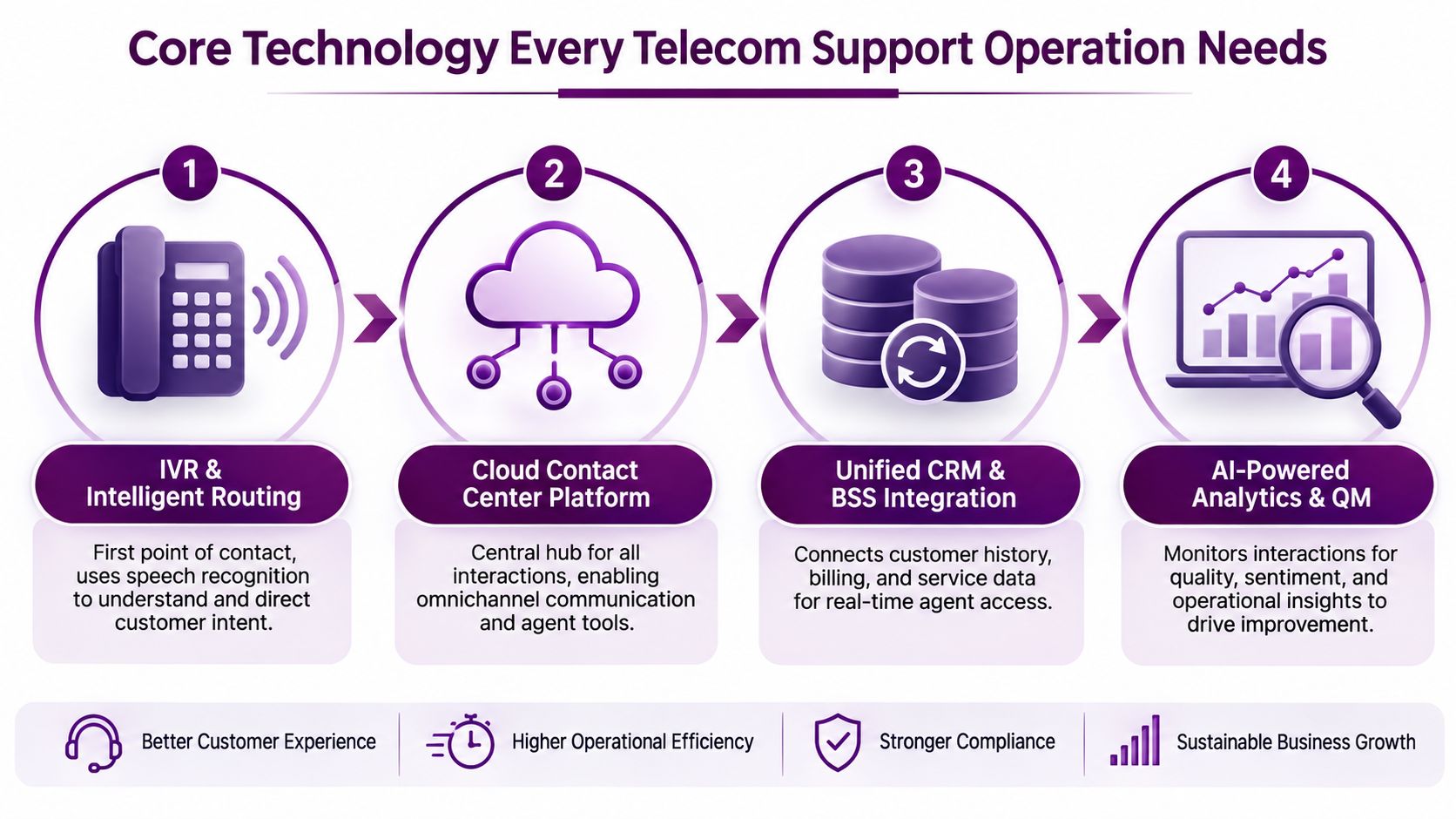
Core Technology Every Telecom Support Operation Needs
Technology should follow the customer interaction, not sit beside it as a collection of disconnected tools. A subscriber may begin with a voice call, send a screenshot through chat, receive an SMS update, and require a network ticket before the issue closes. If those actions create separate records, the customer repeats the story and supervisors lose the timeline.
Start with intent-aware routing
An IVR should identify the subscriber through ANI when appropriate, authenticate safely, and use speech recognition or keypad input to understand intent. “Roaming charge,” “no service,” “cancel my plan,” and “payment failed” shouldn’t all enter the same general queue.
Routing should consider intent, account status, product, language, priority, and agent skill. A customer with a pending disconnection needs a different path from someone requesting a balance lookup. A subscriber reporting a regional outage shouldn’t wait in the same queue as a routine plan question.
Build one conversation across channels
Omnichannel routing should unify voice, chat, SMS, social messaging, and in-app conversations into a shared record. The purpose isn’t to offer every channel. The purpose is to prevent the customer from restarting the case whenever the channel changes.
A practical example is a billing dispute that begins by phone. The agent can send a secure follow-up message, attach the adjustment explanation, and schedule the next update without creating a new case. Supervisors can then review the full sequence rather than isolated contact fragments.
Connect CRM, billing, and provisioning
The agent desktop must expose the systems of record that determine the answer. At minimum, the representative should see:
- Account status: Active services, holds, authentication notes, and authorized contacts.
- Billing context: Recent charges, credits, promotions, device payments, usage, and adjustments.
- Service details: Plan configuration, device information, provisioning state, and open trouble tickets.
- Interaction history: Prior contacts, promises, escalations, and customer sentiment.
Integration doesn’t mean placing every field on one crowded screen. It means giving the agent a reliable timeline and the permissions to complete approved actions without unnecessary transfers. Teams evaluating the architecture can use this contact center technology stack overview as a reference point.
Use bots for bounded work
Chatbots and AI assistants are effective when the task has a clear answer and a safe completion path. Good candidates include FAQs, plan lookup, balance payment, outage lookup, appointment status, and basic device guidance.
Bots fail when they force a complex billing dispute through a scripted menu, attempt retention without authority, or troubleshoot a network issue without NOC context. Those interactions need an immediate handoff with the transcript, authentication state, and collected details attached. AI should reduce repetition, summarize contacts, surface relevant account information, and support quality review. It shouldn’t become a maze that protects the queue while frustrating the subscriber.
Key Metrics and KPIs That Predict Telecom Outcomes
A short call is not automatically an efficient call. If a customer contacts support again about the same bill, outage, or plan change, the operation has created repeat demand. A longer interaction that corrects a disputed charge, prevents an avoidable disconnection, and closes the case can produce the better result.
First-contact resolution is the primary health check. A 2024 U.S. wireless customer care study found overall satisfaction increased 13 points on a 1,000-point scale, with the improvement driven by fewer transfers, faster problem resolution, and higher first-contact resolution. The study covered 17,949 customers who had contacted carrier care during the prior three months, as reported in this APQC telecommunications contact-center benchmark resource.
Measure the outcome, then explain the cost
Track FCR by contact reason, not only as one blended percentage. Billing disputes, device support, outages, plan changes, and cancellations depend on different systems and teams. A low FCR for a network incident may reflect engineering ownership. A low FCR for a payment question usually indicates a permissions, billing workflow, or training problem. Use this call center KPI guide to structure the wider measurement framework, then adapt it to telecom contact reasons.
Average handle time matters, but it should never reward rushed work. Review AHT alongside repeat contacts, transfer rate, reopen rate, escalation aging, and customer satisfaction. AHT can rise when agents complete more of the work during a difficult billing case. That increase is acceptable if repeat demand and escalations fall.
CSAT measures the immediate interaction. NPS reflects broader relationship sentiment, while churn rate shows whether service failures affect account behavior. Retention teams should track save attempts, accepted saves, post-save complaints, and later cancellations. A save that produces a new billing dispute is not a successful save.
Use queue and compliance measures together
Service level and average speed of answer expose access friction, but they do not prove resolution quality. Industry guidance commonly cites an 80/20 standard, meaning 80% of calls answered within 20 seconds, while related summaries report a global average speed of answer around 28 seconds. Those figures appear in Contact Centre Helper’s service-level guidance. Treat them as operating reference points, not targets that justify transfers or incomplete troubleshooting.
| Metric | Definition | Telecom Target |
|---|---|---|
| FCR | Issue resolved without repeat contact or unnecessary transfer | Track by reason and channel. Industry benchmarks place first-contact resolution below the cross-industry average, so use root-cause review rather than a single blended target |
| AHT | Total interaction and after-call work time | Set by contact reason, then review against repeat contacts and CSAT |
| CSAT | Customer rating of the interaction or resolution | Track by issue type, channel, queue, and agent |
| NPS | Customer willingness to recommend the provider | Use as a relationship indicator, not a standalone agent score |
| Service level and ASA | Speed of answer against the queue target | Guidance cites 80% within 20 seconds and an average speed of answer near 28 seconds in the linked benchmark |
| Abandonment | Contacts ending before an agent answers | Industry guidance commonly cites 2% to 5% |
| Complaint clock | Time from complaint registration to required action or escalation | Configure by jurisdiction, regulator, complaint type, and provider policy |
Regulatory timing belongs on the same dashboard as queue performance. UK rules taking effect on 8 April 2026 allow residential and small-business customers to access independent dispute resolution after 6 weeks when a complaint remains unresolved, down from 8 weeks, according to Ofcom’s complaint-resolution update. Display that clock to agents, supervisors, and escalation owners. A queue can meet its answer target while a complaint still breaches the regulatory deadline.
Insourcing vs Nearshore vs Offshore for Telecom
Telecom sourcing decisions fail when leaders compare hourly rates without pricing the operational consequences. Billing disputes, provisioning errors, churn threats, language needs, regulatory clocks, and engineering handoffs all affect the total cost of a support model. A low-cost seat becomes expensive when customers transfer repeatedly, agents need constant retraining, or unresolved issues wait for the next team.
Insourcing: control with capacity limits
An internal team gives the carrier direct control over coaching, policy changes, system access, and escalation paths. That control helps with complex plan rules, product launches, sensitive accounts, and coordination with billing or network operations.
Capacity is the constraint. Fixed staffing leaves coverage gaps during evenings, weekends, launches, storms, and outages. Building bilingual teams and specialized technical queues internally can also take longer than demand allows. Insourcing fits operations that need tight control and can fund coverage for predictable demand, but it struggles when volume changes quickly.
Offshore: scale with distance trade-offs
Offshore delivery can provide broad coverage and labor efficiency for documented, lower-complexity contacts. It works when account workflows are stable, training is disciplined, and escalation rules are explicit.
Distance changes the work when customers need immediate coordination with domestic business hours, field operations, network teams, or compliance reviewers. Technical calls may expose terminology or accent friction, while remote management can lengthen calibration and escalation loops. Data-handling and security controls require direct verification, not assumptions based on contract language.
Nearshore as an operating model
Nearshore works when the provider operates in the same or overlapping time zones as the customer market. A Tijuana team serving North American traffic can coordinate with client managers during shared hours, escalate billing and provisioning issues without a long delay, and handle English and Spanish interactions within one operation.
The operating advantage is coordination, not just labor cost. Shared hours support faster decisions during outage and churn events. Proximity also makes training visits, quality calibration, compliance reviews, and launch management easier to schedule. For customers explaining a complicated bill or technical fault, bilingual coverage can reduce clarification loops and protect first-contact resolution.
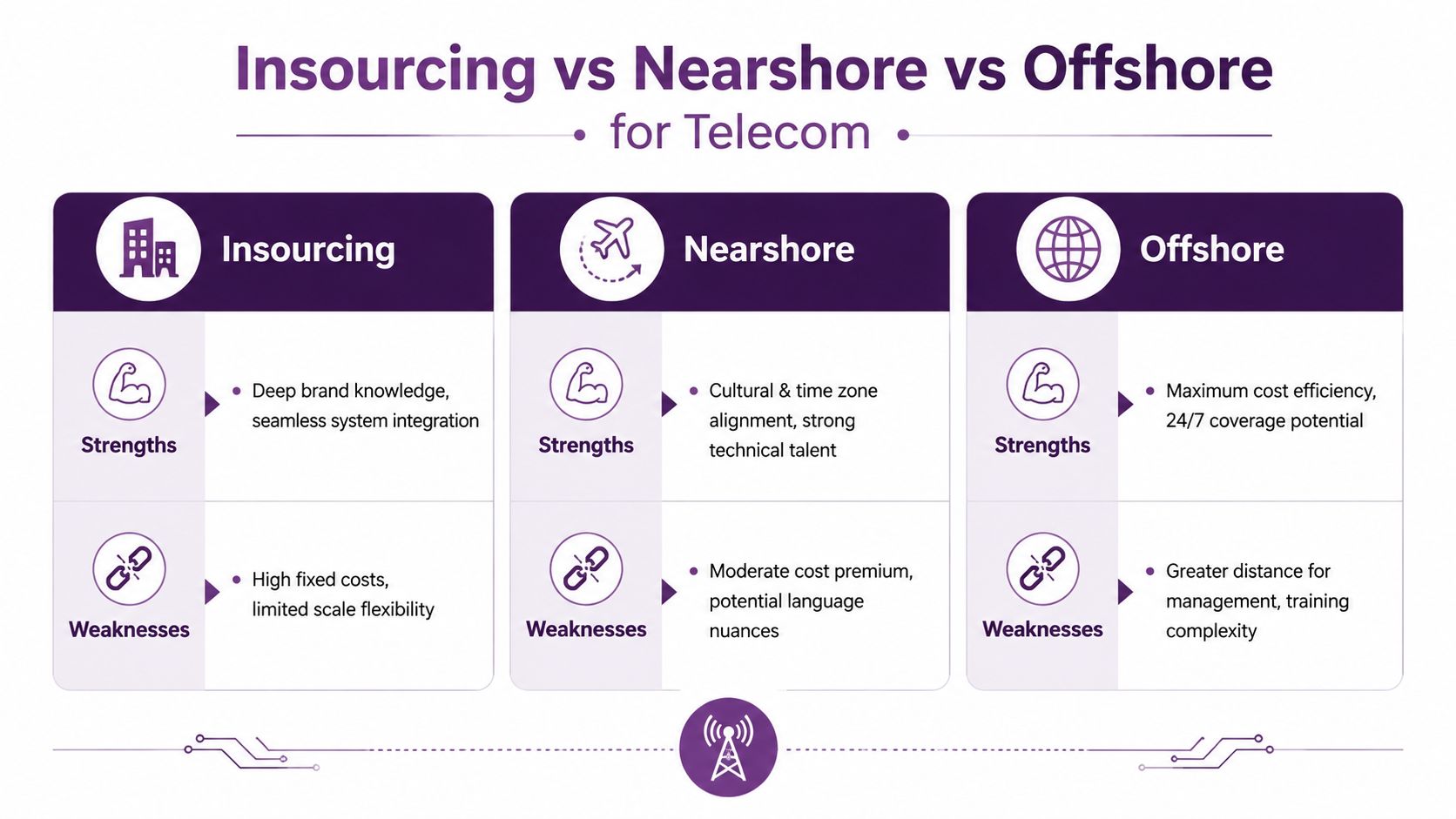
Nearshore still requires management. It can cost more than distant offshore delivery, and language nuances require coaching, call listening, and customer feedback. Set the decision around required quality, coverage, compliance, escalation speed, and sustainable operating cost. Use this offshore versus nearshore contact center comparison to examine the trade-offs without reducing the choice to wages.
How to Choose a Telecom Support Partner and Get Started
A telecom support partner should prove operational fit before discussing price. Ask for the workflow behind a disputed bill, a failed provisioning request, a device setup call, and a customer threatening cancellation. If the provider can describe only staffing and generic service levels, it doesn’t understand the work well enough.
Use a telecom-specific due diligence checklist
- Verified telecom experience: Request references from comparable carriers, MVNOs, ISPs, or telecom programs. Ask what contact reasons the team handled and how escalations reached billing, provisioning, fraud, and network operations.
- BSS, OSS, and CRM integration capability: Require a technical walkthrough covering authentication, account lookup, billing visibility, provisioning status, ticket creation, permissions, and audit trails.
- Bilingual coverage: Confirm which languages the operation supports, at what proficiency level, across voice and digital channels. Test technical vocabulary, billing explanations, and retention conversations.
- Security and compliance controls: Verify applicable SOC 2, PCI, and HIPAA controls, along with CPNI handling, access management, recording policy, retention, incident response, and state PUC familiarity.
- Regulatory operating knowledge: Ask how the partner tracks complaint registration, response windows, ADR eligibility, escalation letters, porting issues, and jurisdiction-specific obligations.
- Transparent reporting: Require reporting for FCR, AHT, CSAT, NPS, service level, ASA, abandonment, transfers, reopen rates, complaint aging, and save outcomes.
- Scalable staffing: Confirm how the partner handles outages, seasonal demand, product launches, language mix changes, and specialized queue requirements.
This vendor evaluation criteria guide provides a broader framework, but telecom buyers should add their own system, regulatory, and complaint-resolution tests.
Red flags that should stop the evaluation
Flat-fee pricing can hide the operational definition of a contact, the treatment of repeat calls, and the cost of escalations. Vague SLAs are equally dangerous. “Fast response” doesn’t tell you whether the provider measures answer time, resolution time, complaint aging, or customer updates.
An offshore-only model for U.S.-bound traffic isn’t automatically wrong, but it deserves hard questions about time zones, language, supervision, data access, and escalation ownership. Don’t accept a polished presentation instead of a live workflow demonstration.
Run a disciplined 90-day launch plan
Weeks 1 to 2 should establish scope. Segment contact volume by reason, channel, language, complexity, service, and escalation dependency. Document the billing and network cases that front-line agents can resolve and the cases that require another team.
Weeks 3 to 6 should produce the RFP and shortlist. Give every bidder the same sample interactions, account scenarios, reporting requirements, security questionnaire, and escalation map. Score operational evidence, not presentation quality.
Weeks 7 to 10 should be a controlled pilot. Define success criteria before launch. Test billing explanations, technical triage, bilingual calls, authentication, ticket handoffs, complaint clocks, quality monitoring, and daily reporting. Review actual transcripts and recordings with the provider’s supervisors.
Weeks 11 to 13 should support a transition or scale decision. Compare pilot results with the baseline, identify unresolved process defects, confirm staffing readiness, and decide whether to expand, revise, or stop. A responsible partner will show where the client’s own policy or system creates friction instead of hiding the issue behind agent performance.
Build a Telecom Support Operation That Resolves More
CallZent provides bilingual nearshore customer service and technical support from Mexico for North American programs. Explore a customized operating model built around your billing, technical, escalation, and customer-experience requirements.
Talk to an ExpertCallZent provides bilingual nearshore telecommunications customer service from Tijuana, including billing inquiries, service troubleshooting, technical assistance, and inbound support for North American programs. If your team needs to test a nearshore model against telecom-specific FCR, billing, escalation, and bilingual requirements, visit CallZent to discuss a scoped operating plan and next steps.