

FINANCIAL ADVISOR SUPPORT SERVICES
Virtual Assistant Services
for Financial Advisors That Scale
Learn how to use virtual assistant services for financial advisors strategically, with task boundaries, compliance controls, ROI guidance, and a nearshore team comparison.
TL;DR — Quick Takeaways
- Administrative drag is expensive. Advisors lose valuable growth time when scheduling, CRM cleanup, onboarding coordination, and paperwork dominate the week.
- Delegation works best with clear boundaries. Virtual assistants should own repeatable process work, while licensed professionals retain regulated decision-making responsibilities.
- Compliance must be built into the workflow. Role-based access, audit trails, supervision rules, and documented SOPs are critical.
- Managed nearshore teams usually outperform solo freelancers for advisory firms that need continuity, oversight, and scalable operational support.
Monday starts with good intentions. You want to prep for review meetings, follow up with prospects, and spend time on planning work that moves the firm forward. By Wednesday, you’re buried in scheduling changes, CRM cleanup, document chasing, billing questions, and inbox triage.
That’s the point where many advisory firms realize the problem isn’t effort. It’s operating design.
Virtual assistant services for financial advisors work best when they’re treated as an operating system for delegation, not a random pile of tasks handed to one person. The firms that get the most value don’t just “hire help.” They define what can be delegated, what must stay with licensed staff, and how client data will be handled from day one.
Stop Drowning in Paperwork and Start Growing Your Firm
Prialto reports that financial advisors spend an average of 16 hours per week on administrative tasks, which equals roughly two full workdays that could go back into prospecting, portfolio reviews, and client relationship management, according to Prialto’s financial advisor virtual assistant overview.
That’s the issue. The cost of admin work isn’t just payroll. It’s advisor attention.
Key takeaway: The smartest use of virtual assistant services for financial advisors is not to “save money on admin.” It’s to reclaim advisor time for work only the advisor can do.
A common mistake is waiting too long. Firms often tolerate operational friction because each task feels small on its own. One rescheduled meeting, one missing form, one CRM note that has to be corrected. Over time, that clutter turns into a real capacity problem.
The better move is to treat delegation as part of firm infrastructure. If onboarding, data entry, scheduling, document tracking, and recurring client follow-up are consuming the week, those functions belong in a documented support lane. That’s where outsourced back office services become useful. Not as a patch, but as a way to build room for growth.
What a Financial Advisor Virtual Assistant Actually Does
A client review is in 20 minutes. The advisor is still hunting for a beneficiary form, the CRM notes are incomplete, and the follow-up from the last meeting never went out. That is the point where firms usually realize they do not need occasional admin help. They need an operating layer that keeps client service work moving before it bottlenecks revenue work.
The term “virtual assistant” undersells the job. In a financial advisory firm, the role usually sits across service operations, workflow coordination, and controlled communication support. The core value is not a random collection of tasks. It is consistent execution inside defined processes.
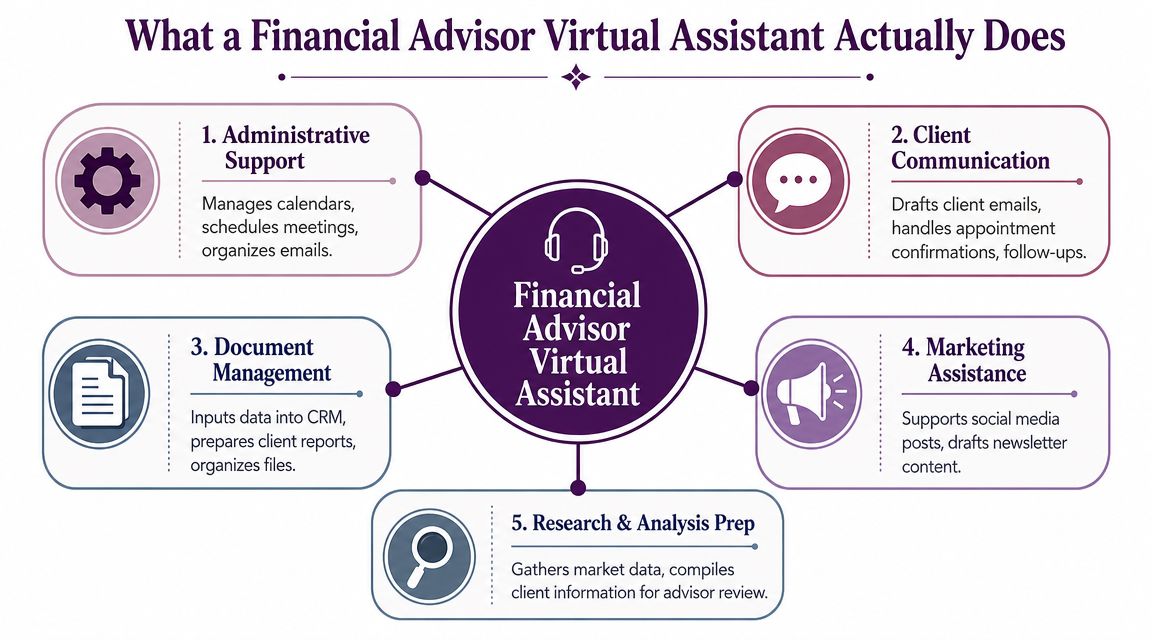
Back-office administration
This is usually the first lane to hand off because the work is repeatable and easy to document.
A financial advisor VA can run calendars, confirm appointments, coordinate meeting prep, maintain task queues, update billing records, organize inboxes, and keep routine client follow-up from stalling. In firms that still move information manually between email, CRM fields, custodial portals, and internal checklists, those steps can often be mapped into a standard operating procedure and assigned to support.
The impact shows up in small moments. Before a quarterly review, the VA confirms attendance, checks whether required documents are in the file, updates household records, and prepares a draft agenda for advisor approval. The advisor starts the meeting prepared instead of spending the previous hour assembling the file.
Client lifecycle support
Good support improves the client experience because it reduces lag between steps.
That work often includes onboarding coordination, document tracking, CRM hygiene, recurring review scheduling, follow-up summaries, and clean offboarding when a relationship ends. None of those tasks require the advisor’s judgment, but each one affects how organized and responsive the firm feels to the client.
This is also where the delivery model matters. A solo freelancer may handle task execution well, but financial firms usually need coverage, supervision, and process consistency across the full client lifecycle. A managed nearshore team can divide work by function, keep SOPs current, and provide continuity when one person is out. That lowers key-person risk, which is a real issue in advisory operations.
Growth and communication support
Advisory firms often assume growth problems start with marketing strategy. In practice, many growth problems start with poor follow-through.
A VA team can support lead routing, meeting scheduling for prospects, newsletter formatting, webinar coordination, data cleanup before campaigns, and draft responses using approved language. They can also help firms use leading compliance automation tools to keep communications workflows organized and reviewable. That combination matters because firms do not just need more outreach. They need outreach that is timely, documented, and easy to supervise.
Where the line should stay firm
The boundary is simple. A VA can collect information, update records, prepare documents for review, and move workflows forward. The advisor or licensed professional should handle recommendations, plan design, suitability decisions, and any regulated judgment call.
That distinction is what separates useful delegation from risky delegation. A provider that blurs those roles usually creates more supervision work than capacity relief.
If your team needs a baseline definition before assigning responsibilities, this overview of what a virtual assistant does in practice is a helpful starting point. For a financial advisory firm, the better question is not whether a VA can help. It is whether the support model gives you controlled access, documented process ownership, and enough depth to scale beyond one person.
Navigating Compliance and Security with a Virtual Assistant
Most advisors don’t hesitate because they doubt a VA can schedule meetings. They hesitate because client records, account data, and written communications sit inside regulated workflows.
That concern is valid.
With the SEC’s 2024 amendments to Regulation S-P increasing expectations around protecting customer records, third-party access controls and vendor oversight became more important, as noted in this discussion of advisor VA compliance responsibilities.

Low-risk tasks and high-risk tasks
Not every delegated activity carries the same exposure. Advisors should separate support work into risk tiers before giving access.
| Task type | Risk level | What works in practice |
|---|---|---|
| Calendar coordination and appointment reminders | Lower | Limit access to scheduling tools and approved templates |
| CRM updates and note logging | Moderate | Use role-based permissions and review queues |
| Onboarding packet tracking | Moderate | Give document workflow access, not unrestricted file access |
| Billing support and form processing | Higher | Restrict edit rights and require documented review steps |
| Client-facing communications involving account details | Higher | Use approval workflows and retention rules |
The key isn’t avoiding delegation. It’s matching permissions to the task.
Controls that firms should insist on
A serious provider should be comfortable discussing process controls in plain language. If they answer with vague reassurance, that’s not enough.
Use a checklist like this:
- Role-based access: Give the VA access only to the systems and fields required for their work. In tools like Salesforce or Redtail, broad permissions are rarely necessary.
- Password security: Use a credential manager and shared access methods that avoid sending passwords in email or chat.
- Written procedures: Every recurring task should have a documented workflow, especially where records, disclosures, or approvals are involved.
- Supervision rules: Define which outbound messages can be sent independently and which require review.
- Audit readiness: Keep timestamps, task records, file movement logs, and communication histories in systems that can be reviewed later.
- Confidentiality protections: NDAs matter, but they’re only one layer. Operational discipline matters more.
Practical rule: If a task touches sensitive client data, the advisor should be able to answer three questions immediately. Who has access, what can they do, and where is the record of that action?
Technology should support the process
Compliance breaks down when firms rely on memory and informal habits. Better systems reduce preventable mistakes.
That’s why many firms pair human support with workflow software, secure documentation practices, and leading compliance automation tools that help standardize approvals, monitoring, and retention. Technology won’t replace supervision, but it makes supervision easier to execute consistently.
For firms that outsource any customer-facing or back-office function, these best practices for protecting customer privacy in BPO are the kind of baseline standards worth applying before access is granted.
The Nearshore Advantage for Financial Firms
Most firms compare two options. Hire a freelancer, or don’t. That’s too narrow.
There’s a third model that often fits advisory firms better: a managed nearshore team. That structure matters because a financial practice usually doesn’t just need task completion. It needs continuity, supervision, and dependable coverage.
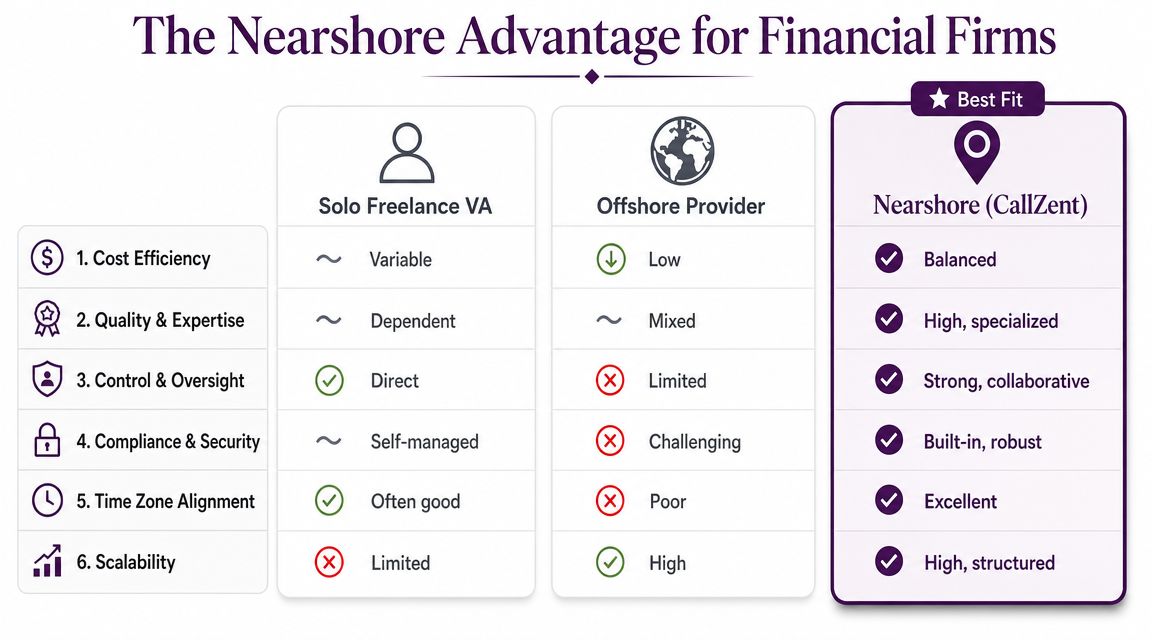
Most advisor-focused guides compare hiring an individual assistant with using a marketplace, but they rarely evaluate the operational strengths of a managed nearshore team, including continuity, bilingual coverage, and built-in supervision, as discussed in this analysis of advisor VA sourcing models.
Where the solo model works
A solo freelance VA can be a good fit if your needs are narrow, your workflows are simple, and you want a direct one-to-one relationship. For example, a solo advisor might use one assistant mainly for scheduling, inbox support, and client reminders.
The trade-off is concentration risk. If that person disappears, gets overloaded, or isn’t detail-oriented enough for financial workflows, the operation stalls fast.
Where offshore teams can struggle
Large offshore providers can offer broad coverage, but North American advisory firms often run into friction around time-zone overlap, language nuance in client communication, and inconsistent familiarity with U.S.-style compliance expectations.
That doesn’t mean offshore is always wrong. It means the management burden usually shifts back to the firm. If you have to build all the oversight yourself, “lower cost” can become expensive in management time.
Why nearshore tends to fit advisory operations better
For firms serving U.S. and Canadian clients, a nearshore model often offers the strongest balance of control and flexibility.
Three advantages stand out:
- Real-time collaboration: Shared or overlapping business hours make it easier to handle same-day service needs, urgent document requests, and live coordination before meetings.
- Bilingual support: English and Spanish coverage is increasingly useful for client servicing, appointment handling, and broader market reach.
- Managed continuity: A team model creates coverage if one person is out and usually includes supervision that a freelance arrangement doesn’t.
Nearshore support is often less about geography than operating rhythm. When your support team works in your business day, issues get resolved before they become backlog.
For firms exploring operating models, this overview of the nearshore advantage is helpful because it frames the choice around collaboration quality, not just labor location.
Calculating the ROI of Virtual Assistant Services
Monday starts with three client reviews on the calendar, two account forms waiting for corrections, and a stack of follow-up emails that should have gone out Friday. If the advisor spends the first two hours fixing admin drift, revenue work gets pushed into the margins. That is the real ROI question.
The firms that get this right do not judge support by hourly cost alone. They measure how much advisor time returns to planning, prospecting, relationship management, and revenue-producing meetings. They also look at which operating bottlenecks disappear once support is handled by a trained assistant or, better yet, a managed team with documented coverage and oversight.
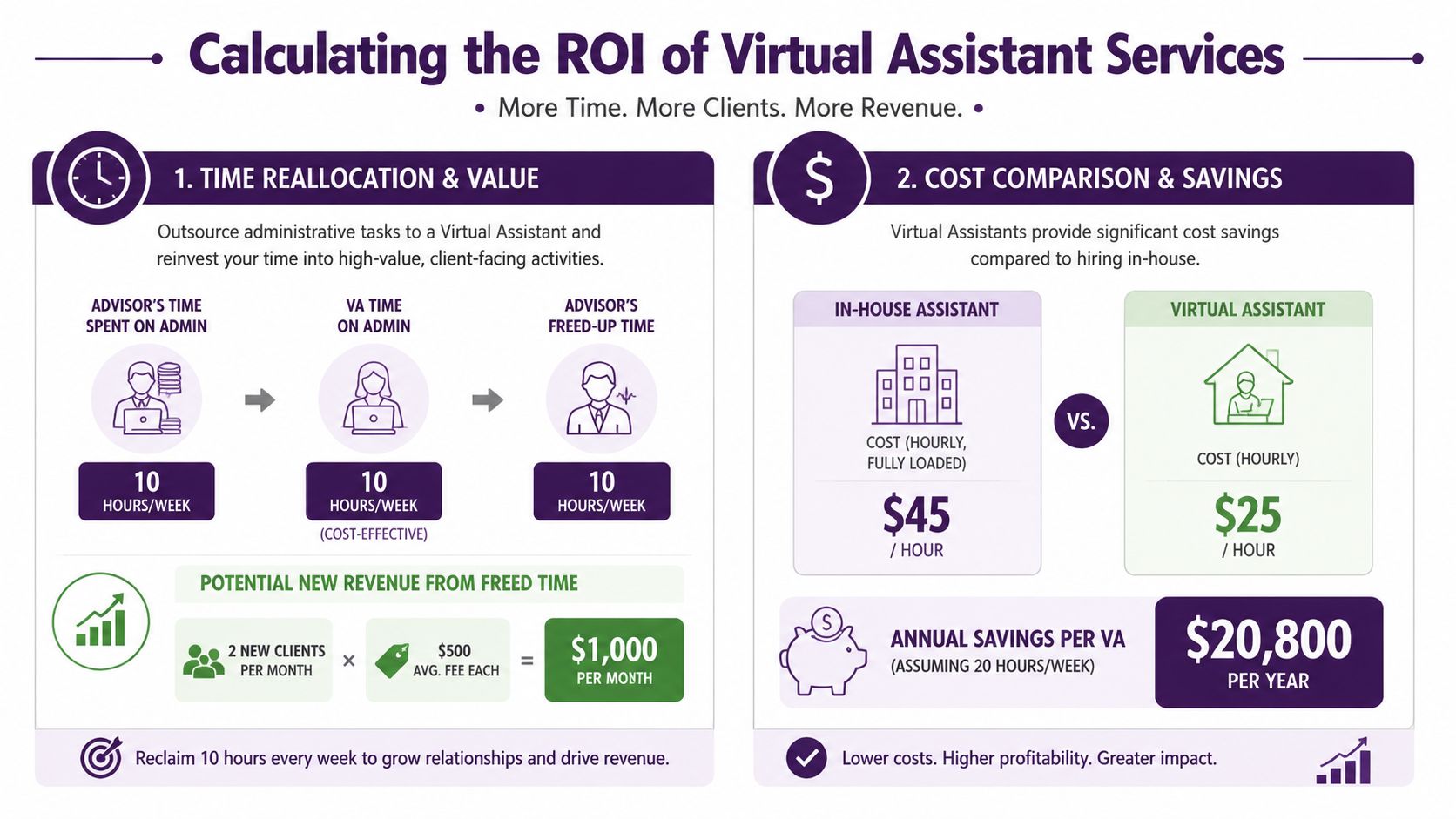
A practical way to calculate ROI
Start with a simple formula:
Value of advisor time recaptured = advisor’s effective hourly value x hours delegated
Then compare that figure to the cost of the support model you choose.
Not all hours inside an advisory firm carry the same economic weight. An hour spent confirming appointments, chasing paperwork, or updating CRM notes is an expensive use of licensed talent. An hour spent in a client review or advancing a prospect is not.
For most firms, ROI shows up in two places at once:
- Direct labor efficiency: Lower-cost support takes recurring administrative work off the advisor’s calendar.
- Capacity gain: The advisor can handle more reviews, faster follow-up, and better client communication without adding internal headcount.
The second category is usually where firms undercount the return.
Where the numbers improve
A well-scoped VA function improves more than payroll math. It changes workflow speed. When a support resource owns meeting prep, document collection, CRM hygiene, onboarding coordination, and routine client follow-up, work stops stalling between steps.
That creates measurable gains:
- Fewer dropped tasks
- Faster response times
- Less rework before meetings
- Shorter onboarding cycles
- More advisor hours available for client-facing work
A solo freelancer can produce part of that value. A managed nearshore team usually produces more predictable value over time because coverage, supervision, and process continuity are built into the service model. The trade-off is straightforward. A freelancer may cost less at the outset, but the firm often absorbs more training, backup planning, and quality control. A managed team costs more than the cheapest freelance option, yet it usually reduces operational risk and interruption costs.
Use a controlled trial to measure the value
Run a 30 to 60 day pilot with a narrow task set. Keep it specific enough to evaluate performance and broad enough to show workflow impact.
Track:
- Hours removed from the advisor’s week
- Turnaround time on delegated tasks
- Error rate and correction effort
- Client follow-through speed
- Whether the advisor increased revenue-producing activity
That last point matters. If delegated support saves six hours a week but those hours disappear into unstructured internal work, the firm has gained relief but not much growth. If those same six hours go into reviews, referrals, dormant prospect reactivation, or plan delivery, the economics look very different.
If you want a broader framework for support economics, this guide to determine AI support value for B2B SaaS is useful because the core discipline is the same. Measure regained capacity, not vendor spend alone.
For an operations-focused comparison, this article on the ROI of outsourcing call centers to save time and money is a helpful reference point. It explains the same principle from another angle: support should reduce cost, improve throughput, and free up higher-value work at the same time.
How to Evaluate and Onboard Your VA Partner
The quality of the first month usually determines whether the relationship becomes valuable or frustrating. Most failures don’t happen because delegation was a bad idea. They happen because the role was vague.
Start with a delegation map
Before you interview anyone, list what currently interrupts your week. Don’t create a dream-state job description. Create a list of real recurring work.
A useful first draft usually includes:
- Daily interruptions: Inbox triage, calendar changes, client reminders, document requests
- Weekly maintenance: CRM updates, review prep, billing follow-up, pipeline tracking
- Process bottlenecks: New-client onboarding, account paperwork, missing records, post-meeting follow-up
Then sort those tasks into three buckets:
| Bucket | What belongs there |
|---|---|
| Delegate now | Repeatable, documented, low-judgment tasks |
| Delegate after training | Tasks that require firm-specific workflow knowledge |
| Keep in-house | Advice, recommendations, approvals, licensed judgment |
That exercise does two things. It sharpens the provider search, and it prevents accidental over-delegation.
Interview for process maturity, not charm
A provider can sound polished and still be a poor fit for a financial firm. The better questions are operational.
Ask things like:
- How do you handle role-based access and permission changes?
- What systems have your staff used for CRM and document tracking?
- How do you document recurring workflows?
- What happens if the assigned support person is unavailable?
- How are quality checks handled on client-facing work?
- How do you train staff on sensitive data handling?
A strong answer is specific. It mentions process, supervision, escalation paths, and documentation. A weak answer stays at the level of “we take security seriously.”
The best provider conversations feel less like a sales call and more like an operations review.
Run a low-risk pilot first
Don’t begin with your messiest workflow. Start with a controlled lane where success is visible.
Good pilot examples include:
- Meeting preparation support: Agenda creation, confirmation emails, note logging
- Onboarding coordination: Packet tracking, checklist follow-up, CRM field completion
- Inbox and scheduling support: Calendar management with approval rules
Give the partner written SOPs, sample outputs, and clear review rules. Then watch where the process breaks. That tells you whether the issue is training, staffing, workflow design, or fit.
Set KPIs that reflect real work
You don’t need a dashboard with dozens of metrics. You need a few indicators that reveal whether the support function is becoming dependable.
Use practical KPIs such as:
- Task accuracy: Were records entered correctly and completely?
- Turnaround time: Were routine requests handled within the expected window?
- Escalation quality: Did the VA know when to ask for review?
- Documentation quality: Are actions traceable in the CRM or task system?
If performance is hard to measure, the role probably isn’t scoped clearly enough.
Frequently Asked Questions
| Question | Answer |
|---|---|
| Which tools should a VA be able to work inside? | At minimum, they should be comfortable in your CRM, calendar platform, email environment, document storage system, and task tracker. For most firms, that means tools like Redtail, Salesforce, Outlook or Gmail, calendar software, and a secure file workflow. The key is not the brand name alone. It’s whether they can follow process inside the system without creating cleanup work. |
| How long does onboarding usually take before a VA becomes useful? | For straightforward administrative tasks, a VA can become helpful quickly if you provide documented workflows, examples, and clear approval rules. More nuanced work, such as inbox triage or client communication drafting, usually takes longer because the person has to learn your firm’s standards and tone. |
| How should sensitive client information be handled during delegation? | Use least-privilege access, written procedures, and documented approvals for higher-risk tasks. Don’t rely on informal sharing through chat or email. The safest setup is one where access is segmented, activity is traceable, and the VA only sees the information needed to complete the task assigned. |
🚀 Scale Your Advisory Operations With CallZent
CallZent helps financial advisors and North American businesses improve operational efficiency through bilingual nearshore virtual assistant services, customer support, and scalable back-office workflows.
Talk to an ExpertIf your advisory firm needs bilingual, nearshore support that can handle client service and back-office operations with tighter oversight and real-time collaboration, CallZent is worth a look. Their team in Tijuana helps North American businesses build scalable support functions without the usual gaps in coverage, communication, or operational control.