
AGENT TRAINING PROGRAMS
Agent Training Programs for High-Growth Teams and Bilingual BPO Success
Learn how to build agent training programs that improve speed-to-proficiency, QA scores, CSAT, bilingual support quality, and operational efficiency in a nearshore BPO environment.
TL;DR — Quick Takeaways
- Agent training programs should be treated as performance systems, not onboarding events. The goal is faster ramp, better quality, and fewer avoidable errors.
- Strong training is staged and practice-heavy. Pre-boarding, initial instruction, simulation, nesting, and ongoing coaching should work together.
- Bilingual nearshore teams need more than language fluency. Training must include cultural context, tone, phrasing, compliance language, and North American customer expectations.
- The best programs connect training to live KPIs. Track QA, CSAT, FCR, AHT, transfer rates, repeat contacts, and speed-to-proficiency.
- Training becomes a profit engine when it reduces rework, escalations, supervisor rescue time, and customer friction.
Most companies still treat training like an onboarding event. That’s the mistake.
If your agents learn a script, click through a few systems, and then get pushed into live volume, your training isn’t building performance. It’s creating avoidable errors, longer handle times, inconsistent customer experiences, and extra coaching load for supervisors.
TL;DR: High-ROI agent training programs are staged, practice-heavy, and tied to live operational outcomes. The strongest programs separate need-to-know from nice-to-know content, use realistic simulation, reinforce skills with coaching, and adapt quickly to changes in products, policies, and channels. In a bilingual nearshore environment, training also has to cover cultural fluency, language precision, and rapid calibration to North American customer expectations.
Is Your Agent Training a Cost Center or Profit Engine
How much margin are you losing by teaching agents just enough to get through nesting, then asking operations to absorb the rest?
Undertrained teams are expensive in ways the budget rarely shows cleanly. The cost does not stop at extra training hours. It shows up as repeat contacts, avoidable escalations, lower QA consistency, longer handle time, supervisor rescue time, and slower speed-to-proficiency for every new class. In a bilingual nearshore BPO, that cost climbs faster because language precision, cultural fluency, and client-specific expectations all affect the customer experience from day one.
Training deserves the same operating discipline as workforce planning or QA. Research cited by Lorman’s employee training benchmarks links stronger training investment with higher income per employee, productivity, and profitability. The exact numbers matter less than the operating reality: teams that prepare agents well reach stable performance faster and need fewer costly interventions later.
That is the difference between training as overhead and training as output.
In nearshore bilingual programs, the upside is even clearer. A good training program shortens the gap between hiring and reliable production while reducing the missteps that come from direct translation, weak policy interpretation, or poor calibration to North American service norms. That matters for brands that need English and Spanish support to feel equally accurate, equally natural, and equally on-brand.
What strong training changes in real operations
Well-built training improves floor economics, not just classroom completion rates.
- Escalations drop: Agents learn policy boundaries, documentation standards, and how to explain next steps in both languages without creating confusion.
- QA scores stabilize: Coaches spend less time correcting the same preventable errors across an entire class.
- Schedules hold up better: Team leads and supervisors spend less time pulling struggling agents through basic interactions.
- Ramp time improves: New hires reach useful production sooner, which matters when volumes are growing or attrition is putting pressure on staffing.
The operational design matters too. Training should sit close to QA, operations, and workforce planning so curriculum changes track with live contact drivers. Teams that need a baseline for role scope and complexity can review how call center agents are structured across customer support functions.
What weak training looks like
Weak programs usually fail in predictable ways.
- Content is front-loaded: New hires get buried in policies, systems, and exception handling before they can perform the core interactions well.
- Practice is too light: Agents hear the material once, pass a quiz, and still struggle when a real customer goes off-script.
- Language training is too generic: Bilingual agents may be fluent, but fluency alone does not prepare them for compliance language, de-escalation phrasing, or cultural expectations by market.
- Success is measured by completion: The program looks finished in the LMS, while the floor pays for the gaps through rework and coaching.
That approach creates temporary confidence and delayed operational drag. A profit engine does the opposite. It reduces variance, gets agents productive faster, and gives the business a lower-cost path to better customer outcomes.
The Blueprint for Elite Agent Training Programs
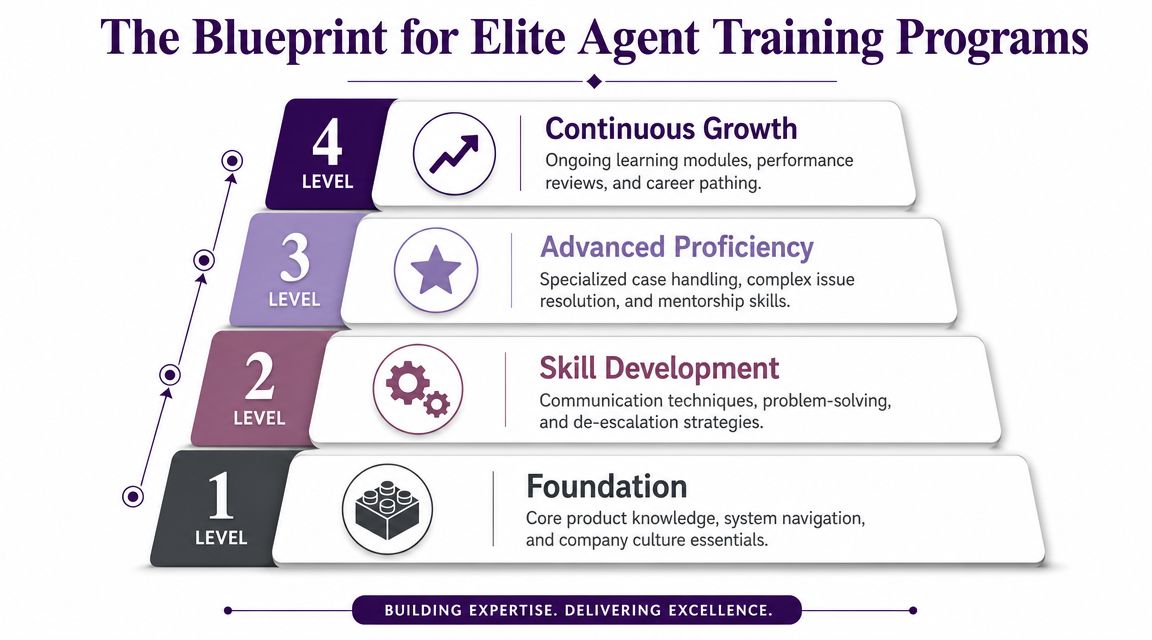
High-performing agent training programs follow a pipeline, not a classroom calendar.
The most reliable structure in contact center training is staged: pre-boarding, initial instruction, simulation, nesting, and ongoing development. That model works because each stage reduces cognitive load at the right moment and gives QA and operations clean checkpoints to spot gaps from live performance and feed them back into training, as described in Process Shepherd’s call center training framework.
Start before day one
Pre-boarding is where many programs either gain momentum or create friction. If system credentials, headset setup, password access, and knowledge base permissions aren’t ready, the first days of training get wasted on avoidable delays.
Use pre-boarding to lock down the basics:
- Access readiness: CRM, telephony, ticketing, chat, and internal messaging
- Expectations: schedule, attendance rules, communication norms, escalation paths
- Context: client brand voice, customer profile, and top contact reasons
This phase sounds simple, but it protects the rest of the program.
Build skill in layers
Initial instruction should cover only what agents need to survive first contact successfully. Don’t dump the entire policy archive into week one. Give them the essentials, then teach the rest when they can anchor it to real conversations.
A practical sequence looks like this:
- Core knowledge first: products, services, workflows, authentication steps, and common case types
- Simulation next: mock calls, objection handling, tool navigation under time pressure
- Nesting after that: controlled live interactions with fast supervisor support
- Ongoing development: refreshers, targeted coaching, and updates tied to trend data
The best training teams don’t ask, “Did everyone attend?” They ask, “What failed in live production, and how do we coach it before it spreads?”
That’s where a documented operating model matters. Teams building or auditing their own process can compare methods against practical call center training techniques such as simulation, shadowing, and nested support.
Why nesting matters more than most teams think
Nesting is where theory gets stress-tested.
An agent may sound polished in role-play and still struggle once queue pressure, customer frustration, account complexity, and system switching all hit at once. Nesting closes that gap. Supervisors and QA leads can catch habits early, like weak verification language, rushed empathy statements, or poor summarization at call close.
The payoff is simple. You stop treating live traffic as the first real training environment.
The Five Essential Types of Agent Training
Many agent training programs fail because they overinvest in one category and assume it covers the rest. It doesn’t.
A polished communicator who can’t use the CRM will still frustrate customers. A systems expert with poor de-escalation skills will still create churn risk. A friendly agent with weak compliance habits can create serious exposure.
Core agent training categories
| Training Type | Primary Goal | Example Activity |
|---|---|---|
| Onboarding Training | Establish baseline readiness and role clarity | Guided walkthrough of schedules, support channels, systems access, and escalation paths |
| Product and Service Training | Build subject-matter confidence | Resolve sample cases using actual policies, SKUs, or service workflows |
| Soft Skills Training | Improve communication quality and control | Role-play empathy, probing, summarizing, and de-escalation |
| Technical Skills Training | Build tool fluency under live conditions | Practice switching between CRM, telephony, ticketing, and knowledge base during mock interactions |
| Compliance and Security Training | Reduce operational and brand risk | Review authentication steps, data-handling rules, and secure call behaviors |
Onboarding training sets the operating standard
This isn’t the glamorous part, but it prevents confusion later.
Onboarding should answer practical questions early. How does the agent ask for help during a call? What does a good note look like in the CRM? When should a case be transferred versus escalated? These basics shape consistency more than a motivational welcome session ever will.
Product and service training creates credibility
Customers can tell when an agent is guessing.
This part of training should focus on common customer intents first, then edge cases. For an e-commerce account, that may mean order status, returns, replacements, refunds, subscription issues, and payment questions. For healthcare or financial services, it may center on eligibility, documentation, verification, and handoff boundaries.
Soft skills training protects the customer experience
Soft skills shouldn’t be taught as vague “be nice” guidance. They need scripts, examples, and correction.
Useful drills include:
- Active listening practice: agent must restate the issue accurately before solving it
- De-escalation scenarios: customer is upset, rushed, confused, or distrustful
- Silence management: agent learns how to hold control while researching a solution
- Closing discipline: summarize action taken, next step, and timing
Practical rule: If soft skills training doesn’t include role-play with correction, it’s awareness training, not performance training.
Technical and compliance training keep errors from multiplying
Technical skills are where many otherwise strong agents lose confidence. They know what to say but can’t move smoothly through the systems required to solve the issue.
Compliance training has a different purpose. It protects the operation. Agents need to know authentication steps, approved disclosures, documentation rules, and what they must never improvise. In regulated or high-trust environments, this category has to be reinforced continuously, not signed off once and forgotten.
Modern Training Delivery That Drives Retention
The delivery method often determines whether the content sticks.
Most operators have seen this play out. A trainer can run a polished session, everyone nods, and then the floor gets the same mistakes the next day. That’s because passive exposure isn’t enough. Industry guidance recommends a three-step cycle: teach the skill, let agents practice it in realistic scenarios, and then provide regular, specific feedback. It also notes that a single exposure doesn’t create durable retention, according to Zendesk’s guidance on better agent training.

What works better than long lectures
The best delivery mix usually combines short self-paced content, live instruction, call listening, and coached repetition.
A practical stack looks like this:
- Short LMS modules: ideal for policies, product updates, and process changes
- Instructor-led calibration: useful when nuance matters and agents need live Q&A
- Mock calls and chat simulations: where agents learn pacing, system handling, and recovery
- Recorded call reviews: agents hear what excellent performance sounds like
For distributed or hybrid teams, a platform for corporate training can help package product updates, short scenario demos, and process refreshers into reusable content. That’s useful when supervisors need consistency across shifts without repeating the same live session all week.
Low-cost methods often outperform fancy ones
One of the most practical lessons in training is that expensive content doesn’t always beat repeatable content.
In a study of new insurance agents, nearly 80% of respondents said the most effective training strategy was listening to recorded sales calls from top producers, followed by virtual ride-alongs and repeated script practice, as summarized in this discussion of agent training delivery methods. That tracks with what strong contact centers already know. Agents improve faster when they hear real conversations, practice the same skill repeatedly, and get corrected quickly.
What to build into every delivery plan
Use a rhythm agents can absorb:
- Teach one skill at a time: don’t bundle empathy, verification, troubleshooting, and compliance into one exercise
- Practice in realistic conditions: include interruptions, difficult customers, and multi-system workflows
- Coach with specifics: replace “be more confident” with “slow down during verification and confirm the next step before hold”
Teams that want a more operations-focused model can review agent training for the modern call center to map delivery formats to floor realities like schedule pressure, QA trends, and channel complexity.
Measuring the Real ROI of Agent Training Programs
How do you know whether training is improving margin or just adding paid hours off the floor?
In a nearshore BPO, that answer has to show up in production. If a bilingual training program is working, agents ramp faster, quality stabilizes earlier, rework drops, and supervisors spend less time correcting the same mistakes in English and Spanish. If those changes do not appear in operating results, the program needs redesign.
The metrics that deserve executive attention
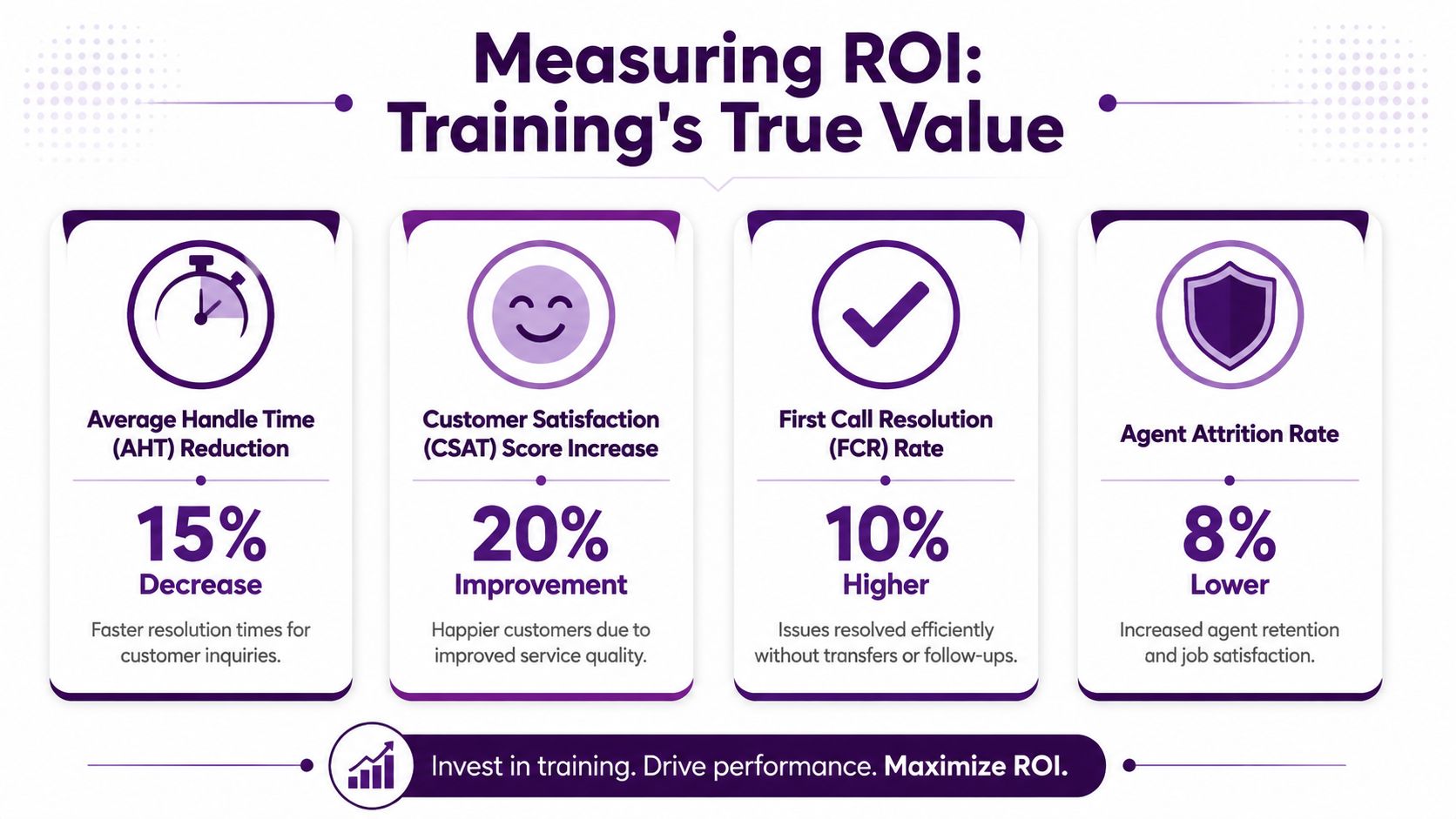
Training scorecards should start with the same outcomes clients pay for and operations teams manage every day:
- First Contact Resolution
- Average Handle Time
- Customer Satisfaction
- QA scores
- Coaching follow-through
Analysts at TechTarget note that strong call center training works best when teams focus on job-critical content, repeated practice, and formal coaching loops, as outlined in TechTarget’s best practices for call center agent training programs. That matters because it changes what you measure. A pass rate at the end of class is only a training metric. Operations leaders need to see whether the agent performs better on live contacts, under normal queue pressure, with actual customers.
For bilingual nearshore teams, add one more layer. Measure language accuracy and cultural fluency where they affect the customer experience most. That usually shows up in fewer clarification loops, shorter dead air, cleaner documentation, and lower escalation rates on calls that require nuance rather than simple translation.
Connect the class to the floor
Use cohort-based before-and-after comparisons.
Compare a new training class against the prior class at the same point in nesting or early production. Review QA deductions, repeat contacts, transfer rate, hold time, after-call work, and supervisor escalations. Then isolate the skill the program was built to improve. If the module focused on de-escalation, look first at CSAT, complaint trends, and save rate. If it focused on systems fluency, AHT, hold behavior, and case accuracy usually move first.
Nearshore programs often outperform generic models on speed-to-proficiency. Agents who train in bilingual scenarios with U.S. and Canadian context tend to need less correction once they hit the floor, especially in accounts where tone, phrasing, and expectation setting affect resolution as much as policy knowledge.
Training produces ROI when post-training behavior changes in ways the client can see and the P&L can measure.
A practical example is hospitality support. If agents practice reservation changes, amenity questions, and service recovery in both languages, using realistic phrasing such as these English phrases for hotel service, they usually reach acceptable QA and CSAT levels faster than teams trained only on policy slides and vocabulary lists.
A simple review cycle that keeps training accountable
Use a review routine that operations, training, and QA can all follow:
- Define the target behavior: stronger ownership, tighter verification, better call control, more accurate bilingual phrasing
- Attach one operational KPI: FCR, AHT, QA rubric items, CSAT, transfer rate, or escalation rate
- Measure by cohort: compare classes, trainers, and nesting periods instead of looking at one blended average
- Check floor adoption: confirm that team leads are coaching the same behavior taught in class
- Update the curriculum fast: if one error repeats across classes, fix the training design, examples, or practice volume
If you need a cleaner framework for selecting the right scorecard, this guide to customer service KPIs that tie training to business outcomes is a useful starting point.
The strongest programs do not chase training activity. They track time-to-proficiency, consistency across bilingual interactions, and the cost of poor performance avoided. That is how training stops being overhead and starts improving revenue retention, client confidence, and labor efficiency.
The Bilingual Nearshore Advantage in Agent Training
Generic agent training programs often ignore one of the biggest variables in North American support. Language accuracy alone isn’t enough.
A bilingual nearshore model works better when the training covers cultural context, expectation management, and the subtle differences in how customers explain urgency, frustration, confusion, or trust concerns. In Tijuana-based operations serving the U.S. and Canada, that can mean coaching agents not just on translation, but on phrasing, pace, politeness norms, and industry vocabulary by market.
Cultural fluency changes the call
A customer doesn’t judge an interaction only by whether the agent used correct English or Spanish.
They judge whether the agent understood the situation quickly, used natural wording, and handled the conversation in a way that felt aligned with the brand. That matters in hospitality, healthcare, telecom, retail, and financial services, where small wording choices can either calm the customer or create friction.
For teams handling service verticals like travel and hospitality, reference materials such as these English phrases for hotel service can be useful in training labs because they show common service language in context rather than as isolated vocabulary lists.
Nearshore proximity supports faster training updates
Operational change is constant. Policies shift. Offers change. A client launches a new workflow. A compliance clarification lands midweek.
Recent agent-training trends show a shift toward micro-topics and live, on-demand help sessions rather than one-time onboarding, suggesting that training is becoming more modular and continuous, according to HealthSherpa’s view of agent training updates. That trend fits nearshore BPO operations well because training teams can adjust quickly and calibrate with U.S.-based clients in the same working day.
Where this matters most
This advantage is strongest when operations need all of the following:
- Bilingual precision: not just translation, but tone and terminology
- Frequent updates: products, policies, scripts, and workflows change often
- Cross-functional support: voice, chat, email, and back-office work overlap
- Faster calibration: client feedback can turn into same-week coaching
For companies evaluating what that looks like in practice, how CallZent trains bilingual agents offers one example of a nearshore training model built around language fluency and operational readiness.
Your Actionable Agent Training Rollout Plan
How do you roll out agent training fast enough to support growth without sending underprepared agents into live customer conversations?
The answer is disciplined sequencing. In bilingual nearshore BPO teams, rollout speed matters, but control matters more. If training expands every time a stakeholder adds “one more topic,” ramp time stretches and labor cost climbs. If training is compressed too hard, QA scores, rework, and escalations show up in the first few weeks on the floor.
The rollout plan below is built for operational readiness. It prioritizes what agents need to handle live contacts, especially in environments where English and Spanish service quality, cultural fluency, and client updates all have to stay aligned.
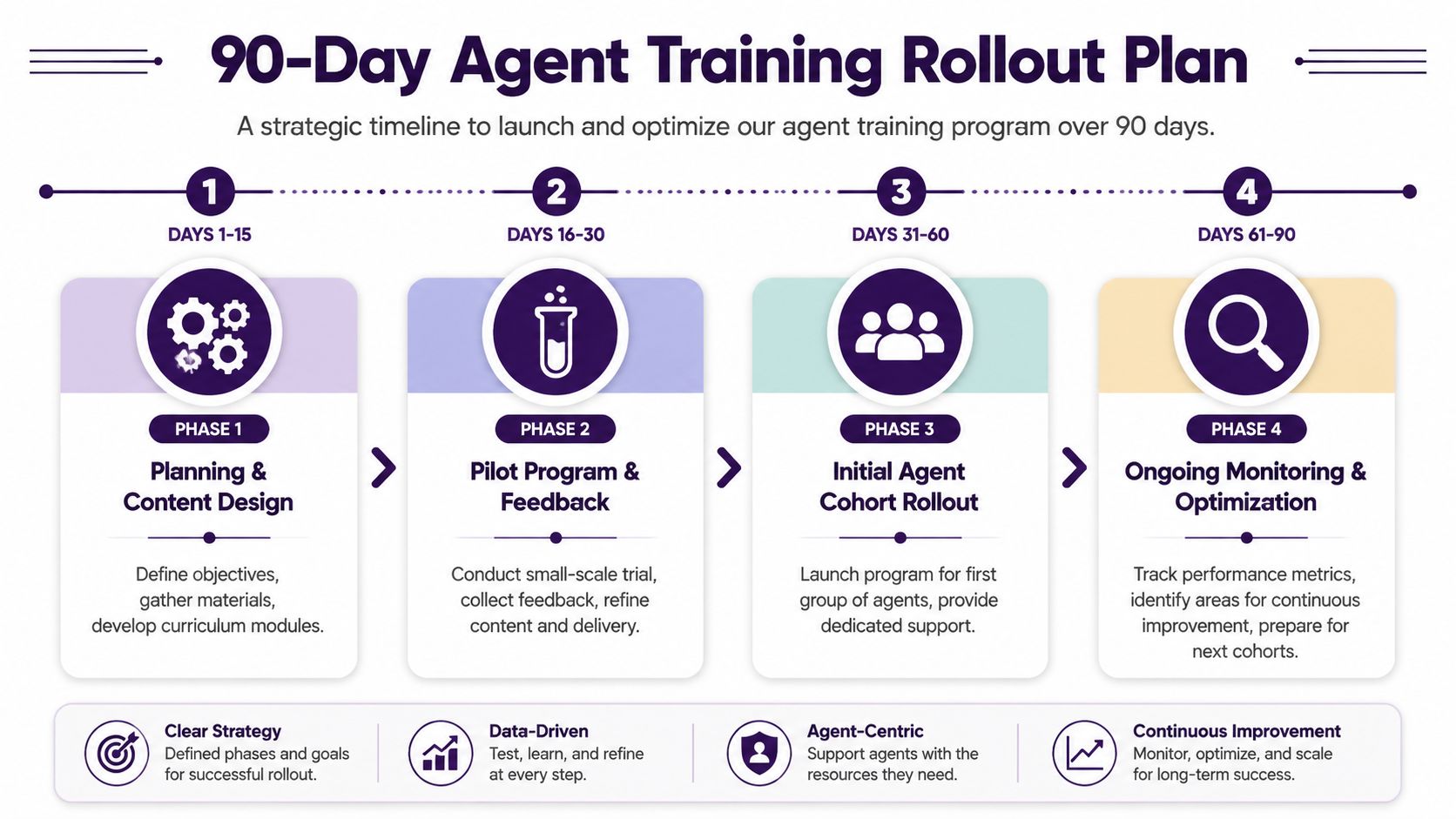
Days 1 to 15 planning and content design
Start with the work agents will do.
Map the first version of training to live contact volume, common transaction types, compliance risk, and the behaviors supervisors will coach on in nesting. In a bilingual nearshore operation, this also means defining where language precision matters most. Authentication scripts, empathy statements, escalation phrasing, and documentation standards often need separate guidance by channel and language.
Use this checklist:
- Define day-one skills: authentication, documentation, call control, common resolutions, and disposition accuracy
- Pull real production examples: anonymized calls, chats, tickets, objections, and edge cases from both language queues
- Set pass criteria: scorecards for simulation, language quality, system handling, and policy adherence
- Trim low-value content: company history, edge-case policies, and secondary workflows can move to post-launch development
Days 16 to 30 pilot and feedback
Run a pilot with a small group and watch where performance slows down.
This stage should expose friction between knowledge and execution. Agents may understand the policy but lose time between systems. They may deliver the right message in English yet sound too literal in Spanish, or vice versa. They may pass classroom checks and still struggle once a customer interrupts, objects, or changes direction.
Those gaps are useful. They show what needs to be fixed before rollout gets expensive.
Train to production pressure. Use timed scenarios, live system practice, bilingual role-play, and supervisor observation. In nearshore programs, I also recommend calibrating early with the client team on tone, brand language, and acceptable variations in phrasing. That step prevents rework later and shortens the path to proficiency.
Days 31 to 60 first cohort rollout
Now the program meets the floor.
Launch the first full cohort in a nested environment with high coaching coverage and fast correction. Daily review matters more than polished reporting at this point. If a pattern appears across ten agents, update the module, script aid, or workflow guide immediately instead of waiting for the next formal review cycle.
A practical weekly rhythm includes:
- Daily contact reviews: calls, chats, or cases scored against the same operating standard
- Targeted refreshers: one skill or failure pattern at a time
- Peer observation: shadowing top performers who handle both quality and pace well
- Visible coaching trackers: open actions, repeat deductions, and follow-up dates by agent
This is also where nearshore teams can outperform offshore models. Same-day calibration with U.S.-based stakeholders is easier, and bilingual trainers can correct language, tone, and workflow issues in the same coaching session instead of splitting them across teams.
Days 61 to 90 monitoring and optimization
By this point, agents should be handling a stable share of live work with less intervention, but the rollout is not finished. The next step is to tighten the link between training and business outcomes.
Review repeat QA deductions, avoidable escalations, handle time instability, incomplete notes, and customer confusion trends by queue, language, and trainer group. Then revise the curriculum based on what is happening in production. If one cohort struggles with documentation while another struggles with objection handling, treat those as separate training problems.
For companies running bilingual support through a nearshore partner, this phase should also include a formal review of trainer effectiveness, nesting throughput, and speed-to-proficiency by language line. That is where training stops looking like overhead and starts producing margin through faster ramp, better retention, and fewer performance misses.
🚀 Build Stronger Bilingual Support Teams With CallZent
CallZent helps North American businesses scale bilingual customer support, technical support, lead generation, back-office operations, and nearshore BPO teams through training models built around operational readiness, QA, coaching, and measurable outcomes.
Talk to an ExpertIf you’re rethinking how your support team ramps, performs, and scales, talk to CallZent about a bilingual nearshore model built around operational readiness, measurable coaching, and agent training programs that support live business outcomes.