

LEAD GENERATION SERVICES
7 Best Lead Generation Company Options for 2026: Which Partner Will Actually Build Your Pipeline?
Compare the 7 best lead generation company options for 2026, including CallZent, Belkins, CIENCE, SalesRoads, Martal Group, Callbox, and LeadGenius. Find the right partner for pipeline growth, outbound outreach, appointment setting, and qualified sales conversations.
TL;DR — Quick Takeaways
- The best lead generation company is not the one with the biggest database. It is the provider whose operating model matches your sales motion.
- CallZent is the strongest nearshore option for North American teams that need bilingual outreach, outbound calling, appointment setting, and fast campaign feedback loops.
- Belkins and CIENCE are strong B2B outbound partners for companies that need managed appointment setting and structured campaign execution.
- LeadGenius is best when data precision matters most, especially for niche B2B markets where standard databases miss the buying committee.
- SalesRoads, Martal Group, and Callbox fit different outreach models, from experienced phone-led appointment setting to multi-region campaign orchestration.
Outsourced Lead Generation Companies: What to Compare
Outsourced lead generation companies help businesses extend prospecting, qualification, outbound outreach, appointment setting, and sales development without building a larger in-house team. The right provider should match your sales process, target market, preferred outreach channels, and qualification requirements.
When comparing providers, look beyond the size of their contact database. Evaluate how they manage targeting, calling, email outreach, lead qualification, appointment setting, reporting, CRM integration, and campaign optimization.
Stop chasing leads if your sales team is already stretched thin. The key question isn’t who can hand you the biggest list. It’s who can help your team move from prospecting to conversations, meetings, and pipeline without adding operational drag.
Lead generation in 2026 looks very different from the old list-broker model. In major B2B markets, vendors now compete on database breadth, workflow integration, verification, and speed to activation. ZoomInfo’s 2026 market review notes that Apollo combines a B2B contact database with sales engagement, including multi-step sequences, email, dialer, LinkedIn touchpoints, AI-drafted outreach, and a Power Dialer, and that Apollo claims 230M+ contacts and 30M+ companies. That shift matters because buyers now expect one system or one partner to handle identification, outreach, and follow-up.
If your priority is practical execution, not listicle hype, this roundup will help. It also helps to understand how to generate local leads effectively when your market depends on geography, timing, and direct outreach.
1. Outbound Call Center Services
What do you need from a lead generation company: more contacts in a dashboard, or more qualified conversations on your calendar?
Outbound call center services sit in a different category from database vendors and email-first agencies. They are built for teams that need live outreach, qualification, follow-up, and appointment setting tied to pipeline activity. That distinction matters in this roundup because the right choice depends on your sales motion, not the loudest brand in the market.
CallZent earns a place here because its model addresses a common North American problem. Many companies want lower operating cost than a fully onshore team, but they do not want the communication gaps, timezone delays, or brand mismatch that can hurt offshore phone performance. A nearshore team in Tijuana gives them a middle ground. They get bilingual English-Spanish coverage, close timezone alignment, and faster feedback loops with management.
That setup tends to work well for businesses where phone conversations still carry weight. Healthcare groups booking consultations, financial services teams handling sensitive qualification, e-commerce brands building partnerships, and startups that need early pipeline coverage often fit this model. The value is not only labor capacity. It is execution quality and the ability to adjust scripts, targeting, and follow-up quickly.
If you are comparing build-versus-buy options, this guide on how to outsource lead generation is a useful starting point. If you want the service breakdown, their outbound lead generation services page explains how calling, qualification, and handoff are structured.
Practical rule: If account executives are spending prime selling hours sourcing lists and chasing first-touch outreach, the issue is workflow design, not rep effort.
James Dooley often makes the right point on partner selection. The best provider is the one whose operating model matches the way your team sells. That is especially true with outbound calling. A company selling into local or regional North American markets may get better results from a nearshore phone team than from a global vendor built around scale first. On the other hand, a company that needs wider language coverage across several regions may outgrow a narrower nearshore setup.
Pros and trade-offs
- Strong fit for North American outreach: Bilingual teams and cultural familiarity help conversations sound closer to your brand.
- Phone-first execution: The service covers outreach, qualification, nurturing, and appointment setting, not just contact data.
- Faster campaign management: Nearshore operations usually make it easier to review calls, refine scripts, and fix issues quickly.
- Industry flexibility: Useful for teams that need different talk tracks, compliance awareness, or buyer-specific qualification rules.
The trade-off is straightforward. CallZent is a better fit for companies that care about phone coverage, collaboration, and English-Spanish support than for buyers chasing the absolute lowest hourly rate. If your program needs broad multilingual reach outside North America, another model may be a better fit. If your real KPI is cost per sales conversation or cost per qualified meeting, nearshore often compares well against both onshore and lower-cost offshore alternatives.
2. Belkins
Need a lead generation partner that can run outbound without forcing your team to piece together strategy, list building, and appointment setting on its own? Belkins is a credible option for companies that want a managed B2B outbound program with a polished operating rhythm.
Their model centers on coordinated outreach across email, phone, LinkedIn, SMS, and manual prospect research. That mix matters because Belkins is usually strongest when outreach needs to be orchestrated, not just automated. In practice, that means tighter campaign management, clearer ownership, and less internal work for sales teams that already know who they want to reach but need help turning that into booked conversations.
Where Belkins fits best
Belkins tends to fit companies with a defined ICP, a working sales process, and deal sizes large enough to support a managed service fee. I would put them on the shortlist for mid-market and enterprise teams that care about messaging discipline, deliverability, and meeting volume in the same engagement.
Their process is also attractive for buyers that want structure. Some leadership teams want a partner that can test messaging, refine targeting, and report on progress without needing constant hand-holding from an in-house SDR manager. If your team is still deciding whether to build internally or hire outside help, this guide on how to outsource lead generation effectively gives a useful framework for evaluating that choice.
Good appointment-setting firms narrow the gap between the accounts you think will respond and the accounts that actually book meetings.
The trade-off is straightforward. Belkins is usually a better fit for teams that value managed execution and channel coordination than for companies chasing the lowest-cost vendor. It is also less forgiving of weak internal sales follow-up. If your reps are slow to work meetings, unclear on qualification, or inconsistent in discovery, even a well-run outbound partner will struggle to turn appointments into pipeline.
From a decision-making standpoint, Belkins sits in a different category than a nearshore phone-first provider such as CallZent. Belkins is often the better match when your program depends on multi-channel outbound and centralized campaign management. A nearshore model can be the stronger choice when live conversation quality, North American coverage, and tight day-to-day collaboration matter more than broad channel orchestration. That distinction matters more than brand recognition. The best lead generation company is usually the one whose operating model matches your sales motion.
3. CIENCE
CIENCE sits in the middle ground between platform thinking and managed-service execution. That’s useful for companies that want more than outsourced SDR labor but don’t want to assemble a fragmented stack on their own.
Their model is modular. You can use managed outbound, data services, and SDR capacity in different ways depending on how much of the motion you want to own internally.
Best for teams that think in systems
CIENCE makes the most sense when your team is comfortable managing metrics, workflow inputs, and ROI calibration. If that sounds heavy, that’s because it is. This is not the easiest fit for buyers who want a fixed-fee black box and no operational involvement.
That said, the market has moved in CIENCE’s direction. Independent coverage separates lead generation vendors into two operating models: full-service agencies and data platforms for in-house teams, and notes that teams with internal sales capacity often get better control and lower marginal cost from data platforms while teams without SDR headcount often benefit more from managed outbound services (VectorAgents market review). CIENCE appeals to companies that want a foot in both camps.
If your own team is deciding where outsourced support should stop and internal execution should begin, CallZent’s page on lead generation marketing services is a useful reference point.
What to watch
- Flexible model: Helpful if you may shift from outsourced execution to in-house SDRs over time.
- Clearer pricing structure than many peers: Good for buyers who hate vague packaging.
- Stronger with involved clients: Best results usually come when your team actively manages feedback loops.
The drawback is complexity. Some buyers don’t want optionality. They want simplicity. CIENCE isn’t the cleanest fit for that.
4. SalesRoads
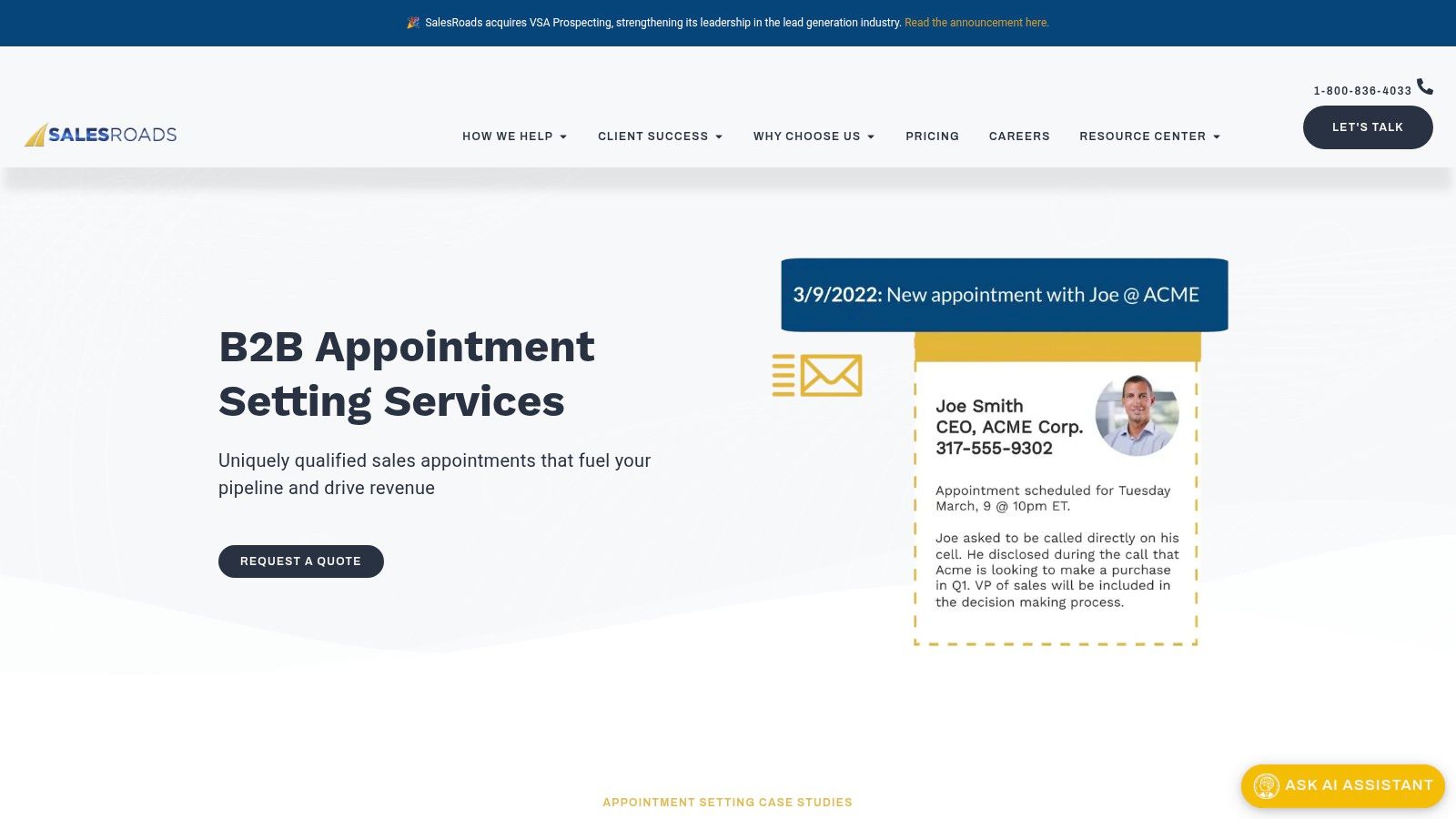
SalesRoads has a different feel than the more tech-branded providers in this list. Its value is operational discipline. If your sales leaders care about launch planning, caller coaching, CRM hygiene, and experienced reps, SalesRoads deserves attention.
This isn’t a flashy choice. It’s a practical one for companies that still believe phone-led outreach works when the team doing it knows how to hold a real conversation.
Why experienced callers still matter
A lot of lead generation failure happens after targeting. The list is fine. The sequence is fine. The outreach falls apart because the rep can’t handle objections, gatekeepers, or vague buyer interest. SalesRoads leans into veteran execution and structured playbooks, which is often what enterprise buyers want.
There is also a cost reality behind that preference. Industry commentary indicates pay-per-lead pricing often averages around about $198 per lead across industries, while U.S.-targeted enterprise accounts can require roughly $300 to $500 per lead. That spread is a reminder that lead generation cost isn’t just about media. Labor quality and sales complexity drive it too.
For companies trying to keep quality high without overpaying for every touch, affordable lead generation services can be a better strategic lens than shopping purely on sticker price.
Field note: Expensive leads aren’t always bad leads. Cheap leads become expensive fast when your reps waste time disqualifying them.
SalesRoads is less suited to companies that want paid media, heavy inbound content execution, or broad digital campaign management under one roof. This is a tighter appointment-setting and SDR-service fit.
5. Martal Group
Martal Group is a good option for North American companies that want onshore SDR execution with an AI-assisted outreach layer. The appeal here is speed and familiarity. If your buyers are in the U.S. or Canada and your leadership team wants that market represented by local-feeling outreach, Martal checks that box.
Their positioning usually lands well with B2B tech, service firms, and e-commerce-related outbound programs that already know who they want to target.
Where Martal wins
Martal is useful when you have a defined ICP, a clear sales motion, and no patience for a long experimentation phase. They are built for outbound activation, not broad marketing transformation.
That makes them a sensible fit for companies that already understand the basics of segmentation and messaging. If your outbound foundation still needs work, you’ll get more value by tightening that first. A practical starting point is CallZent’s guide to lead generation best practices.
One thing I like about Martal’s type of model is that it avoids a common mistake. Too many companies buy a lead generation service before they know what a qualified opportunity should look like. Then they blame the vendor for exposing an internal sales-definition problem. Martal tends to fit better when that definition already exists.
The main drawback is that pricing is custom and usually tied to program scope. You need a sales conversation to know whether the economics make sense for your pipeline goals.
6. Callbox
Callbox fits companies that have outgrown a basic appointment-setting vendor. If you need one partner to coordinate email, phone, LinkedIn, and digital follow-up across several regions or business units, Callbox is built for that kind of workload.
That matters because scale creates coordination problems. A campaign aimed at one U.S. buyer segment is one thing. A program covering multiple countries, product lines, or buyer roles needs tighter process, cleaner handoffs, and better channel timing.
Best for multi-region campaigns
Callbox stands out on orchestration. Their model makes sense when lead generation is not just about booking meetings, but about managing outreach across a larger operating structure with different audiences, lists, and follow-up paths.
James Dooley’s lens is useful here. The best lead generation company is rarely the one with the longest service menu. It is the one that matches your sales motion. Callbox is a stronger fit for teams that need breadth and operational coverage. A nearshore partner like CallZent is often the better choice when you want closer collaboration, easier timezone overlap, and a more controlled outbound program without paying for enterprise-level complexity.
That trade-off is easy to miss during vendor selection.
- Good fit for layered campaigns: Useful when one program has to support several markets, segments, or personas at the same time.
- Wider delivery team: Helpful if you need SDR work, data support, and digital execution under one provider.
- Less efficient for narrow outreach: If your goal is a tightly defined, phone-first campaign, this model can add cost and process you do not need.
I see one recurring mistake with providers in this category. Smaller B2B companies buy the bigger machine before they have proven the message, qualification criteria, or target account logic. Then the vendor spends time coordinating channels around an offer that still needs work. If your motion is already complex, Callbox deserves a look. If it is still taking shape, a simpler onshore or nearshore setup usually gives you a better read on what is driving pipeline.
7. LeadGenius
LeadGenius is the specialist pick in this lineup. When standard databases can’t find the actual buyers you need, LeadGenius becomes interesting fast.
That’s a common problem in niche B2B. You may know the target account, but not the right division, region, budget holder, or influencer. Off-the-shelf data tools often miss those edges.
When bespoke data beats bigger databases
LeadGenius is strongest when your challenge is data precision rather than meeting-setting labor. Think niche healthcare procurement groups, fragmented local market operators, hard-to-map buying committees, or expansion into less standardized international target sets.
Independent commentary also makes an important point that many buyers miss. Most “best lead generation company” pages focus on rankings, not on judging vendors by appointment-setting effectiveness, pipeline contribution, and fit for outbound versus inbound motions (MarketJoy’s commentary on evaluating lead generation companies). LeadGenius is a perfect example. If you judge it like a turnkey appointment-setting agency, you’ll underrate it. If you judge it as a custom data and enrichment partner, you’ll see its value more clearly.
Don’t confuse list access with market access. If the database can’t surface the real buying committee, better sequencing won’t save the campaign.
The downside is obvious. LeadGenius isn’t the best fit if you want a done-for-you appointment-setting engine. It shines when precision data is the bottleneck and your existing GTM team can act on that data well.
Top 7 Lead Generation Companies Comparison
| Solution | 🔄 Implementation Complexity | ⚡ Resource Requirements | 📊 Expected Outcomes | 💡 Ideal Use Cases | ⭐ Key Advantages |
|---|---|---|---|---|---|
| Outbound Call Center Services: The Engine Behind Scalable Business Growth (CallZent) | Moderate, collaborative onboarding and tech integration | Moderate, nearshore bilingual agents, platform tooling, mid‑tier budget | Predictable pipeline growth, higher conversion and booked meetings | North American English/Spanish markets; fast outbound scale for healthcare, finance, e‑commerce, startups | Nearshore bilingual teams, ROI‑first playbook, scalable operations |
| Belkins | Moderate, process‑driven onboarding; multi‑channel setup | Moderate, manual research, omnichannel tools; best with established budgets | High‑quality, ICP‑aligned meetings; meeting guarantees | U.S. B2B teams with defined ACV and sales process | Strong deliverability, copywriting, transparent reporting |
| CIENCE | High, modular AI+human orchestration can feel complex | Flexible, data services, SDR marketplace; requires metric engagement | Scalable SDR capacity and programmatic outreach with clear line items | Teams seeking tech + managed services; month‑to‑month engagements | Transparent pricing, flexible move between managed campaigns and SDR hires |
| SalesRoads | Moderate, structured four‑week launch, heavy training/role‑play | Higher, veteran SDRs, CRM integration, leadership oversight | Reliable appointment quality, pipeline hygiene, enterprise alignment | U.S. enterprises needing experienced SDRs and CRM integration | Operational rigor, strong training and coaching |
| Martal Group | Low–Moderate, vertical playbooks and quick activation | Moderate, onshore SDRs plus AI‑assisted outreach; custom pricing | Fast campaign launches and onshore North America coverage | B2B firms with defined ICP seeking quick activation | Onshore reps, AI‑assisted messaging tests, quick time‑to‑value |
| Callbox | High, multi‑region orchestration and AI platform complexity | High, full teams (SDRs, analysts, marketers), enterprise resources | Multi‑region reach, multi‑channel nurture, mature reporting | Companies targeting multiple regions or complex GTM programs | Mature playbooks, broad channel mix, enterprise scale |
| LeadGenius | Moderate, bespoke data campaigns require research and compliance | Moderate–High, specialized researchers, enrichment tooling, integrations | Precise buying‑committee data and enriched contact coverage | Niche targets and buying‑committee outreach across regions | High data precision, compliance posture, API/platform integrations |
How to Choose the Best Lead Generation Partner for You
What separates a lead generation partner that fills your calendar from one that fills your CRM with noise?
Start with the operating model, not the brand name. Some providers run outbound for you end to end, including research, outreach, follow-up, and meeting setting. Others sell data, enrichment, or intent signals that your internal SDR team still has to work. Those are different buys, with different success metrics, and companies often get poor results because they compare them as if they were the same service.
I usually advise teams to make one decision first. Do you need execution, data, or both? If your sales team lacks capacity, a managed partner makes sense. If your reps can prospect but your records are weak, a data-first provider may be the better fit. If your bottleneck sits in both places, a hybrid model is often the cleanest answer.
What to look for in a lead generation company
Use a practical checklist during evaluation:
- Industry fit: Providers with experience in your market usually ramp faster, ask better qualifying questions, and waste fewer touches on bad prospects.
- Delivery model: Clarify whether you are buying SDR execution, contact data, appointment setting, or a combined program.
- Channel coverage: Phone, email, LinkedIn, and follow-up workflows should support each other. Disconnected channels usually produce uneven results.
- Timezone and communication fit: This affects campaign speed more than many buyers expect. Teams working close to your hours can adjust messaging, lists, and targeting faster.
- Reporting: Ask to see how they track conversation quality, show reasons for disqualification, and connect meetings to pipeline. Activity counts alone do not tell you much.
One more point matters. Test how the partner handles feedback in the first two weeks. A polished sales pitch means little if they cannot revise scripts, fix targeting, and improve quickly once real conversations start.
The James Dooley perspective
James Dooley is known for a simple growth principle that applies here too. Volume without conversion does not create revenue.
That is the right lens for lead generation. The goal is not a bigger list or a higher activity count. The goal is qualified sales conversations that your team can move forward. A cheaper vendor can look efficient on paper and still cost more if meeting quality is poor, contact targeting is sloppy, or your reps spend time cleaning up bad opportunities.
That trade-off is where many buying decisions go wrong. Price matters. So do control, speed, data quality, and sales-readiness. The best choice is usually the company whose model fits your internal sales motion.
Why a nearshore partner can make sense
For North American companies, the decision is often less about finding the single “best lead generation company” and more about choosing the right operating setup. Onshore teams can offer strong market familiarity, but costs are higher. Offshore teams can lower costs, but communication gaps, timezone spread, and QA drift can create friction. Nearshore providers sit in the middle and often give a better balance of oversight, responsiveness, and economics.
CallZent is a good example of that model. Its Tijuana operation supports real-time collaboration with U.S. teams, and the bilingual setup helps companies that need English and Spanish outreach. That matters in industries where speed to feedback, script changes, and consistent call quality affect booked meetings more than a polished dashboard does.
!– CTA –>🚀 Build a Stronger Pipeline With CallZent
CallZent helps North American businesses improve outbound lead generation, bilingual appointment setting, customer outreach, qualification, and sales support through scalable nearshore teams in Mexico.
Talk to an ExpertIf your team wants a partner that works as an extension of sales instead of a separate vendor queue, evaluate nearshore options seriously. For a broader outside perspective on specialist roles and what strong lead generation support should look like, see LinkedFuse’s guide to lead generation experts.