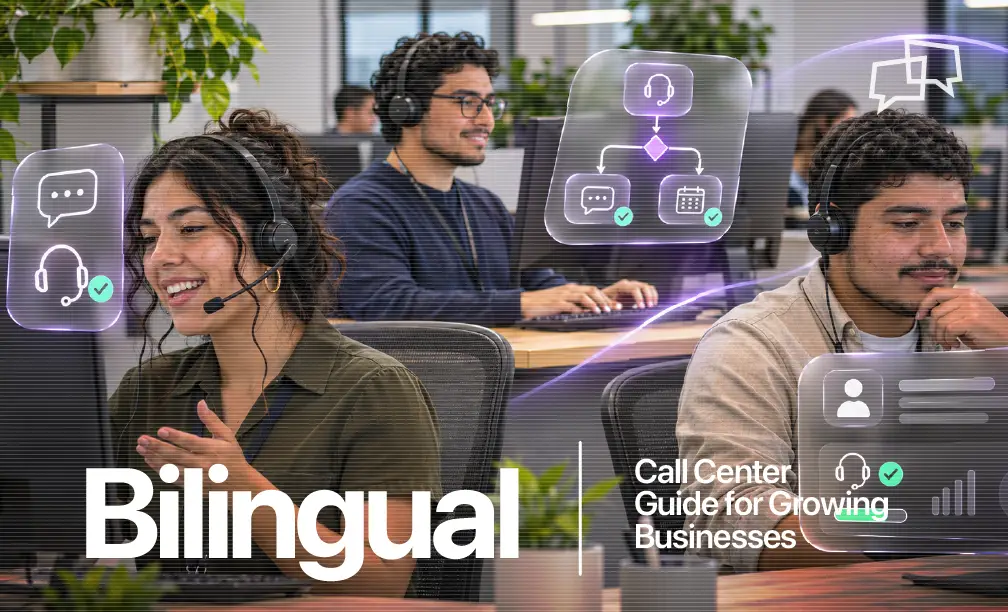
CALLZENT INSIGHTS / BILINGUAL CUSTOMER SUPPORT
Bilingual Call Center Guide:
How to Choose the Right Support Model.
Explore English-Spanish customer support,
shared and dedicated staffing models,
quality assurance, training, performance KPIs,
and the advantages of nearshore delivery.
English + Spanish
Bilingual CX
Staffing Models
Nearshore Mexico
A missed Spanish-language call is rarely
just a missed call.
It can mean an abandoned cart,
an unresolved billing concern,
a patient who does not book care,
or a prospect who chooses a competitor
that feels easier to work with.
This bilingual call center guide
is designed for U.S. businesses that need
to serve more customers without building
an expensive, fragmented internal
support operation.
Bilingual service is not simply about
translating a script. It is about giving
customers the confidence that they will
be understood, respected, and helped
by someone who can move their issue forward.
When support is handled well in both
English and Spanish, it becomes a practical
advantage for retention, revenue,
and brand trust.
THE BUSINESS CASE / 01
01
Why Bilingual Support Has Become a Business Requirement
Spanish-speaking consumers represent
a significant part of the U.S. market.
Yet many businesses still treat Spanish service
as an occasional accommodation rather than
a planned part of their customer experience.
The result is often long waits,
transfers to unavailable team members,
inconsistent answers, and customers
who feel that getting help requires extra effort.
A Large Customer Market With Different Language Needs
The
U.S. Census Bureau’s American Community Survey
language data
documents the large population speaking Spanish
at home across the United States.
Its language statistics help businesses understand
market opportunity, although spoken language
at home does not automatically determine
a person’s preferred customer service language.
The operational question is where your
own customers are asking for support
and whether they can complete their tasks
comfortably in their preferred language.
That experience carries a cost.
A customer who cannot easily confirm
an order, understand a financing option,
schedule an appointment, or resolve
a technical issue is less likely
to complete the next step.
For regulated or high-consideration industries,
unclear communication can also introduce
compliance and reputational risk.
More Than Answering Calls in Two Languages
A well-run bilingual call center gives businesses
the ability to communicate clearly at the moments
that matter most.
It can support inbound customer service,
outbound follow-up,
appointment setting
,
order processing, technical support,
collections, legal intake,
and back-office workflows.
The right program does more than answer calls
in two languages. It protects the customer
journey from unnecessary friction.
A bilingual call center should make
doing business easier, not simply provide translation.
CUSTOMER EXPERIENCE DESIGN / 02
02
What a Bilingual Call Center Should Actually Deliver
Fluent English and Spanish are the starting point,
not the finish line.
Your outsourced team should understand
your products, policies, systems,
escalation rules, and brand standards
well enough to represent your business
with confidence.
That requires a service design built around
the work customers need completed.
eCommerce
Order status, inventory questions,
returns, payment concerns,
and abandoned-cart follow-up.
Healthcare
Appointments, reminders,
approved insurance-related questions,
and sensitive patient communication.
Legal Services
Accurate intake, appointment coordination,
and compassionate initial communication
without unauthorized legal advice.
For an eCommerce company, the work may mean
checking inventory, processing returns,
and recovering abandoned carts.
For a healthcare organization,
it may mean appointment reminders,
insurance-related questions,
and sensitive communication practices.
A legal services team may need bilingual agents
trained to gather intake details accurately
and compassionately.
CallZent’s
bilingual customer service
and
technical and customer support
services can be considered when defining
these different responsibilities.
Natural Language and Cultural Context
The best bilingual programs also account
for regional language differences.
Spanish is not a single customer experience.
A phrase that is familiar to one caller
may sound overly formal, unclear,
or culturally distant to another.
Agents do not need to mirror every dialect,
but they should communicate naturally,
listen carefully, and avoid literal
translations that confuse customers.
Customers should also be able to request
their preferred language without losing
the context of an ongoing interaction.
That makes
omnichannel customer support
especially relevant.
Language fluency matters.
Product knowledge, judgment,
and genuine understanding complete the experience.
STAFFING STRATEGY / 03
03
Choose the Right Coverage Model
Before selecting a provider or staffing plan,
define where bilingual coverage
will create the greatest impact.
A business with a high volume of Spanish-speaking
inbound callers may need dedicated bilingual queues
throughout the day.
Another company may only need coverage
during peak hours, appointment campaigns,
or for specific product lines.
Start with call data.
Review the volume of Spanish-language requests,
the times they arrive, average handle time,
transfers, abandonment, repeat contacts,
and customer satisfaction.
If language preference is not currently tracked,
review appropriately collected call recordings
and ask frontline employees where
language gaps create delays.
Shared, Dedicated, and Blended Bilingual Support
| Coverage Model | How It Works | Best Fit | Trade-Off |
|---|---|---|---|
| Shared Bilingual Support | Agents serve several related accounts or queues | Variable or lower bilingual demand | May provide less account specialization |
| Dedicated Bilingual Team | Agents focus on a defined client program | Steady volume or complex workflows | May require greater staffing commitment |
| Blended Language Coverage | A trained team handles English and Spanish interactions | Growing operations with mixed demand | Requires careful forecasting and language-level reporting |
No one model is automatically better.
A dedicated team offers deeper product knowledge
and stronger continuity, while shared capacity
can be more cost-efficient at lower volumes.
Blended language coverage can improve flexibility
when the same team is trained to handle
related interactions in both languages.
However, companies should still measure
English and Spanish performance separately.
The right choice depends on demand patterns,
complexity, service-level expectations,
and growth plans.
The
ISO 18295-1:2017 contact center standard
provides a useful framework for customer contact
center services, monitoring, and performance
across different operating models.
It is a reference for evaluation, not evidence
that any particular vendor is certified.
Choose the staffing model that fits
your actual demand, not a fixed assumption
about how many bilingual agents you need.
PROGRAM DESIGN / 04
04
Build a Program Around Outcomes, Not Headcount
Outsourcing conversations often begin
with a simple question:
How many agents do we need?
It is a useful question,
but it is not the most strategic one.
Start with the outcomes you need to improve.
Improve Accessibility
Reduce abandoned calls,
language-related transfers,
and unnecessary waiting.
Improve Conversion
Respond faster to prospects,
qualify leads, and support appointments.
Improve Resolution
Help agents solve customer needs
without repeated handoffs.
Extend Coverage
Support customers beyond internal hours
or during changing demand.
You may want fewer abandoned calls,
faster responses to online leads,
higher appointment attendance,
better first-contact resolution,
or extended coverage outside your internal
team’s hours.
Those goals shape staffing, training,
technology access, quality assurance,
and reporting.
Define a Transparent Operating Plan
A strong partner should help translate
business objectives into an operating plan.
That includes call flows, escalation paths,
knowledge base requirements, scheduling,
reporting cadence, and realistic service levels.
Transparent pricing matters here
because it lets leaders understand
what is included and make decisions
based on value, not vague assumptions.
Use CallZent’s
BPO pricing models
and
advantages of nearshore outsourcing
to help frame those conversations.
Flexibility matters just as much.
Seasonal spikes, new product launches,
marketing campaigns, and unexpected service
events can change demand quickly.
Programs with flexible contract structures
can give businesses room to adjust staffing
as the operation proves itself.
Confirm minimum commitments, volume terms,
and ramp-up conditions in the actual agreement.
Buy a better customer experience,
not simply a number of staffed seats.
PEOPLE & BRAND ALIGNMENT / 05
05
Train for Brand Alignment and Human Judgment
Customers can tell when an agent is reading
a generic script.
Scripts have a role in compliance-sensitive
or highly repeatable interactions,
but they should guide the conversation
rather than replace judgment.
Effective
bilingual agent training
gives agents a clear understanding
of your brand voice, customer promises,
products, common concerns,
and boundaries for decision-making.
Practice Difficult Conversations in Both Languages
Training should include realistic role-play
in both languages, especially for emotionally
charged calls such as billing disputes,
cancellations, missed deliveries,
or urgent technical issues.
Bilingual Agent Training Checklist
- English and Spanish communication assessments
- Brand voice and customer-service expectations
- Product, policy, and system knowledge
- Realistic scenarios and language switching
- Identity verification and sensitive-data procedures
- Approved decision authority and exceptions
- Regular coaching and bilingual QA calibration
Agent empowerment is a meaningful
operational advantage.
When agents know what they can resolve
without waiting for approval,
customers get quicker answers
and fewer transfers.
That improves the experience for the caller
and reduces unnecessary workload
for supervisors and internal teams.
Empowerment With Clear Controls
Empowerment does not mean removing controls.
It means defining sensible authority levels,
documenting exceptions, and giving agents
access to current information.
The balance is especially valuable
in bilingual support, where a delayed handoff
can quickly make a customer feel unheard.
Retaining trained agents also helps preserve
brand familiarity and product knowledge.
Review CallZent’s article on
agent retention and stability
when comparing provider people practices.
The strongest bilingual agents
can explain, decide within their authority,
and complete the next step.
PERFORMANCE & ACCOUNTABILITY / 06
06
Measure Quality in Both Languages
Do not assume a quality process built
for English calls will automatically
work for Spanish calls.
Evaluate both languages with the same
level of care, while allowing for natural
differences in phrasing and conversation style.
Quality reviews should look beyond
whether agents followed a checklist.
Review accuracy, empathy, clarity,
ownership, documentation quality,
compliance, and the resolution achieved.
If a call requires a transfer,
ask whether that transfer was necessary
and whether the customer understood
the next step.
Bilingual Call Center KPI Framework
| KPI | What to Measure | Why It Matters |
|---|---|---|
| Service Level | Share of eligible calls answered within the agreed threshold, by language | Availability during demand peaks |
| Average Speed of Answer | Waiting time before an agent answers | Queue responsiveness |
| First-Contact Resolution | Issues resolved without related repeat contacts | Completeness of the assistance |
| Abandonment Rate | Eligible calls abandoned before reaching an agent | Missed opportunities and staffing pressure |
| Customer Satisfaction | Survey results and feedback segmented by language | Customer perception of service quality |
| Conversion Rate | Qualified sales or lead outcomes by language | Commercial effectiveness |
| Appointment Show Rate | Scheduled customers who attend | Scheduling and follow-up effectiveness |
| Quality Assurance | Accuracy, empathy, documentation, compliance, and ownership | Consistency in English and Spanish |
The most useful metrics depend on the program.
A lead-generation campaign should be measured
differently from technical support
or healthcare scheduling.
Establish targets based on your baseline,
call complexity, coverage model,
and customer expectations.
Compare performance by language instead
of relying on a blended average.
CallZent’s
customer service KPI guide
and
average handle time article
provide more context on measuring
service efficiency and customer outcomes.
Calibrate Quality Together
Regular calibration is essential.
Your internal stakeholders and the outsourced
team should review real interactions together,
identify patterns, and agree on coaching priorities.
This keeps quality standards connected
to your brand instead of becoming
a distant spreadsheet exercise.
Measure successful customer outcomes
in each language, not just the number
of calls answered.
LOCATION & DELIVERY MODEL / 07
07
Why Nearshore Delivery Fits Many U.S. Businesses
For businesses serving North American customers,
a
nearshore bilingual call center
can offer a practical balance of cost control,
time-zone alignment, and cultural familiarity.
Mexico-based teams can often support
U.S. business hours with less scheduling
complexity than distant offshore locations,
while providing native or highly proficient
Spanish-language service.
Time-Zone Alignment
More convenient coaching,
program updates, escalations,
and real-time collaboration.
Language Capability
English-Spanish assistance
for customer-facing programs.
Closer Collaboration
Easier access to training,
leadership meetings, and site visits.
Operational Flexibility
Capacity that can adapt
to growth, seasonality,
and changing coverage requirements.
Geographic proximity also makes collaboration easier.
Training sessions, leadership meetings,
process updates, and site visits
are more accessible when your partner
operates nearby.
That can be valuable for growth-stage companies
that expect their processes to evolve quickly.
Evaluate More Than Hourly Cost
Cost savings should be part of the decision,
but not the only factor.
The lowest hourly rate can become expensive
when it produces poor documentation,
repeat contacts, high turnover,
or customer frustration.
Look for a provider that invests in agent experience,
training, supervision, and clear communication.
Better-supported agents are better positioned
to create the real human connections
customers remember.
Use CallZent’s
U.S., Mexico, India, and Philippines
pricing comparison
when evaluating delivery locations,
while confirming the exact scope
of each proposal.
The best delivery location supports
your operating hours, your customers,
and the quality standards of your brand.
EVALUATION & IMPLEMENTATION / 08
08
Questions to Ask Before You Launch
Before moving forward, ask how bilingual proficiency
is assessed, how agents are trained on your account,
and how quality is evaluated in both languages.
Ask who owns day-to-day communication,
how quickly staffing can scale,
and what happens when demand exceeds forecasts.
Bilingual Call Center Vendor Checklist
- Language screening:
How are English and Spanish skills verified? - Program training:
How do agents learn our products and policies? - Quality assurance:
Are calls calibrated in both languages? - Leadership:
Who is accountable for daily performance? - Scalability:
What training and staffing capacity is available? - Security:
What verification and data-access controls apply? - Technology:
Which CRM, telephony, and reporting systems are supported? - Pricing:
What is included, excluded, or subject to additional charges? - Contract flexibility:
What happens when volume or coverage requirements change?
A provider should be comfortable discussing
the limits of a proposed solution,
not just its strengths.
Honest planning creates a stronger partnership
than promises that sound good in a sales conversation
but fail under live call volume.
Check Industry-Specific Language Requirements
In certain healthcare programs,
language access has specific legal requirements.
The
U.S. Department of Health and Human Services’
Section 1557 language-access guidance
explains meaningful access for people with limited
English proficiency in covered health programs.
Those requirements should not be assumed to apply
identically to every business.
Covered organizations should confirm applicable rules,
qualified language-assistance needs,
privacy responsibilities, and the current
legal requirements with their compliance teams.
CallZent approaches bilingual outsourcing
as an extension of the client’s team,
with customized programs built around
customer experience and relevant operating goals.
That partnership mindset is what turns
outsourced support from a coverage solution
into a growth capability.
Start With One High-Impact Queue
The best time to improve bilingual support
is before customer demand exposes the gap.
Start with one high-impact queue,
establish clear measures of success,
and build from what your customers
show you they need.
Define its volume, operating hours,
primary call reasons, language requirements,
escalation paths, and success measures.
Review early interactions and refine
training before expanding coverage.
Start with the customer journey
that needs the most improvement.
Let measurable outcomes guide the next step.
FREQUENTLY ASKED QUESTIONS
10 FAQs About Bilingual Call Center Services
1. What is a bilingual call center?
A bilingual call center provides customer support
in two languages, commonly English and Spanish
for U.S.-focused programs. It may handle inbound
inquiries, outbound follow-up, appointment setting,
order processing, technical support,
and other customer-facing tasks.
2. Why should U.S. businesses offer English and Spanish customer support?
English-Spanish support can help businesses
serve customers in their preferred language,
reduce misunderstandings, support problem resolution,
and improve accessibility. The value depends
on customer demand, agent capability,
and how well the program is managed.
3. What services can a bilingual call center provide?
Services may include inbound customer service,
outbound follow-up, lead qualification,
appointment setting, eCommerce support,
order processing, technical troubleshooting,
payment questions, collections,
and legal or healthcare intake within
approved responsibilities.
4. What is the difference between shared and dedicated bilingual support?
Shared support uses agents who serve multiple
related accounts or queues and may suit variable
demand. Dedicated teams focus on a specific
client program, often providing greater specialization
and continuity. The best model depends on volume,
complexity, staffing requirements,
and service expectations.
5. What is blended bilingual call center coverage?
Blended bilingual coverage allows a trained team
to handle interactions in both English and Spanish.
It can improve staffing flexibility for businesses
with changing demand, provided that language-specific
service levels, quality, and customer outcomes
remain visible.
6. How much does bilingual call center outsourcing cost?
Pricing depends on delivery location,
staffing model, agent requirements,
operating hours, call volume,
technology, quality assurance,
and compliance complexity.
Compare the total cost of equivalent programs,
including implementation and any excluded services,
rather than hourly labor rates alone.
7. How are bilingual call center agents trained?
Training should include English and Spanish
proficiency, product knowledge, brand voice,
system navigation, realistic call scenarios,
terminology, verification, escalation procedures,
and quality standards. Ongoing coaching
helps maintain accuracy as policies and products change.
8. What KPIs should a bilingual call center track?
Important metrics can include service level,
average speed of answer, first-contact resolution,
abandonment rate, customer satisfaction,
conversion rate, appointment show rate,
and quality assurance scores.
Compare English and Spanish performance
rather than using combined averages alone.
9. What are the advantages of a nearshore bilingual call center in Mexico?
Nearshore teams in Mexico may provide
English-Spanish talent, compatible U.S.
operating hours, more convenient collaboration,
and competitive staffing costs.
These advantages can support coaching,
escalation management, and flexible coverage,
depending on the specific provider.
10. How should a business choose a bilingual call center provider?
Evaluate language screening, training,
quality assurance in both languages,
reporting, staffing flexibility,
leadership access, security practices,
technology compatibility, pricing,
and escalation procedures.
Start with clearly defined customer needs
and consider testing a focused queue
before expanding the relationship.
TWO LANGUAGES. ONE CONNECTED CUSTOMER EXPERIENCE.
Better Conversations.
Stronger Customer Relationships.
CallZent provides bilingual nearshore
customer support from Tijuana, Mexico.
Let’s design an English-Spanish support
program around your customers, workflows,
operating hours, and performance goals.