

Customer Experience and Quality Assurance
Customer Service Empathy: Bilingual Training, Scripts, and QA Scorecards
A practical guide to turning empathy into observable call behaviors that supervisors can coach, measure, and connect with customer satisfaction and resolution.
TL;DR — Quick Takeaways
- Customer service empathy should be defined as observable listening, diagnosis, response, and closing behaviors—not a personality trait.
- Attentive empathy creates space for the customer, cognitive empathy confirms the real problem, and affective empathy acknowledges emotion when appropriate.
- Attentive and cognitive behaviors belong on every call; affective empathy should follow diagnosis when the emotional context requires it.
- English phrases should not be translated literally into Spanish. Tone, formality, cultural expectations, and regulated workflows affect what sounds natural.
- QA scorecards should measure deliberate pauses, specific reflection, clarifying questions, and resolution acknowledgment.
- Empathy should be evaluated alongside CSAT, repeat contacts, sentiment, first-contact resolution, and AHT—not as an isolated score.
- A 30-60-90 rollout allows contact centers to establish a baseline, test coaching, calibrate reviewers, and scale successful behaviors.
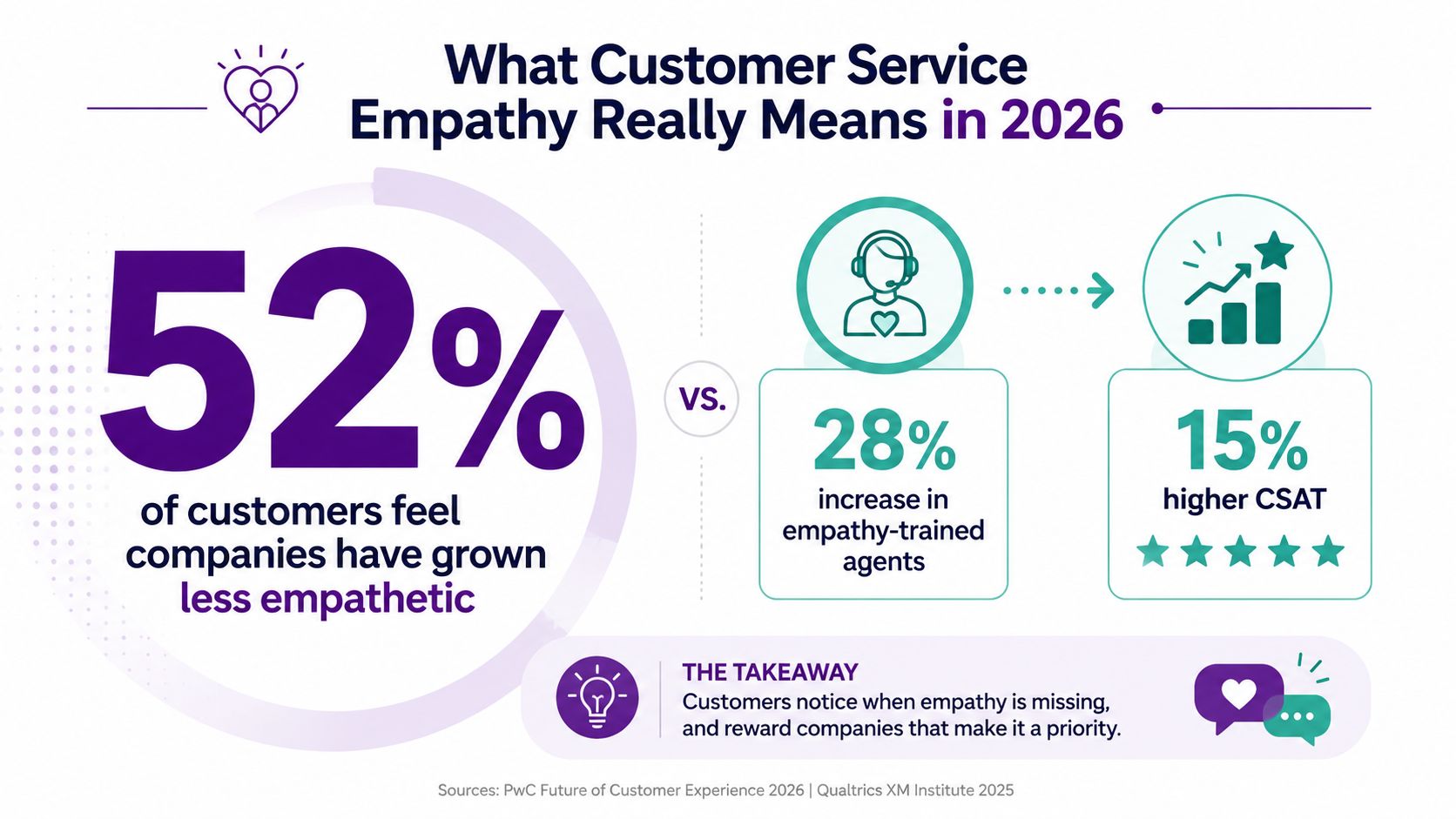
Only 52% of consumers say they feel treated with empathy when they contact customer support, while 48% say companies still show a distinct lack of compassion, according to a 2023 survey of 5,000 adults across the United States, United Kingdom, Germany, Japan, Australia, and New Zealand (Wiley Online Library). That gap should change how contact centers think about customer service empathy. Empathy isn’t a poster on the wall or a phrase added to a script. It’s a set of observable behaviors that supervisors can coach, score, and connect to customer experience outcomes.
For bilingual nearshore teams, the challenge is sharper. Agents have to sound human across languages, cultures, channels, and regulated workflows without turning every call into a longer emotional conversation. The practical question isn’t whether empathy matters. It’s which type of empathy belongs on a particular call, when it should appear, and how a QA manager can verify that it happened.
What Customer Service Empathy Really Means in 2026
58% of customers in the U.S. and 40% in Japan recognized empathy in service interactions, a gap that shows how uneven support can feel across regions. The figures come from the same multi-country survey cited earlier, so this section does not repeat its source link. A separate Genesys report found that 71% of consumers believed service had become more personalized, while only 52% felt shown empathy when contacting support (Genesys). Personalization software can remember a name. It cannot confirm that an agent understood the problem.
Customer service empathy becomes useful only when supervisors can hear and score it. Treat it as an interaction skill that changes how an agent listens, diagnoses, responds, and closes, rather than as a personality trait or a line added to a script.
Empathy is a call behavior, not a slogan
Automation has raised the standard for human support. A customer may reach an agent after repeating the issue to a chatbot, selecting rigid menu options, or receiving a keyword-based reply. Another generic apology then sounds like more system behavior. The agent must show understanding through observable choices, without turning every call into a longer emotional conversation.
Supervisors can audit three mechanics:
- Attentive empathy shows presence through uninterrupted listening, a deliberate pause, and a confirmation that the agent heard the customer.
- Cognitive empathy shows understanding through an accurate summary, a clear view of the customer’s desired outcome, and the right next question.
- Affective empathy acknowledges the customer’s emotional experience with warmth that fits the situation.
These mechanics connect to different service outcomes. Attentive listening can strengthen early trust and first-response sentiment. Cognitive accuracy can reduce repeated explanations and support efficient resolution. Affective recognition can help a frustrated customer recover, but it can sound scripted if the agent uses the same phrase after every statement or before understanding the account.
Research on service interactions found 6.74 satisfaction for high-empathy participants compared with 6.01 for low-empathy participants, with a statistically significant difference (UCLA Anderson School of Management). That finding does not make emotional language appropriate for every queue. It supports a narrower operational point: interaction quality affects the customer experience, so QA should coach the behavior that produced it.
The audit standard
After reviewing a recorded call, a QA manager should answer four questions:
- Did the agent listen before solving?
- Did the agent identify the customer’s practical need accurately?
- Did the agent recognize emotion when it affected the interaction?
- Did the closing statement match the resolution?
Use connection over correction listening when coaching agents to stay curious instead of defensive. CallZent’s guide to empathy in customer service provides another service-focused reference.
Practical rule: If a supervisor cannot identify the exact words, pause, question, or summary that demonstrated empathy, the behavior is not defined well enough to coach.
The Three Mechanics of Empathy on Every Call
A QA analyst should not score empathy by asking whether an agent “sounded nice.” Warmth can help, but the audit must identify the agent’s observable behavior and the customer experience lever it influenced. This makes empathy measurable in coaching, rather than a value printed on a training slide.
Attentive empathy creates room for the real issue
Attentive empathy begins before the agent proposes a solution. The agent allows the customer to finish, acknowledges the reason for contact, and uses a short confirmation such as, “Let me make sure I have this right.” The measurable lever is first-response sentiment and conversational trust. Customers tend to provide clearer details when they are not rushed or dismissed.
QA can mark whether the agent avoided interruption, used a pause appropriately, and confirmed the contact before moving to account questions. Guidance on active listening in call centers can help supervisors turn this mechanic into repeatable call behavior.
Cognitive empathy reduces avoidable repetition
Cognitive empathy is perspective-taking expressed through accuracy. The agent summarizes the issue in the customer’s terms, confirms the desired outcome, and asks a clarifying question before diagnosing. The lever is resolution efficiency. A precise summary can reduce repeated explanations, incorrect transfers, and troubleshooting that does not address the actual problem.
The QA test is concrete: can a reviewer state the customer’s problem and requested outcome from the agent’s summary alone? If not, the agent may have been polite without demonstrating understanding.
Affective empathy supports emotional recovery
Affective empathy recognizes the feeling behind the issue. “I understand why that’s frustrating” may help during a delayed shipment or repeated service failure. It can sound performative on a collections call if the agent says it before understanding the account, or repeats the phrase after every customer statement.
A call-center study describes empathy as listening, selecting an appropriate response, and delivering it quickly enough to keep the call moving (SAGE Journals). That sequence matters in bilingual operations. Accurate translation does not automatically produce the right emotional register, timing, or level of directness.
| Mechanic | Observable Behavior | Sample Phrasing | CX Lever It Moves |
|---|---|---|---|
| Attentive | Pauses, avoids interruption, confirms contact | “I’m listening. Please finish explaining what happened.” | Initial sentiment and trust |
| Cognitive | Summarizes facts and asks a clarifying question | “So the charge appears twice, and you’ve already contacted us twice. Is that correct?” | Resolution clarity and repeat-contact risk |
| Affective | Names or validates emotion after diagnosis | “I can see why having to repeat this has been frustrating.” | Recovery sentiment and CSAT perception |
A bilingual example shows the sequence:
Customer: “I’ve explained this twice already. The same charge is still there.”
Cliente: “Ya expliqué esto dos veces. El mismo cargo todavía aparece.”
Agent, attentive: “I’m listening. Take a moment to finish, then I’ll review the account with you.”
Agente, atento: “Le estoy escuchando. Tómese un momento para terminar y después reviso la cuenta con usted.”
Agent, cognitive: “Let me confirm. You see two charges for the same transaction, and your previous contacts didn’t resolve it.”
Agente, cognitivo: “Permítame confirmar. Ve dos cargos por la misma transacción y sus contactos anteriores no resolvieron el problema.”
Agent, affective: “I understand why that’s frustrating, especially after having to contact us more than once.”
Agente, afectivo: “Entiendo por qué resulta frustrante, especialmente después de tener que contactarnos más de una vez.”
For calibration, attentive and cognitive behaviors belong on every call; affective empathy follows diagnosis when the emotional context calls for it. Supervisors can audit the sequence next week by marking the first listening behavior, the accuracy of the summary, and whether emotional recognition matched the customer’s situation.
Bilingual Scripts That Sound Human in English and Spanish
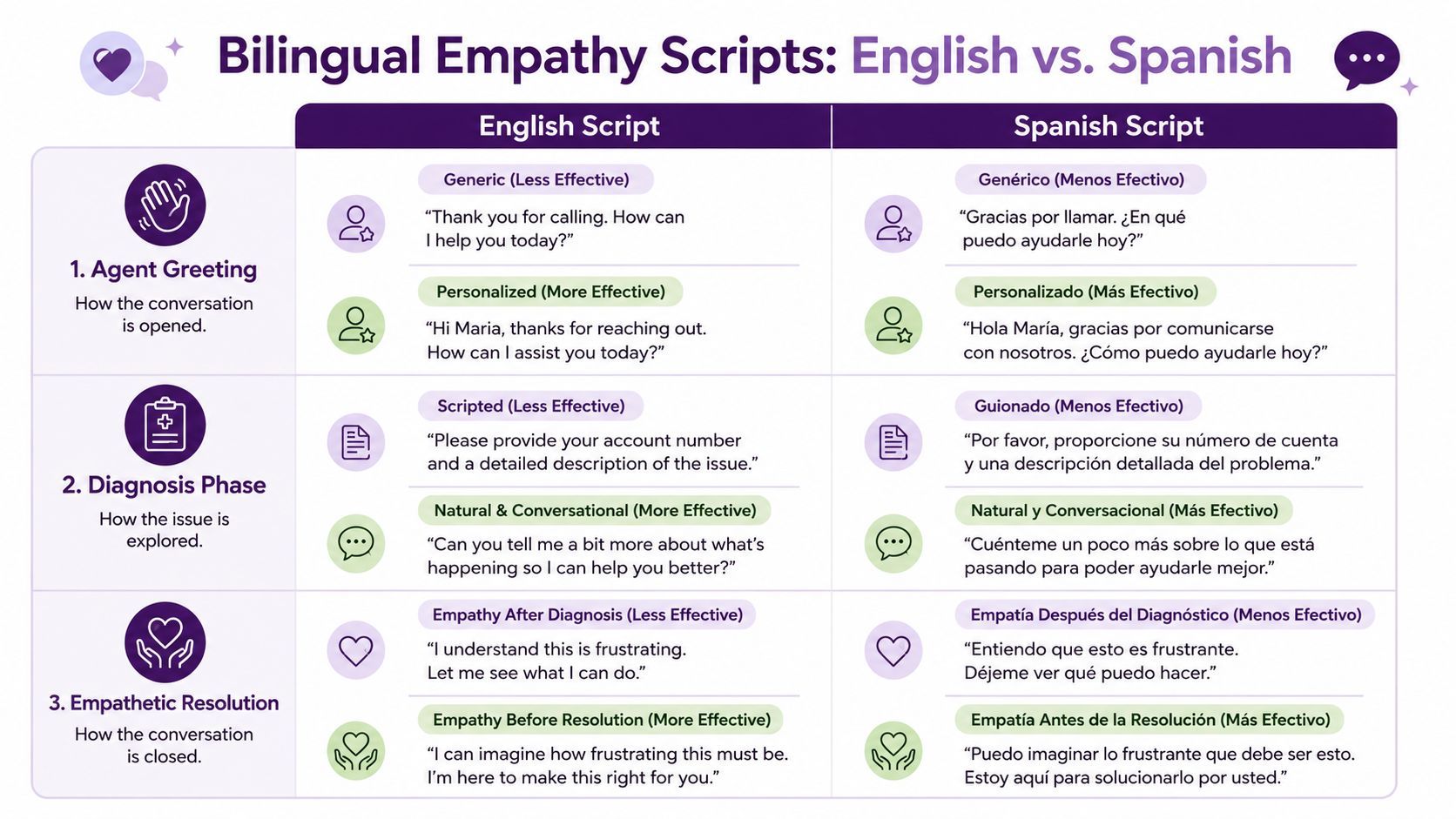
A double-charge complaint exposes weak empathy quickly. The customer has already spoken with two agents, believes the company has not listened, and may treat another scripted response as proof that the next contact will fail too. The solution lies in sequencing the conversation correctly: create space, establish the facts, then acknowledge the impact.
The scenario
The customer says one purchase produced two charges. They want the duplicate removed and do not want to retell the entire story. These three openings show how wording changes the call.
Robotic baseline
Agent: “Thank you for calling. I can help with billing. Please provide your account number.”
Agente: “Gracias por llamar. Puedo ayudarle con facturación. Proporcione su número de cuenta.”
Customer: “I already explained this to two people.”
Cliente: “Ya expliqué esto a dos personas.”
Agent: “I’m sorry for the inconvenience. Please provide your account number.”
Agente: “Lamento el inconveniente. Proporcione su número de cuenta.”
The language is polite, yet the agent has not recognized the customer’s repeated effort or stated what will happen differently.
Empathy too early
Agent: “I totally understand how upsetting this must be. I’m so sorry. We’ll fix it right away.”
Agente: “Entiendo totalmente lo molesto que debe ser. Lo siento mucho. Lo arreglaremos de inmediato.”
Customer: “Then why am I still seeing the charge?”
Cliente: “Entonces, ¿por qué todavía aparece el cargo?”
The agent promises an outcome before reviewing the account. If the transaction is pending, a duplicated authorization, or a posted charge, that promise can create another service failure and lower confidence in the explanation.
Diagnosed first
Agent: “I hear that you’ve already contacted us twice. Let me review the account and confirm whether this is a duplicate posted charge or a pending authorization.”
Agente: “Entiendo que ya se comunicó con nosotros dos veces. Permítame revisar la cuenta y confirmar si se trata de un cargo duplicado aplicado o de una autorización pendiente.”
Customer: “Yes, I just need someone to look at it.”
Cliente: “Sí, solo necesito que alguien lo revise.”
Agent: “I’ll compare the transaction details with you now. Once I confirm what happened, I’ll explain the exact next step. Having to repeat this has been frustrating, and I want to avoid making you start over again.”
Agente: “Ahora compararé con usted los detalles de la transacción. Cuando confirme qué ocurrió, le explicaré el siguiente paso exacto. Tener que repetir esto ha sido frustrante y quiero evitar que tenga que empezar de nuevo.”
The sequence gives supervisors observable checkpoints. The agent first creates room for the account of the problem, then confirms the transaction type, and finally connects the emotional acknowledgment to a specific event. A call center script for structured conversations can support that order without forcing identical wording on every customer.
Attentive empathy surfaces the actual issue behind the complaint
Literal translation creates its own risk. “I totally understand” may sound over-familiar or exaggerated to many Latin American customers, particularly in healthcare and finance. A direct, slightly formal register often communicates credibility more effectively:
- “I understand what happened” becomes “Entiendo lo que ocurrió.”
- “Let’s get this fixed right away” becomes “Revisemos el caso y confirmemos el siguiente paso.”
- “I know exactly how you feel” should usually be avoided because the agent cannot know that.
For the first 30 days, keep this station checklist visible:
- Listen fully: Do not interrupt the first explanation.
- Confirm facts: Repeat the issue and the desired outcome.
- Use precise Spanish: Prefer respectful, natural phrasing over literal translation.
- Name emotion selectively: Tie it to the customer’s statement or the service event.
- Promise only what you verified: Check the account or workflow before offering a resolution.
- Close specifically: State what was done and what happens next.
QA managers can score each item from the recording, while team leads can compare the checklist with repeat contacts and sentiment comments. That makes bilingual empathy a call behavior to coach, rather than a collection of sympathetic phrases agents memorize.
Training Modules and Roleplays That Stick
A single empathy lecture rarely changes call behavior. Agents need short practice cycles, realistic queue scenarios, and feedback tied to one behavior they can repeat on the next call. Keep each session narrow. Broad discussions about personality sound useful in training rooms but give team leads little evidence to coach on the floor. A customer service training program framework can help organize these exercises with wider communication and conflict-resolution work.
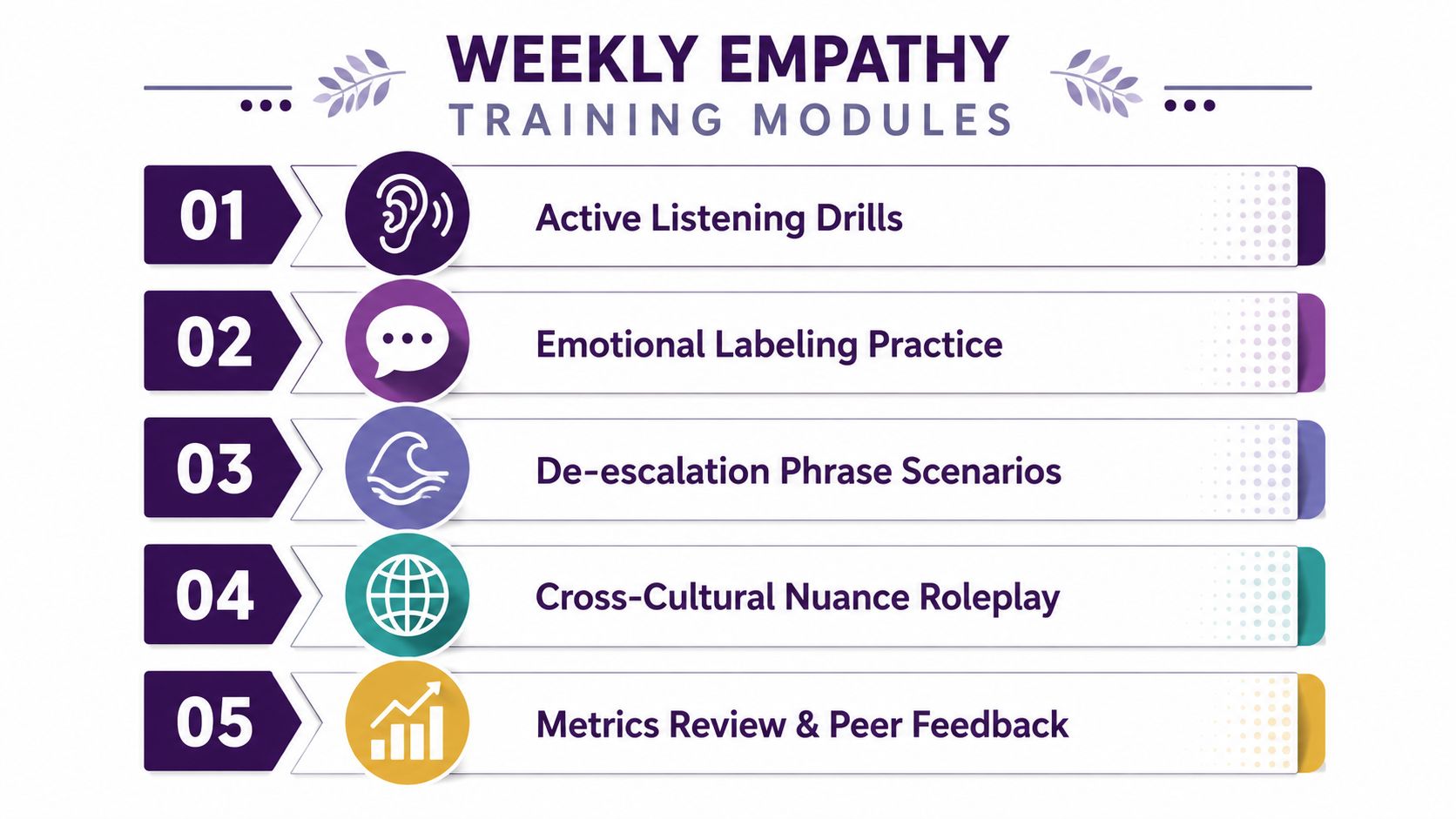
A five-module practice cycle
Module 1, openings that signal attention. Review greetings, interruption control, and confirmation language. Roleplay a late-shipment escalation in which the customer starts speaking before the greeting ends. The observer records whether the agent creates space before account verification.
Module 2, emotion labeling and reflection. Separate the practical issue from the emotional cue. Use a pharmacy prior-authorization denial. The agent first summarizes the denial accurately, then acknowledges the frustration. That order protects the cognitive empathy lever, because reassurance without a correct diagnosis can lower confidence and sentiment.
Module 3, English and Spanish adaptation. Run the same scenario in both languages and compare register, clarity, and respectful distance. Do not reward literal translation. Score whether the phrasing sounds natural for the intended customer and preserves the same resolution path.
Module 4, regulated-industry judgment. Use a healthcare denial and a credit card fraud hold. Agents practice explaining boundaries without implying that policy can be bypassed or promising an immediate release. In finance, “I’ll review what the account allows” keeps the commitment tied to a verified workflow.
Module 5, recovery after a miss. Give the agent an interruption, an inaccurate summary, or an unsuitable phrase to repair. The required sequence is simple: acknowledge the miss, restate the problem, and continue without defensiveness. This tests affective control under pressure, not polished language in isolation.
Facilitation that produces usable evidence
Time the silence after the agent’s reflection. A pause that is too short can sound like interruption, while excessive silence can make the customer question whether the call dropped. Score each roleplay on three auditable behaviors: accurate listening, correct diagnosis, and an appropriate emotional response. These map to attentive, cognitive, and affective empathy, and they give QA managers observable links to CSAT or sentiment comments.
Capture one short recording snippet per agent for the coaching library. Choose a behavior another agent can copy, not a classroom speech that sounds impressive but fails in a live queue. Team leads can compare roleplay scores with repeat contacts and sentiment feedback during the first training cycle.
Coaching cue: Ask, “What did the customer need to hear before the solution?” The answer exposes whether the agent listened, diagnosed the issue, and addressed the emotional cue in the right order.
Coaching Frameworks and QA Scorecards for Empathy
“Show more empathy” is not an actionable coaching note. It gives agents no observable behavior to change and lets QA analysts score the same call differently. A usable scorecard points to moments in the recording and connects each behavior with a customer outcome.
Use four rows:
- Pause before problem-solving. The agent lets the customer finish the relevant explanation before proposing a fix.
- Specific emotional reflection. The agent links the emotion to a stated experience, such as repeated contact, a missed delivery, or financial uncertainty.
- Clarifying question before diagnosis. The agent checks the missing fact instead of assuming the cause.
- Resolution acknowledgment. The agent names what was completed and what remains open.
| Observable Behavior | Scoring Criteria (0-3) | Coaching Trigger |
|---|---|---|
| Deliberate pause | 0, interrupts; 1, pauses inconsistently; 2, usually allows completion; 3, consistently gives space and responds naturally | Agent begins solving before the issue is fully stated |
| Specific reflection | 0, ignores emotion; 1, uses generic language; 2, acknowledges a clear cue; 3, reflects the customer’s specific experience without exaggeration | Repeated “I’m sorry” phrases with no connection to the call |
| Clarifying question | 0, assumes; 1, asks after an incorrect diagnosis; 2, asks a useful question; 3, asks concise questions that prevent repetition | Customer has to correct the agent’s understanding |
| Resolution acknowledgment | 0, closes abruptly; 1, gives vague next steps; 2, explains the outcome; 3, confirms the outcome and customer’s next action | Customer asks what happens next after the closing |
The scale matters less than calibration. Team leads should review calls side by side each week and run a monthly peer calibration with the same recordings. Tag every miss by mechanic, such as attentive-missed, cognitive-unclear, or affective-overused. These tags convert a broad coaching concern into an individual plan and show whether the issue is attentive, cognitive, or affective empathy.
A QA manager can audit this framework by comparing scores with CSAT comments, repeat contacts, and sentiment feedback. The comparison should guide coaching, not turn empathy into a scripted performance. A pause may improve attentive listening, while a precise question can protect both sentiment and resolution quality.
QA software supports the workflow, but it cannot decide whether a phrase fit the moment. Leaders still need to hear context, especially in healthcare, finance, telecom, and collections. CallZent’s QA contact center resource offers a reference for connecting quality review with operational coaching.
Metrics That Track Empathy Without Killing AHT
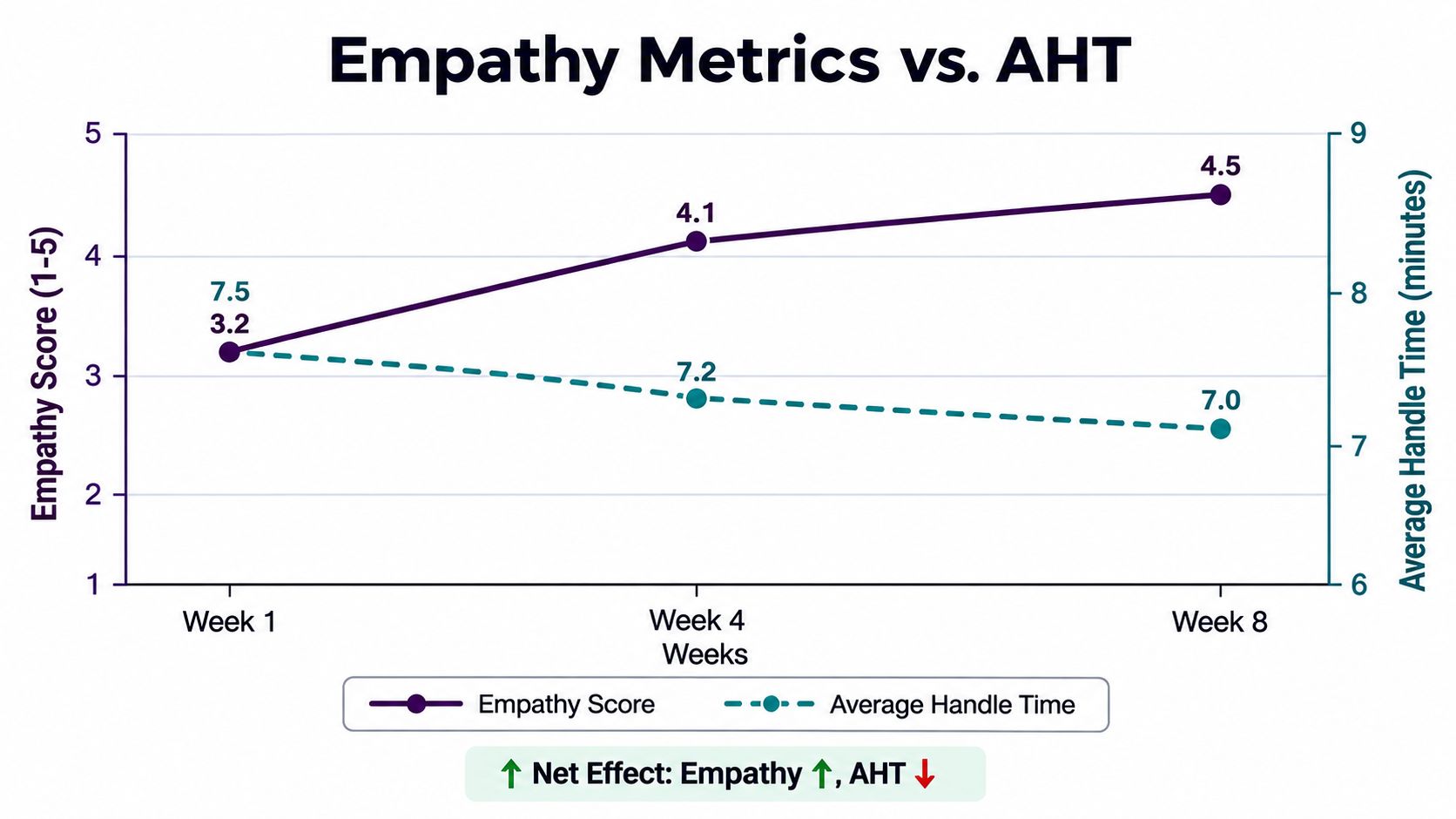
Empathy measurement fails when leaders reward warmth or speed in isolation. Agents then rush reflective statements to protect AHT, or perform emotional language without resolving the customer’s problem. Tie each mechanic to a separate operational signal so a QA manager can review the behavior and its effect.
- Attentive empathy: Review the change in sentiment after the agent’s first response and how silence is used. The audit question is whether the customer explains the issue more clearly, not whether the agent repeats a preferred phrase.
- Cognitive empathy: Compare first-contact resolution on calls flagged for empathy risk with repeat contacts within 72 hours. Accurate understanding should reduce the need for the customer to start over.
- Affective empathy: Score whether the agent identifies the relevant emotion, then compare CSAT on recovered interactions. Labeling every customer as frustrated creates noise and can sound performative.
Speed requires context. Research has linked empathy with satisfaction and loyalty, while call-center findings warn that unnecessary emotional mirroring can slow resolution (UCLA Anderson School of Management). Keep AHT separate from the empathy score during calibration, then check whether the behavior improves clarity and resolution. Empathy should make the next action easier to understand, not add a longer script to every call.
Escalate these patterns to calibration
- Negative sentiment with high CSAT: The agent may use language that feels wrong in context even though the outcome meets the customer’s need.
- Positive sentiment with low CSAT: Warmth may be masking a missed diagnosis, unclear explanation, or incomplete resolution.
- AHT dropping by more than 15 seconds week over week: Review recordings for skipped reflection, clarification, or closing acknowledgment before crediting the change as efficiency.
Do not set one empathy target for every queue. A fraud hold, pharmacy denial, technical outage, and late shipment call require different responses and different boundaries. Use the metrics to select calls for review, then let calibrated human judgment determine whether the behavior helped.
Keep the audit practical. Compare mechanic scores with CSAT comments, repeat contacts, and sentiment feedback, and tag misses such as attentive-missed, cognitive-unclear, or affective-overused. QA software can organize that workflow, but leaders still need context, particularly in healthcare, finance, telecom, and collections. CallZent’s QA contact center resource provides a reference for connecting quality review with operational coaching.
A 30-60-90 Rollout Roadmap for Contact Centers
A rollout should start with queue evidence, not a vendor’s workshop definition of empathy. This cadence helps operations leaders set a baseline, test coaching, and scale the behaviors without losing consistency between English and Spanish support.
Days 1 through 30 establish the baseline
Pull 200 random calls per queue and score attentive, cognitive, and affective behaviors separately. Break results out by line of business, language, channel, and call reason. Publish a heatmap that shows where agents interrupt, misdiagnose the issue, use emotional language too heavily, or end the call without naming the resolution.
Do not coach the entire operation from the first sample. Identify the two most frequent misses in each queue, then select recordings for calibration. Technical support may need stronger diagnosis. Healthcare may need clearer acknowledgment of denials and policy limits. Link each miss to CSAT comments, repeat contacts, or sentiment feedback so the baseline reflects customer impact, not only QA opinion.
Days 31 through 60 test the coaching model
Give two agents per team weekly call reviews using the four-behavior checklist. Keep a control group on the existing QA process, allowing leaders to compare operational movement without assigning every change to the pilot. Build roleplays from real queue patterns, including a credit card fraud hold, a pharmacy prior-authorization denial, and a late-shipment escalation.
Track changes in the recording, not only in the score. If agents add longer empathy statements while customers repeat information more often, the coaching is increasing talk time without improving the interaction. Rework the prompt, practice the diagnosis, and check whether cognitive clarity improves before expanding the module.
Days 61 through 90 scale with controls
Update English and Spanish scripts from pilot findings, then hold calibration across team leads. Review comparable calls in both languages when possible. A phrase that sounds natural in English may sound overly familiar or vague in Spanish.
Pause and recalibrate when:
- AHT rises while repeat contact also rises.
- Agents use emotional language before establishing the facts.
- QA scores diverge sharply between team leads.
- Regulated-industry agents promise outcomes that policy or workflow cannot support.
- Customers receive different emotional treatment for equivalent issues across languages.
The rollout succeeds when empathy becomes part of routine QA, coaching, and workforce discussions. Agents should not memorize more phrases. The operating standard is simple: listen accurately, diagnose carefully, respond to emotion when it helps, and close with a clear next step.
CallZent provides bilingual nearshore customer support and BPO services from Tijuana, including training in active listening, emotional intelligence, and conflict resolution. Healthcare, finance, telecom, retail, and e-commerce operations can visit CallZent to discuss a rollout tied to QA and resolution performance.
Bilingual Customer Support Teams in Mexico
Turn Empathy Into Measurable Service Quality
CallZent provides bilingual nearshore customer support and BPO services with training in active listening, accurate diagnosis, emotional intelligence, conflict resolution, and clear escalation. Build a program connected to QA, customer satisfaction, and resolution performance.
Request a Custom Quote