
Customer Service Quality & Bilingual Operations
Customer Service QA: Scorecards, Calibration, and Better Outcomes
Build a quality assurance program that connects fair scoring, bilingual reviews, targeted coaching, and customer outcomes.
TL;DR — Quick Takeaways
- Score accuracy, ownership, and safeguards alongside communication quality.
- A correct specialist escalation can be good service while final resolution remains pending.
- Separate routine samples from targeted risk reviews and report coverage limits.
- Calibrate individual criteria and adjudicate critical errors, not just total scores.
- Assign corrective actions and recheck both agent behavior and shared process defects.
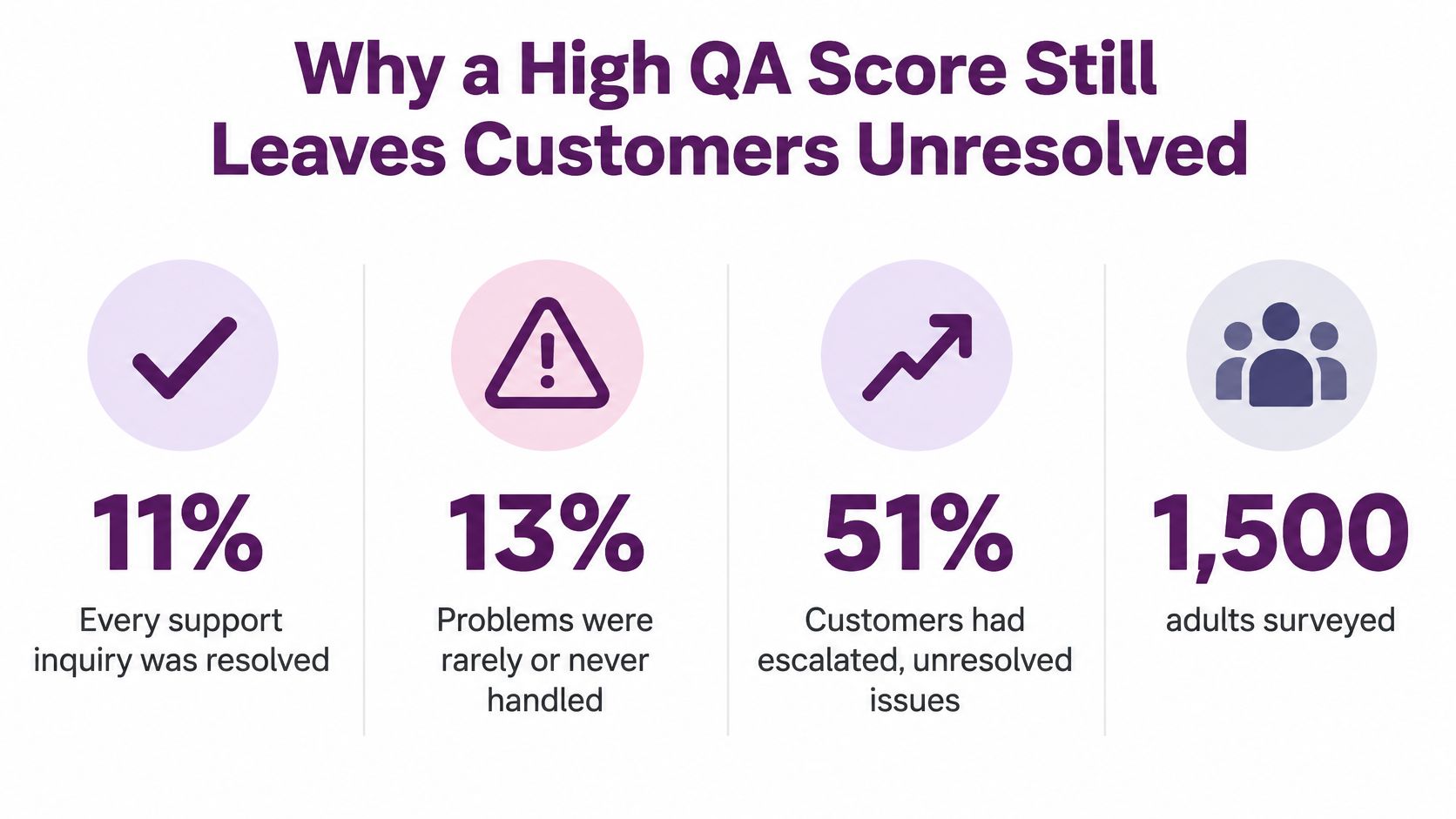
What is a 95% QA score proving if the customer must call back tomorrow about the same unresolved problem? A form can reward a warm greeting, a polished closing, and quick handling while missing an incorrect refund, an incomplete booking, or a promise nobody owns.
Strong customer service QA connects interaction quality with the customer’s outcome. It asks whether the agent completed the authorized work accurately, protected information, and established a dependable next step when resolution required another team.
Why a High QA Score Can Hide an Unresolved Issue
Customer service quality assurance is a structured process for reviewing interactions, identifying defects, calibrating judgments, coaching behavior, and checking whether improvements hold. Courtesy belongs in that process, but it cannot substitute for accuracy or ownership.
A closed ticket does not prove a solved problem. Likewise, an escalation does not automatically prove poor service. A security concern, restricted account change, or clinical question may need a specialist. QA should assess whether the escalation was appropriate, accepted by the right owner, and explained clearly.
Separate Agent-Controlled Errors From Process Failures
If the knowledge base contains an incorrect policy and an agent follows it, record the customer-impacting defect and assign the content correction to its owner. Evaluate the agent against what they could reasonably know and control. If an approved verification step was available but skipped, coaching or another appropriate response may be needed.
Useful cause categories include knowledge, execution, judgment, policy, product, tools, and routing. Several categories can contribute to one failure. Repeated errors across a team deserve investigation of the shared process before managers assume every agent needs the same coaching.
For a call center in Tijuana serving English- and Spanish-speaking customers, compare quality by language as well as channel and issue type. Location and bilingual staffing do not establish equivalent outcomes without evidence.
A Customer Service QA Scorecard Built Around Resolution
The following illustrative 100-point scorecard gives resolution and accuracy the largest combined weight. It is a starting framework, not an industry standard or a published CallZent policy. Adjust criteria, permissions, and critical-error rules to your program.
| Criterion | Points | Evidence of quality | Potential critical issue |
|---|---|---|---|
| Resolution and ownership | 30 | Authorized outcome verified, or appropriate handoff accepted with an owner and update commitment | Materially harmful false promise or abandonment of an urgent escalation |
| Accuracy and reliability | 20 | Information and actions match the approved source and scope | Unauthorized instruction or materially harmful misinformation |
| Clarity and empathy | 15 | Understandable explanation, respectful tone, accurate language handling | Abusive or discriminatory treatment |
| Responsiveness | 15 | Agreed acknowledgment, update, and escalation targets followed | Urgent delay meeting a defined safety or risk trigger |
| Compliance and data handling | 15 | Applicable verification, disclosures, access, and secure data workflows followed | Defined material privacy, security, or payment-handling violation |
| Process and documentation | 5 | Notes, disposition, commitments, and next actions support continuity | Missing or false documentation that meets a defined critical-risk rule |
| Total | 100 | Sum earned points under documented applicability rules | Any confirmed critical error triggers the agreed fail status |
Define What Each Row Means
Resolution and ownership: Confirm what happened rather than promising an outcome the agent cannot verify. For a booking change, check the saved date, time zone, customer details, and confirmation. For a specialist case, document acceptance, the next action, and the update commitment. Do not label the underlying case resolved merely because the transfer succeeded.
Accuracy and reliability: The policy, amount, booking, or troubleshooting instruction must match the approved source. An agent who is uncertain should verify the answer or use the correct escalation route instead of guessing.
Clarity and empathy: Evaluate whether the explanation was understandable, respectful, and responsive to the concern. A language switch should preserve meaning. Accent or regional phrasing alone is not a defect.
Responsiveness: Assess the channel’s agreed response and follow-through commitments. Separate queue delays outside an agent’s control from avoidable delays during their work. Short handle time does not compensate for an incomplete answer.
Compliance and documentation: Score applicable requirements explicitly. A five-point documentation row must not make a serious data-handling failure seem minor; cross-cutting critical rules can override any row’s weight.
Keep Critical Errors Separate From the Weighted Score
Define critical errors before scoring. Record the evidence, category, severity, immediate action, and accountable owner. A confirmed critical error can produce an overall fail even when the numerical score is high. Keep the underlying score and the fail flag visible so the reporting remains explainable.
Specify whether ordinary items use full, partial, or zero credit. For mandatory controls, define applicability and whether a miss is noncritical or critical. If an item is genuinely not applicable, use a documented normalization rule and show the excluded weight. Review changing exclusion rates so the total cannot improve simply by removing difficult criteria.
Escalate suspected safety, privacy, or security incidents immediately through the approved response process. A QA finding is not itself a final legal determination, and incident containment should not wait for a routine calibration meeting.
One Reservation Example, Two Outcomes
In a hypothetical booking change, the agent verifies the request, checks availability, explains the correct policy, saves the new time, and confirms the update. Review the actual record and communication before awarding outcome points.
If a change needs supervisor approval, an accepted handoff with complete context may be excellent interaction handling while final resolution remains pending. By contrast, an unexplained transfer with no receiving owner creates avoidable customer effort. Connect QA with how you measure first call resolution, while keeping agent behavior and case outcomes distinct.
Sample Interactions to Find Problems, Not Just Produce Scores
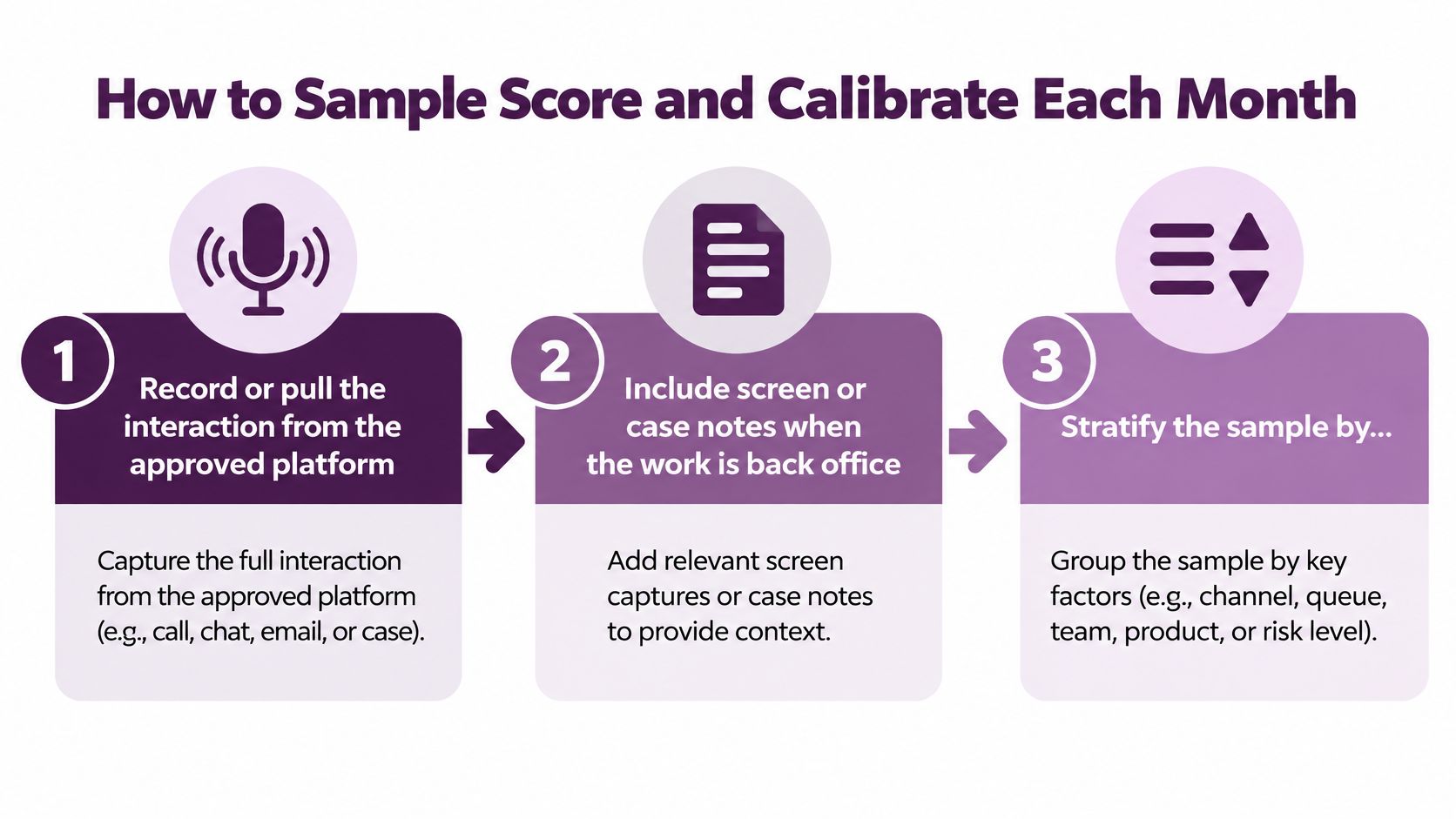
A useful sampling plan covers agents, transaction types, languages, channels, shifts, and meaningful risk areas. Start with the questions you need to answer: individual coaching, team defect trends, or an estimate of population quality. Those purposes may require different selection methods and sample sizes.
- Define the sampling frame. Identify eligible interactions and approved access to recordings, transcripts, screens, and case notes.
- Stratify important groups. Cover language, channel, transaction type, and other relevant differences.
- Select a routine sample. Use random selection within defined groups where practical.
- Add targeted reviews. Review complaints, alerts, repeat contacts, and unusual cases as a separately identified set.
- Follow the case. Check related actions and outcomes available within the observation window.
- Report coverage and limits. Show sample counts, eligibility, exclusions, and unresolved cases.
Use Benchmarks With Their Date and Scope
The COPC 2022 quality assurance report discusses ongoing agent monitoring, coverage across transaction types, and quantitative calibration against a reference at the attribute level. It describes version 7.0 expectations; it is historical context, not proof of current certification requirements or an adequate sample size for your program.
Choose frequency and sample size from risk, workload, desired precision, and available evidence. A handful of contacts can support a coaching conversation but usually cannot justify a precise claim about an individual’s overall performance. A monthly review cadence is an operating choice to validate, not a statistical guarantee.
| Control | Practical design | What to make visible |
|---|---|---|
| Agent and transaction coverage | Plan recurring coverage for all agents and relevant work types; add support for new agents or changed workflows | Who and what was reviewed, and which groups remain unobserved |
| Routine sample | Select across defined strata, using random selection where practical | Counts, selection rules, and any weighting used for aggregate results |
| Risk-based review | Prioritize flagged interactions under a documented risk and incident process | Separate targeted findings from routine population estimates |
| Calibration set | Have reviewers independently score the same interactions against an agreed reference | Item agreement, score differences, and unresolved critical decisions |
| Total-score tolerance | An illustrative tolerance might be within 5 percentage points on a 100-point form | The exact calculation; a matching total can still hide item disagreement |
| Critical-item calibration | Adjudicate every critical disagreement and correct its cause | Agreement by critical item, reference decision, and follow-up |
| Review frequency | Set a regular cadence and increase it for change, new reviewers, or risk signals | Attendance, completed actions, and whether disagreements recur |
Do Not Mix Coaching Samples With Population Claims
If a supervisor deliberately selects the most difficult calls, that sample is valuable for learning but is not an unbiased estimate of all work. Report it separately from routine sampling. If minority-language or high-risk groups are oversampled, use appropriate weighting for an overall estimate or report the groups separately.
Match routine language coverage to the operation while adding enough cases to examine smaller groups. Review flagged high-risk cases promptly, but do not assume keyword flags detect every risky interaction. Test the detection process and periodically review unflagged work as well.
Calibrate Reviewers Before Their Scores Drive Decisions
Calibration asks whether reviewers apply the same definitions to the same evidence. Two reviewers can assign the same total while disagreeing on important items. Compare item-level decisions, critical classifications, applicability, and total-score differences.
Have reviewers score independently before discussing results. Resolve differences against a maintained reference with a named adjudicator. If the policy or example is ambiguous, correct the guidance and record its effective date rather than rewarding whichever reviewer speaks most confidently.
Use an agreed tolerance for total scores and an explicit agreement measure for categorical items. A “5% variance” target is incomplete without a formula; five percentage points on a 100-point scale is clearer. Critical disagreements require adjudication even when the total is within tolerance.
Give agents access to the evidence and a practical appeal route. Preserve score versions and the reason for changes. Reliable calibration supports fair coaching and prevents employees from having to adapt to each reviewer’s personal preferences.
Turn QA Findings Into Coaching and Process Fixes
A score of 84 does not tell a supervisor what to improve. “The new appointment time was not confirmed in three reviewed changes” identifies a behavior that can be examined, practiced, and checked.

The Five-Step Customer Service QA Coaching Loop
- Identify the cause. Separate knowledge, execution, judgment, and shared process or system issues.
- Review the evidence. Use the relevant interaction and written criterion, with sensitive information protected.
- Practice an observable action. Explain what should happen on the next similar contact and confirm understanding.
- Assign a recheck. Name an owner, due date, comparable case type, and success measure.
- Correct shared defects. Route policy, knowledge, tooling, or workflow changes to the responsible team.
Recheck timing should reflect the severity and the next opportunity to observe the work. For a critical issue, contain the risk immediately and validate remediation before restoring affected permissions when required. A seven-day coaching follow-up, if chosen, is not permission to leave an incident unaddressed for a week.
Two Similar Scores Can Need Different Fixes
Suppose Spanish billing explanations repeatedly fail because the approved fee wording exists only in English. Assign a reviewed bilingual version to the content owner, align both versions, and recheck relevant calls. The KCS v6 Practices Guide provides a useful framework for capturing, reusing, and improving support knowledge.
If one agent skips an available confirmation step, investigate training, workload, tool usability, and understanding before deciding the cause. Coach the specific behavior where appropriate and review comparable future contacts. Our guide to agent training for the modern call center helps connect preparation with daily execution.
A QA finding becomes useful when someone owns the correction and checks whether the defect returns.
Track the defect rate in comparable rechecks, relevant repeat contacts, completion of shared fixes, and any unintended effects. A small follow-up sample can show examples of improvement without establishing a reliable population-wide decrease.
Bilingual, Payment, and Channel Checks Worth Scoring
Keep the core quality expectations consistent while adapting evidence to the channel. Voice includes spoken explanations and hold handling. Chat includes written clarity and concurrent workload. Back-office work requires evidence that the authorized transaction was completed accurately and the next team can act.
| Checkpoint | Voice | Chat or digital | Back office |
|---|---|---|---|
| English-Spanish alignment | Equivalent approved policy and natural explanation | Equivalent written guidance and language continuity | Clear language preference and usable case context |
| Acknowledgment and updates | Agreed answer, hold, callback, and escalation rules | Channel-specific response and follow-up commitments | Queue age, due dates, and exception ownership |
| Sensitive information | Approved verification and recording safeguards | Approved collection fields and transcript controls | Necessary data in authorized systems with appropriate access |
| Payment workflow | Prevent sensitive authentication data from entering recordings where possible | Use approved secure payment channels | Keep prohibited authentication data out of notes and exports |
| Automation handoff | Preserve context and route beyond-scope matters to qualified staff | Check automated promises, escalation access, and required disclosures | Validate consequential changes under approved authority |
| Outcome evidence | Verify completed action or accepted next step | Check thread, system action, and follow-through | Verify the transaction and correct disposition, not closure alone |
Evaluate Meaning, Not Accent
Use matched scenarios in English and Spanish with the same intent, policy, and authorized outcome. Reviewers need the language competence to assess the interaction itself. A translated summary alone may miss tone or an inaccurate explanation.
Record whether a language issue comes from agent behavior, approved content, routing, or translation support. Score agent-controlled inaccuracies against documented expectations, while assigning content defects to the proper owner. Do not penalize harmless accent, dialect, or accurate code-switching. Our bilingual customer service guide explains additional operating considerations.
Protect Payment Data Through the Actual Workflow
PCI SSC guidance on audio recordings explains that sensitive authentication data, including card validation codes, must not be stored after authorization, even when encrypted. Prevent capture wherever possible and use the approved response process if a control fails.
Test recording suppression or redaction, transcripts, screen capture, notes, exports, and connected tools. Pausing audio alone does not establish that every copy is protected. Cardholder data and sensitive authentication data have different requirements; the responsible security team should define the program’s controls and assessment scope.
Review Automation and Human Handoffs Together
Sample automated interactions as well as the human segment. Check policy accuracy, unsupported promises, language continuity, access to a person, and whether the receiving agent gets usable context. A well-handled human call does not erase a harmful automated instruction earlier in the journey.
Consequential or restricted decisions need the authority and qualifications required by the workflow. Administrative healthcare agents should route clinical questions to qualified staff. AI flags and human QA do not replace the approved clinical, legal, security, or other specialist process.
Measure Customer Outcomes Alongside QA
- First-contact resolution: Eligible issues resolved during the first contact under documented rules, with an agreed same-issue repeat window. Seven days may be an illustrative window, not a universal definition.
- Repeat-contact rate: The defined share of customers or cases returning about the same issue within the observation period.
- Reopen rate: Closed cases reopened within the documented window, using consistent eligibility rules.
- Escalation quality: Appropriate routing, complete context, receiving-owner acceptance, and fulfilled update commitments.
- Open-case age: Unresolved work by priority and owner, so resolved-only reporting does not hide the waiting.
Keep QA behavior scores, critical-error results, outcomes, and efficiency visible separately. Define denominators and cohort maturity before comparing languages or teams. A low repeat-contact rate is not sufficient evidence of success if customers gave up or could not reach support again.
Launch a Focused QA Pilot With Clear Ownership
Start with a defined queue and an agreed scope. An illustrative first-month plan is to document criteria and critical rules, independently score a calibration set, run routine and targeted reviews, then coach and recheck selected defects. Do not force a four-week schedule when risk controls or workflow readiness require a different sequence.
When discussing a program with CallZent, define language coverage, reviewer competence, monitoring permissions, secure access, training, coaching time, reporting, and incident responsibilities. Compare proposals for the same scope rather than assuming QA is included in every agent rate.
Bring your current form, interaction mix, recurring complaints, repeat-contact definitions, and sensitive-data constraints. Agree on what the pilot should demonstrate and which findings would justify a change. Expand once the workflow, controls, and review capacity are ready, with material risks addressed and enough evidence to judge the next step.
Frequently Asked Questions
What is customer service QA?
Customer service quality assurance is a structured process for reviewing interactions, identifying defects, calibrating scoring, coaching behavior, and checking improvements. It should connect agent actions with accuracy, ownership, safeguards, and customer outcomes rather than measure courtesy alone.
What should a customer service QA scorecard include?
Useful areas include resolution and ownership, accuracy, clarity and empathy, responsiveness, compliance and data handling, and documentation. Define evidence, applicability, points, and critical-error rules for the actual workflow. No single weighting fits every program.
Does an escalation automatically mean the agent failed QA?
No. Escalation can be correct when a request exceeds permissions or requires specialist expertise. Assess routing, context, receiving-owner acceptance, and customer communication. Keep successful handoff handling distinct from final resolution of the case.
How many interactions should QA review per agent?
Choose sample size and frequency based on risk, transaction mix, purpose, and desired precision. Small coaching samples do not reliably estimate an agent’s overall performance. Cover relevant languages and channels, and identify targeted reviews separately from routine samples.
What is QA calibration?
Calibration checks whether reviewers apply the same criteria to the same evidence. Reviewers score independently, compare item decisions with an agreed reference, resolve disagreements, and update guidance. Matching total scores alone does not prove consistent judgments.
What counts as a critical QA failure?
A critical failure is a predefined material error that triggers an override under the program’s rules. Examples may involve serious misinformation, abusive treatment, or privacy, security, and payment-handling violations. Document evidence, adjudication, and immediate response responsibilities.
How should QA evaluate bilingual customer service?
Use equivalent English and Spanish scenarios, aligned policies, and reviewers who can assess the original language. Evaluate accuracy and understanding rather than accent. Distinguish agent-controlled errors from gaps in approved content, routing, or translation support.
How does QA relate to first-contact resolution?
QA evaluates interaction behavior and process quality, while first-contact resolution measures a defined outcome. Review both with repeat contacts, reopens, and open-case age. Set eligibility and a same-issue observation window before comparing results.
Can AI replace human quality reviewers?
Automation can flag interactions, suggest scores, and expand screening, but it needs validation against reliable human-reviewed evidence. Test language performance, false positives, missed risks, and drift. Preserve appropriate oversight, appeals, and specialist authority for consequential decisions.
How can a company start a QA program with CallZent?
Bring a defined queue, current scorecard, interaction mix, language needs, outcome definitions, and security constraints. Agree on review coverage, calibration, coaching, reporting, and incident ownership. Pilot the workflow and assess evidence before expanding its scope.
Bilingual Nearshore Support in Mexico
Build Customer Service QA Around Better Outcomes
Discuss your scorecard, English-Spanish coverage, review process, and coaching needs with CallZent. Define a pilot with clear ownership, practical safeguards, and measurable outcomes.