CALLZENT INSIGHTS / CUSTOMER EXPERIENCE
What Is Customer Support Services? A 2026 Guide.
Understand what customer support services include, how support channels work, which KPIs matter, where automation fits, and how to build a dependable bilingual support operation.
What happens after a customer clicks buy, and who takes responsibility when the automated answer doesn’t solve their problem?
Answering quickly is useful. Resolving the right issue, without exposing customer data or authorizing the wrong action, is what makes support dependable.
For a business owner asking “what is customer support services,” the practical answer goes beyond a call center. You’re designing a system of people, procedures, and tools that helps customers while controlling cost, effort, and risk.
THE FOUNDATION / 01
01
What Customer Support Services Actually Include
A shopper checks a tracking page because their delivery is late. When the carrier misses the promised window, they contact a live agent who checks the shipment, explains the options, and issues an authorized credit.
The tracking tool and the agent perform different jobs, but the business owns the entire outcome.
Definition
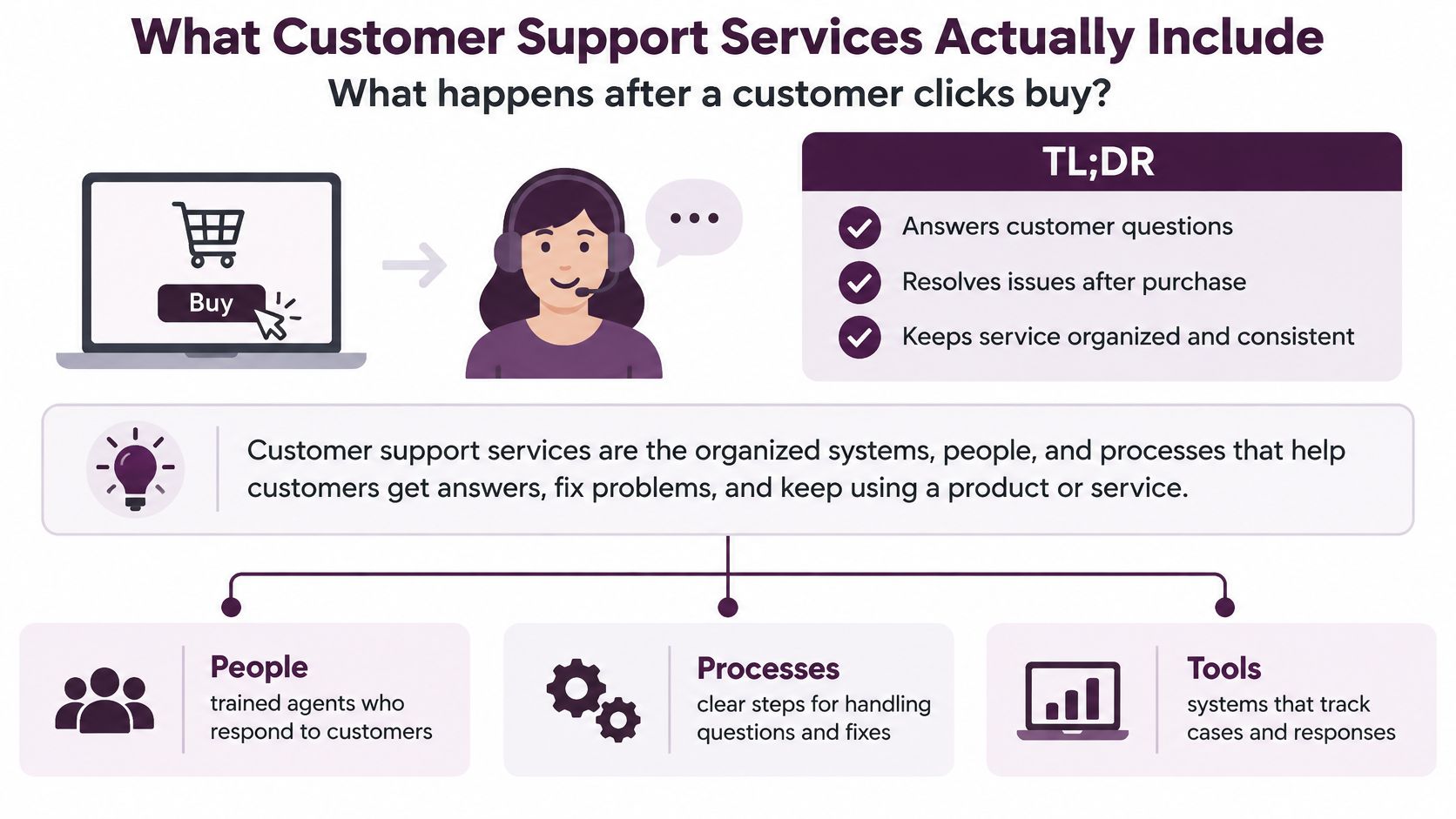
Customer support services are the organized systems, people, and processes that help customers get answers, fix problems, and keep using a product or service.
They include answering questions, resolving complaints, processing orders and account requests, explaining products, and troubleshooting technical problems.
Customers access that help through phone, email, chat, social media, and self-service portals. Behind those channels, someone must maintain accurate information, approve exceptions, schedule staff, and check whether agents followed the correct procedure.
A Dedicated Operation, Not an Occasional Task
The U.S. Bureau of Labor Statistics reported 2,858,710 customer service representative jobs in May 2023, with average pay of $20.92 per hour, or $43,520 annually. That scale helps explain why support requires dedicated training, quality monitoring, staffing, and customer-information systems.
Retail, insurance, healthcare, telecommunications, financial services, and government all rely on support. Their contact reasons differ, but each organization needs clear ownership from the initial question through the final action.
For a small retailer, that might mean giving an agent permission to correct an address while requiring supervisor approval for an exceptional refund. For public social messages, resources such as Exerta’s support for automated social replies can help inform the automated-response layer. Account-specific issues should still move into an authenticated, private workflow.
Apply this test to any team: can the customer reach an authorized person who can complete the next necessary action and confirm what happens afterward?
Support is measured by resolution, not by answered calls.
CLARIFYING THE TERMINOLOGY / 02
02
How Customer Support Differs From Customer Service and Technical Support
These terms overlap because the same employee may perform all of them during a conversation. A helpful distinction is to separate the need being resolved, the relationship being shaped, and the specialist knowledge required.
Customer support addresses a question, complaint, order change, or fault. Customer service covers the broader relationship, including greetings, sales conversations, loyalty, and how the company handles disappointment. Technical support is the specialist work of diagnosing and fixing product, software, or device problems.
Customer Support, Customer Service and Technical Support Compared
| Concept | Scope | Typical Focus | Example |
|---|---|---|---|
| Customer Support | Answering, resolving, and following up on any customer need | Resolution across the customer lifecycle | Order status, refund processing, account changes |
| Customer Service | Overall brand experience, including sales and loyalty | Relationship and satisfaction | Returning-buyer assistance and complaint handling |
| Technical Support | Diagnosing and fixing product, software, or device faults | Specialist troubleshooting and tickets | Router resets, login bugs, server-outage escalations |
Say a software company’s help desk restores account access and diagnoses a login bug. That’s technical support. If the customer then considers canceling, the agent’s patience, explanation, and handling of the request become part of the broader customer-service experience.
Buy the Outcome, Not the Department Label
When you purchase support, specify a resolution process: operating hours, supported channels, agent permissions, escalation owners, and reporting. When you design customer service, you also decide how customers should experience sales, renewals, complaints, and departures.
Our technical and customer support services bring these functions into an operational program, but the scope still needs to distinguish specialist troubleshooting from general assistance. Otherwise, a generalist may receive a technical case they can’t safely complete.
Many businesses put all these responsibilities under the same manager. That can work well when the team has clear boundaries and access to specialists; it fails when everyone owns the conversation but nobody owns the fix.
Buying test: Write the outcome before choosing the job title. “Restore access after verification” is a support requirement; “make cancellation respectful” is a service-design requirement.
Resolution target means support; feeling means service.
OPERATIONAL COVERAGE / 03
03
Service Types and the Channels They Run On
Inbound services begin when customers contact you. Phone answering, reservations, order processing, and help desks belong here. Outbound services begin when your team initiates contact, including appointment setting, lead generation, collections, and follow-up calls.
Outbound work needs its own consent rules, contact permissions, and call-timing controls. Don’t assume that permission to send an order confirmation also authorizes an unrelated sales campaign.
Separate the Work From the Channel
Technical teams manage troubleshooting, tickets, and specialist user assistance. Back-office teams handle the processing behind customer conversations, such as checking records, updating applications, or completing approved workflow steps.
Our capability areas illustrate how providers package this work:
Customer Support
Voice and digital customer interactions.
Sales and Lead Generation
Inbound and outbound prospect conversations.
Back-Office Services
Process support behind the customer-facing team.
Virtual Assistants
Dedicated talent for assigned responsibilities.
Technical and Help Desk
Specialized teams for troubleshooting and user assistance.
One Connected Process
A channel is the route into the work, not the service itself.
Support Channels and When Each One Works
| Channel | Best For | Watch For |
|---|---|---|
| Phone, Inbound and Outbound | Urgent, complex, or emotional issues | Wait times and abandoned calls |
| Detailed requests and documentation | Slow replies without a clear response target | |
| Live Chat | Quick questions during a purchase | Agents handling too many chats at once |
| Social Media | Public complaints and brand visibility | Move sensitive cases to a private channel quickly |
| Self-Service Portal | Order tracking, password resets, FAQs | Dead ends that send customers to agents without context |
| Video or Remote Assist | Setup and technical walkthroughs | Scheduling delays and identity checks |
Omnichannel support means customers can change channels without losing the case history. A customer who moves from chat to phone shouldn’t have to reconstruct the conversation. Our omnichannel customer support approach addresses that connected experience.
Operationally, the receiving agent needs the customer’s stated problem, completed checks, outstanding action, and case owner. They don’t need unrestricted access to every piece of information the company holds.
Match the channel to urgency and complexity. A standard password reset belongs in authenticated self-service; a disputed charge belongs with a person who can verify identity, examine the transaction, and explain the authorized next step.
MEASURING THE EXPERIENCE / 04
04
Core KPIs That Show Whether Support Works
A short call can still be an expensive call. If the agent ends the conversation before solving the problem, the customer calls again, another agent repeats the checks, and you pay for the unfinished work twice.
Use average handle time to understand workload and staffing pressure. Judge the operation through resolution, quality, customer feedback, and whether the right contacts reached a person with enough authority.
Reference Targets for Core Support KPIs
The U.S. General Services Administration’s contact-center guidance publishes high-performing reference targets that work as benchmarks for discussion rather than universal contractual requirements.
| Metric | Reference Target | What It Reveals |
|---|---|---|
| First-Contact Resolution | 90% of inquiries resolved on first contact | Whether the first agent actually solved the need |
| Customer-Disconnected Calls | Below 3% | Dropped or abandoned calls and queue pressure |
| Phone Answer Speed | 80% of calls answered within 20 seconds | Staffing against demand |
| Email and Letter Response | 98% answered within one day | Backlog health |
| Chat Response | 80% of chats answered within 30 seconds | Responsiveness on live channels |
| Customer Satisfaction | Set your own target and track by channel | Experience quality, not speed alone |
Define each measure before using it to assess a provider. First-contact resolution needs a clear rule for identifying reopened issues and related repeat contacts, or closing a ticket can look like completing the work.
Service level is usually expressed as the share of calls answered within a set number of seconds; a percentage reported without that threshold and the eligible call base leaves the result incomplete.
The KPI set should separate contacts that are safe to automate from contacts that need human approval. Status checks and simple questions can carry lighter controls. Payments, identity changes, medical matters, outages, fraud, and exceptions need tighter verification and a named owner.
Segment Before You Celebrate
Break results down by channel, issue complexity, language, customer type, and time period. Urgent healthcare, payment, outage, and fraud contacts should never disappear inside a favorable overall average.
HYPOTHETICAL EXAMPLE
92%
Calls meeting the clinic’s overall answer-speed target
40%
Urgent Monday-morning callers abandoning the queue
Both figures can coexist when the overall report conceals a concentrated staffing gap. These numbers are illustrative, not actual clinic results.
Checks to Add to Your Dashboard
- Transfer rate: Are customers reaching the right team initially?
- Reopen rate: Did the supposed fix hold?
- Escalation aging: How long have unresolved cases waited?
- Authentication adherence: Did agents verify identity correctly?
- Sensitive-data exposure: Did the agent see only what the case required?
- Quality-assurance scores: Were answers and actions accurate?
Our guide to KPIs in customer service supports this outcome-focused approach. Start with three measures, record a four-week baseline, and tighten targets only after understanding the workload.
One blended average can hide the worst failures.
PEOPLE + PROCESS + AUTOMATION / 05
05
Practices That Keep Customers Moving Toward a Fix
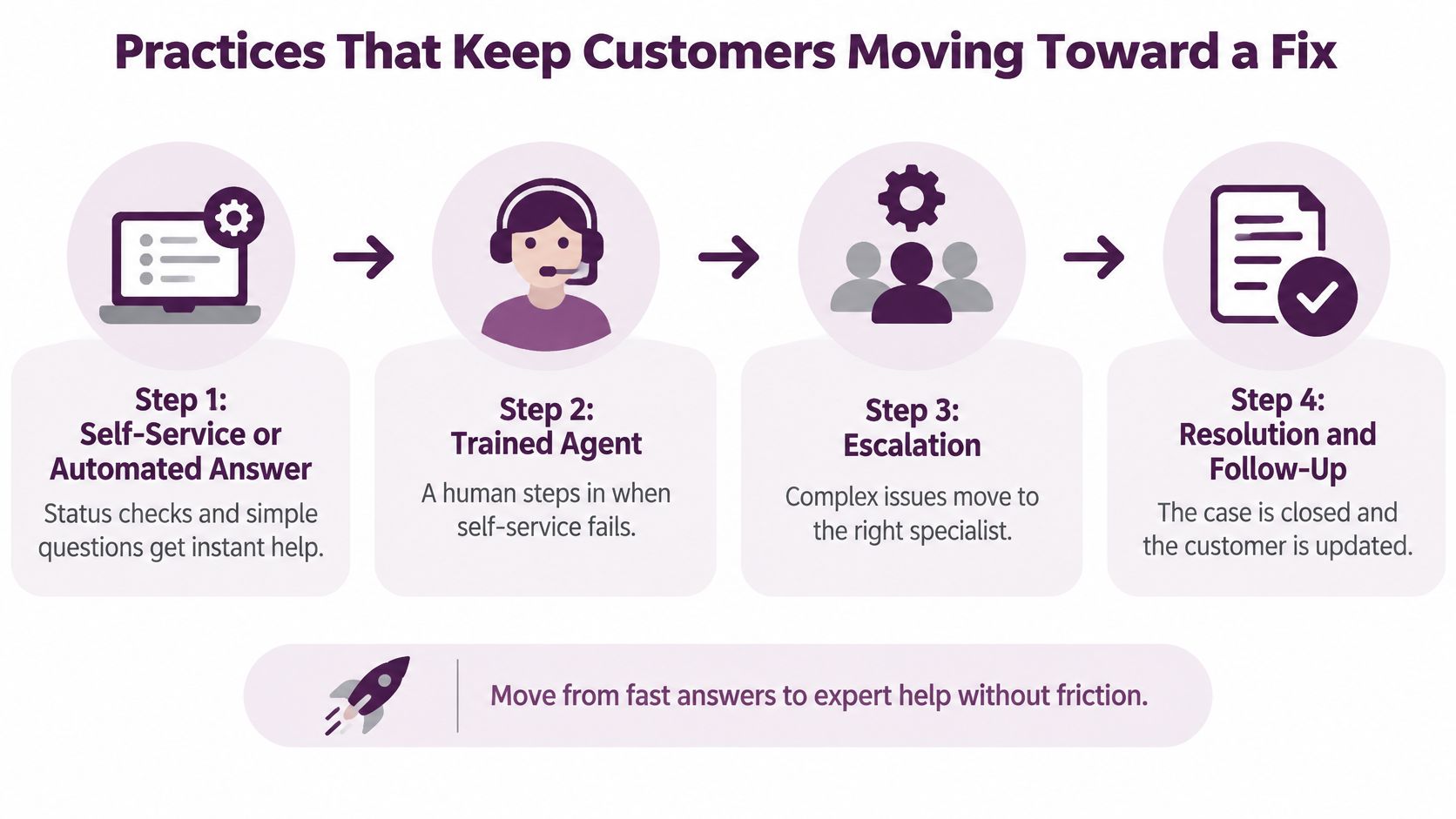
Build escalation around what customers need next, not around the departments on your organization chart. Each handoff should transfer the problem, relevant context, and responsibility for the next action.
A Practical Escalation Flow
Offer Self-Service or an Automated Answer
Use it for status checks and straightforward questions. Provide a visible route out when the answer doesn’t match the customer’s situation.
Connect a Trained Agent
Our Level 1 support provides frontline assistance and initial troubleshooting. The agent should receive the attempted steps so the customer doesn’t start over.
Escalate to a Specialist or Supervisor
Route disputes, exceptions, and high-impact cases to someone with the necessary authority. Name the owner and tell the customer when they’ll receive an update.
An industry summary citing Gartner research reported that only 14% of customer-service issues were fully resolved through self-service, including just 36% of issues customers described as “very simple.” Treat self-service as an entry route, not proof that customers no longer need agents.
Connect the Workflow and Control the Action
A retailer’s returns portal can check eligibility and generate a label. An agent should take over when the package is missing, the order contains several items, or the customer disputes the refund.
We develop scripts, knowledge resources, escalation paths, and interaction guidelines with clients to reflect their brand voice and workflows. Our bilingual teams integrate with existing CRM, help desk, communication, and customer support platforms, so approved context stays available during the handoff.
Proactive assistance can prevent a predictable problem from becoming an incoming complaint. Send an outage warning, appointment reminder, or suspicious-transaction alert when the underlying event warrants it, using approved contact permissions.
Automate information retrieval only within approved access boundaries. Keep consequential payments, health-related actions, account-access changes, and debt decisions human-approved, with an audit trail.
Operational Controls That Make Automation Useful
- Define escalation triggers: Include failed verification, disputes, safety concerns, and requests beyond agent authority.
- Track self-service completion: Confirm that customers finished the intended task.
- Track repeat contacts: Identify customers who return after an automated interaction.
- Review routes quarterly: Update broken answers, ownership gaps, and outdated permissions.
Automation should remove repetitive work, never the path to a person.
THE NEARSHORE ADVANTAGE / 06
06
Why Businesses Choose Nearshore Bilingual Support
Time-zone alignment matters when your operations manager needs to coach an agent, clarify an exception, or resolve a queue problem during the U.S. workday. A nearby team makes real-time collaboration practical without turning ordinary decisions into overnight exchanges.
Our Tijuana teams are designed for U.S. time-zone alignment and bilingual customer interactions. Programs can run in English only or English and Spanish, depending on the people you serve.

Buy Human Capability, Not Just Coverage
In its 2025 findings, Qualtrics reported that 74% of surveyed consumers preferred human channels for resolving an issue or receiving technical support. The business case for an outsourced team therefore depends on the quality of those conversations, not just having someone available.
Say a U.S. insurance broker needs bilingual renewal calls during U.S. business hours. A Tijuana team can coordinate with the broker’s staff while policyholders receive explanations in their preferred language. Licensed or otherwise restricted decisions still need the appropriate authorized owner.
Support roles should also offer a credible career path. Every departure requires recruiting, training, and rebuilding account knowledge, so evaluate coaching, preparation, and employee support rather than assuming a location guarantees retention.
Compare the Complete Operating Cost
INDICATIVE STARTING RATE
From $10/hour
Volume teams in Mexico start from $10 per hour. Technical support, overnight coverage, compliance requirements, and custom integrations may change the final rate. This is not a universal quote.
CallZent brings more than 20 years of leadership experience in customer operations and BPO to this model. For a broader location comparison, Hirespot’s explanation of why hire nearshore talent offers useful context; our bilingual customer service options address the language component.
Location trade-off: Onshore staffing can offer closer local integration at a higher cost. Distant offshore teams may offer lower rates, but account for time-zone friction and supervision.
Nearshore is especially useful when the team must work with your employees throughout the day, rather than just process a detached queue.
Nearshore wins on speed of collaboration, not only on rate.
INDUSTRY APPLICATIONS / 07
07
Industry Use Cases Where Support Makes or Breaks the Experience
The same friendly script won’t work for a patient, a disputed payment, and an emergency plumbing call. Each situation requires different permissions, routing rules, and evidence that the work was completed correctly.

Match Authority to the Customer’s Situation
Healthcare. Our teams handle patient support, appointment scheduling, intake, reminders, and healthcare customer service. Route clinical questions to licensed staff; for urgent issues, resolution means completing the correct handoff, not asking a generalist to give medical advice.
Financial services. The FTC Safeguards Rule under the Gramm-Leach-Bliley Act requires covered financial institutions to maintain reasonable administrative, technical, and physical safeguards for customer information. Translate that obligation into identity checks, limited agent permissions, recording controls, vendor oversight, and tested incident procedures.
E-commerce and home services. Our order processing covers purchases, updates, payments, and inquiries. Send routine tracking requests to the tracking workflow, but route urgent delivery exceptions to agents; for home services, prioritize answering, capturing the job details, and reaching dispatch before the caller tries another company.
Core Support Requirements by Industry
| Sector | Core Control | Metric That Matters Most |
|---|---|---|
| Healthcare | Clinical questions routed to licensed staff; strict privacy controls | First-contact resolution for urgent issues |
| Financial Services | Identity verification, limited permissions, masked data | Authentication adherence |
| E-commerce | Urgent delivery problems routed to agents; tracking for status requests | Repeat contacts |
| Home Services | Fast answering, lead capture, and dispatch | Answer speed in the first minutes |
| Telecommunications | Proactive outage notices and billing routing | Time to accurate outage communication |
| Insurance and Brokers | Detailed claim intake and bilingual renewal calls | Intake completeness |
| Hospitality | Policy answers and booking changes | Booking-change accuracy |
Telecommunications and insurance. Give outage callers verified updates rather than speculative restoration promises. For claims and renewals, capture complete details and route coverage decisions to authorized staff.
Hospitality. Agents need current reservation policies and authority boundaries for booking changes and service recovery. We support these sectors alongside legal, SaaS, IT, and other customer-focused industries, but healthcare, finance, e-commerce, and home-service programs each need distinct controls.
The right controls depend on the industry, not the channel.
PROCUREMENT AND PLANNING / 08
08
Confirm Your Support Model Before You Request a Quote
Complete an operating checklist before comparing hourly rates. Otherwise, a low-cost proposal may cover answering contacts while leaving the resolution work with your existing staff.
Prepare the Scope
- Contacts to resolve: List the customer needs the team must complete, not merely acknowledge.
- Volume by hour: Include peaks, seasonal demand, and work arriving outside business hours.
- Required languages: Choose English-only or bilingual English and Spanish support.
- Channels: Specify phone, email, chat, social, and any approved messaging routes.
- Action risk: Separate informational tasks from consequential decisions.
- Data access: Identify the records required for each role.
- Compliance requirements: Document authentication, recording, retention, and escalation controls.
- Systems: List the CRM, help desk, telephony, and other platforms involved.
For outsourced operations, ISO 18295-2 addresses organizations using internal or outsourced contact centers across channels and sectors. Its distinction between contact-center requirements and client responsibilities reinforces a practical buying rule: outsourcing the interaction doesn’t remove your responsibility for policies, permissions, and oversight.
Understand What Changes the Price
Specialized technical support or collections may require experienced talent, additional training, compliance controls, technology, quality monitoring, or workflow-specific supervision. Outbound sales, overnight coverage, specialized industry knowledge, and custom integrations may also change the final hourly rate.
Customer-specific CRM seats, telephony, and premium platforms may require separate pricing. Keep those items visible rather than comparing a bundled quote with a labor-only estimate.
ILLUSTRATIVE 10-AGENT PROGRAM
$20.8K–$27.7K estimated per month
$249K–$333K estimated per year
Based on a 10-agent team working 40 hours per week in customer service, business-hours coverage, and bilingual English-Spanish support. This is a planning example for that configuration, not a universal quote or a guarantee of productive handling time.
Choose three KPIs and prepare a sample workflow showing a normal contact, an exception, and an escalation. Include expected volumes and the actions your own staff will retain; we develop program scripts, knowledge resources, and escalation paths around those operational boundaries.
Scope Check
Identify excluded work before launch.
Reporting Check
Define each KPI’s denominator, threshold, and review owner.
Continuity Check
Document who takes over during platform failures or unresolved escalations.
Bring your volumes, KPIs and workflow to every quote request.
FREQUENTLY ASKED QUESTIONS
Buyer Questions About Customer Support Services, Answered
Will AI replace our agents?
Not for every kind of work. A Ping Identity consumer survey found that 56% of U.S. consumers were comfortable with AI providing low-stakes support or recommendations, compared with 5% comfortable with AI taking actions with approval and 3% with routine transactions without final approval.
Use AI to retrieve approved information and assist agents. Keep meaningful authorization boundaries around payments, sensitive account changes, and debt decisions, rather than treating a fluent answer as permission to act.
How is customer data protected?
Use minimum-necessary access, identity verification, sensitive-data masking in recordings, retention limits, documented escalation, and audit trails. Covered financial work also needs controls aligned with the applicable Safeguards Rule obligations.
A Twilio report on automation and customer confidence found that 62% of surveyed global consumers distrusted brands’ handling of personal data. Make access boundaries explicit, disclose AI interaction, and preserve relevant context without exposing an entire customer history unnecessarily.
Is self-service enough to reduce agents?
Not by itself. The self-service findings discussed in the escalation workflow show why a portal’s availability isn’t evidence that customers completed their tasks.
Reduce staffing only after measuring actual completion, repeat demand, and the specialist workload left behind. Otherwise, you risk removing agents while making the remaining contacts harder to resolve.
Is customer support the same as customer service?
Support resolves a specific need; customer service shapes the overall relationship. A provider can complete the technical fix and still damage the relationship through unclear explanations, repeated transfers, or an unnecessarily difficult cancellation.
Evaluate both the completed action and how the customer reached it.
What channels do customer support services include?
Customer support can operate through phone, email, live chat, social media, self-service portals, video, and remote assistance. The right channel depends on the issue’s urgency, complexity, identity-verification requirements, and need for human judgment.
What KPIs should customer support teams monitor?
Common KPIs include first-contact resolution, customer satisfaction, answer speed, abandoned calls, repeat contacts, transfer rates, escalation aging, authentication adherence, and quality-assurance scores. Results should be segmented by channel and issue type.
Why choose bilingual nearshore customer support?
Bilingual nearshore support can offer English and Spanish service, U.S. time-zone alignment, and closer collaboration between client teams and agents. Costs and results depend on the operating hours, talent requirements, technology, compliance needs, and program scope.
BUILD A BETTER CUSTOMER EXPERIENCE
Better Customer Support. Stronger Human Connections.
CallZent delivers bilingual nearshore customer support and BPO services from Tijuana, bringing together frontline assistance, technical teams, and back-office workflows. Build a program around clear resolution ownership, escalation paths, your customers, and measurable performance goals.